

Automated PCOS Disease Detection Using Clinical and Diagnostic Features


Article Information
Abstract
Polycystic Ovary Syndrome (PCOS) is a prevalent endocrine disorder affecting reproductive-age women, leading to infertility, hormonal imbalance, insulin resistance, and cardiovascular complications. Early diagnosis remains challenging due to heterogeneous manifestations, overlapping symptoms, and lack of automated screening tools. To address these issues, this study presents a comprehensive comparative framework for PCOS prediction using machine learning and deep learning on a public dataset of 541 patient records. The framework incorporates missing value imputation, feature standardization, SMOTE class balancing, and correlation-based feature selection. Five machine learning algorithms (Decision Tree, KNN, SVM, Random Forest, XGBoost) and two deep learning architectures (LSTM, CNN-ResNet) were evaluated using accuracy, precision, recall, F1-score, and ROC-AUC, with confusion matrices employed for detailed classification analysis. KNN achieved the highest accuracy (92.66\%), recall (91.67\%), and F1-score (89.19\%), while XGBoost delivered the best discriminative capability (ROC-AUC = 0.9540). Among deep learning models, LSTM consistently outperformed CNN-ResNet, demonstrating superior ability to capture complex clinical feature relationships. SHAP-based explainability identified ovarian follicle counts, menstrual irregularities, hair growth, weight gain, skin darkening, and anti-Müllerian hormone (AMH) levels as the most influential predictors. These findings indicate that explainable machine learning models, particularly KNN and XGBoost, provide accurate and interpretable decision support for early PCOS screening, enabling timely intervention and offering a promising foundation for intelligent healthcare decision-support systems.
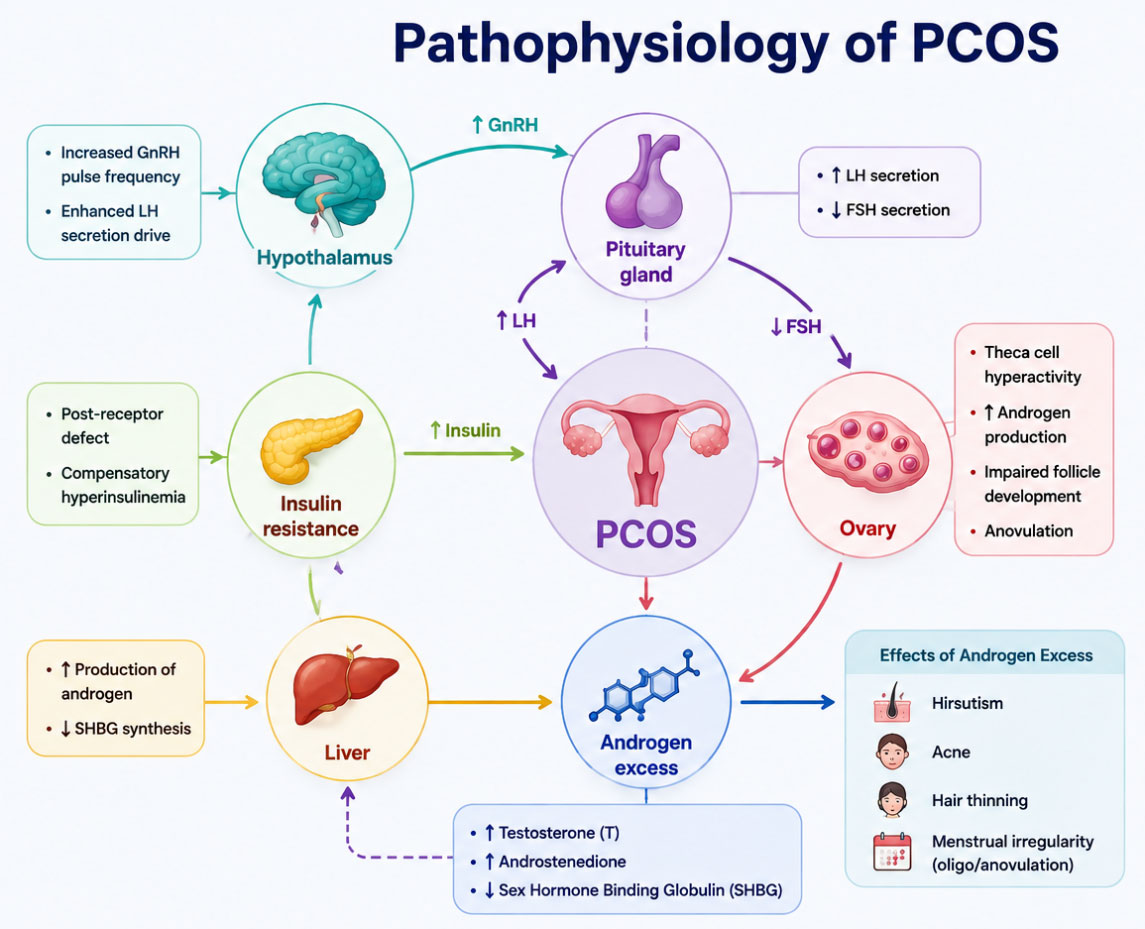
Graphical Abstract
Keywords
Data Availability Statement
Funding
Conflicts of Interest
AI Use Statement
Ethical Approval and Consent to Participate
References
- Nasim, S., Almutairi, M. S., Munir, K., Raza, A., & Younas, F. (2022). A novel approach for polycystic ovary syndrome prediction using machine learning in bioinformatics. IEEE Access, 10, 97610-97624.
[CrossRef] [Google Scholar] - Raj, A., Joshi, P., Devi, S., & Rawat, S. (2023). Comparative analysis of machine learning algorithms to diagnose polycystic ovary syndrome. In Combating Women's Health Issues with Machine Learning (pp. 136-153). CRC Press. https://www.taylorfrancis.com/chapters/edit/10.1201/9781003378556-9
[Google Scholar] - Mridul, A. H., Ahsan, N., Alam, S. S., Afrose, S., & Sultana, Z. (2024). Polycystic ovary syndrome (pcos) disease prediction using traditional machine learning and deep learning algorithms. International Journal of Computer Information Systems and Industrial Management Applications, 16(3), 25-25. https://cspub-ijcisim.org/index.php/ijcisim/article/view/712
[Google Scholar] - Govindharajan, G., Subramanian, S., Doraipandian, M., & Rajendran, S. (2026). Innovative AI-driven models for predicting polycystic ovarian syndrome: An extensive review of machine learning and deep learning frameworks. Archives of Computational Methods in Engineering, 33(2), 2115-2140.
[CrossRef] [Google Scholar] - Ghaderzadeh, M., Garavand, A., & Salehnasab, C. (2025). Artificial intelligence in polycystic ovary syndrome: A systematic review of diagnostic and predictive applications. BMC Medical Informatics and Decision Making, 25(1), 427.
[CrossRef] [Google Scholar] - Uddin, K. M. M., Chowdhury, A., Druvo, M. M. R., Jaima, M. T., Bhuiyan, M. T. A., & Islam, M. M. (2025). Improving Diagnostic Accuracy for PCOS: A Hybrid Machine Learning Architecture with Feature Selection, Data Balancing, and Explainable AI Techniques. Results in Control and Optimization, 100647.
[CrossRef] [Google Scholar] - Dhanka, S., Kumar, A., Sharma, A., Vundavilli, H., Maini, S., & Rajasekar, E. (2026). Advances in machine learning and deep learning for hormonal disorder diagnosis: an exhaustive review on PCOS, thyroid, and optimization techniques. Archives of Computational Methods in Engineering, 33(2), 2785-2829.
[CrossRef] [Google Scholar] - Ahmed, S., Rahman, M. S., Jahan, I., Kaiser, M. S., Hosen, A. S., Ghimire, D., & Kim, S. H. (2023). A review on the detection techniques of polycystic ovary syndrome using machine learning. IEEE Access, 11, 86522-86543.
[CrossRef] [Google Scholar] - Ahmad, R., Maghrabi, L. A., Khaja, I. A., Maghrabi, L. A., & Ahmad, M. (2024). SMOTE-based automated PCOS prediction using lightweight deep learning models. Diagnostics, 14(19), 2225.
[CrossRef] [Google Scholar] - Sen, P., Alina, T. A., Arefin, M. S., Reza, A. W., & Hussain, M. M. (2025, July). Machine Learning-Based Predictive Modeling for Polycystic Ovary Syndrome Diagnosis: A Multi-Algorithm Comparative Analysis. In 2025 International Conference on Quantum Photonics, Artificial Intelligence, and Networking (QPAIN) (pp. 1-6). IEEE.
[CrossRef] [Google Scholar] - Zad, Z., Jiang, V. S., Wolf, A. T., Wang, T., Cheng, J. J., Paschalidis, I. C., & Mahalingaiah, S. (2024). Predicting polycystic ovary syndrome with machine learning algorithms from electronic health records. Frontiers in endocrinology, 15, 1298628.
[CrossRef] [Google Scholar] - Faris, N. N., & Miften, F. S. (2022). An intelligence model for detection of PCOS based on k‐means coupled with LS‐SVM. Concurrency and computation: practice and experience, 34(21), e7139.
[CrossRef] [Google Scholar] - Devi, V. S., Nivedha, S., Harisha, V., Mol, D., & Janaranjini, J. R. (2026). Enhanced prediction of PCOS and PCOD using deep learning for early diagnosis and clinical risk stratification. International Journal of Advanced Research in Computer Science & Technology (IJARCST), 9(3), 783-793.
[CrossRef] [Google Scholar] - Ghadekar, P., Tekade, S., Sakharwade, D., Tripathi, A., Tiwadi, S., & Zanzane, S. (2024, July). Multimodal PCOS detection: Combining XG boost for images with zero shot learning for textual data. In 2024 Asia Pacific Conference on Innovation in Technology (APCIT) (pp. 1-8). IEEE.
[CrossRef] [Google Scholar] - Hdaib, D., Almajali, N., Alquran, H., Mustafa, W. A., Al-Azzawi, W., & Alkhayyat, A. (2022, May). Detection of polycystic ovary syndrome (PCOS) using machine learning algorithms. In 2022 5th international conference on engineering technology and its applications (IICETA) (pp. 532-536). IEEE.
[CrossRef] [Google Scholar] - Agirsoy, M., & Oehlschlaeger, M. A. (2025). A machine learning approach for non-invasive PCOS diagnosis from ultrasound and clinical features. Scientific Reports, 15(1), 33638.
[CrossRef] [Google Scholar] - Yadav, N., Ranjith, K. A., & Pande, S. D. (2024). Revolutionizing PCOS diagnosis: Deep learning image classification with LSTM-integrated artificial neural networks. In Artificial intelligence and information technologies (pp. 381-386). CRC Press. https://www.taylorfrancis.com/chapters/edit/10.1201/9781032700502-61
[Google Scholar] - Pulluparambil, S. J., & B, S. B. (2025). Detection and prediction of polycystic ovary syndrome using attention-based CNN-RNN classification model. International Journal of Advanced Computer Science and Applications, 16(2).
[CrossRef] [Google Scholar] - Men, L., Ilk, N., Tang, X., & Liu, Y. (2021). Multi-disease prediction using LSTM recurrent neural networks. Expert Systems with Applications, 177, 114905.
[CrossRef] [Google Scholar] - Bharati, S., Podder, P., & Mondal, M. R. H. (2020, June). Diagnosis of polycystic ovary syndrome using machine learning algorithms. In 2020 IEEE region 10 symposium (TENSYMP) (pp. 1486-1489). IEEE.
[CrossRef] [Google Scholar] - Tiwari, S., Kane, L., Koundal, D., Jain, A., Alhudhaif, A., Polat, K., ... & Althubiti, S. A. (2022). SPOSDS: A smart Polycystic Ovary Syndrome diagnostic system using machine learning. Expert Systems with Applications, 203, 117592.
[CrossRef] [Google Scholar] - Zigarelli, A., Jia, Z., & Lee, H. (2022). Machine-aided self-diagnostic prediction models for polycystic ovary syndrome: observational study. JMIR Formative Research, 6(3), e29967.
[CrossRef] [Google Scholar] - Umaa, M. G., & Uma, M. P. (2024). SmartScanPCOS: A feature-driven approach to cutting-edge prediction of Polycystic Ovary Syndrome using Machine Learning and Explainable Artificial Intelligence. Heliyon, 10(20).
[CrossRef] [Google Scholar] - Suha, S. A., & Islam, M. N. (2022). An extended machine learning technique for polycystic ovary syndrome detection using ovary ultrasound image. Scientific Reports, 12(1), 17123.
[CrossRef] [Google Scholar] - Abouhawwash, M., Sridevi, S., Sundararajan, S. C. M., Pachlor, R., Karim, F. K., & Khafaga, D. S. (2023). Automatic Diagnosis of Polycystic Ovarian Syndrome Using Wrapper Methodology with Deep Learning Techniques. Computer Systems Science and Engineering, 47(1), 239-253.
[CrossRef] [Google Scholar] - Khanna, V. V., Chadaga, K., Sampathila, N., Prabhu, S., Bhandage, V., & Hegde, G. K. (2023). A distinctive explainable machine learning framework for detection of polycystic ovary syndrome. Applied System Innovation, 6(2), 32.
[CrossRef] [Google Scholar] - Kottarathil, P. (2020). Polycystic ovary syndrome (PCOS) [Data set]. Kaggle. https://www.kaggle.com/datasets/prasoonkottarathil/polycystic-ovary-syndrome-PCOS
[Google Scholar] - Kiranyaz, S., Avci, O., Abdeljaber, O., Ince, T., Gabbouj, M., & Inman, D. J. (2021). 1D convolutional neural networks and applications: A survey. Mechanical Systems and Signal Processing, 151, 107398.
[CrossRef] [Google Scholar] - Elmannai, H., El-Rashidy, N., Mashal, I., Alohali, M. A., Farag, S., El-Sappagh, S., & Saleh, H. (2023). Polycystic ovary syndrome detection machine learning model based on optimized feature selection and explainable artificial intelligence. Diagnostics, 13(8), 1506.
[CrossRef] [Google Scholar] - Lundberg, S. M., & Lee, S. I. (2017). A unified approach to interpreting model predictions. Advances in Neural Information Processing Systems, 30, 4765-4774.
[Google Scholar] - Mohi Uddin, M., Bhuiyan, M. T. A., Rahman, M. M., Islam, M. M., & Uddin, M. A. (2025). Early PCOS detection: A comparative analysis of traditional and ensemble machine learning models with advanced feature selection. Engineering Reports, 7(2), e70008.
[CrossRef] [Google Scholar] - Danaei Mehr, H., & Polat, H. (2022). Diagnosis of polycystic ovary syndrome through different machine learning and feature selection techniques. Health and Technology, 12(1), 137-150.
[CrossRef] [Google Scholar] - Sarath, T., & Brindha, K. (2026). AI-quantum framework for accurate infertility risk classification in PCOS patients using EHR data. Frontiers in Artificial Intelligence, 9, 1776461.
[CrossRef] [Google Scholar] - Xu, Z. (2025). Early detection of polycystic ovary syndrome: A systematic evaluation of machine learning models using clinical parameters. Research Square.
[CrossRef] [Google Scholar]
Cite This Article
TY  - JOUR
AU  - Rubab, Sana
AU  - Shaheen, Musarrat
AU  - Tabassum, Zohra
AU  - Liaqat, Samreen
AU  - Saleem, Memoona
AU  - Ali, Aamir
PY  - 2026
DA  - 2025/08/09
TI  - Automated PCOS Disease Detection Using Clinical and Diagnostic Features
JO  - Biomedical Informatics and Smart Healthcare
T2  - Biomedical Informatics and Smart Healthcare
JF  - Biomedical Informatics and Smart Healthcare
VL  - 2
IS  - 3
SP  - 108
EP  - 128
DO  - 10.62762/BISH.2026.255887
UR  - https://www.icck.org/article/abs/BISH.2026.255887
KW  - polycystic ovary syndrome
KW  - PCOS
KW  - machine learning
KW  - deep learning
KW  - k-nearest neighbors
KW  - XGBoost
KW  - SHAP
KW  - clinical decision support
AB  - Polycystic Ovary Syndrome (PCOS) is a prevalent endocrine disorder affecting reproductive-age women, leading to infertility, hormonal imbalance, insulin resistance, and cardiovascular complications. Early diagnosis remains challenging due to heterogeneous manifestations, overlapping symptoms, and lack of automated screening tools. To address these issues, this study presents a comprehensive comparative framework for PCOS prediction using machine learning and deep learning on a public dataset of 541 patient records. The framework incorporates missing value imputation, feature standardization, SMOTE class balancing, and correlation-based feature selection. Five machine learning algorithms (Decision Tree, KNN, SVM, Random Forest, XGBoost) and two deep learning architectures (LSTM, CNN-ResNet) were evaluated using accuracy, precision, recall, F1-score, and ROC-AUC, with confusion matrices employed for detailed classification analysis. KNN achieved the highest accuracy (92.66\%), recall (91.67\%), and F1-score (89.19\%), while XGBoost delivered the best discriminative capability (ROC-AUC = 0.9540). Among deep learning models, LSTM consistently outperformed CNN-ResNet, demonstrating superior ability to capture complex clinical feature relationships. SHAP-based explainability identified ovarian follicle counts, menstrual irregularities, hair growth, weight gain, skin darkening, and anti-Müllerian hormone (AMH) levels as the most influential predictors. These findings indicate that explainable machine learning models, particularly KNN and XGBoost, provide accurate and interpretable decision support for early PCOS screening, enabling timely intervention and offering a promising foundation for intelligent healthcare decision-support systems.
SN  - 3068-5524
PB  - Institute of Central Computation and Knowledge
LA  - English
ER  -
@article{Rubab2026Automated,
  author = {Sana Rubab and Musarrat Shaheen and Zohra Tabassum and Samreen Liaqat and Memoona Saleem and Aamir Ali},
  title = {Automated PCOS Disease Detection Using Clinical and Diagnostic Features},
  journal = {Biomedical Informatics and Smart Healthcare},
  year = {2026},
  volume = {2},
  number = {3},
  pages = {108-128},
  doi = {10.62762/BISH.2026.255887},
  url = {https://www.icck.org/article/abs/BISH.2026.255887},
  abstract = {Polycystic Ovary Syndrome (PCOS) is a prevalent endocrine disorder affecting reproductive-age women, leading to infertility, hormonal imbalance, insulin resistance, and cardiovascular complications. Early diagnosis remains challenging due to heterogeneous manifestations, overlapping symptoms, and lack of automated screening tools. To address these issues, this study presents a comprehensive comparative framework for PCOS prediction using machine learning and deep learning on a public dataset of 541 patient records. The framework incorporates missing value imputation, feature standardization, SMOTE class balancing, and correlation-based feature selection. Five machine learning algorithms (Decision Tree, KNN, SVM, Random Forest, XGBoost) and two deep learning architectures (LSTM, CNN-ResNet) were evaluated using accuracy, precision, recall, F1-score, and ROC-AUC, with confusion matrices employed for detailed classification analysis. KNN achieved the highest accuracy (92.66\\%), recall (91.67\\%), and F1-score (89.19\\%), while XGBoost delivered the best discriminative capability (ROC-AUC = 0.9540). Among deep learning models, LSTM consistently outperformed CNN-ResNet, demonstrating superior ability to capture complex clinical feature relationships. SHAP-based explainability identified ovarian follicle counts, menstrual irregularities, hair growth, weight gain, skin darkening, and anti-Müllerian hormone (AMH) levels as the most influential predictors. These findings indicate that explainable machine learning models, particularly KNN and XGBoost, provide accurate and interpretable decision support for early PCOS screening, enabling timely intervention and offering a promising foundation for intelligent healthcare decision-support systems.},
  keywords = {polycystic ovary syndrome, PCOS, machine learning, deep learning, k-nearest neighbors, XGBoost, SHAP, clinical decision support},
  issn = {3068-5524},
  publisher = {Institute of Central Computation and Knowledge}
}
Article Metrics
Publisher's Note
ICCK stays neutral with regard to jurisdictional claims in published maps and institutional affiliations.
Rights and Permissions
 Copyright © 2026 by the Author(s). Published by Institute of Central Computation and Knowledge. This article is an open access article distributed under the terms and conditions of the Creative Commons Attribution (CC BY) license (https://creativecommons.org/licenses/by/4.0/), which permits use, sharing, adaptation, distribution and reproduction in any medium or format, as long as you give appropriate credit to the original author(s) and the source, provide a link to the Creative Commons licence, and indicate if changes were made.


Portico
