

HDSF: A Healthcare Decision Support Framework to Provide A Seamless and Adaptable Patient Experience



Article Information
Abstract
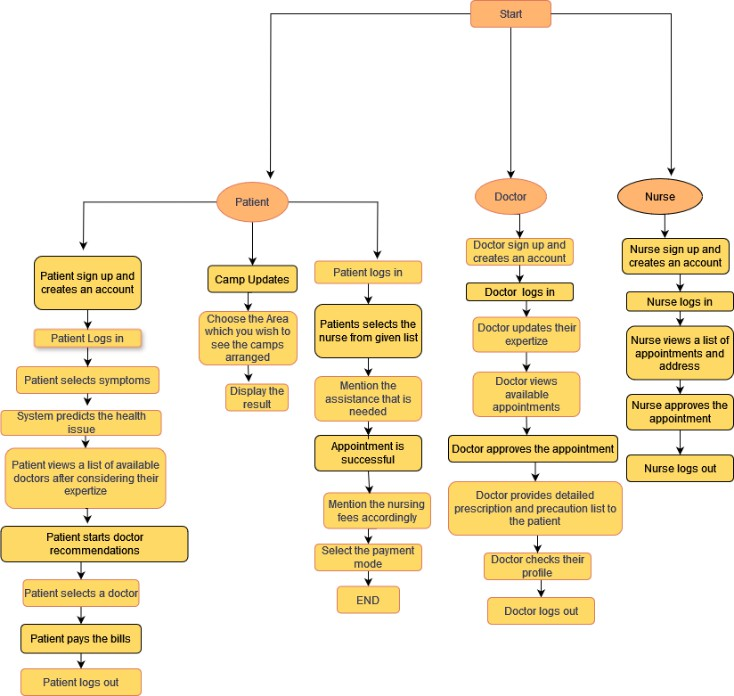
Healthcare decision support framework(HDSF), a comprehensive web application framework designed to revolutionize healthcare accessibility and efficiency. HDSF integrates various facilities including online appointment booking, virtual doctor consultations, symptom detection, detailed prescription management, home nursing appointment scheduling, and updates on local health camps with Google Maps integration for navigation. The application employs a robust architecture with a front end developed using HTML, CSS, and Bootstrap, while the back-end leverages Java and Java Servlet technologies. Data management is facilitated by MySQL, and the application is developed within the Eclipse IDE and XAMPP environment. Additionally, HDSF incorporates advanced algorithms such as Apriori for association rule learning and K-Nearest Neighbors (KNN) for classification tasks, enhancing its diagnostic and recommendation capabilities. This paper details the development process, system architecture, and algorithmic implementations, highlighting HDSF's potential to improve patient care and streamline healthcare services.
Graphical Abstract
Keywords
Data Availability Statement
Funding
Conflicts of Interest
Ethical Approval and Consent to Participate
References
- Smith, A. C., Thomas, E., Snoswell, C. L., Haydon, H., Mehrotra, A., Clemensen, J., & Caffery, L. J. (2020). Telehealth for global emergencies: Implications for coronavirus disease 2019 (COVID-19). Journal of telemedicine and telecare, 26(5), 309-313.
[CrossRef] [Google Scholar] - Bhattacherjee, A., & Hikmet, N. (2020). Design and implementation of a hospital information system: A case study in interoperability challenges. Journal of Medical Systems, 44(7), 124.
[CrossRef] [Google Scholar] - Kawamoto, K., Houlihan, C. A., Balas, E. A., & Lobach, D. F. (2005). Improving clinical practice using clinical decision support systems: A systematic review of trials to identify features critical to success. BMJ, 330(7494), 765.
[CrossRef] [Google Scholar] - Chen, J. H., & Asch, S. M. (2017). Machine learning and prediction in medicine—Beyond the peak of inflated expectations. New England Journal of Medicine, 376(26), 2507–2509.
[CrossRef] [Google Scholar] - Oracle Health Sciences. (2022). Best practices for building secure healthcare applications with Java EE. White Paper, Oracle Corporation.
[Google Scholar] - Patel, V. L., Shortliffe, E. H., Stefanelli, M., Szolovits, P., Berthold, M. R., Bellazzi, R., & Abu-Hanna, A. (2009). The coming of age of artificial intelligence in medicine. Artificial intelligence in medicine, 46(1), 5-17.
[CrossRef] [Google Scholar] - Apache Software Foundation. (2023). Apache Tomcat Servlet/JSP Container: Developer’s Guide. Official Documentation.
[Google Scholar] - Hripcsak, G., & Albers, D. J. (2013). Next-generation phenotyping of electronic health records. Journal of the American Medical Informatics Association, 20(1), 117–121.
[CrossRef] [Google Scholar] - Sittig, D. F., & Singh, H. (2010). A new sociotechnical model for studying health information technology in complex adaptive healthcare systems. BMJ Quality & Safety, 19(Suppl 3), i68-i74.
[CrossRef] [Google Scholar] - Kothinti, R. R. (2024). Deep learning in healthcare: Transforming disease diagnosis, personalized treatment, and clinical decision-making through AI-driven innovations.
[Google Scholar] - Mukherjee, M., & Khushi, M. (2021). SMOTE-ENC: A novel SMOTE-based method to generate synthetic data for nominal and continuous features. Applied System Innovation, 4(1), 18.
[CrossRef] [Google Scholar]
Cite This Article
TY  - JOUR
AU  - Sharma, Rahul
AU  - Sharma, Kapil Dev
AU  - Bijalwan, Anchit
PY  - 2025
DA  - 2025/05/30
TI  - HDSF: A Healthcare Decision Support Framework to Provide A Seamless and Adaptable Patient Experience
JO  - Biomedical Informatics and Smart Healthcare
T2  - Biomedical Informatics and Smart Healthcare
JF  - Biomedical Informatics and Smart Healthcare
VL  - 1
IS  - 1
SP  - 1
EP  - 8
DO  - 10.62762/BISH.2025.352565
UR  - https://www.icck.org/article/abs/BISH.2025.352565
KW  - healthcare decision support framework (HDSF)
KW  - healthcare web application
KW  - online medical services
KW  - machine learning algorithms in healthcare
AB  - Healthcare decision support framework(HDSF), a comprehensive web application framework designed to revolutionize healthcare accessibility and efficiency. HDSF integrates various facilities including online appointment booking, virtual doctor consultations, symptom detection, detailed prescription management, home nursing appointment scheduling, and updates on local health camps with Google Maps integration for navigation. The application employs a robust architecture with a front end developed using HTML, CSS, and Bootstrap, while the back-end leverages Java and Java Servlet technologies. Data management is facilitated by MySQL, and the application is developed within the Eclipse IDE and XAMPP environment. Additionally, HDSF incorporates advanced algorithms such as Apriori for association rule learning and K-Nearest Neighbors (KNN) for classification tasks, enhancing its diagnostic and recommendation capabilities. This paper details the development process, system architecture, and algorithmic implementations, highlighting HDSF's potential to improve patient care and streamline healthcare services.
SN  - 3068-5524
PB  - Institute of Central Computation and Knowledge
LA  - English
ER  -
@article{Sharma2025HDSF,
  author = {Rahul Sharma and Kapil Dev Sharma and Anchit Bijalwan},
  title = {HDSF: A Healthcare Decision Support Framework to Provide A Seamless and Adaptable Patient Experience},
  journal = {Biomedical Informatics and Smart Healthcare},
  year = {2025},
  volume = {1},
  number = {1},
  pages = {1-8},
  doi = {10.62762/BISH.2025.352565},
  url = {https://www.icck.org/article/abs/BISH.2025.352565},
  abstract = {Healthcare decision support framework(HDSF), a comprehensive web application framework designed to revolutionize healthcare accessibility and efficiency. HDSF integrates various facilities including online appointment booking, virtual doctor consultations, symptom detection, detailed prescription management, home nursing appointment scheduling, and updates on local health camps with Google Maps integration for navigation. The application employs a robust architecture with a front end developed using HTML, CSS, and Bootstrap, while the back-end leverages Java and Java Servlet technologies. Data management is facilitated by MySQL, and the application is developed within the Eclipse IDE and XAMPP environment. Additionally, HDSF incorporates advanced algorithms such as Apriori for association rule learning and K-Nearest Neighbors (KNN) for classification tasks, enhancing its diagnostic and recommendation capabilities. This paper details the development process, system architecture, and algorithmic implementations, highlighting HDSF's potential to improve patient care and streamline healthcare services.},
  keywords = {healthcare decision support framework (HDSF), healthcare web application, online medical services, machine learning algorithms in healthcare},
  issn = {3068-5524},
  publisher = {Institute of Central Computation and Knowledge}
}
Article Metrics
Publisher's Note
ICCK stays neutral with regard to jurisdictional claims in published maps and institutional affiliations.
Rights and Permissions
 Copyright © 2025 by the Author(s). Published by Institute of Central Computation and Knowledge. This article is an open access article distributed under the terms and conditions of the Creative Commons Attribution (CC BY) license (https://creativecommons.org/licenses/by/4.0/), which permits use, sharing, adaptation, distribution and reproduction in any medium or format, as long as you give appropriate credit to the original author(s) and the source, provide a link to the Creative Commons licence, and indicate if changes were made.


Portico
