

Exploring the Temporal Dynamics and Causal Interactions Between the Amygdala and vmPFC: A Multidimensional Approach Using Time-Lagged Correlation, Granger Causality, and Entropy Analysis



Article Information
Abstract
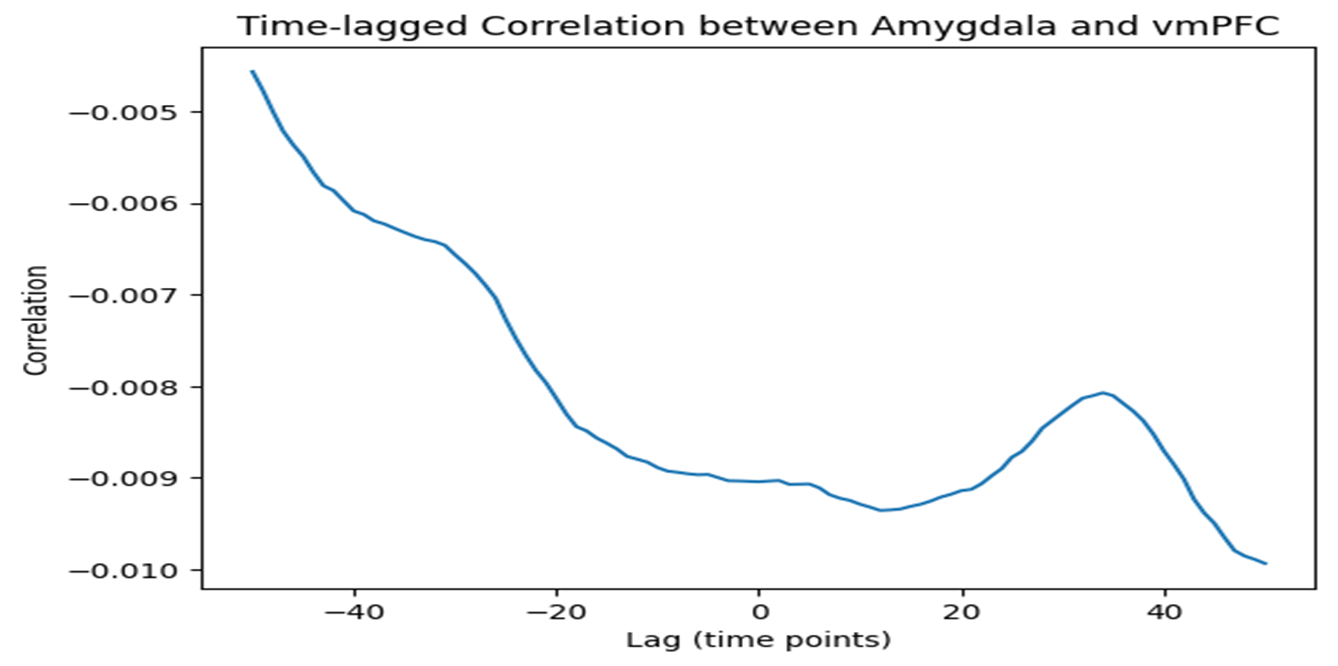
Understanding the dynamic interaction between the amygdala and the ventromedial prefrontal cortex (vmPFC) is essential for unraveling the neural mechanisms underlying emotion regulation. This study introduces a multidimensional analytical framework that integrates functional connectivity, time-lagged correlation, Granger causality analysis (GCA), and entropy-based complexity metrics to explore the amygdala–vmPFC relationship during emotionally aversive tasks using intracranial EEG (iEEG) data. Our findings reveal a significant negative functional correlation (r = -0.009, p < 0.05) between the amygdala and vmPFC, indicating an inhibitory relationship. Time-lagged correlation analysis further uncovers a temporal delay (~30 time points), suggesting that amygdala activity precedes vmPFC modulation. Entropy analysis shows that the vmPFC exhibits higher signal complexity (H = 4.26) than the amygdala (H = 3.98), consistent with its role in higher-order emotional regulation. However, GCA results yielded no statistically significant directional influence, highlighting the non-linear and multifaceted nature of these interactions. This study is among the first to combine entropy, time-lag, and causality metrics for analyzing vmPFC–amygdala dynamics in human iEEG. Our integrated framework offers deeper insights into brain region interplay and lays the groundwork for future research in affective neuroscience and neuroeconomics.
Graphical Abstract
Keywords
Data Availability Statement
Funding
Conflicts of Interest
Ethical Approval and Consent to Participate
References
- Mehta, N. D., Haroon, E., Xu, X., Woolwine, B. J., Li, Z., & Felger, J. C. (2018). Inflammation negatively correlates with amygdala-ventromedial prefrontal functional connectivity in association with anxiety in patients with depression: Preliminary results. Brain, behavior, and immunity, 73, 725-730.
[CrossRef] [Google Scholar] - Motzkin, J. C., Philippi, C. L., Wolf, R. C., Baskaya, M. K., & Koenigs, M. (2015). Ventromedial prefrontal cortex is critical for the regulation of amygdala activity in humans. Biological Psychiatry, 77(3), 276–284.
[CrossRef] [Google Scholar] - Gee, D. G., Humphreys, K. L., Flannery, J., Goff, B., Telzer, E. H., Shapiro, M., ... & Tottenham, N. (2013). A developmental shift from positive to negative connectivity in human amygdala–prefrontal circuitry. Journal of Neuroscience, 33(10), 4584–4593.
[CrossRef] [Google Scholar] - Paret, C., Ruf, M., Gerchen, M. F., Kluetsch, R., Demirakca, T., Jungkunz, M., ... & Schmahl, C. (2016). fMRI neurofeedback of amygdala response to aversive stimuli enhances prefrontal–limbic brain connectivity. NeuroImage, 125, 182–188.
[CrossRef] [Google Scholar] - Vuilleumier, P. (2005). How brains beware: Neural mechanisms of emotional attention. Trends in Cognitive Sciences, 9(12), 585–594.
[CrossRef] [Google Scholar] - Wager, T. D., Davidson, M. L., Hughes, B. L., Lindquist, M. A., & Ochsner, K. N. (2008). Prefrontal–subcortical pathways mediating successful emotion regulation. Neuron, 59(6), 1037–1050.
[CrossRef] [Google Scholar] - Etkin, A., Egner, T., & Kalisch, R. (2011). Emotional processing in anterior cingulate and medial prefrontal cortex. Trends in Cognitive Sciences, 15(2), 85–93.
[CrossRef] [Google Scholar] - Frontiers in Human Neuroscience. (2017). Prefrontal–amygdala connectivity and state anxiety during fear extinction recall in adolescents. Frontiers in Human Neuroscience, 11, 587.
[CrossRef] [Google Scholar] - Phillips, M. L., Drevets, W. C., Rauch, S. L., & Lane, R. (2003). Neurobiology of emotion perception I: The neural basis of normal emotion perception. Biological Psychiatry, 54(5), 504–514.
[CrossRef] [Google Scholar] - Silvers, J. A., Insel, C., Powers, A., Franz, P., Helion, C., Martin, R. E., ... & Ochsner, K. N. (2017). vlPFC–vmPFC–amygdala interactions underlie age-related differences in cognitive regulation of emotion. Cerebral cortex, 27(7), 3502-3514.
[CrossRef] [Google Scholar] - Harnad, S. (2000). Correlation vs. Causality: How/Why the Mind/Body Problem Is Hard.[Invited Commentary of Humphrey, N.`` How to Solve the Mind-Body Problem''] Journal of Consciousness Studies 7 (4): 54-61.
[Google Scholar] - Bressler, S. L., & Seth, A. K. (2011). Wiener–Granger causality: a well established methodology. Neuroimage, 58(2), 323-329.
[CrossRef] [Google Scholar] - Seth, A. K., Barrett, A. B., & Barnett, L. (2015). Granger causality analysis in neuroscience and neuroimaging. Journal of Neuroscience, 35(8), 3293–3297.
[CrossRef] [Google Scholar] - Dosenbach, N. U. F., Fair, D. A., Miezin, F. M., Cohen, A. L., Wenger, K. K., Dosenbach, R. A. T., ... & Petersen, S. E. (2007). Distinct brain networks for adaptive and stable task control in humans. Proceedings of the National Academy of Sciences, 104(26), 11073–11078.
[CrossRef] [Google Scholar] - Gold, A. L., Shechner, T., Farber, M. J., Spiro, C. N., Leibenluft, E., Pine, D. S., & Britton, J. C. (2016). Amygdala–cortical connectivity: associations with anxiety, development, and threat. Depression and anxiety, 33(10), 917-926.
[CrossRef] [Google Scholar] - Fedele, T., Boran, E., Chirkov, V., Hilfiker, P., Grunwald, T., & Stieglitz, L. (2020). Dataset of neurons and intracranial EEG from human amygdala during aversive dynamic visual stimulation. OpenNeuro doi, 10.
[CrossRef] [Google Scholar] - Feinsod, M., Kreinin, B., Chistyakov, A., & Klein, E. (1998). Preliminary evidence for a beneficial effect of low-frequency, repetitive transcranial magnetic stimulation in patients with major depression and schizophrenia. Depression and Anxiety, 7(2), 65–68.
[CrossRef] [Google Scholar] - Faghiri, A., Stephen, J. M., Wang, Y. P., Wilson, T. W., & Calhoun, V. D. (2019). Brain development includes linear and multiple nonlinear trajectories: a cross-sectional resting-state functional magnetic resonance imaging study. Brain connectivity, 9(10), 777-788.
[CrossRef] [Google Scholar] - Rykhlevskaia, E., Fabiani, M., & Gratton, G. (2006). Lagged covariance structure models for studying functional connectivity in the brain. Neuroimage, 30(4), 1203-1218.
[CrossRef] [Google Scholar] - Rousselet, G. A., & Pernet, C. R. (2012). Improving standards in brain–behavior correlation analyses. Frontiers in Human Neuroscience, 6, 119.
[CrossRef] [Google Scholar] - Ghashghaei, H. T., & Barbas, H. (2002). Pathways for emotion: Interactions of prefrontal and anterior temporal pathways in the amygdala of the rhesus monkey. Neuroscience, 115(4), 1261–1279.
[CrossRef] [Google Scholar] - Stokes, P. A., & Purdon, P. L. (2017). A study of problems encountered in Granger causality analysis from a neuroscience perspective. Proceedings of the national academy of sciences, 114(34), E7063-E7072.
[CrossRef] [Google Scholar] - McDonald, A. J., Mascagni, F., & Guo, L. (1996). Projections of the medial and lateral prefrontal cortices to the amygdala: A Phaseolus vulgaris leucoagglutinin study in the rat. Neuroscience, 71(1), 55–75.
[CrossRef] [Google Scholar] - Rusakov, D. A. (2023). A misadventure of the correlation coefficient. Trends in Neurosciences, 46(2), 94–96.
[CrossRef] [Google Scholar] - Urry, H. L., van Reekum, C. M., Johnstone, T., Kalin, N. H., Thurow, M. E., Schaefer, H. S., ... & Davidson, R. J. (2006). Amygdala and ventromedial prefrontal cortex are inversely coupled during regulation of negative affect and predict the diurnal pattern of cortisol secretion among older adults. Journal of Neuroscience, 26(16), 4415–4425.
[CrossRef] [Google Scholar]
Cite This Article
TY  - JOUR
AU  - Su, Wynn
AU  - Mishra, Satyam
AU  - Bijalwan, Anchit
PY  - 2025
DA  - 2025/06/24
TI  - Exploring the Temporal Dynamics and Causal Interactions Between the Amygdala and vmPFC: A Multidimensional Approach Using Time-Lagged Correlation, Granger Causality, and Entropy Analysis
JO  - Biomedical Informatics and Smart Healthcare
T2  - Biomedical Informatics and Smart Healthcare
JF  - Biomedical Informatics and Smart Healthcare
VL  - 1
IS  - 1
SP  - 27
EP  - 34
DO  - 10.62762/BISH.2025.346171
UR  - https://www.icck.org/article/abs/BISH.2025.346171
KW  - amygdala-vmPFC connectivity
KW  - time-lagged correlation
KW  - granger causality
KW  - EEG signal analysis
KW  - entropy metrics
KW  - neural dynamics
AB  - Understanding the dynamic interaction between the amygdala and the ventromedial prefrontal cortex (vmPFC) is essential for unraveling the neural mechanisms underlying emotion regulation. This study introduces a multidimensional analytical framework that integrates functional connectivity, time-lagged correlation, Granger causality analysis (GCA), and entropy-based complexity metrics to explore the amygdala–vmPFC relationship during emotionally aversive tasks using intracranial EEG (iEEG) data. Our findings reveal a significant negative functional correlation (r = -0.009, p < 0.05) between the amygdala and vmPFC, indicating an inhibitory relationship. Time-lagged correlation analysis further uncovers a temporal delay (~30 time points), suggesting that amygdala activity precedes vmPFC modulation. Entropy analysis shows that the vmPFC exhibits higher signal complexity (H = 4.26) than the amygdala (H = 3.98), consistent with its role in higher-order emotional regulation. However, GCA results yielded no statistically significant directional influence, highlighting the non-linear and multifaceted nature of these interactions. This study is among the first to combine entropy, time-lag, and causality metrics for analyzing vmPFC–amygdala dynamics in human iEEG. Our integrated framework offers deeper insights into brain region interplay and lays the groundwork for future research in affective neuroscience and neuroeconomics.
SN  - 3068-5524
PB  - Institute of Central Computation and Knowledge
LA  - English
ER  -
@article{Su2025Exploring,
  author = {Wynn Su and Satyam Mishra and Anchit Bijalwan},
  title = {Exploring the Temporal Dynamics and Causal Interactions Between the Amygdala and vmPFC: A Multidimensional Approach Using Time-Lagged Correlation, Granger Causality, and Entropy Analysis},
  journal = {Biomedical Informatics and Smart Healthcare},
  year = {2025},
  volume = {1},
  number = {1},
  pages = {27-34},
  doi = {10.62762/BISH.2025.346171},
  url = {https://www.icck.org/article/abs/BISH.2025.346171},
  abstract = {Understanding the dynamic interaction between the amygdala and the ventromedial prefrontal cortex (vmPFC) is essential for unraveling the neural mechanisms underlying emotion regulation. This study introduces a multidimensional analytical framework that integrates functional connectivity, time-lagged correlation, Granger causality analysis (GCA), and entropy-based complexity metrics to explore the amygdala–vmPFC relationship during emotionally aversive tasks using intracranial EEG (iEEG) data. Our findings reveal a significant negative functional correlation (r = -0.009, p < 0.05) between the amygdala and vmPFC, indicating an inhibitory relationship. Time-lagged correlation analysis further uncovers a temporal delay (~30 time points), suggesting that amygdala activity precedes vmPFC modulation. Entropy analysis shows that the vmPFC exhibits higher signal complexity (H = 4.26) than the amygdala (H = 3.98), consistent with its role in higher-order emotional regulation. However, GCA results yielded no statistically significant directional influence, highlighting the non-linear and multifaceted nature of these interactions. This study is among the first to combine entropy, time-lag, and causality metrics for analyzing vmPFC–amygdala dynamics in human iEEG. Our integrated framework offers deeper insights into brain region interplay and lays the groundwork for future research in affective neuroscience and neuroeconomics.},
  keywords = {amygdala-vmPFC connectivity, time-lagged correlation, granger causality, EEG signal analysis, entropy metrics, neural dynamics},
  issn = {3068-5524},
  publisher = {Institute of Central Computation and Knowledge}
}
Article Metrics
Publisher's Note
ICCK stays neutral with regard to jurisdictional claims in published maps and institutional affiliations.
Rights and Permissions
 Copyright © 2025 by the Author(s). Published by Institute of Central Computation and Knowledge. This article is an open access article distributed under the terms and conditions of the Creative Commons Attribution (CC BY) license (https://creativecommons.org/licenses/by/4.0/), which permits use, sharing, adaptation, distribution and reproduction in any medium or format, as long as you give appropriate credit to the original author(s) and the source, provide a link to the Creative Commons licence, and indicate if changes were made.


Portico
