

Accelerating Pharmaceutical R&D: The Role of Generative Artificial Intelligence in Modern Drug Discovery




Article Information
Abstract
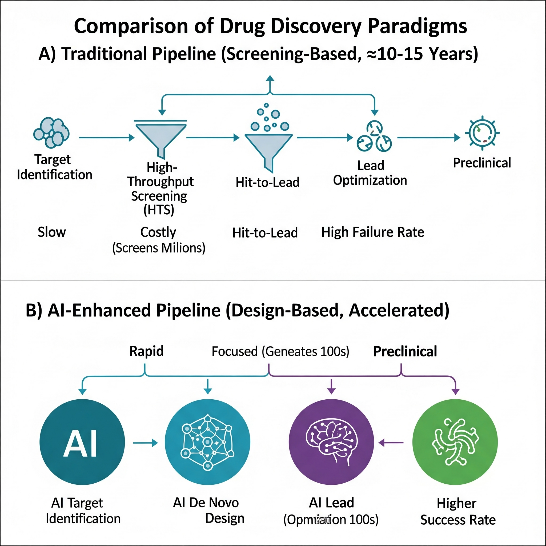
Exorbitant expenses, lengthy development periods, and a high incidence of drug candidate attrition plague the conventional pharmaceutical R&D pipeline---a problem sometimes referred to as ``Eroom's Law.'' By radically reorganizing the discovery process, generative artificial intelligence (AI), which has emerged as a transformational force, promises to buck this tendency. Through data synthesis on key performance metrics, this review offers a thorough analysis of the effects of AI-enhanced methodologies. We explore how a new set of tools is changing the paradigm from experimental screening to in silico design. These tools include graph neural networks (GNNs)—a class of neural architectures that operate directly on graph-structured data by recursively aggregating information from neighbouring nodes—for molecular modelling. Additionally, large language models (LLMs)—Transformer-based neural networks trained on massive text corpora that learn contextual representations of biological sequences and scientific literature—are revolutionizing target identification. According to our analysis, integrating AI results in previously unheard-of benefits: clinical success rates for AI-discovered candidates are expected to rise from a baseline of 7.9% to as high as 90%, costs are predicted to be cut by 45--80%, and early-stage discovery timelines are compressed by up to 62.5% (e.g., reducing target-to-lead time from 24 to 9 months). These improvements stem from a sharp rise in molecular-level prediction accuracy. We come to the conclusion that generative AI is a crucial tool for accelerating the development of new treatments, allowing for a quicker, more economical, and more successful strategy that will characterize the next phase of pharmaceutical innovation.
Graphical Abstract
Keywords
Data Availability Statement
Funding
Conflicts of Interest
Ethical Approval and Consent to Participate
References
- Ocana, A., Pandiella, A., Privat, C., Bravo, I., Luengo-Oroz, M., Amir, E., & Gyorffy, B. (2025). Integrating artificial intelligence in drug discovery and early drug development: a transformative approach. Biomarker Research, 13(1), 45.
[CrossRef] [Google Scholar] - Lovetrue, B., & Lovetrue, I. (2022). Prospectively validated disease-agnostic predictive medicine with augmented intelligence. medRxiv, 2022-03.
[CrossRef] [Google Scholar] - Lee, J., Yoon, W., Kim, S., Kim, D., Kim, S., So, C. H., & Kang, J. (2020). BioBERT: a pre-trained biomedical language representation model for biomedical text mining. Bioinformatics, 36(4), 1234-1240.
[CrossRef] [Google Scholar] - Zhang, O., Lin, H., Zhang, X., Wang, X., Wu, Z., Ye, Q., ... & Hou, T. (2025). Graph Neural Networks in Modern AI-aided Drug Discovery. Chemical Reviews.
[CrossRef] [Google Scholar] - Jumper, J., Evans, R., Pritzel, A., Green, T., Figurnov, M., Ronneberger, O., ... & Hassabis, D. (2021). Highly accurate protein structure prediction with AlphaFold. nature, 596(7873), 583-589.
[CrossRef] [Google Scholar] - Tan, D., Henry, C. J., & Leung, C. K. (2025). A Guided Variational Autoencoder for Targeted Molecule Optimization in Drug Discovery. Journal of Healthcare Informatics Research, 1-21.
[CrossRef] [Google Scholar] - Kao, P. Y., Yang, Y. C., Chiang, W. Y., Hsiao, J. Y., Cao, Y., Aliper, A., ... & Lin, Y. C. (2023). Exploring the advantages of quantum generative adversarial networks in generative chemistry. Journal of Chemical Information and Modeling, 63(11), 3307-3318.
[CrossRef] [Google Scholar] - Guo, Z., Liu, J., Wang, Y., Chen, M., Wang, D., Xu, D., & Cheng, J. (2024). Diffusion models in bioinformatics and computational biology. Nature reviews bioengineering, 2(2), 136-154.
[CrossRef] [Google Scholar] - Mao, J., Wang, J., Zeb, A., Cho, K. H., Jin, H., Kim, J., ... & No, K. T. (2023). Transformer-based molecular generative model for antiviral drug design. Journal of chemical information and modeling, 64(7), 2733-2745.
[CrossRef] [Google Scholar] - Guo, H., Xing, X., Zhou, Y., Jiang, W., Chen, X., Wang, T., ... & Xu, J. (2025). A Survey of Large Language Model for Drug Research and Development. IEEE Access.
[CrossRef] [Google Scholar] - Ho, D., Quake, S. R., McCabe, E. R., Chng, W. J., Chow, E. K., Ding, X., ... & Zarrinpar, A. (2020). Enabling technologies for personalized and precision medicine. Trends in biotechnology, 38(5), 497-518.
[CrossRef] [Google Scholar] - Fang, S. J., Yin, Z. D., Cai, Q., Li, L. F., Zheng, P., & Chen, L. (2025). Harnessing artificial intelligence for brain disease: advances in diagnosis, drug discovery, and closed-loop therapeutics. Frontiers in Neurology, 16, 1615523.
[CrossRef] [Google Scholar] - Gutnik, D., Evseev, P., Miroshnikov, K., & Shneider, M. (2023). Using AlphaFold predictions in viral research. Current Issues in Molecular Biology, 45(4), 3705-3732.
[CrossRef] [Google Scholar] - Devlin, J., Chang, M. W., Lee, K., & Toutanova, K. (2019, June). Bert: Pre-training of deep bidirectional transformers for language understanding. In Proceedings of the 2019 conference of the North American chapter of the association for computational linguistics: human language technologies, volume 1 (long and short papers) (pp. 4171-4186).
[CrossRef] [Google Scholar] - Ramsay, R. R., Popovic-Nikolic, M. R., Nikolic, K., Uliassi, E., & Bolognesi, M. L. (2018). A perspective on multi-target drug discovery and design for complex diseases. Clinical and translational medicine, 7(1), 3.
[CrossRef] [Google Scholar] - Mendez, D., Gaulton, A., Bento, A. P., Chambers, J., De Veij, M., Félix, E., ... & Leach, A. R. (2019). ChEMBL: towards direct deposition of bioassay data. Nucleic acids research, 47(D1), D930-D940.
[CrossRef] [Google Scholar] - Sertkaya, A., Beleche, T., Jessup, A., & Sommers, B. D. (2024). Costs of drug development and research and development intensity in the US, 2000-2018. JAMA network open, 7(6), e2415445-e2415445.
[CrossRef] [Google Scholar]
Cite This Article
TY  - JOUR
AU  - Mishra, Abhijat
AU  - Sarkar, Saurabh
AU  - Chandan, Radha Raman
AU  - Bhushan, Shashi
AU  - Shivahare, Basu Dev
PY  - 2025
DA  - 2025/09/27
TI  - Accelerating Pharmaceutical R&D: The Role of Generative Artificial Intelligence in Modern Drug Discovery
JO  - Biomedical Informatics and Smart Healthcare
T2  - Biomedical Informatics and Smart Healthcare
JF  - Biomedical Informatics and Smart Healthcare
VL  - 1
IS  - 2
SP  - 67
EP  - 78
DO  - 10.62762/BISH.2025.789201
UR  - https://www.icck.org/article/abs/BISH.2025.789201
KW  - generative AI
KW  - drug discovery
KW  - target identification
KW  - machine learning
KW  - AlphaFold
KW  - pharmaceutical research
KW  - computational chemistry
AB  - Exorbitant expenses, lengthy development periods, and a high incidence of drug candidate attrition plague the conventional pharmaceutical R&D pipeline---a problem sometimes referred to as ``Eroom's Law.'' By radically reorganizing the discovery process, generative artificial intelligence (AI), which has emerged as a transformational force, promises to buck this tendency. Through data synthesis on key performance metrics, this review offers a thorough analysis of the effects of AI-enhanced methodologies. We explore how a new set of tools is changing the paradigm from experimental screening to in silico design. These tools include graph neural networks (GNNs)—a class of neural architectures that operate directly on graph-structured data by recursively aggregating information from neighbouring nodes—for molecular modelling. Additionally, large language models (LLMs)—Transformer-based neural networks trained on massive text corpora that learn contextual representations of biological sequences and scientific literature—are revolutionizing target identification. According to our analysis, integrating AI results in previously unheard-of benefits: clinical success rates for AI-discovered candidates are expected to rise from a baseline of 7.9% to as high as 90%, costs are predicted to be cut by 45--80%, and early-stage discovery timelines are compressed by up to 62.5% (e.g., reducing target-to-lead time from 24 to 9 months). These improvements stem from a sharp rise in molecular-level prediction accuracy. We come to the conclusion that generative AI is a crucial tool for accelerating the development of new treatments, allowing for a quicker, more economical, and more successful strategy that will characterize the next phase of pharmaceutical innovation.
SN  - 3068-5524
PB  - Institute of Central Computation and Knowledge
LA  - English
ER  -
@article{Mishra2025Accelerati,
  author = {Abhijat Mishra and Saurabh Sarkar and Radha Raman Chandan and Shashi Bhushan and Basu Dev Shivahare},
  title = {Accelerating Pharmaceutical R\&D: The Role of Generative Artificial Intelligence in Modern Drug Discovery},
  journal = {Biomedical Informatics and Smart Healthcare},
  year = {2025},
  volume = {1},
  number = {2},
  pages = {67-78},
  doi = {10.62762/BISH.2025.789201},
  url = {https://www.icck.org/article/abs/BISH.2025.789201},
  abstract = {Exorbitant expenses, lengthy development periods, and a high incidence of drug candidate attrition plague the conventional pharmaceutical R\&D pipeline---a problem sometimes referred to as ``Eroom's Law.'' By radically reorganizing the discovery process, generative artificial intelligence (AI), which has emerged as a transformational force, promises to buck this tendency. Through data synthesis on key performance metrics, this review offers a thorough analysis of the effects of AI-enhanced methodologies. We explore how a new set of tools is changing the paradigm from experimental screening to in silico design. These tools include graph neural networks (GNNs)—a class of neural architectures that operate directly on graph-structured data by recursively aggregating information from neighbouring nodes—for molecular modelling. Additionally, large language models (LLMs)—Transformer-based neural networks trained on massive text corpora that learn contextual representations of biological sequences and scientific literature—are revolutionizing target identification. According to our analysis, integrating AI results in previously unheard-of benefits: clinical success rates for AI-discovered candidates are expected to rise from a baseline of 7.9\% to as high as 90\%, costs are predicted to be cut by 45--80\%, and early-stage discovery timelines are compressed by up to 62.5\% (e.g., reducing target-to-lead time from 24 to 9 months). These improvements stem from a sharp rise in molecular-level prediction accuracy. We come to the conclusion that generative AI is a crucial tool for accelerating the development of new treatments, allowing for a quicker, more economical, and more successful strategy that will characterize the next phase of pharmaceutical innovation.},
  keywords = {generative AI, drug discovery, target identification, machine learning, AlphaFold, pharmaceutical research, computational chemistry},
  issn = {3068-5524},
  publisher = {Institute of Central Computation and Knowledge}
}
Article Metrics
Publisher's Note
ICCK stays neutral with regard to jurisdictional claims in published maps and institutional affiliations.
Rights and Permissions
 Copyright © 2025 by the Author(s). Published by Institute of Central Computation and Knowledge. This article is an open access article distributed under the terms and conditions of the Creative Commons Attribution (CC BY) license (https://creativecommons.org/licenses/by/4.0/), which permits use, sharing, adaptation, distribution and reproduction in any medium or format, as long as you give appropriate credit to the original author(s) and the source, provide a link to the Creative Commons licence, and indicate if changes were made.


Portico
