

Transformer Enabled ResNet Based Automated Skin Cancer Detection System




Article Information
Abstract
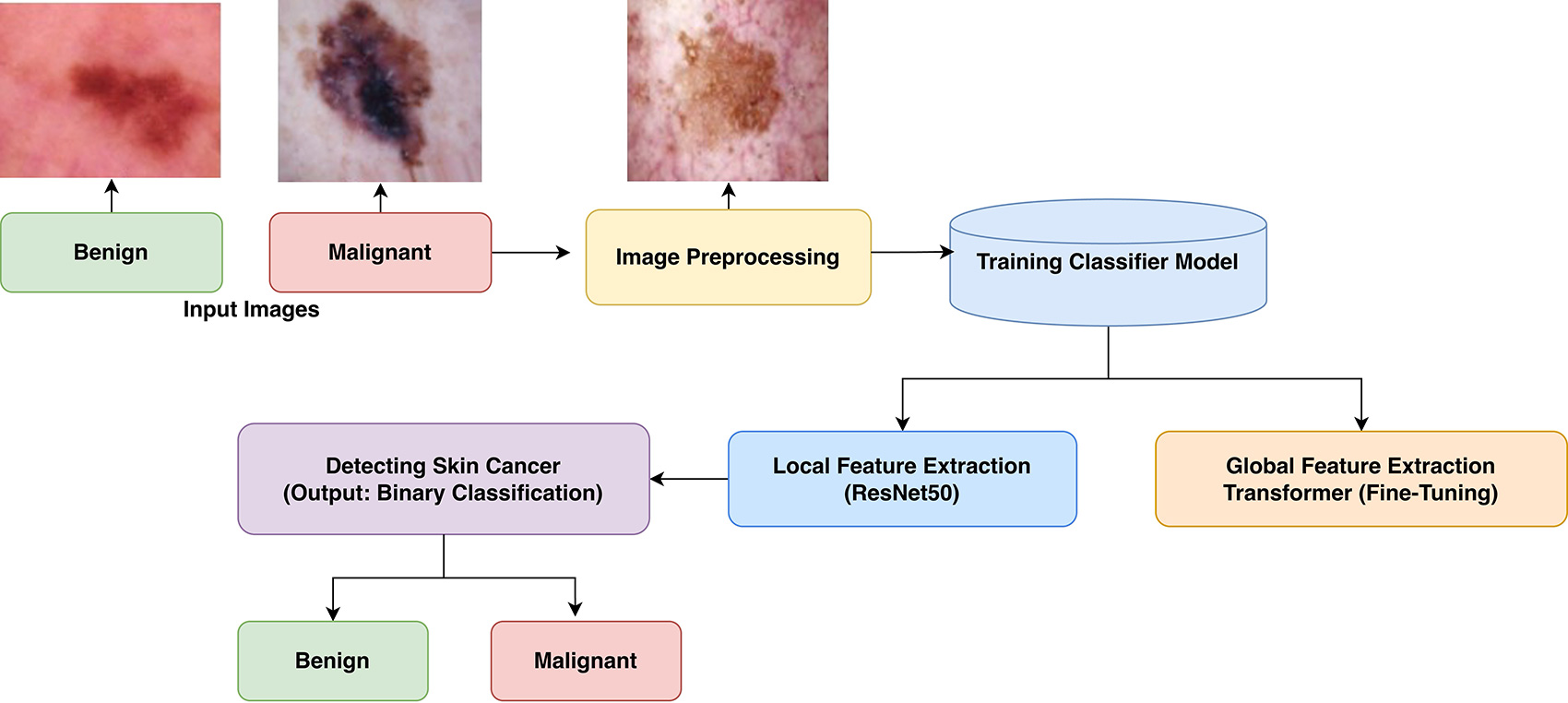
Early diagnosis plays a critical role in the successful skin cancer treatment. To classify skin lesions as benign or malignant, this study suggested a deep learning-enabled method that combines a Transformer module with ResNet50. At first ResNet50, a powerful convolutional neural network, to extract the image features and then enhance the model with a Transformer layer to improve the model accuracy is used. The final model is fine-tuned to achieve better accuracy. This approach shows improved classification results compared to the traditional model. The results signify that combining CNN-based feature extraction with Transformer-enabled global attention suggestively improves skin lesion classification, making the suggested framework a promising method for early and consistent skin cancer detection in intelligent healthcare systems.
Graphical Abstract
Keywords
Data Availability Statement
Funding
Conflicts of Interest
Ethical Approval and Consent to Participate
References
- Ranjan Kumar, H. S., Gireesh Babu, C. N., Vijay, C. P., Raju, K., Santhosh Kumar, K. L., Prabhavathi, K., & Puttegowda, K. (2025). Deep learning-based automated classification of skin lesions using CNN and computer vision. SN Computer Science, 6(7), 846.
[CrossRef] [Google Scholar] - Dosovitskiy, A. (2020). An image is worth 16x16 words: Transformers for image recognition at scale. arXiv preprint arXiv:2010.11929.
[Google Scholar] - Chen, J., Lu, Y., Yu, Q., Luo, X., Adeli, E., Wang, Y., ... & Zhou, Y. (2021). Transunet: Transformers make strong encoders for medical image segmentation. arXiv preprint arXiv:2102.04306.
[Google Scholar] - Rath, K. T., Muduli, D., Kumar, G. K., Ray, D. S., & Sharma, S. K. (2024, June). Enhancing Skin Cancer Diagnosis using Dermoscopic Images: A Feature Fusion based Deep Learning Approach. In 2024 15th International Conference on Computing Communication and Networking Technologies (ICCCNT) (pp. 1-6). IEEE.
[CrossRef] [Google Scholar] - Roy, P., Efat, A. H., Hasan, S. M., Srizon, A. Y., Hossain, M. R., Faruk, M. F., & Al Mamun, M. (2024, September). Multi-Scale Feature Fusion Framework Based on Attention Integrated Customized DenseNet201 Architecture for Multi-Class Skin Lesion Detection. In 2024 IEEE International Conference on Power, Electrical, Electronics and Industrial Applications (PEEIACON) (pp. 496-501). IEEE.
[CrossRef] [Google Scholar] - Xin, C., Liu, Z., Zhao, K., Miao, L., Ma, Y., Zhu, X., ... & Chen, H. (2022). An improved transformer network for skin cancer classification. Computers in Biology and Medicine, 149, 105939.
[CrossRef] [Google Scholar] - Himel, G. M. S., Islam, M. M., Al-Aff, K. A., Karim, S. I., & Sikder, M. K. U. (2024). Skin cancer segmentation and classification using vision transformer for automatic analysis in dermatoscopy‐based noninvasive digital system. International Journal of Biomedical Imaging, 2024(1), 3022192.
[CrossRef] [Google Scholar] - Sharma, G., & Chadha, R. (2022, April). Skin Cancer and Oral Cancer Detection using Deep Learning Technique. In 2022 IEEE International Conference On Distributed Computing And Electrical Circuits And Electronics (Icdcece) (pp. 1-5). IEEE.
[CrossRef] [Google Scholar] - Daghrir, J., Tlig, L., Bouchouicha, M., & Sayadi, M. (2020, September). Melanoma skin cancer detection using deep learning and classical machine learning techniques: A hybrid approach. In 2020 5th international conference on advanced technologies for signal and image processing (ATSIP) (pp. 1-5). IEEE.
[CrossRef] [Google Scholar] - Padhy, S., Dash, S., Kumar, N., Singh, S. P., Kumar, G., & Moral, P. (2025). Temporal integration of ResNet features with LSTM for enhanced skin lesion classification. Results in Engineering, 25, 104201.
[CrossRef] [Google Scholar]
Cited By (2)
-
Hongjuan Wang, Chenxi Wang, Xinjun An. DKTransformer: An Accurate and Efficient Model for Fine-Grained Food Image Classification.
Sensors, 2026 , 26 (4).
[CrossRef] -
Sai Bhargav Kasetty, Rajakumar Krishnan. A unified comparative framework for multiscale geometric transforms in SAR and multispectral satellite image analysis.
Frontiers in Remote Sensing, 2026 , 7 .
[CrossRef]
Cite This Article
TY  - JOUR
AU  - Negi, Simran
AU  - Joshi, Aditya
PY  - 2025
DA  - 2025/12/31
TI  - Transformer Enabled ResNet Based Automated Skin Cancer Detection System
JO  - Biomedical Informatics and Smart Healthcare
T2  - Biomedical Informatics and Smart Healthcare
JF  - Biomedical Informatics and Smart Healthcare
VL  - 1
IS  - 3
SP  - 149
EP  - 154
DO  - 10.62762/BISH.2025.444143
UR  - https://www.icck.org/article/abs/BISH.2025.444143
KW  - ResNet50
KW  - deep learning
KW  - convolutional neural networks
KW  - skin cancer
AB  - Early diagnosis plays a critical role in the successful skin cancer treatment. To classify skin lesions as benign or malignant, this study suggested a deep learning-enabled method that combines a Transformer module with ResNet50. At first ResNet50, a powerful convolutional neural network, to extract the image features and then enhance the model with a Transformer layer to improve the model accuracy is used. The final model is fine-tuned to achieve better accuracy. This approach shows improved classification results compared to the traditional model. The results signify that combining CNN-based feature extraction with Transformer-enabled global attention suggestively improves skin lesion classification, making the suggested framework a promising method for early and consistent skin cancer detection in intelligent healthcare systems.
SN  - 3068-5524
PB  - Institute of Central Computation and Knowledge
LA  - English
ER  -
@article{Negi2025Transforme,
  author = {Simran Negi and Aditya Joshi},
  title = {Transformer Enabled ResNet Based Automated Skin Cancer Detection System},
  journal = {Biomedical Informatics and Smart Healthcare},
  year = {2025},
  volume = {1},
  number = {3},
  pages = {149-154},
  doi = {10.62762/BISH.2025.444143},
  url = {https://www.icck.org/article/abs/BISH.2025.444143},
  abstract = {Early diagnosis plays a critical role in the successful skin cancer treatment. To classify skin lesions as benign or malignant, this study suggested a deep learning-enabled method that combines a Transformer module with ResNet50. At first ResNet50, a powerful convolutional neural network, to extract the image features and then enhance the model with a Transformer layer to improve the model accuracy is used. The final model is fine-tuned to achieve better accuracy. This approach shows improved classification results compared to the traditional model. The results signify that combining CNN-based feature extraction with Transformer-enabled global attention suggestively improves skin lesion classification, making the suggested framework a promising method for early and consistent skin cancer detection in intelligent healthcare systems.},
  keywords = {ResNet50, deep learning, convolutional neural networks, skin cancer},
  issn = {3068-5524},
  publisher = {Institute of Central Computation and Knowledge}
}
Publisher's Note
ICCK stays neutral with regard to jurisdictional claims in published maps and institutional affiliations.
Rights and Permissions
 Copyright © 2025 by the Author(s). Published by Institute of Central Computation and Knowledge. This article is an open access article distributed under the terms and conditions of the Creative Commons Attribution (CC BY) license (https://creativecommons.org/licenses/by/4.0/), which permits use, sharing, adaptation, distribution and reproduction in any medium or format, as long as you give appropriate credit to the original author(s) and the source, provide a link to the Creative Commons licence, and indicate if changes were made.


Portico
