


ICCK

Adnan Abbas Shah

COMSATS University Islamabad

Section 01

Academic Profile

Adnan Abbas Shah has completed his Master’s degree in Remote Sensing and GIS from COMSATS University Islamabad, Pakistan. His research focuses on disaster risk assessment, flood and coastline monitoring, urbanization, climate change impacts, and environmental monitoring using satellite data. He has strong expertise in advanced machine learning techniques, including image segmentation and spatial downscaling, implemented through cloud computing platforms such as Google Earth Engine, Python, and R. He is currently working at the Environmental & Air Quality Research Lab, COMSATS University Islamabad, where he contributes to air quality analysis, geospatial modeling, and climate-related research.

Section 02

Editorial Roles

This user currently does not serve as an editor for any ICCK journals.

Section 03

ICCK Publications

Open Access | Research Article | 16 April 2026
Spatiotemporal Assessment of Desertification Sensitivity in Ningxia, China, Using the MEDALUS Framework and Random Forest Classification (2001–2022)
Journal of Geoscience and Earth Observation | Volume 1, Issue 1: 39-54, 2026 | DOI: 10.62762/JGEO.2025.205415
Abstract
In semi-arid regions, desertification is a critical environmental degradation factor. This study analyzes land degradation and desertification vulnerability dynamics in Ningxia, China (2001–2022) using the MEDALUS framework with a Random Forest classifier. Land-cover change was significant due to irrigation and agricultural expansion, with farmland increasing to 65.29% of the landscape while grassland shrank to 10.13%, intensifying ecological pressure. Bare land followed a U-shaped trend, reaching 9.17% in 2022, indicating increased soil exposure. Soil quality remained moderately stable, with 70–80% of land retaining integrity despite ongoing degradation. Vegetation quality fluctuated co... More >

Graphical Abstract
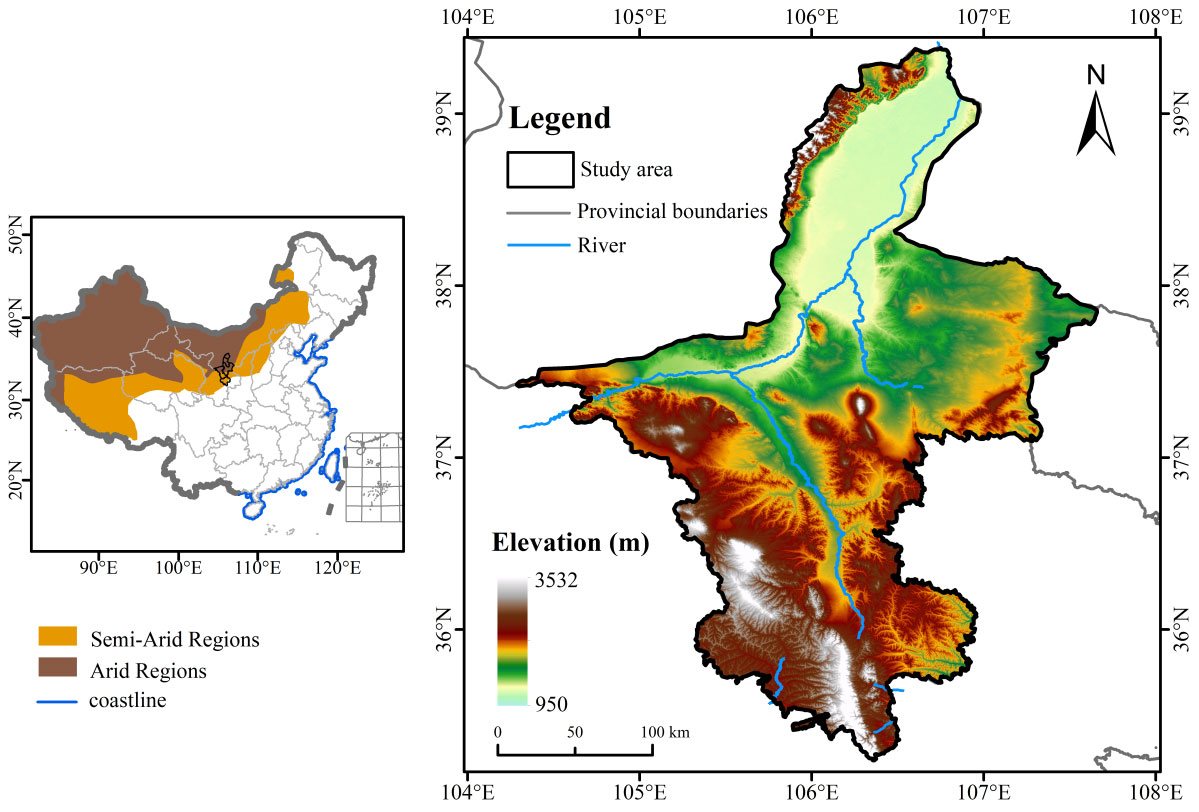
Spatiotemporal Assessment of Desertification Sensitivity in Ningxia, China, Using the MEDALUS Framework and Random Forest Classification (2001–2022)