

ICCK Transactions on Systems Safety and Reliability | Volume 2, Issue 4: 235-249, 2026 | DOI: 10.62762/TSSR.2026.749493
Abstract
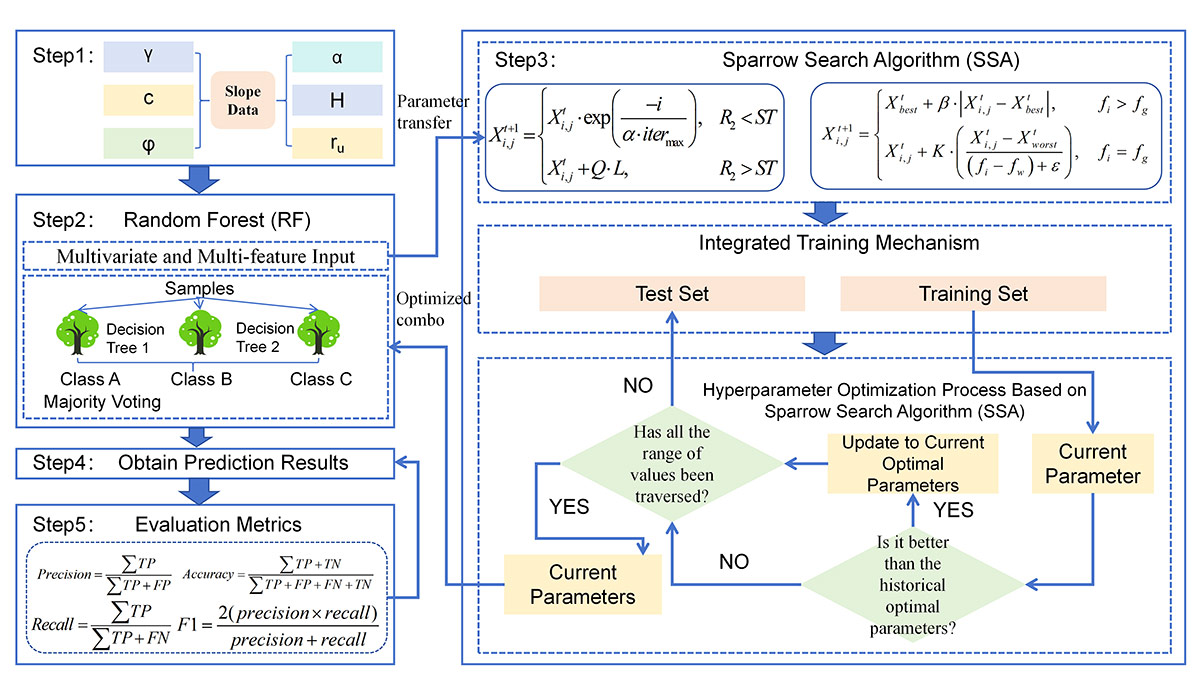
Slope stability prediction is a critical challenge in geotechnical engineering. This challenge arises from the complex nonlinear interactions among multiple influencing factors such as soil properties, slope geometry, and hydraulic conditions. Traditional analytical methods rely on simplified assumptions that fail to capture these complex relationships. To address these limitations, this study proposes a hybrid predictive framework that integrates machine learning models with intelligent optimization algorithms. Six key parameters, including unit weight, cohesion, internal friction angle, slope angle, slope height, and pore water pressure ratio, are selected as input features. Three machine... More >
Graphical Abstract