

Slope Stability Analysis Based on Machine Learning Optimized with Sparrow Search




Article Information
Abstract
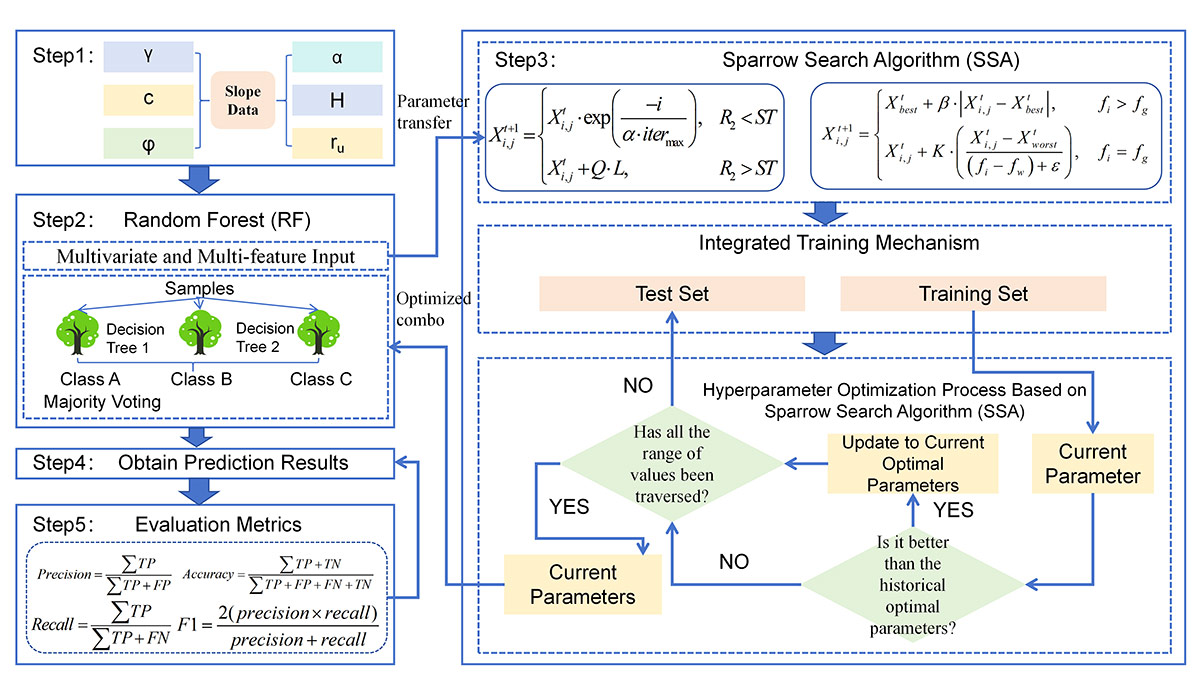
Slope stability prediction is a critical challenge in geotechnical engineering. This challenge arises from the complex nonlinear interactions among multiple influencing factors such as soil properties, slope geometry, and hydraulic conditions. Traditional analytical methods rely on simplified assumptions that fail to capture these complex relationships. To address these limitations, this study proposes a hybrid predictive framework that integrates machine learning models with intelligent optimization algorithms. Six key parameters, including unit weight, cohesion, internal friction angle, slope angle, slope height, and pore water pressure ratio, are selected as input features. Three machine learning models, namely Random Forest, XGBoost, and Support Vector Machine, are optimized using four intelligent optimization algorithms, including the Sparrow Search Algorithm, Lion Swarm Optimization, Whale Optimization Algorithm, and Genetic Algorithm, resulting in twelve combined configurations. Among all combinations, the Sparrow Search Algorithm-optimized Random Forest model achieves the best performance, with an accuracy of 95.56%, precision of 95.24%, recall of 95.24%, F1 score of 95.24%, and AUC value of 0.9850. Validation using ten independent engineering cases confirms that the predictions of this model are consistent with actual slope conditions, demonstrating strong engineering applicability. This study provides a systematic comparative framework for hybrid model selection and offers practical guidance for intelligent slope stability assessment.
Graphical Abstract
Keywords
Data Availability Statement
Funding
Conflicts of Interest
AI Use Statement
Ethical Approval and Consent to Participate
References
- Cheng, Y. M., Lansivaara, T., & Wei, W. B. (2007). Two-dimensional slope stability analysis by limit equilibrium and strength reduction methods. Computers and geotechnics, 34(3), 137-150.
[CrossRef] [Google Scholar] - Griffiths, D. V., & Lane, P. A. (1999). Slope stability analysis by finite elements. Geotechnique, 49(3), 387-403.
[CrossRef] [Google Scholar] - Liu, S. Y., Shao, L. T., & Li, H. J. (2015). Slope stability analysis using the limit equilibrium method and two finite element methods. Computers and Geotechnics, 63, 291-298.
[CrossRef] [Google Scholar] - Nanehkaran, Y. A., Licai, Z., Chengyong, J., Chen, J., Anwar, S., Azarafza, M., & Derakhshani, R. (2023). Comparative analysis for slope stability by using machine learning methods. Applied Sciences, 13(3), 1555.
[CrossRef] [Google Scholar] - Zhou, J., Li, E., Yang, S., Wang, M., Shi, X., Yao, S., & Mitri, H. S. (2019). Slope stability prediction for circular mode failure using gradient boosting machine approach based on an updated database of case histories. Safety Science, 118, 505-518.
[CrossRef] [Google Scholar] - Boser, B. E., Guyon, I. M., & Vapnik, V. N. (1992, July). A training algorithm for optimal margin classifiers. In Proceedings of the fifth annual workshop on Computational learning theory (pp. 144-152).
[CrossRef] [Google Scholar] - Huang, F., Xiong, H., Chen, S., Lv, Z., Huang, J., Chang, Z., & Catani, F. (2023). Slope stability prediction based on a long short-term memory neural network: comparisons with convolutional neural networks, support vector machines and random forest models. International Journal of Coal Science & Technology, 10(1), 18.
[CrossRef] [Google Scholar] - Li, M., Li, K., Qin, Q., & Yue, R. (2023). Slope stability prediction based on IPOARF algorithm: A case study of Lala Copper Mine, Sichuan, China. Expert Systems with Applications, 229, 120595.
[CrossRef] [Google Scholar] - Gordan, B., Jahed Armaghani, D., Hajihassani, M., & Monjezi, M. (2016). Prediction of seismic slope stability through combination of particle swarm optimization and neural network. Engineering with computers, 32(1), 85-97.
[CrossRef] [Google Scholar] - Khajehzadeh, M., Taha, M. R., Keawsawasvong, S., Mirzaei, H., & Jebeli, M. (2022). An effective artificial intelligence approach for slope stability evaluation. IEEE Access, 10, 5660-5671.
[CrossRef] [Google Scholar] - Tien Bui, D., Moayedi, H., Gör, M., Jaafari, A., & Foong, L. K. (2019). Predicting slope stability failure through machine learning paradigms. ISPRS International Journal of Geo-Information, 8(9), 395.
[CrossRef] [Google Scholar] - Breiman, L. (2001). Random forests. \emph{Machine Learning, 45(1), 5--32.
[CrossRef] [Google Scholar] - Chen, T., & Guestrin, C. (2016, August). Xgboost: A scalable tree boosting system. In Proceedings of the 22nd acm sigkdd international conference on knowledge discovery and data mining (pp. 785-794).
[CrossRef] [Google Scholar] - Xue, J., & Shen, B. (2020). A novel swarm intelligence optimization approach: sparrow search algorithm. Systems science & control engineering, 8(1), 22-34.
[CrossRef] [Google Scholar] - Holland, J. H. (1992). Adaptation in Natural and Artificial Systems: An Introductory Analysis with Applications to Biology, Control, and Artificial Intelligence. MIT Press.
[CrossRef] [Google Scholar] - Mirjalili, S., & Lewis, A. (2016). The whale optimization algorithm. Advances in engineering software, 95, 51-67.
[CrossRef] [Google Scholar] - Yazdani, M., & Jolai, F. (2016). Lion optimization algorithm (LOA): A nature-inspired metaheuristic algorithm. Journal of Computational Design and Engineering, 3(1), 24-36.
[CrossRef] [Google Scholar] - Lin, S., Zheng, H., Han, C., Han, B., & Li, W. (2021). Evaluation and prediction of slope stability using machine learning approaches. Frontiers of Structural and Civil Engineering, 15(4), 821-833.
[CrossRef] [Google Scholar]
Cite This Article
TY  - JOUR
AU  - Zhou, Fangfang
AU  - Wang, Jing
AU  - Yan, Rongfang
AU  - Zhang, Jiandong
PY  - 2026
DA  - 2026/10/25
TI  - Slope Stability Analysis Based on Machine Learning Optimized with Sparrow Search
JO  - ICCK Transactions on Systems Safety and Reliability
T2  - ICCK Transactions on Systems Safety and Reliability
JF  - ICCK Transactions on Systems Safety and Reliability
VL  - 2
IS  - 4
SP  - 235
EP  - 249
DO  - 10.62762/TSSR.2026.749493
UR  - https://www.icck.org/article/abs/TSSR.2026.749493
KW  - Slope stability prediction
KW  - Machine learning
KW  - Intelligent optimization algorithms
KW  - SSA-RF
AB  - Slope stability prediction is a critical challenge in geotechnical engineering. This challenge arises from the complex nonlinear interactions among multiple influencing factors such as soil properties, slope geometry, and hydraulic conditions. Traditional analytical methods rely on simplified assumptions that fail to capture these complex relationships. To address these limitations, this study proposes a hybrid predictive framework that integrates machine learning models with intelligent optimization algorithms. Six key parameters, including unit weight, cohesion, internal friction angle, slope angle, slope height, and pore water pressure ratio, are selected as input features. Three machine learning models, namely Random Forest, XGBoost, and Support Vector Machine, are optimized using four intelligent optimization algorithms, including the Sparrow Search Algorithm, Lion Swarm Optimization, Whale Optimization Algorithm, and Genetic Algorithm, resulting in twelve combined configurations. Among all combinations, the Sparrow Search Algorithm-optimized Random Forest model achieves the best performance, with an accuracy of 95.56%, precision of 95.24%, recall of 95.24%, F1 score of 95.24%, and AUC value of 0.9850. Validation using ten independent engineering cases confirms that the predictions of this model are consistent with actual slope conditions, demonstrating strong engineering applicability. This study provides a systematic comparative framework for hybrid model selection and offers practical guidance for intelligent slope stability assessment.
SN  - 3069-1087
PB  - Institute of Central Computation and Knowledge
LA  - English
ER  -
@article{Zhou2026Slope,
  author = {Fangfang Zhou and Jing Wang and Rongfang Yan and Jiandong Zhang},
  title = {Slope Stability Analysis Based on Machine Learning Optimized with Sparrow Search},
  journal = {ICCK Transactions on Systems Safety and Reliability},
  year = {2026},
  volume = {2},
  number = {4},
  pages = {235-249},
  doi = {10.62762/TSSR.2026.749493},
  url = {https://www.icck.org/article/abs/TSSR.2026.749493},
  abstract = {Slope stability prediction is a critical challenge in geotechnical engineering. This challenge arises from the complex nonlinear interactions among multiple influencing factors such as soil properties, slope geometry, and hydraulic conditions. Traditional analytical methods rely on simplified assumptions that fail to capture these complex relationships. To address these limitations, this study proposes a hybrid predictive framework that integrates machine learning models with intelligent optimization algorithms. Six key parameters, including unit weight, cohesion, internal friction angle, slope angle, slope height, and pore water pressure ratio, are selected as input features. Three machine learning models, namely Random Forest, XGBoost, and Support Vector Machine, are optimized using four intelligent optimization algorithms, including the Sparrow Search Algorithm, Lion Swarm Optimization, Whale Optimization Algorithm, and Genetic Algorithm, resulting in twelve combined configurations. Among all combinations, the Sparrow Search Algorithm-optimized Random Forest model achieves the best performance, with an accuracy of 95.56\%, precision of 95.24\%, recall of 95.24\%, F1 score of 95.24\%, and AUC value of 0.9850. Validation using ten independent engineering cases confirms that the predictions of this model are consistent with actual slope conditions, demonstrating strong engineering applicability. This study provides a systematic comparative framework for hybrid model selection and offers practical guidance for intelligent slope stability assessment.},
  keywords = {Slope stability prediction, Machine learning, Intelligent optimization algorithms, SSA-RF},
  issn = {3069-1087},
  publisher = {Institute of Central Computation and Knowledge}
}
Article Metrics
Publisher's Note
ICCK stays neutral with regard to jurisdictional claims in published maps and institutional affiliations.
Rights and Permissions


Portico
