

Journal of Geo-Energy and Environment | Volume 3, Issue 1: 48-71, 2026 | DOI: 10.62762/JGEE.2026.403029
Abstract
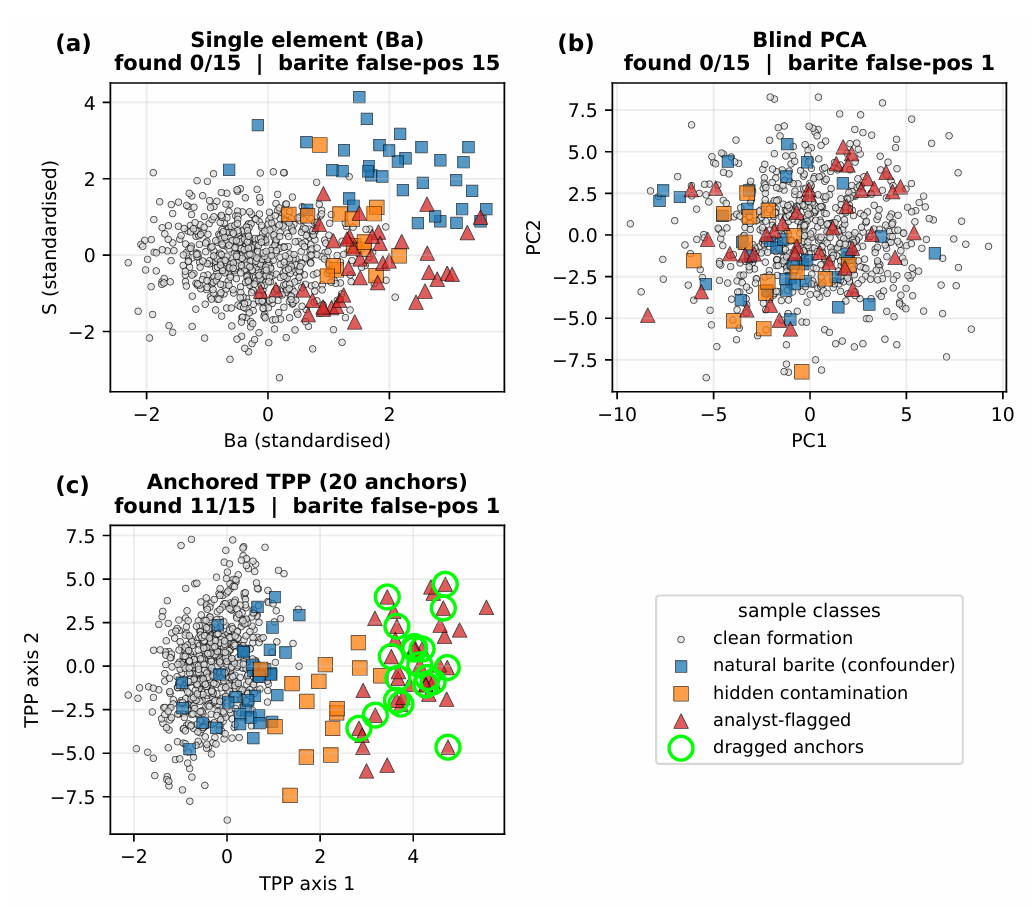
Wellsite X-ray fluorescence (XRF) analysis of drill cuttings provides multi-element profiles for chemostratigraphy, well correlation and reservoir characterization, but the data are exposed to artefacts of the drilling workflow, such as drilling-fluid residue, carry-over between samples and detector drift. Quality control (QC) usually relies on principal component analysis (PCA), which ranks samples by variance rather than geological meaning, or on supervised classifiers, which need labels that do not exist at the QC stage. In practice, analysts often suspect a problem and can point to a few samples that show it. We introduce anchored targeted projection pursuit (anchored TPP), which builds... More >
Graphical Abstract