

Anchored Targeted Projection Pursuit for Hypothesis-Driven Quality Control of Drill-Cuttings Geochemical Data



Article Information
Abstract
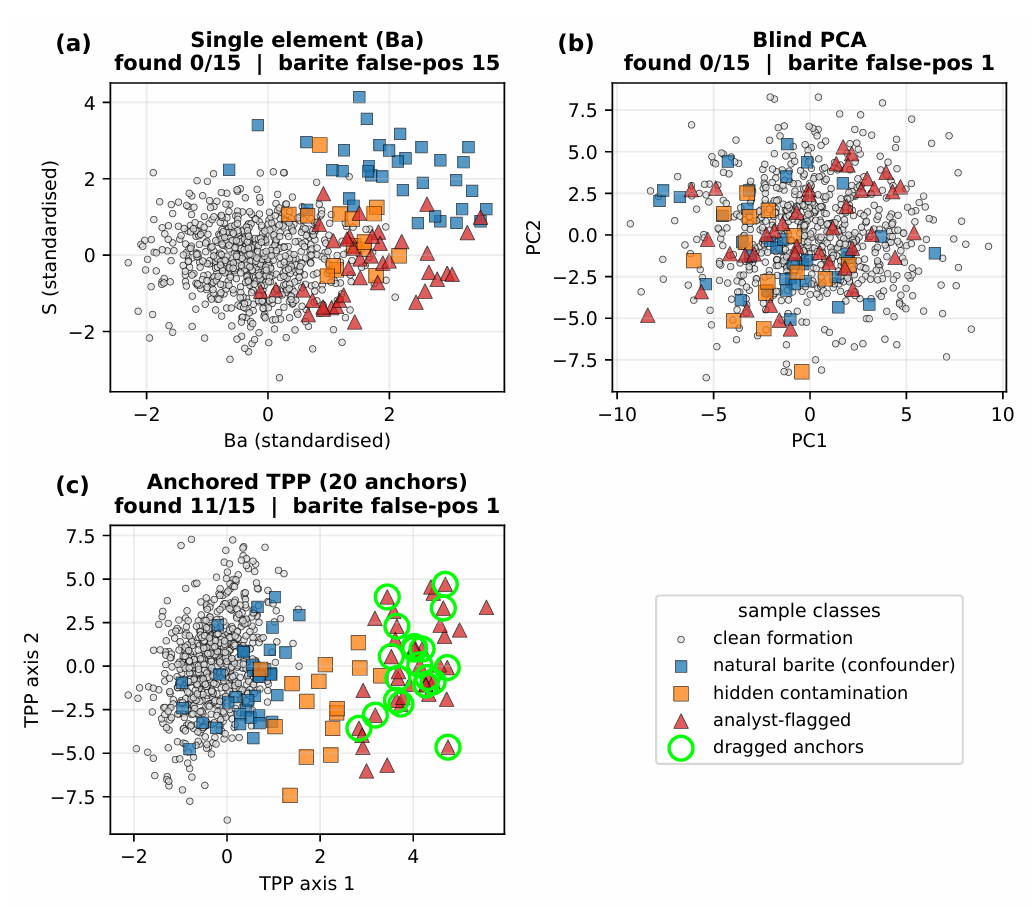
Wellsite X-ray fluorescence (XRF) analysis of drill cuttings provides multi-element profiles for chemostratigraphy, well correlation and reservoir characterization, but the data are exposed to artefacts of the drilling workflow, such as drilling-fluid residue, carry-over between samples and detector drift. Quality control (QC) usually relies on principal component analysis (PCA), which ranks samples by variance rather than geological meaning, or on supervised classifiers, which need labels that do not exist at the QC stage. In practice, analysts often suspect a problem and can point to a few samples that show it. We introduce anchored targeted projection pursuit (anchored TPP), which builds its projection target from these anchors alone and leaves all other samples unconstrained. The fit reduces to a weighted orthogonal Procrustes problem with a closed-form solution and no tuning parameters. It remains well posed when variables outnumber samples, and its loadings name the elemental contrast behind each flag. We test it on a synthetic XRF benchmark and on a semi-synthetic experiment that plants a potassium chloride (KCl) brine mud signature into real cuttings data from an unconventional hydrocarbon well. Anchored TPP detects contamination that PCA and single-element thresholds miss, and log-ratio pre-treatment more than doubles its recovery. Positive--unlabelled learning recovers marginally more (0.55 of 12 hidden samples; 95% confidence interval 0.07-1.03), but anchored TPP is interpretable, tuning-free and fast enough for interactive use. Because all contamination labels are planted, field validation against laboratory-confirmed intervals remains necessary.
Graphical Abstract
Keywords
Data Availability Statement
Funding
Conflicts of Interest
AI Use Statement
Ethical Approval and Consent to Participate
References
- Kirkwood, C., Cave, M., Beamish, D., Grebby, S., & Ferreira, A. (2016). A machine learning approach to geochemical mapping. Journal of Geochemical Exploration, 167, 49-61.
[CrossRef] [Google Scholar] - Caté, A., Perozzi, L., Gloaguen, E., & Blouin, M. (2017). Machine learning as a tool for geologists. The Leading Edge, 36(3), 215-219.
[CrossRef] [Google Scholar] - Hall, B. (2016). Facies classification using machine learning. The Leading Edge, 35(10), 906-909.
[CrossRef] [Google Scholar] - Lee, S., & Moon, I. (2026). Recent advances and future perspectives of AI-based mineral exploration: A review of machine learning, deep learning, and geologically informed approaches. Minerals, 16(6), 584.
[CrossRef] [Google Scholar] - Howarth, R. J., Coles, B. J., & Ramsey, M. H. (2000). The potential of multivariate quality control as a diagnostic tool in geoanalysis. Analyst, 125(11), 2032-2037.
[CrossRef] [Google Scholar] - Bourdeau, J. E., Zhang, S. E., Lawley, C. J., Parsa, M., Nwaila, G. T., & Ghorbani, Y. (2023). Predictive Geochemical Exploration: Inferential Generation of Modern Geochemical Data, Anomaly Detection and Application to Northern Manitoba. Natural Resources Research, 32(6), 2355-2386.
[CrossRef] [Google Scholar] - Balaram, V., & Satyanarayanan, M. (2022). Data quality in geochemical elemental and isotopic analysis. Minerals, 12(8), 999.
[CrossRef] [Google Scholar] - Rowe, H., Hughes, N., & Robinson, K. (2012). The quantification and application of handheld energy-dispersive x-ray fluorescence (ED-XRF) in mudrock chemostratigraphy and geochemistry. Chemical geology, 324, 122-131.
[CrossRef] [Google Scholar] - Carr, R., Yarbrough, L., Lentz, N., Neset, K., Lucero, B., & Kirst, T. (2014). On-site XRF analysis of drill cuttings in the Williston Basin. In Proceedings of the Unconventional Resources Technology Conference (URTeC 2014), Denver, Colorado, USA, Paper URTEC-1934308-MS.
[CrossRef] [Google Scholar] - Ross, P. S., Bourke, A., & Fresia, B. (2014). Improving lithological discrimination in exploration drill-cores using portable X-ray fluorescence measurements: (1) testing three Olympus Innov-X analysers on unprepared cores. Geochemistry: Exploration, Environment, Analysis, 14(2), 171-185.
[CrossRef] [Google Scholar] - Zhou, S., Wang, J., Wang, W., & Liao, S. (2023). Evaluation of portable X-ray fluorescence analysis and its applicability as a tool in geochemical exploration. Minerals, 13(2), 166.
[CrossRef] [Google Scholar] - Grunsky, E. C., & Caritat, P. D. (2020). State-of-the-art analysis of geochemical data for mineral exploration. Geochemistry: Exploration, Environment, Analysis, 20(2), 217-232.
[CrossRef] [Google Scholar] - Kowalska, S., Kubik, B., Skupio, R., & Wolański, K. (2020). Downhole lithological profile reconstruction based on chemical composition of core samples and drill cuttings measured with portable X-ray fluorescence spectrometer. Minerals, 10(12), 1101.
[CrossRef] [Google Scholar] - Laperche, V., & Lemière, B. (2020). Possible pitfalls in the analysis of minerals and loose materials by portable XRF, and how to overcome them. Minerals, 11(1), 33.
[CrossRef] [Google Scholar] - Hall, B. (2018). Geochemical facies analysis using unsupervised machine learning. CSEG Recorder, 26-30. https://cseg.ca/wp-content/uploads/2018-01-RECORDER-Geochemical_Facies_Analysis.pdf
[Google Scholar] - Ratcliffe, K. T., Wright, A. M., & Schmidt, K. (2012). Application of inorganic whole-rock geochemistry to shale resource plays: An example from the Eagle Ford Shale Formation, Texas. The Sedimentary Record, 10(2), 4-9.
[CrossRef] [Google Scholar] - Ratnayake, A. S., & Sampei, Y. (2019). Organic geochemical evaluation of contamination tracers in deepwater well rock cuttings from the Mannar Basin, Sri Lanka. Journal of Petroleum Exploration and Production Technology, 9(2), 989-996.
[CrossRef] [Google Scholar] - Haluszczak, L. O., Rose, A. W., & Kump, L. R. (2013). Geochemical evaluation of flowback brine from Marcellus gas wells in Pennsylvania, USA. Applied Geochemistry, 28, 55-61.
[CrossRef] [Google Scholar] - Ablard, P., Bell, C., Cook, D., Fornasier, I., Poyet, J.-P., Sharma, S., Fielding, K., Lawton, L., Haines, G., Herkommer, M. A., McCarthy, K., Radakovic, M., & Umar, L. (2012). The expanding role of mud logging. Oilfield Review, 24(1), 24-41. https://www.scienceopen.com/document?vid=7e621021-d2df-4946-8182-0cedca082a8b
[Google Scholar] - Filzmoser, P., & Hron, K. (2008). Outlier detection for compositional data using robust methods. Mathematical Geosciences, 40(3), 233-248.
[CrossRef] [Google Scholar] - Grunsky, E. C. (2010). The interpretation of geochemical survey data. Geochemistry: Exploration, Environment, Analysis, 10(1), 27-74.
[CrossRef] [Google Scholar] - Hajihosseinlou, M., Maghsoudi, A., & Ghezelbash, R. (2024). Geochemical anomaly detection and pattern recognition: A combined study of the apriori Algorithm, principal component Analysis, and spectral clustering. Minerals, 14(12), 1202.
[CrossRef] [Google Scholar] - Ren, X., Wang, G., & Mou, N. (2026). Identification of Geochemical Anomalies by Pattern Recognition: A Case Study of Wulonggou Area in Qinghai Province, China. Minerals, 16(4), 411.
[CrossRef] [Google Scholar] - Wang, J., Zuo, R., & Xiong, Y. (2020). Mapping mineral prospectivity via semi-supervised random forest. Natural Resources Research, 29(1), 189-202.
[CrossRef] [Google Scholar] - Zhou, K., Sun, T., Liu, Y., Feng, M., Tang, J., Mao, L., Pu, W., & Huang, J. (2023). Prospectivity mapping of tungsten mineralization in Southern Jiangxi Province using few-shot learning. Minerals, 13(5), 669.
[CrossRef] [Google Scholar] - Zuo, R., & Wang, Z. (2020). Effects of random negative training samples on mineral prospectivity mapping. Natural Resources Research, 29(6), 3443-3455.
[CrossRef] [Google Scholar] - Faith, J., Mintram, R., & Angelova, M. (2006). Targeted projection pursuit for visualizing gene expression data classifications. Bioinformatics, 22(21), 2667-2673.
[CrossRef] [Google Scholar] - Jimenez, L. O., & Landgrebe, D. A. (1999). Hyperspectral data analysis and supervised feature reduction via projection pursuit. IEEE Transactions on Geoscience and Remote Sensing, 37(6), 2653-2667.
[CrossRef] [Google Scholar] - Malpica, J. A., Rejas, J. G., & Alonso, M. C. (2008). A projection pursuit algorithm for anomaly detection in hyperspectral imagery. Pattern Recognition, 41(11), 3313-3327.
[CrossRef] [Google Scholar] - Schölkopf, B., Platt, J. C., Shawe-Taylor, J., Smola, A. J., & Williamson, R. C. (2001). Estimating the support of a high-dimensional distribution. Neural computation, 13(7), 1443-1471.
[CrossRef] [Google Scholar] - Elkan, C., & Noto, K. (2008). Learning classifiers from only positive and unlabeled data. In 14th ACM SIGKDD International Conference on Knowledge Discovery and Data Mining (pp.~213-220).
[CrossRef] [Google Scholar] - Bekker, J., & Davis, J. (2020). Learning from positive and unlabeled data: A survey. Machine Learning, 109(4), 719-760.
[CrossRef] [Google Scholar] - Bourdeau, J. E., Zhang, S. E., Nwaila, G. T., & Ghorbani, Y. (2024). Data generation for exploration geochemistry: Past, present and future. Applied Geochemistry, 172, 106124.
[CrossRef] [Google Scholar] - Campos, G. O., Zimek, A., Sander, J., Campello, R. J., Micenková, B., Schubert, E., ... & Houle, M. E. (2016). On the evaluation of unsupervised outlier detection: measures, datasets, and an empirical study. Data mining and knowledge discovery, 30(4), 891-927.
[CrossRef] [Google Scholar] - Friedman, J. H., & Tukey, J. W. (1974). A projection pursuit algorithm for exploratory data analysis. IEEE Transactions on computers, 100(9), 881-890.
[CrossRef] [Google Scholar] - Huber, P. J. (1985). Projection pursuit. The Annals of Statistics, 13(2), 435-475.
[CrossRef] [Google Scholar] - Barnett, R. M., Manchuk, J. G., & Deutsch, C. V. (2014). Projection pursuit multivariate transform. Mathematical Geosciences, 46(2), 337-359.
[CrossRef] [Google Scholar] - Rousseeuw, P. J., & Van Driessen, K. (1999). A fast algorithm for the minimum covariance determinant estimator. Technometrics, 41(3), 212-223.
[CrossRef] [Google Scholar] - Liu, F. T., Ting, K. M., & Zhou, Z. H. (2008, December). Isolation forest. In 2008 eighth ieee international conference on data mining (pp. 413-422). IEEE.
[CrossRef] [Google Scholar] - Chen, Y., & Wu, W. (2019). Isolation forest as an alternative data-driven mineral prospectivity mapping method with a higher data-processing efficiency. Natural Resources Research, 28(1), 31-46.
[CrossRef] [Google Scholar] - Shahrestani, S., & Carranza, E. J. M. (2024). Effectiveness of LOF, iForest and OCSVM in detecting anomalies in stream sediment geochemical data. Geochemistry: Exploration, Environment, Analysis, 24(3), geochem2024-009.
[CrossRef] [Google Scholar] - Breunig, M. M., Kriegel, H. P., Ng, R. T., & Sander, J. (2000, May). LOF: identifying density-based local outliers. In Proceedings of the 2000 ACM SIGMOD international conference on Management of data (pp. 93-104).
[CrossRef] [Google Scholar] - Yang, Z., & Chen, Y. (2025). Anomaly detection-oriented positive-unlabeled metric learning for extracting high-dimensional geochemical anomalies linked to mineralization. Natural Resources Research, 34(3), 1219-1241.
[CrossRef] [Google Scholar] - Schönemann, P. H. (1966). A generalized solution of the orthogonal procrustes problem. Psychometrika, 31(1), 1-10.
[CrossRef] [Google Scholar] - Higham, N. J. (1986). Computing the polar decomposition\textemdash{with applications. SIAM Journal on Scientific and Statistical Computing, 7(4), 1160-1174.
[CrossRef] [Google Scholar] - Aitchison, J. (1982). The statistical analysis of compositional data. Journal of the Royal Statistical Society: Series B (Methodological), 44(2), 139-160.
[CrossRef] [Google Scholar] - Zhao, Z., Qiao, K., Liu, Y., Chen, J., & Li, C. (2022). Geochemical data mining by integrated multivariate component data analysis: The Heilongjiang Duobaoshan area (China) case study. Minerals, 12(8), 1035.
[CrossRef] [Google Scholar] - Martín-Fernández, J. A., Barceló-Vidal, C., & Pawlowsky-Glahn, V. (2003). Dealing with zeros and missing values in compositional data sets using nonparametric imputation. Mathematical Geology, 35(3), 253-278.
[CrossRef] [Google Scholar] - Filzmoser, P., Hron, K., & Reimann, C. (2009). Principal component analysis for compositional data with outliers. Environmetrics: The Official Journal of the International Environmetrics Society, 20(6), 621-632.
[CrossRef] [Google Scholar] - Barnes, R. J. (1991). The variogram sill and the sample variance. Mathematical geology, 23(4), 673-678.
[CrossRef] [Google Scholar] - Reimann, C., Filzmoser, P., & Garrett, R. G. (2002). Factor analysis applied to regional geochemical data: problems and possibilities. Applied geochemistry, 17(3), 185-206.
[CrossRef] [Google Scholar] - Zuo, R. (2017). Machine learning of mineralization-related geochemical anomalies: A review of potential methods. Natural Resources Research, 26(4), 457-464.
[CrossRef] [Google Scholar] - Puchhammer, P., Kalubowila, C., Braus, L., Pospiech, S., Sarala, P., & Filzmoser, P. (2024). A performance study of local outlier detection methods for mineral exploration with geochemical compositional data. Journal of Geochemical Exploration, 258, 107392.
[CrossRef] [Google Scholar] - Liu, Y., Carranza, E. J. M., Zhou, K., & Xia, Q. (2019). Compositional Balance Analysis: An Elegant Method of Geochemical Pattern Recognition and Anomaly Mapping for Mineral Exploration. Natural Resources Research, 28(4), 1269-1283.
[CrossRef] [Google Scholar] - Zhang, S., Carranza, E. J. M., Fu, C., Zhang, W., & Qin, X. (2024). Interpretable machine learning for geochemical anomaly delineation in the Yuanbo Nang District, Gansu Province, China. Minerals, 14(5), 500.
[CrossRef] [Google Scholar] - Egozcue, J. J., Pawlowsky-Glahn, V., Mateu-Figueras, G., & Barcelo-Vidal, C. (2003). Isometric logratio transformations for compositional data analysis. Mathematical geology, 35(3), 279-300.
[CrossRef] [Google Scholar]
Cite This Article
TY  - JOUR
AU  - Li, Yupeng
AU  - Shahrani, Saeed S.
AU  - Yuan, Zhaoxian
PY  - 2026
DA  - 2026/10/14
TI  - Anchored Targeted Projection Pursuit for Hypothesis-Driven Quality Control of Drill-Cuttings Geochemical Data
JO  - Journal of Geo-Energy and Environment
T2  - Journal of Geo-Energy and Environment
JF  - Journal of Geo-Energy and Environment
VL  - 3
IS  - 1
SP  - 48
EP  - 71
DO  - 10.62762/JGEE.2026.403029
UR  - https://www.icck.org/article/abs/JGEE.2026.403029
KW  - projection pursuit
KW  - drill cuttings
KW  - data quality control
KW  - chemostratigraphy
KW  - reservoir characterization
KW  - X-ray fluorescence
KW  - drilling-fluid contamination
KW  - compositional data
KW  - human-in-the-loop analysis
AB  - Wellsite X-ray fluorescence (XRF) analysis of drill cuttings provides multi-element profiles for chemostratigraphy, well correlation and reservoir characterization, but the data are exposed to artefacts of the drilling workflow, such as drilling-fluid residue, carry-over between samples and detector drift. Quality control (QC) usually relies on principal component analysis (PCA), which ranks samples by variance rather than geological meaning, or on supervised classifiers, which need labels that do not exist at the QC stage. In practice, analysts often suspect a problem and can point to a few samples that show it. We introduce anchored targeted projection pursuit (anchored TPP), which builds its projection target from these anchors alone and leaves all other samples unconstrained. The fit reduces to a weighted orthogonal Procrustes problem with a closed-form solution and no tuning parameters. It remains well posed when variables outnumber samples, and its loadings name the elemental contrast behind each flag. We test it on a synthetic XRF benchmark and on a semi-synthetic experiment that plants a potassium chloride (KCl) brine mud signature into real cuttings data from an unconventional hydrocarbon well. Anchored TPP detects contamination that PCA and single-element thresholds miss, and log-ratio pre-treatment more than doubles its recovery. Positive--unlabelled learning recovers marginally more (0.55 of 12 hidden samples; 95% confidence interval 0.07-1.03), but anchored TPP is interpretable, tuning-free and fast enough for interactive use. Because all contamination labels are planted, field validation against laboratory-confirmed intervals remains necessary.
SN  - 3069-3268
PB  - Institute of Central Computation and Knowledge
LA  - English
ER  -
@article{Li2026Anchored,
  author = {Yupeng Li and Saeed S. Shahrani and Zhaoxian Yuan},
  title = {Anchored Targeted Projection Pursuit for Hypothesis-Driven Quality Control of Drill-Cuttings Geochemical Data},
  journal = {Journal of Geo-Energy and Environment},
  year = {2026},
  volume = {3},
  number = {1},
  pages = {48-71},
  doi = {10.62762/JGEE.2026.403029},
  url = {https://www.icck.org/article/abs/JGEE.2026.403029},
  abstract = {Wellsite X-ray fluorescence (XRF) analysis of drill cuttings provides multi-element profiles for chemostratigraphy, well correlation and reservoir characterization, but the data are exposed to artefacts of the drilling workflow, such as drilling-fluid residue, carry-over between samples and detector drift. Quality control (QC) usually relies on principal component analysis (PCA), which ranks samples by variance rather than geological meaning, or on supervised classifiers, which need labels that do not exist at the QC stage. In practice, analysts often suspect a problem and can point to a few samples that show it. We introduce anchored targeted projection pursuit (anchored TPP), which builds its projection target from these anchors alone and leaves all other samples unconstrained. The fit reduces to a weighted orthogonal Procrustes problem with a closed-form solution and no tuning parameters. It remains well posed when variables outnumber samples, and its loadings name the elemental contrast behind each flag. We test it on a synthetic XRF benchmark and on a semi-synthetic experiment that plants a potassium chloride (KCl) brine mud signature into real cuttings data from an unconventional hydrocarbon well. Anchored TPP detects contamination that PCA and single-element thresholds miss, and log-ratio pre-treatment more than doubles its recovery. Positive--unlabelled learning recovers marginally more (0.55 of 12 hidden samples; 95\% confidence interval 0.07-1.03), but anchored TPP is interpretable, tuning-free and fast enough for interactive use. Because all contamination labels are planted, field validation against laboratory-confirmed intervals remains necessary.},
  keywords = {projection pursuit, drill cuttings, data quality control, chemostratigraphy, reservoir characterization, X-ray fluorescence, drilling-fluid contamination, compositional data, human-in-the-loop analysis},
  issn = {3069-3268},
  publisher = {Institute of Central Computation and Knowledge}
}
Article Metrics
Publisher's Note
ICCK stays neutral with regard to jurisdictional claims in published maps and institutional affiliations.
Rights and Permissions
 Copyright © 2026 by the Author(s). Published by Institute of Central Computation and Knowledge. This article is an open access article distributed under the terms and conditions of the Creative Commons Attribution (CC BY) license (https://creativecommons.org/licenses/by/4.0/), which permits use, sharing, adaptation, distribution and reproduction in any medium or format, as long as you give appropriate credit to the original author(s) and the source, provide a link to the Creative Commons licence, and indicate if changes were made.


Portico
