

Geological Characteristics and Three-Dimensional Development Potential of Deep Shale Gas in the Luzhou Area, Southern Sichuan Basin, China



Article Information
Abstract
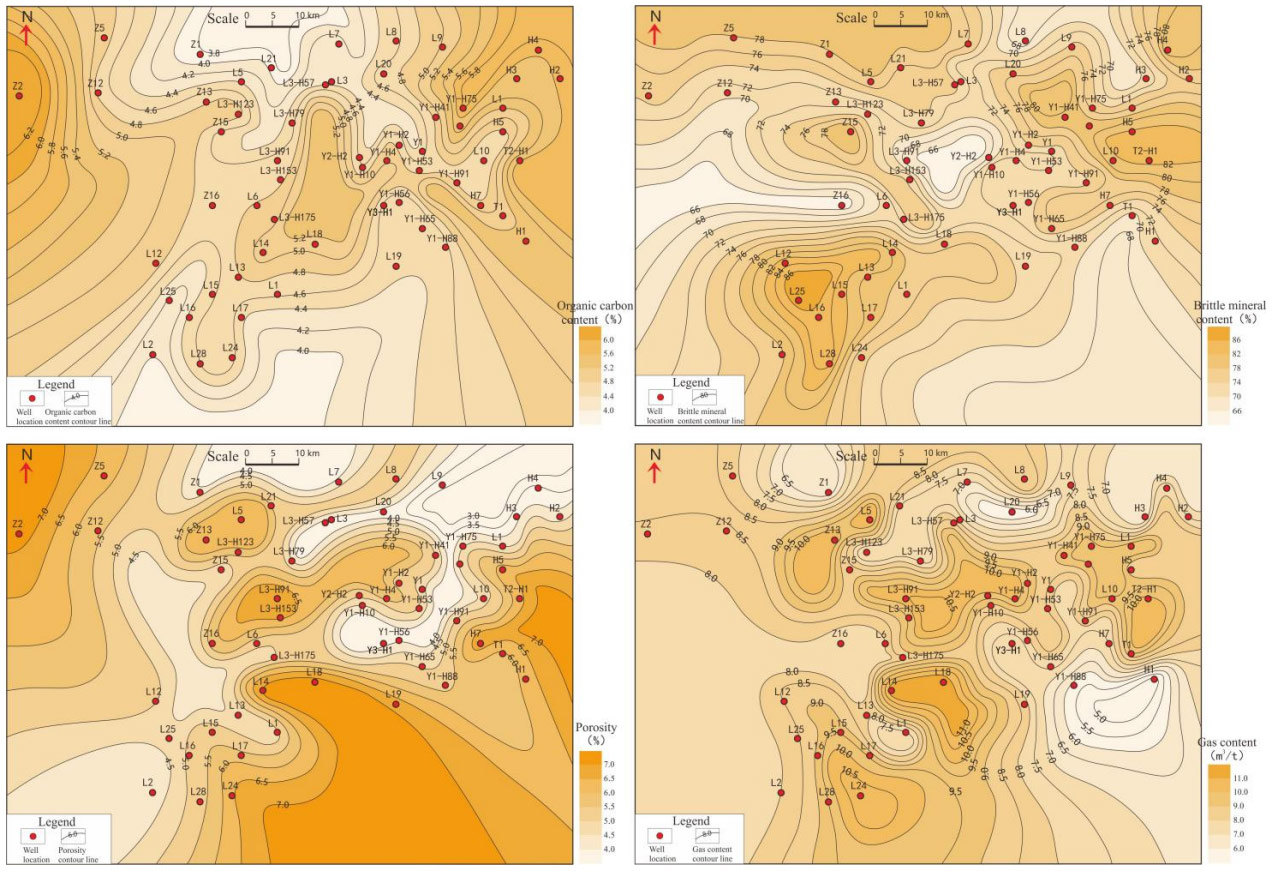
Deep shale sedimentary environment, diagenesis, and pore evolution are closely related to the occurrence state and content of shale gas, exerting significant control on reservoir quality. In this study, scanning electron microscopy (SEM), mineral composition, spectral gamma-ray logging, elemental logging, and comprehensive well log data were used to analyze the sedimentary environment. Combined with pore structure and storage space experiments, the geological conditions for deep shale gas accumulation were discussed. The Longmaxi Formation high-quality shale reservoirs in southern Sichuan (Luzhou area) are laterally extensive, vertically thick, and contain well-developed natural fractures; thus, reasonable well pattern deployment is crucial to avoid casing deformation, mitigate fracture interference, and improve productivity. Results show that shale gas enrichment and accumulation are controlled by four main factors: (1) Deep-water anoxic deposition enriching organic matter ("source control"), (2) Source–reservoir coupling controlling accumulation, (3) Temperature–pressure coupling controlling gas content, and (4) Faults controlling preservation. Based on static reservoir characteristics and production dynamics, a three-dimensional inter-well development model was established. Horizontal well spacing is 300--400 m, vertically targeting two layers (Long 1-11 and upper Long 1-13 sublayers) with staggered hydraulic fracturing and phased production. Field statistics show that this multi-layer phased scheme reduces engineering problems, lowers casing deformation incidence, and increases average EUR per 1000 m by about 10% compared with conventional single-layer deployment.
Graphical Abstract
Keywords
Data Availability Statement
Funding
Conflicts of Interest
Ethical Approval and Consent to Participate
References
- Wu, M., Xiong, Y., Qin, Y., & Peng, J. (2025). Brief Analysis of Intelligent Collaborative Management of Oil and Gas Field Enterprises under the`` Dual Carbon'' Goals: Based on the Integration and Innovation of Green Low-Carbon and Digital Technologies. Frontiers in Economics and Management, 6(6), 20-26.
[CrossRef] [Google Scholar] - Sun, C., Nie, H., Dang, W., Chen, Q., Zhang, G., Li, W., & Lu, Z. (2021). Shale gas exploration and development in China: Current status, geological challenges, and future directions. Energy & Fuels, 35(8), 6359-6379.
[CrossRef] [Google Scholar] - Zhang, L., He, X., Li, X., Li, K., He, J., Zhang, Z., ... & Liu, W. (2022). Shale gas exploration and development in the Sichuan Basin: Progress, challenge and countermeasures. Natural Gas Industry B, 9(2), 176-186.
[CrossRef] [Google Scholar] - He, X., Chen, G., Wu, J., Liu, Y., Wu, S., Zhang, J., & Zhang, X. (2023). Deep shale gas exploration and development in the southern Sichuan Basin: New progress and challenges. Natural Gas Industry B, 10(1), 32-43.
[CrossRef] [Google Scholar] - Fan, C., Li, H., Qin, Q., He, S., & Zhong, C. (2020). Geological conditions and exploration potential of shale gas reservoir in Wufeng and Longmaxi Formation of southeastern Sichuan Basin, China. Journal of Petroleum Science and Engineering, 191, 107138.
[CrossRef] [Google Scholar] - Shen, C., Wu, J., Zeng, B., Song, Y., Yao, Z., Dong, Y., & Du, Y. (2024). Measures and results of prevention and control on casing deformation and frac-hit in deep shale gas wells in Southern Sichuan Basin. Natural Gas Industry B, 11(3), 262-273.
[CrossRef] [Google Scholar] - Xu, Z., Liang, X., Lu, H., Zhang, J., Shu, H., Xu, Y., ... & Shi, W. (2020). Structural deformation characteristics and shale gas preservation conditions in the Zhaotong National Shale Gas Demonstration Area along the southern margin of the Sichuan Basin. Natural Gas Industry B, 7(3), 224-233.
[CrossRef] [Google Scholar] - Li, J., Li, H., Yang, C., Wu, Y., Gao, Z., & Jiang, S. (2022). Geological characteristics and controlling factors of deep shale gas enrichment of the Wufeng-Longmaxi Formation in the southern Sichuan Basin, China. Lithosphere, 2022(Special 12), 4737801.
[CrossRef] [Google Scholar] - Yong, R., Chen, G., Yang, X., Huang, S., Li, B., Zheng, M., ... & He, Y. (2023). Profitable development technology of the Changning-Weiyuan national shale gas demonstration area in the Sichuan Basin and its enlightenment. Natural Gas Industry B, 10(1), 73-85.
[CrossRef] [Google Scholar] - Li, H. (2022). Research progress on evaluation methods and factors influencing shale brittleness: A review. Energy Reports, 8, 4344-4358.
[CrossRef] [Google Scholar] - Shizhen, T. A. O., Yiqing, Y. A. N. G., Yue, C. H. E. N., Xiangbai, L. I. U., Wei, Y. A. N. G., Jian, L. I., ... & Jinhua, J. I. A. (2024). Geological conditions, genetic mechanisms and accumulation patterns of helium resources. Petroleum Exploration and Development, 51(2), 498-518.
[CrossRef] [Google Scholar] - Pu, B., Dong, D., Ning, X., Wang, S., Wang, Y., & Feng, S. (2022). Lithology and sedimentary heterogeneity of Longmaxi shale in the southern Sichuan Basin. Interpretation, 10(1), T45-T56.
[CrossRef] [Google Scholar] - Luo, T., Guo, X., He, Z., Zhao, J. X., Tao, Z., Dong, T., ... & Chen, J. (2024). Contrasting fracturing and cementation timings during shale gas accumulation and preservation: An example from the Wufeng-Longmaxi shales in the Fuling shale gas field, Sichuan Basin, China. Marine and Petroleum Geology, 170, 107138.
[CrossRef] [Google Scholar] - He, S., Li, H., Qin, Q., & Long, S. (2021). Influence of mineral compositions on shale pore development of Longmaxi Formation in the Dingshan area, southeastern Sichuan Basin, China. Energy & Fuels, 35(13), 10551-10561.
[CrossRef] [Google Scholar] - Xusheng, G. U. O., Dongfeng, H. U., Yuping, L., Zhihong, W., Xiangfeng, W., & Zhujiang, L. (2017). Geological factors controlling shale gas enrichment and high production in Fuling shale gas field. Petroleum Exploration and Development, 44(4), 513-523.
[CrossRef] [Google Scholar] - Fu, H., Huang, L., Hou, B., Weng, D., Guan, B., Zhong, T., & Zhao, Y. (2024). Experimental and numerical investigation on interaction mechanism between hydraulic fracture and natural fracture. Rock Mechanics and Rock Engineering, 57(12), 10571-10582.
[CrossRef] [Google Scholar] - Gong, X., Jin, Z., Ma, X., Liu, Y., Li, G., & Guo, Y. (2025). Experimental study of the effect of natural fracture curvature on hydraulic fracture propagation behavior. Scientific Reports, 15(1), 20716.
[CrossRef] [Google Scholar] - Wei, Y., Liu, Q., Lu, S., Zhao, R., Song, Z., & Mou, Y. (2025). Accumulation mechanisms of nonmarine shale oil in China: A case study of the Shahejie Formation in Raoyang Sag, Bohai Bay Basin. Science China Earth Sciences, 1-21.
[CrossRef] [Google Scholar] - Liu, Y., Zheng, X., Peng, X., Zhang, Y., Chen, H., & He, J. (2022). Influence of natural fractures on propagation of hydraulic fractures in tight reservoirs during hydraulic fracturing. Marine and Petroleum Geology, 138, 105505.
[CrossRef] [Google Scholar] - Liu, X., Qu, Z., Guo, T., Sun, Y., Wang, Z., & Bakhshi, E. (2019). Numerical simulation of non-planar fracture propagation in multi-cluster fracturing with natural fractures based on Lattice methods. Engineering Fracture Mechanics, 220, 106625.
[CrossRef] [Google Scholar]
Cited By (17)
-
Yue Sun, Yuqiang Jiang, Chan Jiang, Yixiao Yang, Yifan Gu. Pore structure evolution model of shale reservoir under different fluid pressures: a case study of Wufeng-Longmaxi Formation, SW China.
Open Geosciences, 2026 , 18 (1).
[CrossRef] -
Qibing Wen, Liangjun Xu, Licheng Yang, Xin Chen, Xinrui Yang, Siyuan Chang, Lu Xu, Huilin Li, Tong Xia, Dongxi Liu, Ziyang Tang. Shale reservoir characteristics and exploration potential of the Permian Wujiaoping Formation in the Nanya Syncline, Sichuan Basin, China.
Applied Earth Science: Transactions of the Institutions of Mining and Metallurgy, 2026 .
[CrossRef] -
Jingpeng Wang, Jun Li, Wei Lian, Zongyu Lu, Yanxian Wu, Tao Wan. Mechanisms and Applications of Casing Running Mechanics in CCUS Extended‐Reach Horizontal Wells.
Energy Science & Engineering, 2026 , 14 (1).
[CrossRef] -
Jianqin Xue, Yanxiong Wu, Bo Wang, Ziwei Pei, Yinghai Jiang, Yunzhao Wu, Boce Zhang, Bohan Qiao, Wenzhuo Wang, Changan Shan, Hu Li. Reservoir characteristics and main controlling factors of karst shale oil in the Lower Ganchaigou Formation, Yingxi area, Qaidam Basin.
Applied Earth Science: Transactions of the Institutions of Mining and Metallurgy, 2026 , 135 (3).
[CrossRef] -
Jiqiang Wang, Xin Zheng, Xiangdong Xie, Lei Jia, Sen Yan, Hu Li. Fault sealing evaluation and its effect on hydrocarbon accumulation in buried-hill fault-block oilfields, Bohai Bay Basin, China.
Applied Earth Science: Transactions of the Institutions of Mining and Metallurgy, 2026 , 135 (1).
[CrossRef] -
Jing Liu, Maolong Xia, Bo Feng, Jie Hu, Jing Liang, Cunhui Fan, Yulu Zeng, Huwei Cao, Hu Li. Multi-Indicator comprehensive evaluation of middle Permian hydrocarbon preservation conditions in Western Sichuan and its exploration significance.
Applied Earth Science: Transactions of the Institutions of Mining and Metallurgy, 2026 , 135 (3).
[CrossRef] -
Xiaosheng Chuai, Longyong Shu, Zhonggang Huo. Reconstruction of Tectonic Stress Magnitude of the Yanshanian Period in the Pingdingshan Mining Area by Using the Microstructural Estimation Method.
ACS Omega, 2026 , 11 (26).
[CrossRef] -
Huanshan Shi, Wangshui Hu, Yibo Li, Danyang Lu, Hu Li. Pore-structure controls on absolute permeability of 1-mm digital sandstone subsamples under a fixed CT field of view.
Scientific Reports, 2026 , 16 (1).
[CrossRef] -
Tianbiao Zhao, Hu Li. Management of Shale Gas Hydraulic Fracturing Flowback Fluid in China: A Review of Advances, Persisting Challenges, and Pathways toward Sustainability.
Energy & Fuels, 2026 , 40 (25).
[CrossRef] -
Hongxiang Jin, Hongxi Li, Feiyang Wang, Huajun Zhu, Chunpu Wang, Tao Zhang. Geological characteristics and gas accumulation condition of deep coal-rock gas in Carboniferous Benxi Formation, Western Ordos Basin, China.
Applied Earth Science: Transactions of the Institutions of Mining and Metallurgy, 2026 .
[CrossRef] -
Sijie He, Xizhe Li, Yaoqiang Lin, Yujin Wan, Ruilan Luo, Nijun Qi. Evaluation of shale gas reserve recoverability and three-dimensional development potential: a case study of the Weiyuan Block, Sichuan basin.
Scientific Reports, 2026 , 16 (1).
[CrossRef] -
Bo Hu, Kui Chen, Hui Ran, Hong Hu, Yao Yang, Xi Zhao. Lithology identification and shale content calculation for high-gamma tight sandstones in the Taiyuan Formation of Daniudi gas field.
Applied Earth Science: Transactions of the Institutions of Mining and Metallurgy, 2026 .
[CrossRef] -
Songxin Zhao, Kaide Liu, Chaowei Sun, Wenping Yue, Qiyu Wang, Yu Xia, Xinping Wang, Hu Li. Study on characterization of sandstone pore structure and seepage mechanism based on NMR and CT technology.
PLOS One, 2026 , 21 (1).
[CrossRef] -
Jinjie Yong, Shijia Chen, Shaoyong Hu, Zhicheng Liu, Mengtian Zheng, Tingshan Zhang. Geological conditions for shale gas accumulation and favorable zone evaluation in the Longmaxi formation of the Yanyuan Basin.
Scientific Reports, 2025 , 15 (1).
[CrossRef] -
Qiuyuan Shen, Hui Long, Lin Jiang, Yue Yang, Tian Liu, Chao Geng, Jiayu Peng, Chenghai Li, Meiyan Fu. The sandbodys of shallow water delta during lake transgression under greenhouse climate and its reservoir property: a case study of the lower Jurassic in the Sichuan Basin, China.
Frontiers in Earth Science, 2025 , 13 .
[CrossRef] -
Jiang Lu, Nan Wu, Yanxin Lv, Xiaoyu Fang, Haibo Li, Yi Xin, Weiji Liu. Long distance migration assisted structural trapping during CO2 storage in offshore basin.
Scientific Reports, 2025 , 15 (1).
[CrossRef] -
Penglin Zheng, Jingshou Liu, Hui Zhang, Bohan Tian, Ke Xu, Ziyi Li, Jianli Qiang, Yang Luo, Yixiong Hu, Zhenyun Li, Shujun Lai, Qiuyu Chen. Quantitative analysis of the influence of faults on deep in situ stress under different stress types.
Scientific Reports, 2025 , 16 (1).
[CrossRef]
Cite This Article
TY  - JOUR
AU  - Li, Jing
AU  - Huang, Tingting
AU  - Li, Hu
AU  - Gong, Xin
AU  - Gao, Zhi
AU  - Luo, Ang
PY  - 2025
DA  - 2025/08/31
TI  - Geological Characteristics and Three-Dimensional Development Potential of Deep Shale Gas in the Luzhou Area, Southern Sichuan Basin, China
JO  - Journal of Geo-Energy and Environment
T2  - Journal of Geo-Energy and Environment
JF  - Journal of Geo-Energy and Environment
VL  - 1
IS  - 1
SP  - 32
EP  - 45
DO  - 10.62762/JGEE.2025.600070
UR  - https://www.icck.org/article/abs/JGEE.2025.600070
KW  - deep shale
KW  - exploration potential
KW  - sedimentary environment
KW  - accumulation conditions
KW  - Luzhou area
AB  - Deep shale sedimentary environment, diagenesis, and pore evolution are closely related to the occurrence state and content of shale gas, exerting significant control on reservoir quality. In this study, scanning electron microscopy (SEM), mineral composition, spectral gamma-ray logging, elemental logging, and comprehensive well log data were used to analyze the sedimentary environment. Combined with pore structure and storage space experiments, the geological conditions for deep shale gas accumulation were discussed. The Longmaxi Formation high-quality shale reservoirs in southern Sichuan (Luzhou area) are laterally extensive, vertically thick, and contain well-developed natural fractures; thus, reasonable well pattern deployment is crucial to avoid casing deformation, mitigate fracture interference, and improve productivity. Results show that shale gas enrichment and accumulation are controlled by four main factors: (1) Deep-water anoxic deposition enriching organic matter ("source control"), (2) Source–reservoir coupling controlling accumulation, (3) Temperature–pressure coupling controlling gas content, and (4) Faults controlling preservation. Based on static reservoir characteristics and production dynamics, a three-dimensional inter-well development model was established. Horizontal well spacing is 300--400 m, vertically targeting two layers (Long 1-11 and upper Long 1-13 sublayers) with staggered hydraulic fracturing and phased production. Field statistics show that this multi-layer phased scheme reduces engineering problems, lowers casing deformation incidence, and increases average EUR per 1000 m by about 10% compared with conventional single-layer deployment.
SN  - 3069-3268
PB  - Institute of Central Computation and Knowledge
LA  - English
ER  -
@article{Li2025Geological,
  author = {Jing Li and Tingting Huang and Hu Li and Xin Gong and Zhi Gao and Ang Luo},
  title = {Geological Characteristics and Three-Dimensional Development Potential of Deep Shale Gas in the Luzhou Area, Southern Sichuan Basin, China},
  journal = {Journal of Geo-Energy and Environment},
  year = {2025},
  volume = {1},
  number = {1},
  pages = {32-45},
  doi = {10.62762/JGEE.2025.600070},
  url = {https://www.icck.org/article/abs/JGEE.2025.600070},
  abstract = {Deep shale sedimentary environment, diagenesis, and pore evolution are closely related to the occurrence state and content of shale gas, exerting significant control on reservoir quality. In this study, scanning electron microscopy (SEM), mineral composition, spectral gamma-ray logging, elemental logging, and comprehensive well log data were used to analyze the sedimentary environment. Combined with pore structure and storage space experiments, the geological conditions for deep shale gas accumulation were discussed. The Longmaxi Formation high-quality shale reservoirs in southern Sichuan (Luzhou area) are laterally extensive, vertically thick, and contain well-developed natural fractures; thus, reasonable well pattern deployment is crucial to avoid casing deformation, mitigate fracture interference, and improve productivity. Results show that shale gas enrichment and accumulation are controlled by four main factors: (1) Deep-water anoxic deposition enriching organic matter ("source control"), (2) Source–reservoir coupling controlling accumulation, (3) Temperature–pressure coupling controlling gas content, and (4) Faults controlling preservation. Based on static reservoir characteristics and production dynamics, a three-dimensional inter-well development model was established. Horizontal well spacing is 300--400 m, vertically targeting two layers (Long 1-11 and upper Long 1-13 sublayers) with staggered hydraulic fracturing and phased production. Field statistics show that this multi-layer phased scheme reduces engineering problems, lowers casing deformation incidence, and increases average EUR per 1000 m by about 10\% compared with conventional single-layer deployment.},
  keywords = {deep shale, exploration potential, sedimentary environment, accumulation conditions, Luzhou area},
  issn = {3069-3268},
  publisher = {Institute of Central Computation and Knowledge}
}
Publisher's Note
ICCK stays neutral with regard to jurisdictional claims in published maps and institutional affiliations.
Rights and Permissions
 Copyright © 2025 by the Author(s). Published by Institute of Central Computation and Knowledge. This article is an open access article distributed under the terms and conditions of the Creative Commons Attribution (CC BY) license (https://creativecommons.org/licenses/by/4.0/), which permits use, sharing, adaptation, distribution and reproduction in any medium or format, as long as you give appropriate credit to the original author(s) and the source, provide a link to the Creative Commons licence, and indicate if changes were made.


Portico
