

Origin and Evolution of the South Sichuan Basin Danxia Landform: Insights into Broader Chinese Danxia Landform Development


Article Information
Abstract
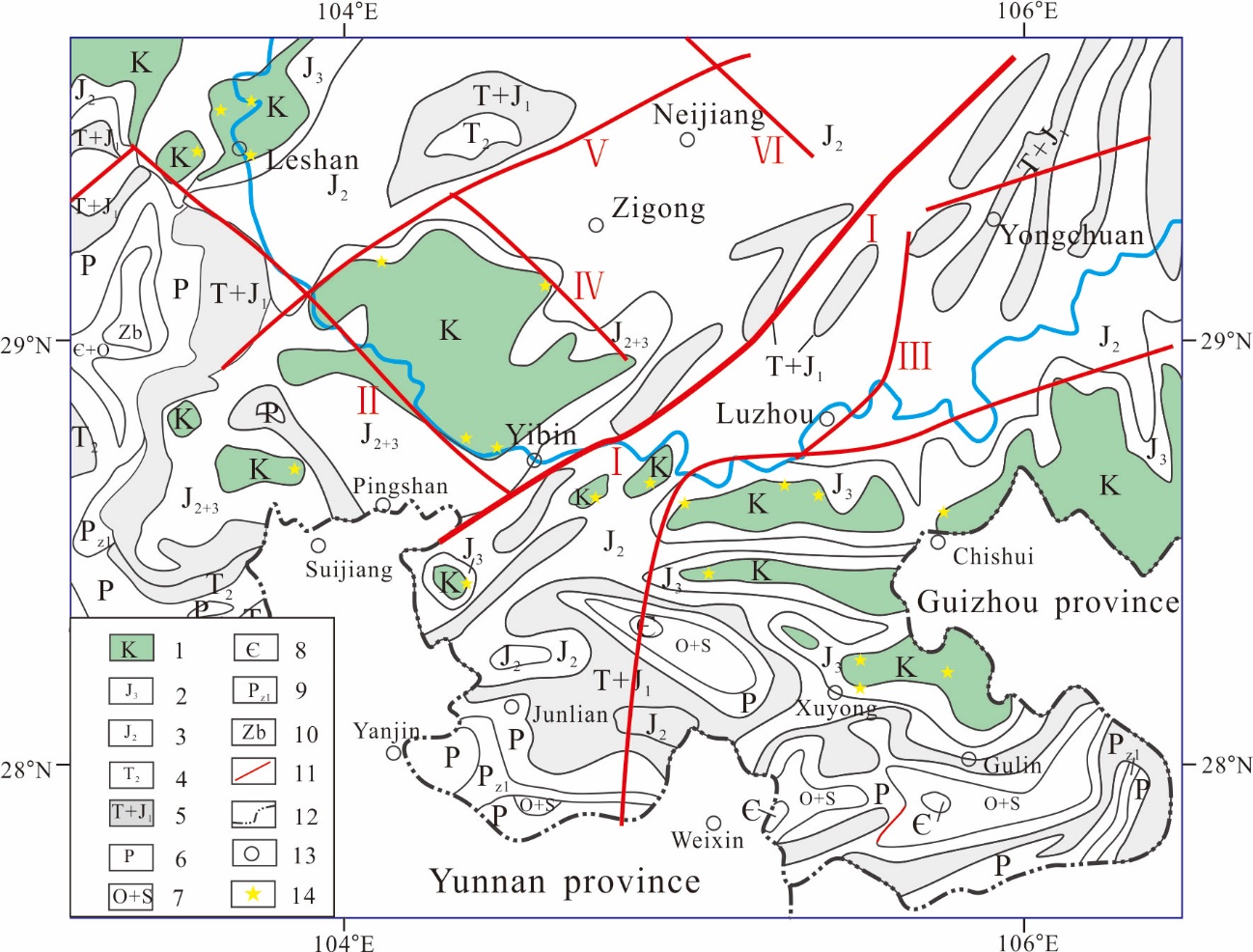
Danxia landform, recognized for its steep cliffs and red coloration, has drawn significant scientific attention. While Chinese Danxia Landforms are UNESCO World Heritage Sites, their genesis and evolution, particularly in less-explored regions, remain under study. The southern Sichuan Basin, one of China's three largest Danxia outcrop areas, offers a unique case study due to its distinct geological setting and limited research. This study investigates the genesis of Danxia landforms in the southern Sichuan Basin using a multi-faceted approach. Field observations documented geomorphological characteristics and stratigraphy of the Danxia formations. Tectonic analysis, using regional structural data and fault mapping, assessed the impact of tectonic uplift and deformation. The findings suggest that the genesis of Danxia landforms in the southern Sichuan Basin is driven by four factors: (1) thick, well-bedded red sandstones and conglomerates; (2) regional tectonic structures, such as faults and folds; (3) episodic tectonic uplift, creating topographic relief and fluvial incision; and (4) the combined effects of weathering, erosion, and gravity shaping the cliffs. The analysis challenges the prevailing southeast-to-northwest evolutionary model for Chinese Danxia, as the southern Sichuan Basin follows a distinct developmental trajectory, influenced by regional tectonic settings and external forces. This study shows that Danxia genesis is a complex interaction of lithological, tectonic, and geomorphic processes. The findings highlight regional variability and underscore the importance of considering regional tectonic context and external forces in understanding Danxia evolution across China. This research deepens understanding of Danxia genesis and provides insights for conserving these globally significant landscapes.
Graphical Abstract
Keywords
Data Availability Statement
Funding
Conflicts of Interest
Ethical Approval and Consent to Participate
References
- Ouyang, J., Zhu, C., & Peng, H. (2011). A contrast introduction to Danxia landforms from a world-wide references for similar landforms. Scientia Geographica Sinica, (8), 996–1000.
[Google Scholar] - Huang, J., Chen, Z., & Qi, D. (2015). Study on distribution of Danxia landform in China (first). Mountain Research, (4), 385–396.
[Google Scholar] - Li, P., Chen, Y., Li, H., & Chen, A. (2015). Types and development value of tourism geology resources in southern Sichuan. Resource Development & Market, 31(7), 881–885.
[Google Scholar] - Qiu, J. T., Mu, H. X., Rui, X. M., Yang, Y. J., Li, P., Qiu, L., & Xu, C. B. (2024). The relationships between Danxia Geoheritages and Regional tectonics in Southern Sichuan Basin: implications for the spatial distribution of Danxia landforms in China. Geoheritage, 16(1), 24.
[CrossRef] [Google Scholar] - Qi, D. L., Yu, R., Zhang, R. S., Ge, Y., & Li, J. (2005). On the spatial pattern of Danxia landform in China. Acta Geographica Sinica, 60(1), 41-52.
[Google Scholar] - Cheng, G., Jiang, B., Li, M., Li, F., & Zhu, M. (2021). Structural evolution of southern Sichuan Basin (South China) and its control effects on tectonic fracture distribution in Longmaxi shale. Journal of Structural Geology, 153, 104465.
[CrossRef] [Google Scholar] - Pang, G., & Xiao, Q. (2015). China tectonic map 1: 2500000. Geological Publishing House.
[Google Scholar] - Yan, L., Peng, H., Zhang, S., Zhang, R., Kašanin-Grubin, M., Lin, K., & Tu, X. (2019). The spatial patterns of red beds and Danxia landforms: implication for the formation factors–China. Scientific Reports, 9(1), 1961.
[CrossRef] [Google Scholar] - Sichuan Bureau of Geology & Mineral Resources. (1991). Regional geology of Sichuan Province. Geological Publishing House.
[Google Scholar] - Young, R. W., Wray, R. A., & Young, A. R. (2009). Sandstone landforms. Cambridge University Press.
[Google Scholar] - Peng, H. (2001). Danxia geomorphology of China: A review. Chinese Science Bulletin, 46(Suppl 1), 38-44.
[CrossRef] [Google Scholar] - Li, S., Li, J., Zhou, Y., Wo, Y., & Wang, X. (2011). Fission track evidence for Mesozoic-Cenozoic uplifting in the south-eastern margin of Sichuan basin. Acta Petrologica et Mineralogica, 30(2), 225–233.
[Google Scholar] - Chen, X., & Shi, X. L. (2018). Geoscience landscape division and tourism zonation in the mid-southern section of the Hengduan Mountains, eastern Qinghai-Tibet Plateau. Journal of Mountain Science, 15(4), 894-917.
[CrossRef] [Google Scholar] - Peng, H., Pan, Z., Yan, L., & Simonson, S. (2013). A review of the research on red beds and Danxia landform. Acta Geographica Sinica, 68(9), 1170–1181.
[Google Scholar] - Zhang, G., Chen, K., Zhang, H., & Zhang, H. (2018). The evolution stage decision of Danxia landform based on digital elevation model (DEM). Acta Scientiarum Naturalium Universitatis Sunyatseni, 57(2), 12–21.
[Google Scholar] - Deli, Q., Rong, Y., Renshun, Z., Yunjian, G., & Jialin, L. (2005). Comparative studies of Danxia landforms in China. Journal of Geographical Sciences, 15(3), 337-345.
[CrossRef] [Google Scholar] - Liu, S., Yang, Y., Deng, B., Zhong, Y., Wen, L., Sun, W., ... & Peng, H. (2021). Tectonic evolution of the Sichuan Basin, southwest China. Earth-Science Reviews, 213, 103470.
[CrossRef] [Google Scholar] - Tang, S. L., Yan, D. P., Qiu, L., Gao, J. F., & Wang, C. L. (2014). Partitioning of the Cretaceous Pan-Yangtze Basin in the central South China Block by exhumation of the Xuefeng Mountains during a transition from extensional to compressional tectonics?. Gondwana Research, 25(4), 1644-1659.
[CrossRef] [Google Scholar] - Jianan, Z. H. A. O. (2017). Geochronology study of clastic rock, dike rock and peripheral granite in Nanxiong Basin and discussion of uranium mineralization. Mineral Resources and Geology, 31(5), 884-890.
[Google Scholar] - Hu, S., Long, Z., Zhu, J., Hu, D., Huang, Y., Shi, Y., & Hu, J. (2019). Characteristics of geothermal field and the tectonic-thermal evolution in Pearl River Mouth basin. Acta Petrolei Sinica, 40(S1), 178–187.
[CrossRef] [Google Scholar] - Zhang, J., Li, C., & Sun, X. (2013). The detrital apatite fission-track evidence for tectonic processes since Mesozoic-Cenozoic in Wujiang River catchments. Geological Review, 59(3), 537–543.
[Google Scholar]
Cited By (6)
-
Jiahuan He, Zhijuan Tang, Qiang Kang, Jiaqi Wang, Chuanye Zhou, Haolin Li, Chun Zhang, Li Wang, Xingwang Tian, Juedong An, Cheng Tang. A non-destructive testing technique for localized electrical resistivity in heterogeneous rock.
Frontiers in Earth Science, 2026 , 14 .
[CrossRef] -
Ruigang Zhang, Zhiwei Cui, Yang Chen, Jinhua Luan, Xiong Zhang, Dan Zhou, Deju Zhang, Haitong Zhao, Zhengqin Gan, Xinzhe Liu, Hu Li. Methods for measuring stratigraphic attitude and true thickness based on high-precision 3D real-scene models: A case study of the early Silurian Chongqing Lagerstätte Section, China.
PLOS One, 2026 , 21 (9).
[CrossRef] -
Lijun Ran, Geyun Xie, Xin Hu, Jing Luo, Gang Yuan, Kaifa Li. Sedimentation–diagenesis–tectonics coupling and its control on gas reservoir development in Sinian carbonates, western Deyang-Anyue Rift Trough, Sichuan Basin.
Frontiers in Earth Science, 2026 , 14 .
[CrossRef] -
Qibing Wen, Liangjun Xu, Licheng Yang, Xin Chen, Xinrui Yang, Siyuan Chang, Lu Xu, Huilin Li, Tong Xia, Dongxi Liu, Ziyang Tang. Shale reservoir characteristics and exploration potential of the Permian Wujiaoping Formation in the Nanya Syncline, Sichuan Basin, China.
Applied Earth Science: Transactions of the Institutions of Mining and Metallurgy, 2026 .
[CrossRef] -
Jinfeng Zhang, Chenggang Liang, Yiwei Chen, Tianlu Xu, Jinhua Liu, Weishi Tang, Hangfeng Gou. Reservoir characteristics and sweet spot prediction of mixed tight oil reservoirs in the saline lacustrine Lucaogou Formation, Jimusaer Sag, Junggar Basin, China.
Applied Earth Science: Transactions of the Institutions of Mining and Metallurgy, 2026 .
[CrossRef] -
Jinkai Xia, Hongxiang Zhang, Cai Chen, Changchao Chen, Caiming Luo, Ling Cao, Haoran Gao, Xuefei Li, Junpeng Yang, Quanyun Miao, Jiafu Qi. A structural interpretation model of the Kekeya segment in the piedmont thrust belt of the West Kunlun Mountains and its petroleum geological implications.
Frontiers in Earth Science, 2026 , 14 .
[CrossRef]
Cite This Article
TY  - JOUR
AU  - Li, Pengju
AU  - Cao, Yan
AU  - Li, Hongying
PY  - 2025
DA  - 2025/10/04
TI  - Origin and Evolution of the South Sichuan Basin Danxia Landform: Insights into Broader Chinese Danxia Landform Development
JO  - Journal of Geo-Energy and Environment
T2  - Journal of Geo-Energy and Environment
JF  - Journal of Geo-Energy and Environment
VL  - 1
IS  - 2
SP  - 76
EP  - 87
DO  - 10.62762/JGEE.2025.503978
UR  - https://www.icck.org/article/abs/JGEE.2025.503978
KW  - Danxia landform
KW  - genesis and evolution
KW  - tectonic structures
KW  - evolutionary model
KW  - south Sichuan basin
AB  - Danxia landform, recognized for its steep cliffs and red coloration, has drawn significant scientific attention. While Chinese Danxia Landforms are UNESCO World Heritage Sites, their genesis and evolution, particularly in less-explored regions, remain under study. The southern Sichuan Basin, one of China's three largest Danxia outcrop areas, offers a unique case study due to its distinct geological setting and limited research. This study investigates the genesis of Danxia landforms in the southern Sichuan Basin using a multi-faceted approach. Field observations documented geomorphological characteristics and stratigraphy of the Danxia formations. Tectonic analysis, using regional structural data and fault mapping, assessed the impact of tectonic uplift and deformation. The findings suggest that the genesis of Danxia landforms in the southern Sichuan Basin is driven by four factors: (1) thick, well-bedded red sandstones and conglomerates; (2) regional tectonic structures, such as faults and folds; (3) episodic tectonic uplift, creating topographic relief and fluvial incision; and (4) the combined effects of weathering, erosion, and gravity shaping the cliffs. The analysis challenges the prevailing southeast-to-northwest evolutionary model for Chinese Danxia, as the southern Sichuan Basin follows a distinct developmental trajectory, influenced by regional tectonic settings and external forces. This study shows that Danxia genesis is a complex interaction of lithological, tectonic, and geomorphic processes. The findings highlight regional variability and underscore the importance of considering regional tectonic context and external forces in understanding Danxia evolution across China. This research deepens understanding of Danxia genesis and provides insights for conserving these globally significant landscapes.
SN  - 3069-3268
PB  - Institute of Central Computation and Knowledge
LA  - English
ER  -
@article{Li2025Origin,
  author = {Pengju Li and Yan Cao and Hongying Li},
  title = {Origin and Evolution of the South Sichuan Basin Danxia Landform: Insights into Broader Chinese Danxia Landform Development},
  journal = {Journal of Geo-Energy and Environment},
  year = {2025},
  volume = {1},
  number = {2},
  pages = {76-87},
  doi = {10.62762/JGEE.2025.503978},
  url = {https://www.icck.org/article/abs/JGEE.2025.503978},
  abstract = {Danxia landform, recognized for its steep cliffs and red coloration, has drawn significant scientific attention. While Chinese Danxia Landforms are UNESCO World Heritage Sites, their genesis and evolution, particularly in less-explored regions, remain under study. The southern Sichuan Basin, one of China's three largest Danxia outcrop areas, offers a unique case study due to its distinct geological setting and limited research. This study investigates the genesis of Danxia landforms in the southern Sichuan Basin using a multi-faceted approach. Field observations documented geomorphological characteristics and stratigraphy of the Danxia formations. Tectonic analysis, using regional structural data and fault mapping, assessed the impact of tectonic uplift and deformation. The findings suggest that the genesis of Danxia landforms in the southern Sichuan Basin is driven by four factors: (1) thick, well-bedded red sandstones and conglomerates; (2) regional tectonic structures, such as faults and folds; (3) episodic tectonic uplift, creating topographic relief and fluvial incision; and (4) the combined effects of weathering, erosion, and gravity shaping the cliffs. The analysis challenges the prevailing southeast-to-northwest evolutionary model for Chinese Danxia, as the southern Sichuan Basin follows a distinct developmental trajectory, influenced by regional tectonic settings and external forces. This study shows that Danxia genesis is a complex interaction of lithological, tectonic, and geomorphic processes. The findings highlight regional variability and underscore the importance of considering regional tectonic context and external forces in understanding Danxia evolution across China. This research deepens understanding of Danxia genesis and provides insights for conserving these globally significant landscapes.},
  keywords = {Danxia landform, genesis and evolution, tectonic structures, evolutionary model, south Sichuan basin},
  issn = {3069-3268},
  publisher = {Institute of Central Computation and Knowledge}
}
Publisher's Note
ICCK stays neutral with regard to jurisdictional claims in published maps and institutional affiliations.
Rights and Permissions
 Copyright © 2025 by the Author(s). Published by Institute of Central Computation and Knowledge. This article is an open access article distributed under the terms and conditions of the Creative Commons Attribution (CC BY) license (https://creativecommons.org/licenses/by/4.0/), which permits use, sharing, adaptation, distribution and reproduction in any medium or format, as long as you give appropriate credit to the original author(s) and the source, provide a link to the Creative Commons licence, and indicate if changes were made.


Portico
