

Professional Evaluation and Distribution Patterns of Shale Gas Reservoirs in the Wufeng Formation-Long 11 Sub-member of Well Block Z205, Sichuan Basin



Article Information
Abstract
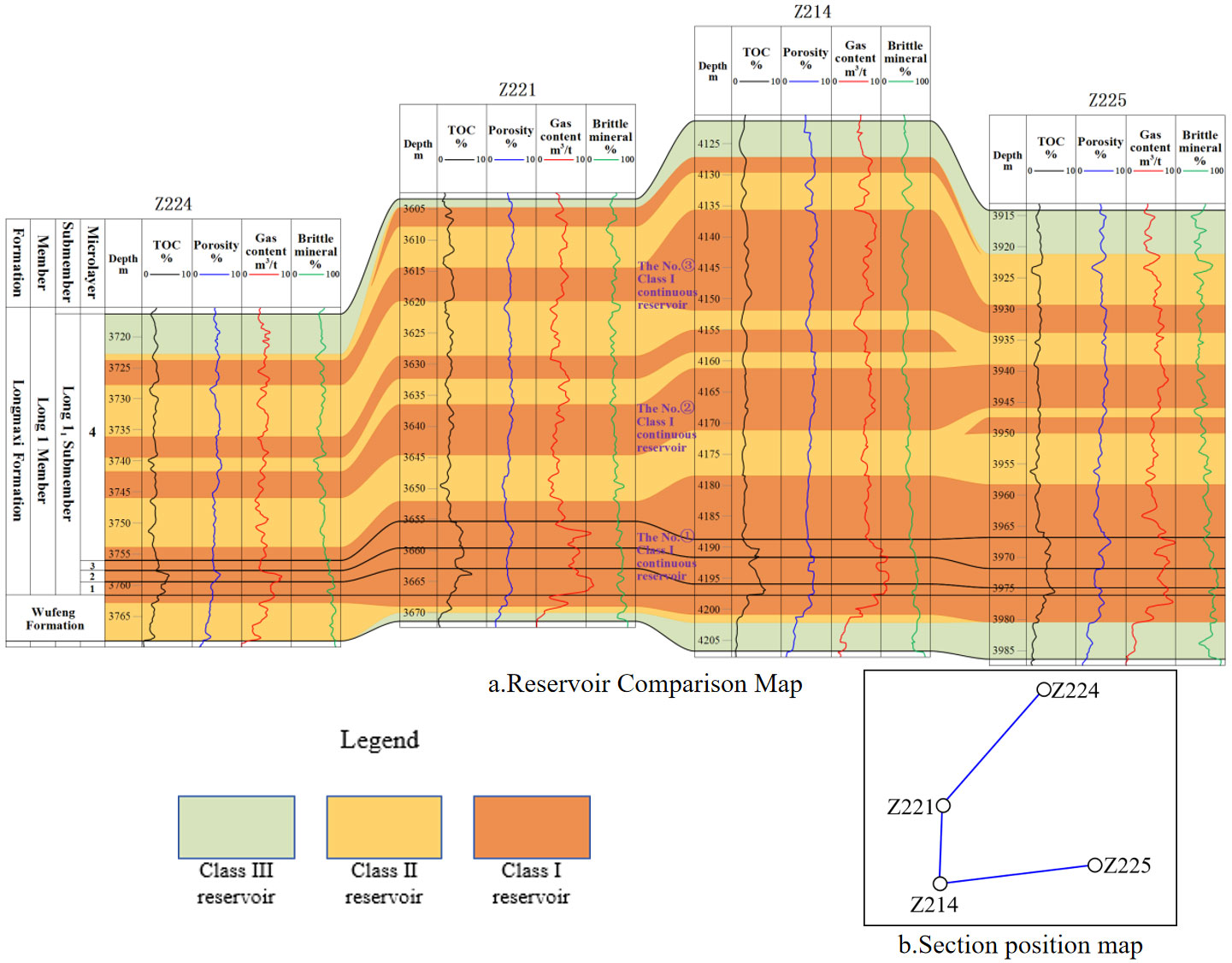
The deep shale gas ($\geq 3500$ m) in the Z205 well area is a critical exploration and development target in the Sichuan Basin. The shale gas reservoirs of the Upper Ordovician Wufeng Formation -- Lower Silurian Longmaxi Formation (Long 1$_1$ submember) in this area are characterized by deep burial and significant vertical and lateral heterogeneity. The Long 1$_1$ submember is subdivided into the Wufeng Formation, Long 1$_1^1$, Long 1$_1^2$, Long 1$_1^3$, and Long 1$_1^4$. This study conducts a detailed stratigraphic comparison based on integrated logging, core analysis, and analytical test data from the well area, clarifying the longitudinal and lateral distribution patterns of the reservoirs. Utilizing the TOPSIS algorithm, a reservoir classification and evaluation model integrating subjective weights and objective analysis is established. Reservoirs are classified as Class I when $C_i \geq 0.6$, Class II when $0.4 \leq C_i < 0.6$, Class III when $0.2 \leq C_i < 0.4$, and non-reservoir when $C_i < 0.2$. Results indicate significant directional variations in the thickness of each sub-layer within the Wufeng-Long 1$_1$ submember. The main reservoir intervals, Long 1$_1^1$ to Long 1$_1^3$, exhibit an overall thickening trend from north to south and west to east. At least three stable, laterally extensive Class I continuous reservoir units are identified vertically. The No. 1 Class I reservoir is primarily distributed from Long 1$_1^1$ to Long 1$_1^3$ and the basal part of Long 1$_1^4$, being most developed in the central synclinal areas (Huliongchang, Gaoshikuan, and northern Panlongchang Synclines). The No. 2 and No. 3 Class I reservoirs are mainly located within the middle-upper sections of Long 1$_1^4$. They are most developed within the Gaoshikuan Syncline, thinning towards the southern and northern margins. The research outcomes provide significant guidance and reference value for the subsequent exploration, development, and related research of shale gas in the Z205 well area and analogous regions.
Graphical Abstract
Keywords
Data Availability Statement
Funding
Conflicts of Interest
Ethical Approval and Consent to Participate
References
- Li, Y., Nie, H., & Long, P. (2009). Development characteristics of organic-rich shale and strategic selection of shale gas exploration area in China. Natural Gas Industry, 29(12), 115–118.
[Google Scholar] - Liu, H., & Wang, H. (2012). Adsorptivity and influential factors of marine shales in south China. Natural Gas Industry, 32(9), 5–9.
[Google Scholar] - Zhang, J., Jin, Z., & Yuan, M. (2004). Reservoiring mechanism of shale gas and its distribution. Natural Gas Industry, 24(7), 15–18.
[Google Scholar] - Wang, M., He, J., Liu, S., Zeng, C., Jia, S., Nie, Z., ... & Zhang, C. (2023). Effect of sedimentary facies characteristics on deep shale gas desserts: A case from the Longmaxi Formation, South Sichuan Basin, China. Minerals, 13(4), 476.
[CrossRef] [Google Scholar] - Li, J., Zhang, Q., Jiang, W., Li, H., Li, L., Xue, T., ... & Gao, Z. (2025). Lithological controls on pore structure and their implications for deep shale gas reservoir quality in the Longmaxi Formation, Luzhou area, Southern Sichuan Basin, China. Energy & Fuels, 39(3), 1541-1558.
[CrossRef] [Google Scholar] - Li, J., Li, H., Jiang, W., Cai, M., He, J., Wang, Q., & Li, D. (2024). Shale pore characteristics and their impact on the gas-bearing properties of the Longmaxi Formation in the Luzhou area. Scientific Reports, 14(1), 16896.
[CrossRef] [Google Scholar] - Wu, Y., Wang, Y., & Li, J. (2025). Sedimentary characteristics and main reservoir control factors of deep shale in the Sichuan Basin: A case study on the Longmaxi Formation in the eastern Weiyuan area. Natural Gas Industry, 52(1), 15–28.
[Google Scholar] - Xusheng, G. U. O., Ruyue, W. A. N. G., Baojian, S. H. E. N., Guanping, W. A. N. G., Chengxiang, W. A. N., & Qianru, W. A. N. G. (2025). Geological characteristics, resource potential, and development direction of shale gas in China. Petroleum Exploration and Development, 52(1), 17-32.
[CrossRef] [Google Scholar] - Shujing, B. A. O., Mingna, G. E., Peirong, Z. H. A. O., Tianxu, G. U. O., Bo, G. A. O., Shizhen, L. I., ... & Fei, L. I. (2025). Status-quo, potential, and recommendations on shale gas exploration and exploitation in China. Oil & Gas Geology, 46(2), 348-364.
[Google Scholar] - She, C. (2024). New progress and development prospect of key technologies for drilling of deep shale gas wells in the Sichuan Basin. Natural Gas Industry, 44(3), 1–9.
[Google Scholar] - Zou, C., Zhao, Q., Cong, L., Wang, H., Shi, Z., Wu, J., & Pan, S. (2021). Development progress, potential and prospect of shale gas in China. Natural Gas Industry, 41(1), 1-14.
[Google Scholar] - Chenglin, Z. H. A. N. G., Xuefeng, Y. A. N. G., & Shengxian, Z. H. A. O. (2022). Target position optimization for shale reservoirs in Zigong Block of southern Sichuan Basin. Reservoir Evaluation and Development, 12(3), 496-505.
[Google Scholar] - Zhe, L. I., Hui, Z. H. A. O., Haotian, H. A. N., Guoxiang, S. U. N., Qi, Z. H. O. U., Si, G. E., & Xiaosong, W. A. N. G. (2025). Differences in microscopic pore structures and main controlling factors of different sedimentary microfacies of deep shale reservoir: Case study of Wufeng-Longmaxi formations in Well Z301 of Zigong area, South Sichuan Basin. Natural Gas Geoscience, 36(4), 701-712.
[Google Scholar] - Hongyan, W. A. N. G., Shangwen, Z., Qun, Z., Zhensheng, S. H. I., Dexun, L. I. U., & Pengfei, J. I. A. O. (2023). Enrichment characteristics, exploration and exploitation progress, and prospects of deep shale gas in the southern Sichuan Basin, China. Oil & Gas Geology, 44(6), 1430-1441.
[Google Scholar] - Haijie, Z. H. A. N. G., Yongcheng, M. U., Guisheng, H. A. N., Junwei, P. U., & Tongtong, L. U. O. (2024). Shale gas reservoirs of the Upper Ordovician Wufeng Formation-Lower Silurian Longmaxi Formation, Dazu area, Sichuan Basin: Characteristics and distribution. Natural Gas Exploration and Development, 47(4), 28-37.
[CrossRef] [Google Scholar] - Anlong, W., Xiaoqin, S., & Xiaolong, L. (2020). Logging evaluation method for shale gas reservoirs of Wufeng-Longmaxi formation in Nanchuan block. Science Technology and Engineering, 20(34), 14046-14052.
[Google Scholar] - Li, Z. (2025). Studies on Methods of Shale Gas Reservoir Logging Evaluation and Classification in Lower Cambrian Niutitang Formation in Western Hubei [Doctoral dissertation, China University of Geosciences (Beijing)].
[Google Scholar] - Xiong, K. (2024). Comprehensive evaluation method for shale gas reservoir logging in Zhaotong area [Master's thesis, Xi'an Shiyou University].
[Google Scholar] - Qian, L. I. U. (2023). Logging evaluation of gas—bearing potential in wujiaping formation shale gas reservoir in Hongxing Area. Journal of Jianghan Petroleum University of Staff and Workers, 36(2), 35-38.
[Google Scholar] - Opricovic, S., & Tzeng, G. H. (2004). Compromise solution by MCDM methods: A comparative analysis of VIKOR and TOPSIS. European journal of operational research, 156(2), 445-455.
[CrossRef] [Google Scholar] - Dai, B., Li, D., Zhang, L., Liu, Y., Zhang, Z., & Chen, S. (2022). Rock mass classification method based on entropy weight–TOPSIS–grey correlation analysis. Sustainability, 14(17), 10500.
[CrossRef] [Google Scholar] - Liu, Y., Xie, G., Zheng, H., Ma, X., Ren, G., Feng, X., ... & Lei, F. (2025). Optimization of Fracturing Sweet Spot in Deep Carbonate Reservoirs by Combining TOPSIS and AHP Algorithm. Processes, 13(9), 2777.
[CrossRef] [Google Scholar] - Ban, S., Liu, H., Wei, X., Shi, X., Mao, H., Song, Y., & Tan, H. (2023). The application of the fuzzy comprehensive evaluation method in the sealing evaluation of caprocks in underground gas storage. Applied Sciences, 13(17), 9753.
[CrossRef] [Google Scholar] - Wei, N., Yang, F., Lu, K., Xie, J., & Zhang, S. (2022). A method of multi-objective optimization and multi-attribute decision-making for Huangjinxia reservoir. Applied Sciences, 12(13), 6300.
[CrossRef] [Google Scholar]
Cited By (17)
-
Yongjing Cen, Qingsong Tang, Jianhai Li, Feng Liang, Xin Zhang, Lien Wang, Qianyu Liu, Hu Li. Controlling effect of strike-slip faults on Ediacaran Dengying Formation microbial mound-shoal complex reservoir, Penglai Gas Field, SW China.
Applied Earth Science: Transactions of the Institutions of Mining and Metallurgy, 2026 , 135 (3).
[CrossRef] -
Qibing Wen, Liangjun Xu, Licheng Yang, Xin Chen, Xinrui Yang, Siyuan Chang, Lu Xu, Huilin Li, Tong Xia, Dongxi Liu, Ziyang Tang. Shale reservoir characteristics and exploration potential of the Permian Wujiaoping Formation in the Nanya Syncline, Sichuan Basin, China.
Applied Earth Science: Transactions of the Institutions of Mining and Metallurgy, 2026 .
[CrossRef] -
Jiajie Li, Hu Li, Shengxian Zhao, Qirong Qin, Bryan X. Medina-Rodriguez, Li Li. Fracture characteristics and distribution prediction under multi-phase tectonic superimposition in the Changning area, Southern Sichuan Basin: implications for shale gas preservation.
Engineering Fracture Mechanics, 2026 , 346 .
[CrossRef] -
Tianbiao Zhao, Hu Li. Management of Shale Gas Hydraulic Fracturing Flowback Fluid in China: A Review of Advances, Persisting Challenges, and Pathways toward Sustainability.
Energy & Fuels, 2026 , 40 (25).
[CrossRef] -
Hu Li, Qirong Qin, Cunbao Li, Ahmed E. Radwan, Jianbo Wang, Cunhui Fan. Quantitative characterization of complex multi-scale fractures in low-permeable sandstone reservoir: Insights from geological and mathematical approach.
Geomechanics and Geophysics for Geo-Energy and Geo-Resources, 2026 , 12 (1).
[CrossRef] -
Yansong Wang, Yifan Gu, Junwei Pu, Lin Jiang, Yuqiang Jiang, Kun Zhang, Hu Li. A Review of Molecular Simulation Techniques Applied in Microscopic Occurrence Patterns of Shale Gas.
ACS Earth and Space Chemistry, 2026 , 10 (6).
[CrossRef] -
Yongyang Liu, Xuefeng Yang, Shengxian Zhao, Yuanhan He, Wenping Liu, Bo Li, Ruhua Zhang, Shengjun Liu, Yong Wu, Cunhui Fan, Hu Li. Fracture Characteristics and Prediction in the Longmaxi Formation, Central Luzhou Area, Sichuan Basin, China.
Journal of Petroleum Geology, 2026 , 49 (3).
[CrossRef] -
Wenhao Zhang, Dandan Wang, Shizhen Li, Xingui Zhou, Yuanlin Meng, Yunbo Zhang, Minfei Wang, Hu Li. Geochemical characteristics and hydrocarbon generation potential of lower cretaceous source rocks in the eastern peripheral basin group of the Songliao Basin, Northeastern China.
Frontiers in Earth Science, 2026 , 14 .
[CrossRef] -
Bo Hu, Kui Chen, Hui Ran, Hong Hu, Yao Yang, Xi Zhao. Lithology identification and shale content calculation for high-gamma tight sandstones in the Taiyuan Formation of Daniudi gas field.
Applied Earth Science: Transactions of the Institutions of Mining and Metallurgy, 2026 .
[CrossRef] -
Jing Li, Yuqi Deng, Tingting Huang, Guo Chen, Bei Yang, Xiaohai Ren, Hu Li. Digital Core-Based Characterization and Fracability Evaluation of Deep Shale Gas Reservoirs in the Weiyuan Area, Sichuan Basin, China.
Minerals, 2026 , 16 (4).
[CrossRef] -
Tianbiao Zhao. A mini review on “from decades to centuries”: temporal gaps in CCUS governance.
Frontiers in Earth Science, 2026 , 14 .
[CrossRef] -
Hongxiang Jin, Hongxi Li, Huajun Zhu, Xin Wang, Chunpu Wang, Shaobo Tang, Jian He. Deep coal-rock geomechanics for wellbore stability and drilling-fluid design in the Benxi–Shanxi Formations, Ordos Basin, China.
Applied Earth Science: Transactions of the Institutions of Mining and Metallurgy, 2026 .
[CrossRef] -
Jianqin Xue, Yanxiong Wu, Bo Wang, Ziwei Pei, Yinghai Jiang, Yunzhao Wu, Boce Zhang, Bohan Qiao, Wenzhuo Wang, Changan Shan, Hu Li. Reservoir characteristics and main controlling factors of karst shale oil in the Lower Ganchaigou Formation, Yingxi area, Qaidam Basin.
Applied Earth Science: Transactions of the Institutions of Mining and Metallurgy, 2026 , 135 (3).
[CrossRef] -
Sijie He, Xizhe Li, Yaoqiang Lin, Yujin Wan, Ruilan Luo, Nijun Qi. Evaluation of shale gas reserve recoverability and three-dimensional development potential: a case study of the Weiyuan Block, Sichuan basin.
Scientific Reports, 2026 , 16 (1).
[CrossRef] -
Jing Li, Wenping Liu, Yadong Yang, Xunxi Qiu, Xin Gong, Hu Li, Jia He, Xing Liu, Zhi Gao, Ang Luo, Cheng Yang. Main Controlling Factors and Three-Dimensional Development Potential of Deep to Ultra-Deep Shale Gas in the Luzhou Area, Sichuan Basin.
Processes, 2026 , 14 (9).
[CrossRef] -
Jianyong Zhang, You Zhang, Yuwei Li, Chao Ni, Jiayi Zhong, Hu Li, Yangui Chen, Qian Yuan. The Critical Factors in the Formation of Ultra‐Deep Carbonate Reservoirs: A Case Study of Tarim Basin and Sichuan Basin, Midwest China.
Geological Journal, 2026 .
[CrossRef] -
Jiang Lu, Nan Wu, Yanxin Lv, Xiaoyu Fang, Haibo Li, Yi Xin, Weiji Liu. Long distance migration assisted structural trapping during CO2 storage in offshore basin.
Scientific Reports, 2025 , 15 (1).
[CrossRef]
Cite This Article
TY  - JOUR
AU  - Gong, Xin
AU  - He, Jia
AU  - Li, Jing
AU  - Luo, Ang
AU  - Cao, Wen
AU  - Liu, Xing
PY  - 2025
DA  - 2025/11/04
TI  - Professional Evaluation and Distribution Patterns of Shale Gas Reservoirs in the Wufeng Formation-Long 11 Sub-member of Well Block Z205, Sichuan Basin
JO  - Journal of Geo-Energy and Environment
T2  - Journal of Geo-Energy and Environment
JF  - Journal of Geo-Energy and Environment
VL  - 1
IS  - 2
SP  - 96
EP  - 105
DO  - 10.62762/JGEE.2025.365363
UR  - https://www.icck.org/article/abs/JGEE.2025.365363
KW  - Sichuan basin
KW  - z205 well area
KW  - deep shale gas
KW  - TOPSIS algorithm
KW  - reservoir classification evaluation
KW  - reservoir distribution pattern
AB  - The deep shale gas ($\geq 3500$ m) in the Z205 well area is a critical exploration and development target in the Sichuan Basin. The shale gas reservoirs of the Upper Ordovician Wufeng Formation -- Lower Silurian Longmaxi Formation (Long 1$_1$ submember) in this area are characterized by deep burial and significant vertical and lateral heterogeneity. The Long 1$_1$ submember is subdivided into the Wufeng Formation, Long 1$_1^1$, Long 1$_1^2$, Long 1$_1^3$, and Long 1$_1^4$. This study conducts a detailed stratigraphic comparison based on integrated logging, core analysis, and analytical test data from the well area, clarifying the longitudinal and lateral distribution patterns of the reservoirs. Utilizing the TOPSIS algorithm, a reservoir classification and evaluation model integrating subjective weights and objective analysis is established. Reservoirs are classified as Class I when $C_i \geq 0.6$, Class II when $0.4 \leq C_i < 0.6$, Class III when $0.2 \leq C_i < 0.4$, and non-reservoir when $C_i < 0.2$. Results indicate significant directional variations in the thickness of each sub-layer within the Wufeng-Long 1$_1$ submember. The main reservoir intervals, Long 1$_1^1$ to Long 1$_1^3$, exhibit an overall thickening trend from north to south and west to east. At least three stable, laterally extensive Class I continuous reservoir units are identified vertically. The No. 1 Class I reservoir is primarily distributed from Long 1$_1^1$ to Long 1$_1^3$ and the basal part of Long 1$_1^4$, being most developed in the central synclinal areas (Huliongchang, Gaoshikuan, and northern Panlongchang Synclines). The No. 2 and No. 3 Class I reservoirs are mainly located within the middle-upper sections of Long 1$_1^4$. They are most developed within the Gaoshikuan Syncline, thinning towards the southern and northern margins. The research outcomes provide significant guidance and reference value for the subsequent exploration, development, and related research of shale gas in the Z205 well area and analogous regions.
SN  - 3069-3268
PB  - Institute of Central Computation and Knowledge
LA  - English
ER  -
@article{Gong2025Profession,
  author = {Xin Gong and Jia He and Jing Li and Ang Luo and Wen Cao and Xing Liu},
  title = {Professional Evaluation and Distribution Patterns of Shale Gas Reservoirs in the Wufeng Formation-Long 11 Sub-member of Well Block Z205, Sichuan Basin},
  journal = {Journal of Geo-Energy and Environment},
  year = {2025},
  volume = {1},
  number = {2},
  pages = {96-105},
  doi = {10.62762/JGEE.2025.365363},
  url = {https://www.icck.org/article/abs/JGEE.2025.365363},
  abstract = {The deep shale gas (\$\geq 3500\$ m) in the Z205 well area is a critical exploration and development target in the Sichuan Basin. The shale gas reservoirs of the Upper Ordovician Wufeng Formation -- Lower Silurian Longmaxi Formation (Long 1\$\_1\$ submember) in this area are characterized by deep burial and significant vertical and lateral heterogeneity. The Long 1\$\_1\$ submember is subdivided into the Wufeng Formation, Long 1\$\_1^1\$, Long 1\$\_1^2\$, Long 1\$\_1^3\$, and Long 1\$\_1^4\$. This study conducts a detailed stratigraphic comparison based on integrated logging, core analysis, and analytical test data from the well area, clarifying the longitudinal and lateral distribution patterns of the reservoirs. Utilizing the TOPSIS algorithm, a reservoir classification and evaluation model integrating subjective weights and objective analysis is established. Reservoirs are classified as Class I when \$C\_i \geq 0.6\$, Class II when \$0.4 \leq C\_i < 0.6\$, Class III when \$0.2 \leq C\_i < 0.4\$, and non-reservoir when \$C\_i < 0.2\$. Results indicate significant directional variations in the thickness of each sub-layer within the Wufeng-Long 1\$\_1\$ submember. The main reservoir intervals, Long 1\$\_1^1\$ to Long 1\$\_1^3\$, exhibit an overall thickening trend from north to south and west to east. At least three stable, laterally extensive Class I continuous reservoir units are identified vertically. The No. 1 Class I reservoir is primarily distributed from Long 1\$\_1^1\$ to Long 1\$\_1^3\$ and the basal part of Long 1\$\_1^4\$, being most developed in the central synclinal areas (Huliongchang, Gaoshikuan, and northern Panlongchang Synclines). The No. 2 and No. 3 Class I reservoirs are mainly located within the middle-upper sections of Long 1\$\_1^4\$. They are most developed within the Gaoshikuan Syncline, thinning towards the southern and northern margins. The research outcomes provide significant guidance and reference value for the subsequent exploration, development, and related research of shale gas in the Z205 well area and analogous regions.},
  keywords = {Sichuan basin, z205 well area, deep shale gas, TOPSIS algorithm, reservoir classification evaluation, reservoir distribution pattern},
  issn = {3069-3268},
  publisher = {Institute of Central Computation and Knowledge}
}
Publisher's Note
ICCK stays neutral with regard to jurisdictional claims in published maps and institutional affiliations.
Rights and Permissions
 Copyright © 2025 by the Author(s). Published by Institute of Central Computation and Knowledge. This article is an open access article distributed under the terms and conditions of the Creative Commons Attribution (CC BY) license (https://creativecommons.org/licenses/by/4.0/), which permits use, sharing, adaptation, distribution and reproduction in any medium or format, as long as you give appropriate credit to the original author(s) and the source, provide a link to the Creative Commons licence, and indicate if changes were made.


Portico
