

Quantitative Assessment of Shale Gas Preservation in the Longmaxi Formation: Insights from Shale Fluid Properties


Article Information
Abstract
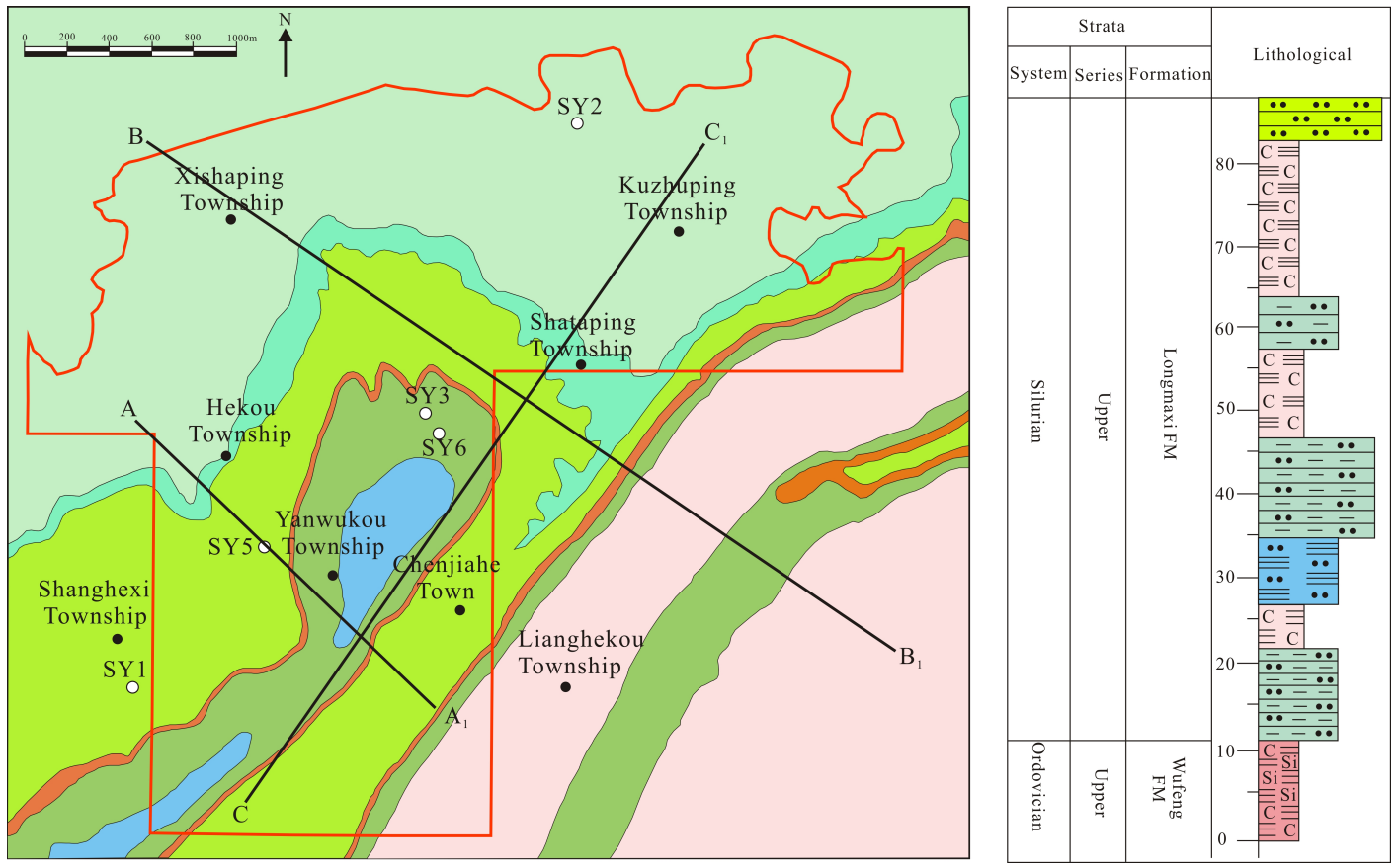
The shale gas content of the Longmaxi Formation exhibits significant spatial variation in different structural parts of the Sangzhi area in Hubei Province, reflecting differences in preservation conditions. To quantitatively evaluate these conditions, this study integrates analyses of structural features, fault distribution, formation water chemistry, and shale gas composition from four wells. Results show that preservation is primarily controlled by the F1 and F3 faults. Wells distant from these faults (SY3 and SY5) display weak connectivity with surface water, feature CaCl2-type formation water with high salinity and diagnostic ion coefficients, and contain hydrocarbon gases derived from organic pyrolysis. These characteristics lead to high gas content and favorable preservation conditions. In contrast, wells adjacent to faults (SY1 and SY6) exhibit strong connectivity with the surface, NaHCO3-type water of low salinity, high N2 and CO2} contents of atmospheric origin, and low gas content, indicating poor preservation. These findings demonstrate that shale gas preservation in the Longmaxi Formation is jointly controlled by structural settings, water--rock interactions, and nonhydrocarbon gas sources, providing a quantitative framework for assessing preservation conditions in shale gas exploration.
Graphical Abstract
Keywords
Data Availability Statement
Funding
Conflicts of Interest
Ethical Approval and Consent to Participate
References
- Li, J., Zhang, Q., Jiang, W., Li, H., Li, L., Xue, T., ... & Gao, Z. (2025). Lithological controls on pore structure and their implications for deep shale gas reservoir quality in the Longmaxi Formation, Luzhou area, Southern Sichuan Basin, China. Energy & Fuels, 39(3), 1541-1558.
[CrossRef] [Google Scholar] - Wang, E., Guo, T., Li, M., Li, C., Dong, X., Zhang, N., & Feng, Y. (2022). Exploration potential of different lithofacies of deep marine shale gas systems: Insight into organic matter accumulation and pore formation mechanisms. Journal of Natural Gas Science and Engineering, 102, 104563.
[CrossRef] [Google Scholar] - He, S., Qin, Q., Li, H., & Zhao, S. (2022). Geological characteristics of deep shale gas in the Silurian Longmaxi Formation in the southern Sichuan Basin, China. Frontiers in Earth Science, 9, 818155.
[CrossRef] [Google Scholar] - Shan, C. A., Shi, Y., Liang, X., Zhang, L., Wang, G., Jiang, L., ... & Mei, J. (2024). Diagenetic characteristics and microscopic pore evolution of deep shale gas reservoirs in Longmaxi Formation, Southeastern Sichuan basin, China. Unconventional Resources, 4, 100090.
[CrossRef] [Google Scholar] - Li, X., Chen, S., Wang, X., Zhu, Y., Chang, M., & Uwamahoro, C. (2019). Pore structure heterogeneity of the Xiamaling Formation shale gas reservoir in the Yanshan area of China: Evaluation of geological controlling factors. Acta Geologica Sinica‐English Edition, 93(3), 588-603.
[CrossRef] [Google Scholar] - Zhou, X. J., Li, S. Z., Wang, Y. J., & Liu, J. (2011). Tectonic features of the Fanjing Mount and Sangzhi Area on the west of Xuefeng Uplift. Earth Science-Journal of China University of Geosciences, 36, 985-92.
[Google Scholar] - An, Z., Zhao, Y., & Zhang, Y. (2024). Pore heterogeneity analysis and control mechanisms in Cambrian shale of the Shuijingtuo Formation, Yichang area, China. Frontiers in Earth Science, 12, 1365516.
[CrossRef] [Google Scholar] - Li, H., Xu, Z., Gao, X., Xie, J., Qin, Q., Wang, H., & He, S. (2025). Pore structure evolution and geological controls in lacustrine shale systems with implications for marine shale reservoir characterization. Scientific Reports, 15(1), 17702.
[CrossRef] [Google Scholar] - Xu, Z., Liang, X., Lu, H., Zhang, J., Shu, H., Xu, Y., ... & Shi, W. (2020). Structural deformation characteristics and shale gas preservation conditions in the Zhaotong National Shale Gas Demonstration Area along the southern margin of the Sichuan Basin. Natural Gas Industry B, 7(3), 224-233.
[CrossRef] [Google Scholar] - Xu, L., Huang, S., Liu, Z., Wen, Y., Zhou, X., Zhang, Y., ... & Chen, C. (2021). Geological controls of shale gas accumulation and enrichment mechanism in Lower Cambrian Niutitang Formation of western Hubei, Middle Yangtze, China. Frontiers of Earth Science, 15(2), 310-331.
[CrossRef] [Google Scholar] - Ge, X., Hu, W., Ma, Y., Li, M., Tang, J., & Zhao, P. (2021). Quantitative evaluation of geological conditions for shale gas preservation based on vertical and lateral constraints in the Songkan area, Northern Guizhou, southern China. Marine and Petroleum Geology, 124, 104787.
[CrossRef] [Google Scholar] - Hu, D., Zhang, H., Ni, K., & Yu, G. (2014). Preservation conditions for marine shale gas at the southeastern margin of the Sichuan Basin and their controlling factors. Natural Gas Industry B, 1(2), 178-184.
[CrossRef] [Google Scholar] - Wang, S., Su, P., Wang, J., Zhang, C., & Wang, M. (2022). Composition of Formation Water and Natural Gas as an Indicator of Shale Gas Preservation Conditions: A Case Study of the Marine Shale of the Niutitang Formation in the Cengong Block in Northern Guizhou, China. ACS omega, 7(5), 4630-4639.
[CrossRef] [Google Scholar] - Liu, G., Hu, G., Shi, X., Ma, Y., Yin, X., & Li, A. (2021). Carbonate cementation patterns and diagenetic reservoir facies of the triassic Yanchang Formation deep-water sandstone in the huangling area of the Ordos Basin, northwest China. Journal of Petroleum Science and Engineering, 203, 108608.
[CrossRef] [Google Scholar] - Peng, X., Gan-lu, W., Fan-gui, Z., Yu-liang, M., Hao-tian, Z., & Jie-gang, L. (2018). The characteristics and mechanism of high-over matured nitrogen-rich shale gas of Niutitang Formation, northern Guizhou area. Natural Gas Geoscience, 29(9).
[CrossRef] [Google Scholar] - Liu, Y., Jin, J., Pan, R., Li, X., Zhu, Z., & Xu, L. (2022). Normal Pressure Shale Gas Preservation Conditions in the Transition Zone of the Southeast Basin Margin of Sichuan Basin. Water, 14(10), 1562.
[CrossRef] [Google Scholar] - Jun, Y., Peng, L., Yuexin, L., Shaohui, Y., Daoyuan, B., Fanghui, W., ... & Nengli, P. (2021). Superimposed features and deformation mechanism of Early Mesozoic folds in the Sangzhi-Shimen area, northern Hunan. Bulletin of Geological Science and Technology, 40(6), 43-54.
[Google Scholar] - Liang, X., Shan, C. A., Wang, W., Li, Z., Zhu, D., Xu, J., ... & Yuan, X. (2023). Exploration and development in the Zhaotong national shale gas demonstration area: Progress and prospects. Natural Gas Industry B, 10(1), 44-61.
[CrossRef] [Google Scholar] - Liu, S., Steel, R., & Zhang, G. (2005). Mesozoic sedimentary basin development and tectonic implication, northern Yangtze Block, eastern China: record of continent–continent collision. Journal of Asian Earth Sciences, 25(1), 9-27.
[CrossRef] [Google Scholar] - Li, S., Li, Y., He, Z., Chen, K., Zhou, Y., & Yan, D. (2020). Differential deformation on two sides of Qiyueshan Fault along the eastern margin of Sichuan Basin, China, and its influence on shale gas preservation. Marine and Petroleum Geology, 121, 104602.
[CrossRef] [Google Scholar] - He, S., Qin, Q., Li, H., & Wang, S. (2022). Deformation differences in complex structural areas in the southern Sichuan Basin and its influence on shale gas preservation: A case study of changning and luzhou areas. Frontiers in Earth Science, 9, 818534.
[CrossRef] [Google Scholar] - Fan, C., Xie, H., Li, H., Zhao, S., Shi, X., Liu, J., ... & Lian, C. (2022). Complicated fault characterization and its influence on shale gas preservation in the southern margin of the Sichuan Basin, China. Lithosphere, 2022(Special 12), 8035106.
[CrossRef] [Google Scholar] - Sun, J., Xiao, X., & Cheng, P. (2021). Influence of water on shale pore heterogeneity and the implications for shale gas-bearing property-A case study of marine Longmaxi Formation shale in northern Guizhou. Marine and Petroleum Geology, 134, 105379.
[CrossRef] [Google Scholar] - Cao, C., Li, L., Liu, Y., Du, L., Li, Z., & He, J. (2020). Factors Affecting Shale Gas Chemistry and Stable Isotope and Noble Gas Isotope Composition and Distribution: A Case Study of Lower Silurian Longmaxi Shale Gas, Sichuan Basin. Energies, 13(22), 5981.
[CrossRef] [Google Scholar] - Leng, W., Zhan, H., Ge, L., Wang, W., Ma, Y., Zhao, K., ... & Xiao, L. (2015). Rapidly determinating the principal components of natural gas distilled from shale with terahertz spectroscopy. Fuel, 159, 84-88.
[CrossRef] [Google Scholar] - Chen, X., Eichhubl, P., Olson, J. E., & Dewers, T. A. (2020). Salinity, pH, and temperature controls on fracture mechanical properties of three shales and their implications for fracture growth in chemically reactive fluid environments. Geomechanics for Energy and the Environment, 21, 100140.
[CrossRef] [Google Scholar] - Wang, M., Gui, H., Hu, R., Zhao, H., Li, J., Yu, H., & Fang, H. (2019). Hydrogeochemical characteristics and water quality evaluation of carboniferous Taiyuan formation limestone water in Sulin mining area in Northern Anhui, China. International Journal of Environmental Research and Public Health, 16(14), 2512.
[CrossRef] [Google Scholar] - Maksimov, S. N., Müller, E., Botneva, T. A., Goldbecher, K., Zor'Kin, L. M., & Pankina, R. G. (1976). Origin of high-nitrogen gas pools. International Geology Review, 18(5), 551-556.
[CrossRef] [Google Scholar] - Wang, R., Ding, W., Gong, D., Zeng, W., Wang, X., Zhou, X., ... & Xiao, Z. (2016). Development characteristics and major controlling factors of shale fractures in the Lower Cambrian Niutitang Formation, southeastern Chongqing-northern Guizhou area. Acta Petrolei Sinica, 37(7), 832.
[CrossRef] [Google Scholar]
Cited By (25)
-
Tianbiao Zhao, Hu Li. Management of Shale Gas Hydraulic Fracturing Flowback Fluid in China: A Review of Advances, Persisting Challenges, and Pathways toward Sustainability.
Energy & Fuels, 2026 , 40 (25).
[CrossRef] -
Zhi Gao, Tian Tang, Cheng Yang, Jing Li, Yijia Wu, Ying Wang, Jingru Ruan, Yi Xiao, Hu Li, Kun Zhang. Reservoir Characteristics and Productivity Controlling Factors of the Wufeng–Longmaxi Formations in the Lu203–Yang101 Well Block, Southern Sichuan Basin, China.
Energies, 2026 , 19 (2).
[CrossRef] -
Jingpeng Wang, Jun Li, Wei Lian, Zongyu Lu, Yanxian Wu, Tao Wan. Mechanisms and Applications of Casing Running Mechanics in CCUS Extended‐Reach Horizontal Wells.
Energy Science & Engineering, 2026 , 14 (1).
[CrossRef] -
Jiqiang Wang, Xin Zheng, Xiangdong Xie, Lei Jia, Sen Yan, Hu Li. Fault sealing evaluation and its effect on hydrocarbon accumulation in buried-hill fault-block oilfields, Bohai Bay Basin, China.
Applied Earth Science: Transactions of the Institutions of Mining and Metallurgy, 2026 , 135 (1).
[CrossRef] -
Songxin Zhao, Kaide Liu, Chaowei Sun, Wenping Yue, Qiyu Wang, Yu Xia, Xinping Wang, Hu Li. Study on characterization of sandstone pore structure and seepage mechanism based on NMR and CT technology.
PLOS One, 2026 , 21 (1).
[CrossRef] -
Yinhui Wang, Xiaodan Gao, Hu Li. Generalized spatial two stage least squares analysis of foreign direct investment air pollution and green technology innovation in Chinese cities.
Scientific Reports, 2026 , 16 (1).
[CrossRef] -
Zhuo Li, Zhenxue Jiang, Xianglu Tang, Wenlong Gong, Wei Wu. Formation, Evolution, and Preservation Mechanisms of Overpressure in the Wufeng–Longmaxi Shale, Changning Area, Sichuan Basin.
Journal of Petroleum Geology, 2026 .
[CrossRef] -
Songyang Wan, Weiwei Liu, Liang Liao, Yuping Ouyang, Yonghui Yan, Hu Li, Kun Zhang. Geological Characteristics and Resource Potential of the Leping Formation Shale Gas in the Qingjiang Basin, Southern Poyang Depression, China.
Journal of Petroleum Geology, 2026 , 49 (4).
[CrossRef] -
Hao Ma, Junbin Chen, Nianfeng Li, Hua Chen, Bin Liu, Siqi Xiao. Sedimentary Characteristics of the Wufeng–Longmaxi Formation Shales and Their Controlling Mechanisms on Shale Gas Accumulation in the Mugan Syncline, Northeastern Yunnan, China.
Processes, 2026 , 14 (11).
[CrossRef] -
Jing Li, Yuqi Deng, Tingting Huang, Guo Chen, Bei Yang, Xiaohai Ren, Hu Li. Digital Core-Based Characterization and Fracability Evaluation of Deep Shale Gas Reservoirs in the Weiyuan Area, Sichuan Basin, China.
Minerals, 2026 , 16 (4).
[CrossRef] -
Jing Liu, Maolong Xia, Bo Feng, Jie Hu, Jing Liang, Cunhui Fan, Yulu Zeng, Huwei Cao, Hu Li. Multi-Indicator comprehensive evaluation of middle Permian hydrocarbon preservation conditions in Western Sichuan and its exploration significance.
Applied Earth Science: Transactions of the Institutions of Mining and Metallurgy, 2026 , 135 (3).
[CrossRef] -
Hu Li, Qirong Qin, Cunbao Li, Ahmed E. Radwan, Jianbo Wang, Cunhui Fan. Quantitative characterization of complex multi-scale fractures in low-permeable sandstone reservoir: Insights from geological and mathematical approach.
Geomechanics and Geophysics for Geo-Energy and Geo-Resources, 2026 , 12 (1).
[CrossRef] -
Yue Sun, Yuqiang Jiang, Chan Jiang, Yixiao Yang, Yifan Gu. Pore structure evolution model of shale reservoir under different fluid pressures: a case study of Wufeng-Longmaxi Formation, SW China.
Open Geosciences, 2026 , 18 (1).
[CrossRef] -
Wenhao Zhang, Dandan Wang, Shizhen Li, Xingui Zhou, Yuanlin Meng, Yunbo Zhang, Minfei Wang, Hu Li. Geochemical characteristics and hydrocarbon generation potential of lower cretaceous source rocks in the eastern peripheral basin group of the Songliao Basin, Northeastern China.
Frontiers in Earth Science, 2026 , 14 .
[CrossRef] -
Jianqin Xue, Yanxiong Wu, Bo Wang, Ziwei Pei, Yinghai Jiang, Yunzhao Wu, Boce Zhang, Bohan Qiao, Wenzhuo Wang, Changan Shan, Hu Li. Reservoir characteristics and main controlling factors of karst shale oil in the Lower Ganchaigou Formation, Yingxi area, Qaidam Basin.
Applied Earth Science: Transactions of the Institutions of Mining and Metallurgy, 2026 , 135 (3).
[CrossRef] -
Yongyang Liu, Xuefeng Yang, Shengxian Zhao, Yuanhan He, Wenping Liu, Bo Li, Ruhua Zhang, Shengjun Liu, Yong Wu, Cunhui Fan, Hu Li. Fracture Characteristics and Prediction in the Longmaxi Formation, Central Luzhou Area, Sichuan Basin, China.
Journal of Petroleum Geology, 2026 , 49 (3).
[CrossRef] -
Hongxiang Jin, Hongxi Li, Huajun Zhu, Xin Wang, Chunpu Wang, Shaobo Tang, Jian He. Deep coal-rock geomechanics for wellbore stability and drilling-fluid design in the Benxi–Shanxi Formations, Ordos Basin, China.
Applied Earth Science: Transactions of the Institutions of Mining and Metallurgy, 2026 .
[CrossRef] -
Jing Li, Wenping Liu, Yadong Yang, Xunxi Qiu, Xin Gong, Hu Li, Jia He, Xing Liu, Zhi Gao, Ang Luo, Cheng Yang. Main Controlling Factors and Three-Dimensional Development Potential of Deep to Ultra-Deep Shale Gas in the Luzhou Area, Sichuan Basin.
Processes, 2026 , 14 (9).
[CrossRef] -
Peiyan Li, Jiliang Yu, Ming Xie, Dan Lu, Gangquan Li, Xuan Chen, Deqiang Sun, Yuhao Deng. Lithofacies Identification and Gas-Bearing Potential Evaluation of Shallow Shale Gas in China: A Case Study of the Wufeng-Longmaxi Formations, Northern Guizhou.
Minerals, 2026 , 16 (2).
[CrossRef] -
Hongxiang Jin, Hongxi Li, Feiyang Wang, Huajun Zhu, Chunpu Wang, Tao Zhang. Geological characteristics and gas accumulation condition of deep coal-rock gas in Carboniferous Benxi Formation, Western Ordos Basin, China.
Applied Earth Science: Transactions of the Institutions of Mining and Metallurgy, 2026 .
[CrossRef]
Cite This Article
TY  - JOUR
AU  - Ren, Guanxiong
AU  - Guo, Wenbo
AU  - Yuan, Lu
PY  - 2025
DA  - 2025/08/30
TI  - Quantitative Assessment of Shale Gas Preservation in the Longmaxi Formation: Insights from Shale Fluid Properties
JO  - Journal of Geo-Energy and Environment
T2  - Journal of Geo-Energy and Environment
JF  - Journal of Geo-Energy and Environment
VL  - 1
IS  - 1
SP  - 8
EP  - 22
DO  - 10.62762/JGEE.2025.391517
UR  - https://www.icck.org/article/abs/JGEE.2025.391517
KW  - shale gas preservation
KW  - longmaxi formation
KW  - fluid properties
KW  - structural control
KW  - nonhydrocarbon gases
AB  - The shale gas content of the Longmaxi Formation exhibits significant spatial variation in different structural parts of the Sangzhi area in Hubei Province, reflecting differences in preservation conditions. To quantitatively evaluate these conditions, this study integrates analyses of structural features, fault distribution, formation water chemistry, and shale gas composition from four wells. Results show that preservation is primarily controlled by the F1 and F3 faults. Wells distant from these faults (SY3 and SY5) display weak connectivity with surface water, feature CaCl2-type formation water with high salinity and diagnostic ion coefficients, and contain hydrocarbon gases derived from organic pyrolysis. These characteristics lead to high gas content and favorable preservation conditions. In contrast, wells adjacent to faults (SY1 and SY6) exhibit strong connectivity with the surface, NaHCO3-type water of low salinity, high N2 and CO2} contents of atmospheric origin, and low gas content, indicating poor preservation. These findings demonstrate that shale gas preservation in the Longmaxi Formation is jointly controlled by structural settings, water--rock interactions, and nonhydrocarbon gas sources, providing a quantitative framework for assessing preservation conditions in shale gas exploration.
SN  - 3069-3268
PB  - Institute of Central Computation and Knowledge
LA  - English
ER  -
@article{Ren2025Quantitati,
  author = {Guanxiong Ren and Wenbo Guo and Lu Yuan},
  title = {Quantitative Assessment of Shale Gas Preservation in the Longmaxi Formation: Insights from Shale Fluid Properties},
  journal = {Journal of Geo-Energy and Environment},
  year = {2025},
  volume = {1},
  number = {1},
  pages = {8-22},
  doi = {10.62762/JGEE.2025.391517},
  url = {https://www.icck.org/article/abs/JGEE.2025.391517},
  abstract = {The shale gas content of the Longmaxi Formation exhibits significant spatial variation in different structural parts of the Sangzhi area in Hubei Province, reflecting differences in preservation conditions. To quantitatively evaluate these conditions, this study integrates analyses of structural features, fault distribution, formation water chemistry, and shale gas composition from four wells. Results show that preservation is primarily controlled by the F1 and F3 faults. Wells distant from these faults (SY3 and SY5) display weak connectivity with surface water, feature CaCl2-type formation water with high salinity and diagnostic ion coefficients, and contain hydrocarbon gases derived from organic pyrolysis. These characteristics lead to high gas content and favorable preservation conditions. In contrast, wells adjacent to faults (SY1 and SY6) exhibit strong connectivity with the surface, NaHCO3-type water of low salinity, high N2 and CO2} contents of atmospheric origin, and low gas content, indicating poor preservation. These findings demonstrate that shale gas preservation in the Longmaxi Formation is jointly controlled by structural settings, water--rock interactions, and nonhydrocarbon gas sources, providing a quantitative framework for assessing preservation conditions in shale gas exploration.},
  keywords = {shale gas preservation, longmaxi formation, fluid properties, structural control, nonhydrocarbon gases},
  issn = {3069-3268},
  publisher = {Institute of Central Computation and Knowledge}
}
Publisher's Note
ICCK stays neutral with regard to jurisdictional claims in published maps and institutional affiliations.
Rights and Permissions
 Copyright © 2025 by the Author(s). Published by Institute of Central Computation and Knowledge. This article is an open access article distributed under the terms and conditions of the Creative Commons Attribution (CC BY) license (https://creativecommons.org/licenses/by/4.0/), which permits use, sharing, adaptation, distribution and reproduction in any medium or format, as long as you give appropriate credit to the original author(s) and the source, provide a link to the Creative Commons licence, and indicate if changes were made.


Portico
