Volume 1, Issue 2 (In Progress)


In Progress
Citations: Crossref logo 0,   0   |   Viewed: 2675, Download: 365

Table of Contents

Open Access | Perspective | 25 June 2026
Why Large Spacecraft Swarms Will Be Maintained Primarily by Design, Not Solely by Control
Aerospace Engineering Communications | Volume 1, Issue 2: 87-92, 2026 | DOI: 10.62762/AEC.2026.392649
Abstract
As orbital swarms grow toward populations of tens to hundreds, long-term maintenance changes character. We argue that it is distinct from reconfiguration or trajectory planning, defined by two requirements: it is perpetual, and it must be low-frequency, because every active maneuver arc is stolen from the payload's working time. Against these requirements the three dominant paradigms: centralized planning, distributed reactive control, and configuration design-then-maintain, fail in qualitatively different ways. Two of these failures are structural, properties of how the problem is posed; only the third is fixable. We therefore contend that scalable swarm maintenance will be achieved primari... More >

Graphical Abstract
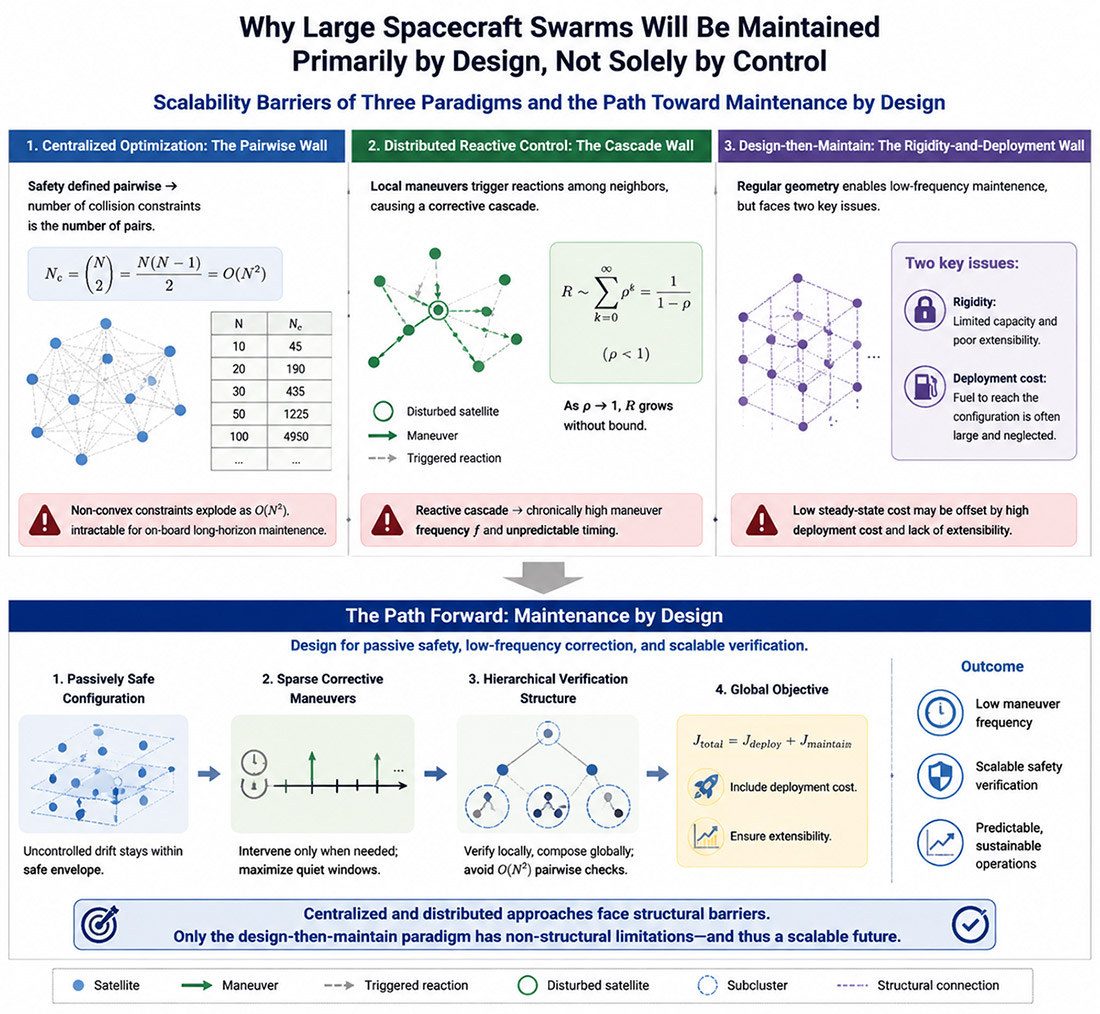
Why Large Spacecraft Swarms Will Be Maintained Primarily by Design, Not Solely by Control
Open Access | Perspective | 15 June 2026
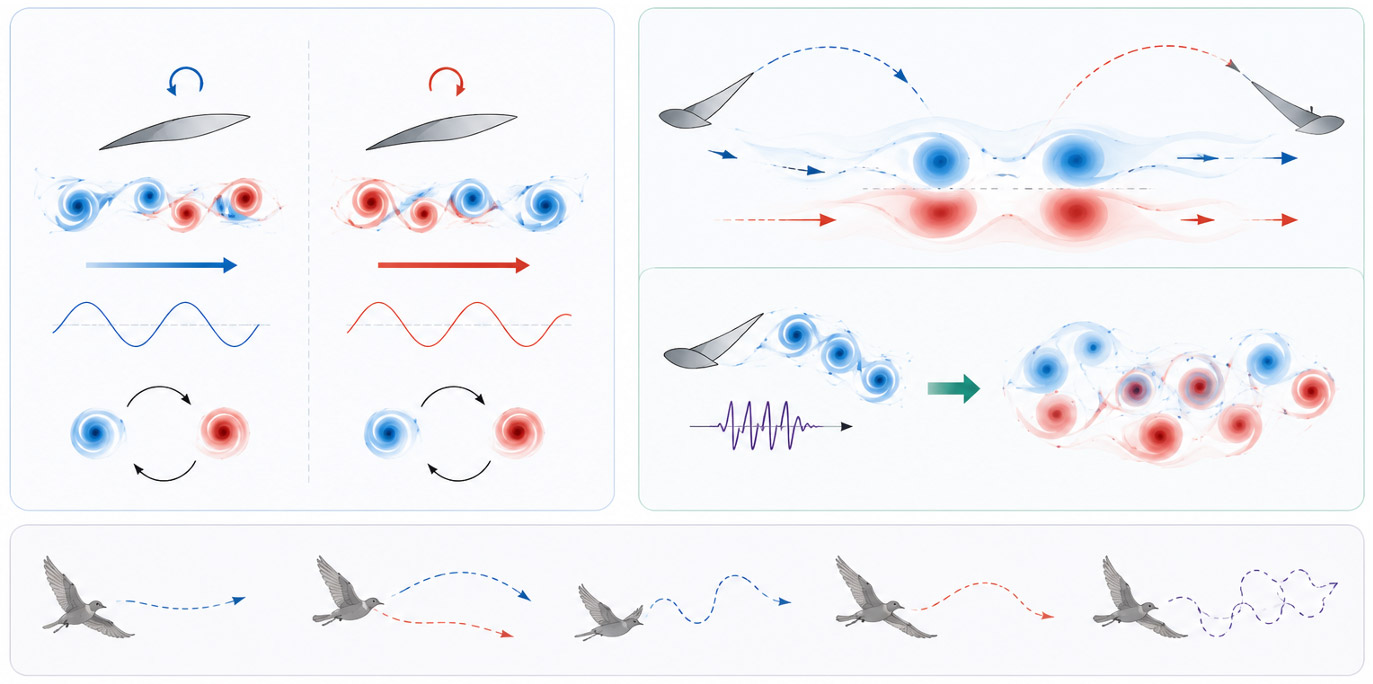
Beyond Periodic Flapping: Adaptive Unsteady Aerodynamics in Bio-inspired Flying Robots
Aerospace Engineering Communications | Volume 1, Issue 2: 81-86, 2026 | DOI: 10.62762/AEC.2026.970989
Abstract
Flapping-wing flight has long inspired bio-inspired aerial robots because of its extraordinary aerodynamic efficiency and maneuverability. Although substantial progress has been achieved in understanding unsteady aerodynamic mechanisms, most existing frameworks remain centered on idealized periodic wing motions and cycle-averaged propulsion. Recent studies increasingly suggest that transient asymmetries and multi-frequency perturbations, traditionally regarded as disturbances, can actively reorganize vortex dynamics and enhance aerodynamic performance. These findings imply that biological flight may rely not solely on stable periodic propulsion, but on continuous adaptation to evolving flow... More >

Graphical Abstract
Beyond Periodic Flapping: Adaptive Unsteady Aerodynamics in Bio-inspired Flying Robots
Open Access | Research Article | 22 April 2026 | Cited: Crossref logo  1
Advanced Barrier Function-Based Robust Prescribed Performance Control with Actuator Fault
Aerospace Engineering Communications | Volume 1, Issue 2: 68-80, 2026 | DOI: 10.62762/AEC.2026.303859
Abstract
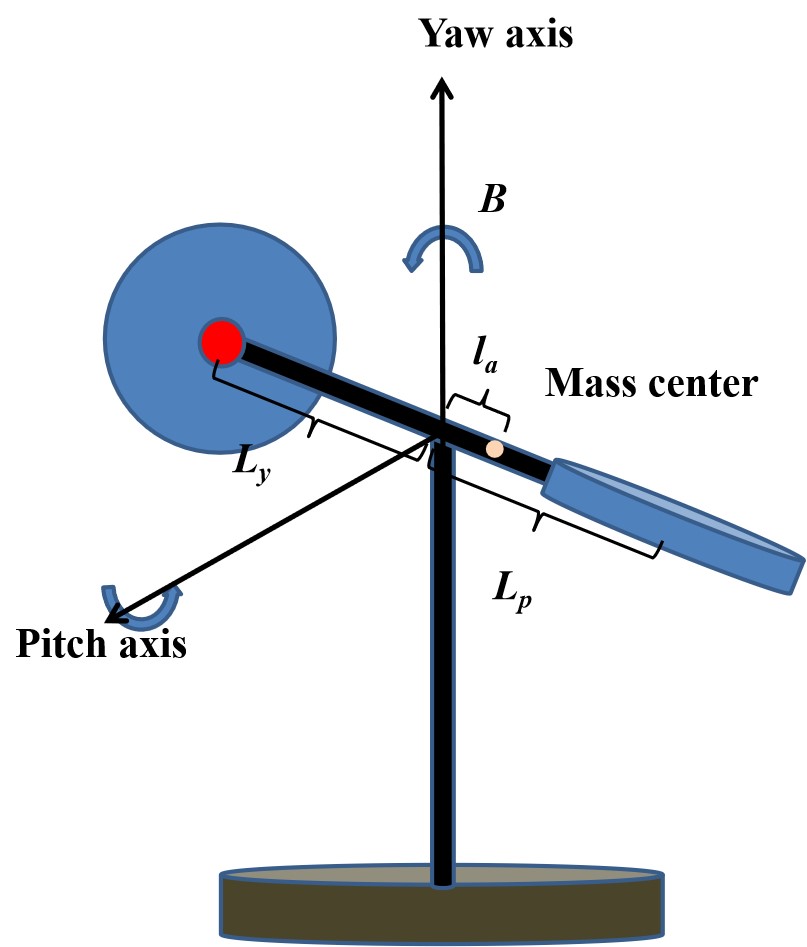
This paper investigates prescribed performance control (PPC) using an advanced barrier function (ABF) based adaptive super-twisting control scheme with non-fragility. The specialty of the proposed scheme is that it removes the error transformation process, and therefore simplifies the design of PPC. Furthermore, the ABF is combined with an online adaptation law to solve the problem of fragility inherent to the traditional PPC. The proposed method is robust to actuator faults, unknown initial states, and sudden disturbances. The stability of the system is proved via the Lyapunov framework. Finally, experiments on a two-degree-of-freedom (2-DOF) helicopter platform are conducted to verify the... More >

Graphical Abstract
Advanced Barrier Function-Based Robust Prescribed Performance Control with Actuator Fault
Open Access | Research Article | 11 March 2026
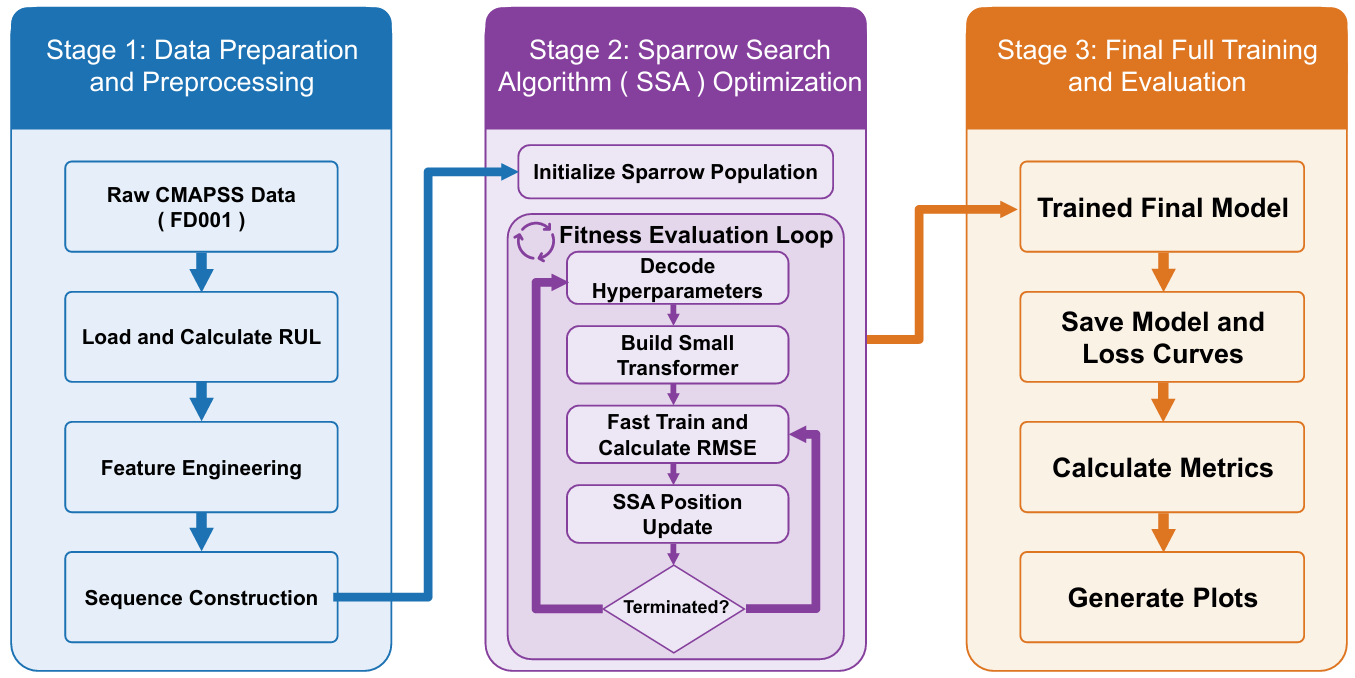
Data-Driven RUL Prediction of CMAPSS Jet Engines: A Swarm Intelligence-Optimized Transformer Approach
Aerospace Engineering Communications | Volume 1, Issue 2: 57-67, 2026 | DOI: 10.62762/AEC.2026.464396
Abstract
Remaining useful life (RUL) prediction is a core task in prognostics and health management. While Transformers excel at modeling long-range temporal dependencies, their performance is highly sensitive to hyperparameters, and improper splitting of sliding-window samples can introduce data leakage. We propose a Sparrow Search Algorithm (SSA)-optimized Transformer for CMAPSS RUL prediction, adopting an engine-wise split for leakage-aware model selection and using validation RMSE as the fitness function to guide SSA-based hyperparameter optimization. On the FD001 test set, the model achieves RMSE $13.79$, MAE $10.00$, $R^2=0.88$, and a NASA score of $356.26$. The prediction curves and residual d... More >

Graphical Abstract
Data-Driven RUL Prediction of CMAPSS Jet Engines: A Swarm Intelligence-Optimized Transformer Approach