

Energy-Aware Operating Theatres Scheduling Using Metaheuristics


Article Information
Abstract
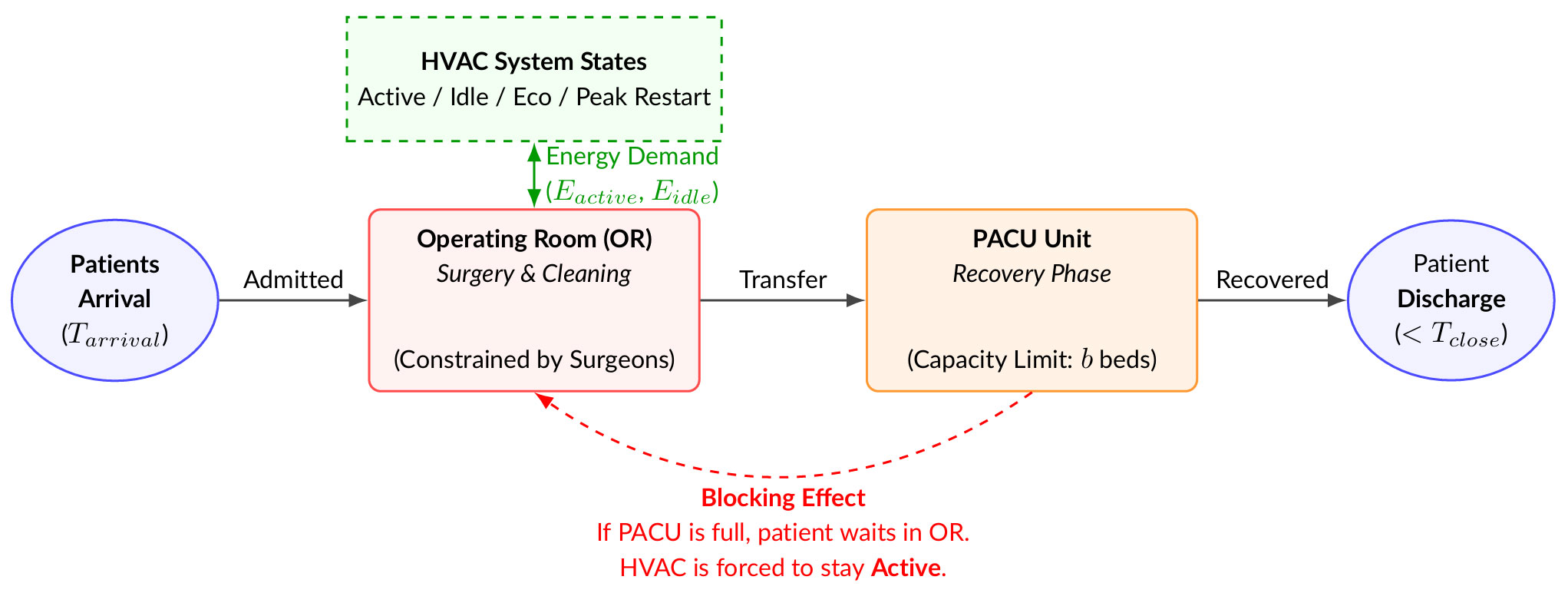
Operating rooms (ORs) account for a significant fraction of a hospital's energy footprint, yet traditional surgical scheduling models ignore the dynamic energy consumption of heating, ventilation, and air conditioning (HVAC) systems, particularly the thermal inertia and peak restart loads. Furthermore, the interaction with the Post‑Anesthesia Care Unit (PACU) creates blocking effects that invalidate isolated OR schedules. This paper introduces a bi‑objective mixed‑integer linear programming (MILP) model and a metaheuristic framework for the Green Ambulatory Surgery Scheduling Problem with PACU constraints (G‑ASSP‑P). The objectives minimise both total completion time (makespan) and total energy consumption, explicitly modelling HVAC transition penalties. To solve large, realistic instances, a discrete adaptation of the Interior Search Algorithm (ISA) is adopted and compared against the Non‑dominated Sorting Genetic Algorithm II (NSGA‑II). Computational experiments on three instance scales (20, 50, 70 surgeries) with 4–12 ORs and 8–25 PACU beds demonstrate that NSGA‑II consistently outperforms ISA in terms of hypervolume and solution diversity. The trade‑off analysis reveals that substantial energy savings (exceeding 30%) can be achieved with only a marginal increase in makespan, offering hospital managers a practical tool to balance efficiency and sustainability.
Graphical Abstract
Keywords
Data Availability Statement
Funding
Conflicts of Interest
AI Use Statement
Ethical Approval and Consent to Participate
References
- Beliën, J., Brailsford, S., Demeulemeester, E., Demirtas, D., Hans, E. W., & Harper, P. (2025). Fifty years of operational research applied to healthcare. European journal of operational research, 326(2), 189-206.
[CrossRef] [Google Scholar] - Cheng, H., Adulyasak, Y., & Rousseau, L.-M. (2025). An environmentally friendly elective patient scheduling under the predict-then-optimize framework. Annals of Operations Research. Advance online publication.
[CrossRef] [Google Scholar] - Shehadeh, K. S., & Padman, R. (2022). Stochastic optimization approaches for elective surgery scheduling with downstream capacity constraints: Models, challenges, and opportunities. Computers & Operations Research, 137, 105523.
[CrossRef] [Google Scholar] - El Amraoui, A., Belhor, M., & El Amraoui, L. (2026). A new heuristic algorithm for resource-constrained operating room scheduling problem: A case study. Ain Shams Engineering Journal, 17(6), 104108.
[CrossRef] [Google Scholar] - Vieira, B. S., Silva, E. M., & Chaves, A. A. (2025). Random-key algorithms for optimizing integrated operating room scheduling. Applied Soft Computing, 180, 113368.
[CrossRef] [Google Scholar] - Liu, Y., Huang, Y., Dai, Z., & Gao, Y. (2025). Self-optimized learning algorithm for multi-specialty multi-stage elective surgery scheduling. Engineering Applications of Artificial Intelligence, 147, 110346.
[CrossRef] [Google Scholar] - Spence, C., Shah, O. A., Cebula, A., Tucker, K., Sochart, D., Kader, D., & Asopa, V. (2023). Machine learning models to predict surgical case duration compared to current industry standards: scoping review. BJS Open, 7(6), zrad113.
[CrossRef] [Google Scholar] - Zhang, R., Yu, H., Gao, K., Fu, Y., & Kim, J. H. (2024). A Q-learning based artificial bee colony algorithm for solving surgery scheduling problems with setup time. Swarm and Evolutionary Computation, 90, 101686.
[CrossRef] [Google Scholar] - Dai, Z., & Li, Z.-P. (2025). Intelligent scheduling method for ambulatory surgery based on machine learning and fuzzy optimization. Annals of Operations Research. Advance online publication.
[CrossRef] [Google Scholar] - Dekhici, L., & Khaled, B. (2010). Operating theatre scheduling under constraints. Journal of Applied Sciences, 14(10), 1380-1388. https://dx.doi.org/10.3923/jas.2010.1380.1388
[Google Scholar] - Dekhici, L., Guerraiche, K., Güven, A. F., Bajaj, M., Blazek, V., & Prokop, L. (2026). Machine learning-embedded energy cost optimization for hybrid flow shop scheduling toward low-carbon industrial energy systems. Unconventional Resources, 100411.
[CrossRef] [Google Scholar] - Atisattapong, W., & Pongpatcharapun, P. (2024). Master Surgical Scheduling of Multi-Surgeon Surgical Schedules Using a Mixed-Integer Linear Programming Model and Genetic Algorithms. In Proceedings of the 4th International Conference on Robotics, Automation and Artificial Intelligence (RAAI 2024) (pp. 274-283). IEEE.
[CrossRef] [Google Scholar] - Latorre-Núñez, G., Lüer-Villagra, A., Marianov, V., Obreque, C., Ramis, F., & Neriz, L. (2016). Scheduling operating rooms with consideration of all resources, post anesthesia beds and emergency surgeries. Computers & Industrial Engineering, 97, 248-257.
[CrossRef] [Google Scholar] - Dekhici, L., & Belkadi, K. (2023). A Bi-Objective Paediatric Operating Theater Scheduling. International Journal of Healthcare Information Systems and Informatics (IJHISI), 18(1), 1-15.
[CrossRef] [Google Scholar] - Belkhamsa, M., Jarboui, B., & Masmoudi, M. (2018). Two metaheuristics for solving no-wait operating room surgery scheduling problem under various resource constraints. Computers & Industrial Engineering, 126, 494-506.
[CrossRef] [Google Scholar] - Mostofa, N., Dexter, F., & Titler, S. S. (2026). Influence of sequencing the shortest and least variable cases early in the workday on operating room performance when constrained by post-anesthesia care unit availability: a narrative review. Perioperative Care and Operating Room Management, 100654.
[CrossRef] [Google Scholar] - Wang, Y., Wang, J., Yao, W., Ren, J., Chen, L., & Ban, Q. (2026). Ventilation and indoor air quality management in operating rooms: A systematic review of pollutant sources, transmission, and control techniques. Journal of Building Engineering, 115427.
[CrossRef] [Google Scholar] - Chen, S., Chiong, R., & Li, D. (2025). A prescriptive tree-based model for energy-efficient room scheduling: Considering uncertainty in energy generation and consumption. European Journal of Operational Research, 326(2), 374-388.
[CrossRef] [Google Scholar] - Zhan, Y., Shen, S., Wan, G., & Zhang, Z. (2025). Optimizing surgery scheduling under post-anesthesia care unit capacity constraints and random services durations. Computers & Operations Research, 107368.
[CrossRef] [Google Scholar] - Gandomi, A. H. (2014). Interior search algorithm (ISA): a novel approach for global optimization. ISA Transactions, 53(4), 1168-1183.
[CrossRef] [Google Scholar]
Cite This Article
TY  - JOUR
AU  - Dekhici, Latifa
AU  - Guerraiche, Khaled
AU  - Jlassi, Jihen
AU  - Djari, Mohammed Adel
PY  - 2026
DA  - 2026/08/26
TI  - Energy-Aware Operating Theatres Scheduling Using Metaheuristics
JO  - Intelligent Computing for Engineering
T2  - Intelligent Computing for Engineering
JF  - Intelligent Computing for Engineering
VL  - 1
IS  - 1
SP  - 17
EP  - 29
DO  - 10.62762/ICE.2026.457366
UR  - https://www.icck.org/article/abs/ICE.2026.457366
KW  - operating room scheduling
KW  - energy efficiency
KW  - multi-objective optimisation
KW  - HVAC
KW  - Healthcare
KW  - metaheuristics
KW  - NSGA-II
KW  - interior search algorithm
AB  - Operating rooms (ORs) account for a significant fraction of a hospital's energy footprint, yet traditional surgical scheduling models ignore the dynamic energy consumption of heating, ventilation, and air conditioning (HVAC) systems, particularly the thermal inertia and peak restart loads. Furthermore, the interaction with the Post‑Anesthesia Care Unit (PACU) creates blocking effects that invalidate isolated OR schedules. This paper introduces a bi‑objective mixed‑integer linear programming (MILP) model and a metaheuristic framework for the Green Ambulatory Surgery Scheduling Problem with PACU constraints (G‑ASSP‑P). The objectives minimise both total completion time (makespan) and total energy consumption, explicitly modelling HVAC transition penalties. To solve large, realistic instances, a discrete adaptation of the Interior Search Algorithm (ISA) is adopted and compared against the Non‑dominated Sorting Genetic Algorithm II (NSGA‑II). Computational experiments on three instance scales (20, 50, 70 surgeries) with 4–12 ORs and 8–25 PACU beds demonstrate that NSGA‑II consistently outperforms ISA in terms of hypervolume and solution diversity. The trade‑off analysis reveals that substantial energy savings (exceeding 30%) can be achieved with only a marginal increase in makespan, offering hospital managers a practical tool to balance efficiency and sustainability.
SN  - 5 Articles Required
PB  - Institute of Central Computation and Knowledge
LA  - English
ER  -
@article{Dekhici2026EnergyAwar,
  author = {Latifa Dekhici and Khaled Guerraiche and Jihen Jlassi and Mohammed Adel Djari},
  title = {Energy-Aware Operating Theatres Scheduling Using Metaheuristics},
  journal = {Intelligent Computing for Engineering},
  year = {2026},
  volume = {1},
  number = {1},
  pages = {17-29},
  doi = {10.62762/ICE.2026.457366},
  url = {https://www.icck.org/article/abs/ICE.2026.457366},
  abstract = {Operating rooms (ORs) account for a significant fraction of a hospital's energy footprint, yet traditional surgical scheduling models ignore the dynamic energy consumption of heating, ventilation, and air conditioning (HVAC) systems, particularly the thermal inertia and peak restart loads. Furthermore, the interaction with the Post‑Anesthesia Care Unit (PACU) creates blocking effects that invalidate isolated OR schedules. This paper introduces a bi‑objective mixed‑integer linear programming (MILP) model and a metaheuristic framework for the Green Ambulatory Surgery Scheduling Problem with PACU constraints (G‑ASSP‑P). The objectives minimise both total completion time (makespan) and total energy consumption, explicitly modelling HVAC transition penalties. To solve large, realistic instances, a discrete adaptation of the Interior Search Algorithm (ISA) is adopted and compared against the Non‑dominated Sorting Genetic Algorithm II (NSGA‑II). Computational experiments on three instance scales (20, 50, 70 surgeries) with 4–12 ORs and 8–25 PACU beds demonstrate that NSGA‑II consistently outperforms ISA in terms of hypervolume and solution diversity. The trade‑off analysis reveals that substantial energy savings (exceeding 30\%) can be achieved with only a marginal increase in makespan, offering hospital managers a practical tool to balance efficiency and sustainability.},
  keywords = {operating room scheduling, energy efficiency, multi-objective optimisation, HVAC, Healthcare, metaheuristics, NSGA-II, interior search algorithm},
  issn = {5 Articles Required},
  publisher = {Institute of Central Computation and Knowledge}
}
Article Metrics
Publisher's Note
ICCK stays neutral with regard to jurisdictional claims in published maps and institutional affiliations.
Rights and Permissions
 Copyright © 2026 by the Author(s). Published by Institute of Central Computation and Knowledge. This article is an open access article distributed under the terms and conditions of the Creative Commons Attribution (CC BY) license (https://creativecommons.org/licenses/by/4.0/), which permits use, sharing, adaptation, distribution and reproduction in any medium or format, as long as you give appropriate credit to the original author(s) and the source, provide a link to the Creative Commons licence, and indicate if changes were made.


Portico
