

Teaching Research and Practice of 'General Chemistry' in Agriculture and Forestry Education Focused on Cultivating Innovative Ability


Article Information
Abstract
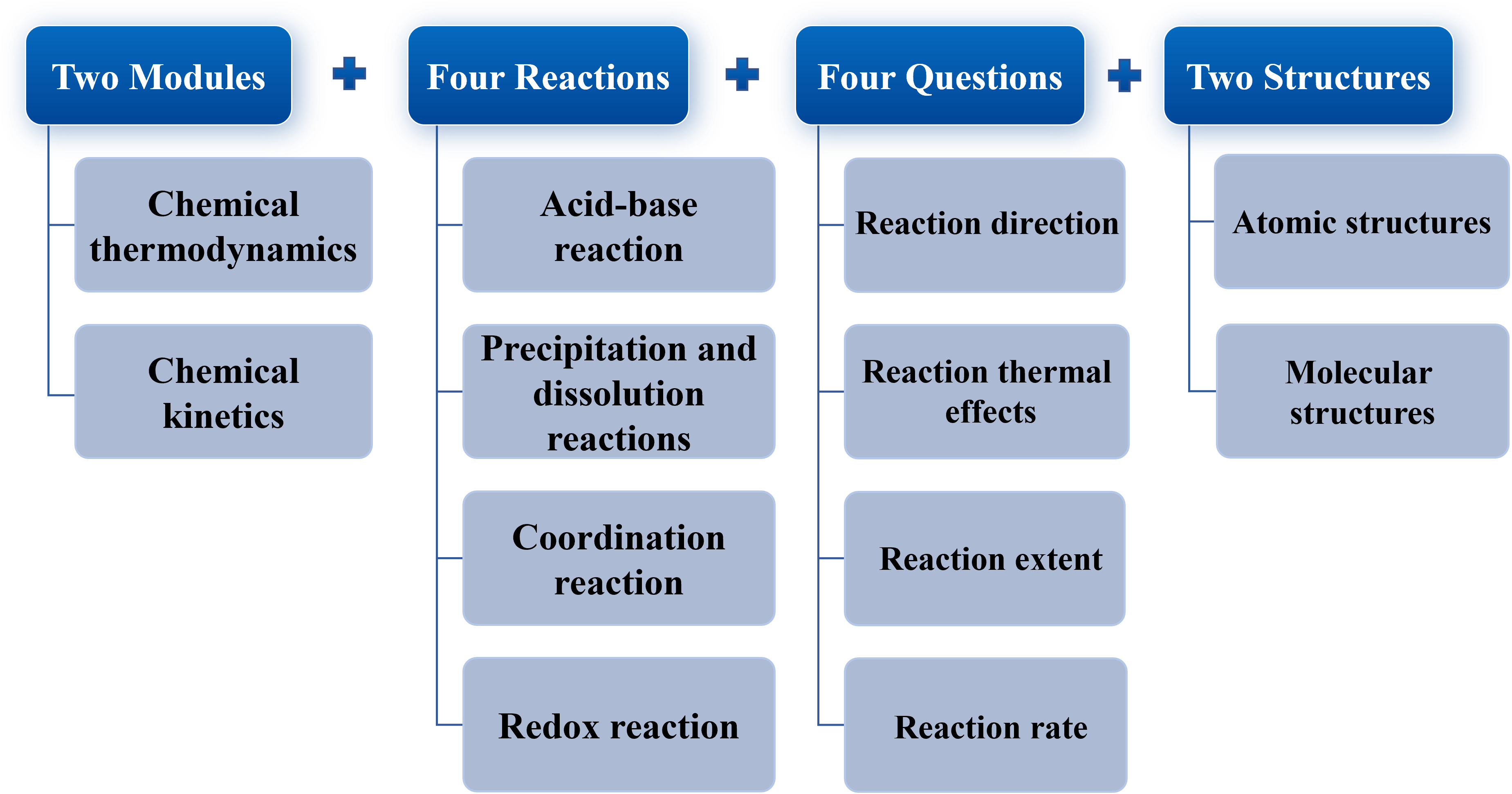
Taking the "General Chemistry" course—a public foundational course for agriculture-related majors and a postgraduate entrance examination subject in agricultural and forestry universities—as the research object, this study adheres to the Outcome-Based Education (OBE) philosophy and the "Four-Integration" principle (integrating science and agriculture, science and education, industry and education, and ideological-political education). It reconstructed advanced teaching content of "connection points–knowledge points–thematic inquiry series" to address the misalignment between course content and agricultural development needs, while seamlessly integrating ideological-political elements including scientific exploration spirit, passion for agriculture, and ecological civilization concepts. A blended teaching model characterized by "three combinations, one passthrough, and six enhancements" was created to overcome students' insufficient ability in solving practical agricultural problems. A diversified evaluation model featuring "whole-process, three-dimensional, dual-assessment" was established to resolve the lack of process-based evaluation of students' professional application skills. The teaching reform practices have demonstrably improved students' course objective attainment rates and scientific reasoning performance, providing preliminary evidence for the cultivation of innovative capabilities.
Graphical Abstract
Keywords
Data Availability Statement
Funding
Conflicts of Interest
AI Use Statement
Ethical Approval and Consent to Participate
References
- Boyer Commission on Educating Undergraduates in the Research University. (1998). Reinventing undergraduate education: A blueprint for America's research universities. State University of New York at Stony Brook for the Carnegie Foundation for the Advancement of Teaching.
[Google Scholar] - Partnership for 21st Century Skills. (2011). Framework for 21st century learning. https://www.marietta.edu/sites/default/files/documents/21st_century_skills_standards_book_2.pdf
[Google Scholar] - Lin, C. D. (2017). The research of core competencies and values for students in China. Studies of Psychology and Behavior, 15(2), 145-154. https://psybeh.tjnu.edu.cn/EN/abstract/abstract1652.shtml
[Google Scholar] - Xiong, W., Yang, J., & Shen, W. (2022). Higher education reform in China: A comprehensive review of policymaking, implementation, and outcomes since 1978. China Economic Review, 72, 101752.
[CrossRef] [Google Scholar] - Xu, Z., Ge, L., He, W., Song, G., Liu, J., Hou, L., ... & Li, X. (2024). Developing a BOPPPS (Bridge-in, Objectives, Pre-assessment, Participatory Learning, Post-assessment and Summary) model combined with the OBE (Outcome Based Education) concept to improve the teaching outcomes of higher education. Humanities and Social Sciences Communications, 11(1), 1-13.
[CrossRef] [Google Scholar] - Gao, C., Xie, Q., Xu, T., Zhong, D., Ji, Y., & Ren, Y. (2025). Construction and practice of the multimodal information-integrated blended teaching model for geoscience courses under OBE framework: A case study of the course of Lithofacies Paleogeography. Chinese Geological Education, 34(5), 88-93. https://www.chinageoeducation.net.cn/CN/Y2025/V34/I5/88
[Google Scholar] - Shunan, G. (2025). Research on the Teaching Mode of the`` Advanced Financial Management'' Course Based on the BOPPPS Teaching Mode. International Educational Research, 8(4), p145-p145.
[CrossRef] [Google Scholar] - Li, S., Liu, Q., Guo, S., Li, Y., Chen, F., Wang, C., ... & Li, E. (2023). Research on the application of the blended BOPPPS based on an online and offline mixed teaching model in the course of fermentation engineering in applied universities. Biochemistry and Molecular Biology Education, 51(3), 244-253.
[CrossRef] [Google Scholar]
Cite This Article
TY  - JOUR
AU  - Gong, Xia
AU  - Tan, Guixia
AU  - Wen, Yangping
AU  - Wang, Linyu
AU  - Sun, Tingting
AU  - Deng, Changxi
AU  - Gong, Lei
AU  - Chen, Rongrong
AU  - Zhang, Ji
AU  - Wang, Zongde
AU  - Xiong, Jiangbo
AU  - Zeng, Yanhua
PY  - 2026
DA  - 2026/06/24
TI  - Teaching Research and Practice of 'General Chemistry' in Agriculture and Forestry Education Focused on Cultivating Innovative Ability
JO  - Journal of Digital Intelligence in Education
T2  - Journal of Digital Intelligence in Education
JF  - Journal of Digital Intelligence in Education
VL  - 1
IS  - 1
SP  - 5
EP  - 16
DO  - 10.62762/JDIE.2025.605046
UR  - https://www.icck.org/article/abs/JDIE.2025.605046
KW  - innovative capabilities
KW  - general chemistry
KW  - thematic inquiry series
KW  - ideological and political system
KW  - teaching model
KW  - evaluation model
AB  - Taking the "General Chemistry" course—a public foundational course for agriculture-related majors and a postgraduate entrance examination subject in agricultural and forestry universities—as the research object, this study adheres to the Outcome-Based Education (OBE) philosophy and the "Four-Integration" principle (integrating science and agriculture, science and education, industry and education, and ideological-political education). It reconstructed advanced teaching content of "connection points–knowledge points–thematic inquiry series" to address the misalignment between course content and agricultural development needs, while seamlessly integrating ideological-political elements including scientific exploration spirit, passion for agriculture, and ecological civilization concepts. A blended teaching model characterized by "three combinations, one passthrough, and six enhancements" was created to overcome students' insufficient ability in solving practical agricultural problems. A diversified evaluation model featuring "whole-process, three-dimensional, dual-assessment" was established to resolve the lack of process-based evaluation of students' professional application skills. The teaching reform practices have demonstrably improved students' course objective attainment rates and scientific reasoning performance, providing preliminary evidence for the cultivation of innovative capabilities.
SN  - pending
PB  - Institute of Central Computation and Knowledge
LA  - English
ER  -
@article{Gong2026Teaching,
  author = {Xia Gong and Guixia Tan and Yangping Wen and Linyu Wang and Tingting Sun and Changxi Deng and Lei Gong and Rongrong Chen and Ji Zhang and Zongde Wang and Jiangbo Xiong and Yanhua Zeng},
  title = {Teaching Research and Practice of 'General Chemistry' in Agriculture and Forestry Education Focused on Cultivating Innovative Ability},
  journal = {Journal of Digital Intelligence in Education},
  year = {2026},
  volume = {1},
  number = {1},
  pages = {5-16},
  doi = {10.62762/JDIE.2025.605046},
  url = {https://www.icck.org/article/abs/JDIE.2025.605046},
  abstract = {Taking the "General Chemistry" course—a public foundational course for agriculture-related majors and a postgraduate entrance examination subject in agricultural and forestry universities—as the research object, this study adheres to the Outcome-Based Education (OBE) philosophy and the "Four-Integration" principle (integrating science and agriculture, science and education, industry and education, and ideological-political education). It reconstructed advanced teaching content of "connection points–knowledge points–thematic inquiry series" to address the misalignment between course content and agricultural development needs, while seamlessly integrating ideological-political elements including scientific exploration spirit, passion for agriculture, and ecological civilization concepts. A blended teaching model characterized by "three combinations, one passthrough, and six enhancements" was created to overcome students' insufficient ability in solving practical agricultural problems. A diversified evaluation model featuring "whole-process, three-dimensional, dual-assessment" was established to resolve the lack of process-based evaluation of students' professional application skills. The teaching reform practices have demonstrably improved students' course objective attainment rates and scientific reasoning performance, providing preliminary evidence for the cultivation of innovative capabilities.},
  keywords = {innovative capabilities, general chemistry, thematic inquiry series, ideological and political system, teaching model, evaluation model},
  issn = {pending},
  publisher = {Institute of Central Computation and Knowledge}
}
Article Metrics
Publisher's Note
ICCK stays neutral with regard to jurisdictional claims in published maps and institutional affiliations.
Rights and Permissions
 Copyright © 2026 by the Author(s). Published by Institute of Central Computation and Knowledge. This article is an open access article distributed under the terms and conditions of the Creative Commons Attribution (CC BY) license (https://creativecommons.org/licenses/by/4.0/), which permits use, sharing, adaptation, distribution and reproduction in any medium or format, as long as you give appropriate credit to the original author(s) and the source, provide a link to the Creative Commons licence, and indicate if changes were made.


Portico
