

Machine Learning and Deep Learning Approaches in Thermal Remote Sensing: A Systematic Review (2018–2026)



Article Information
Abstract
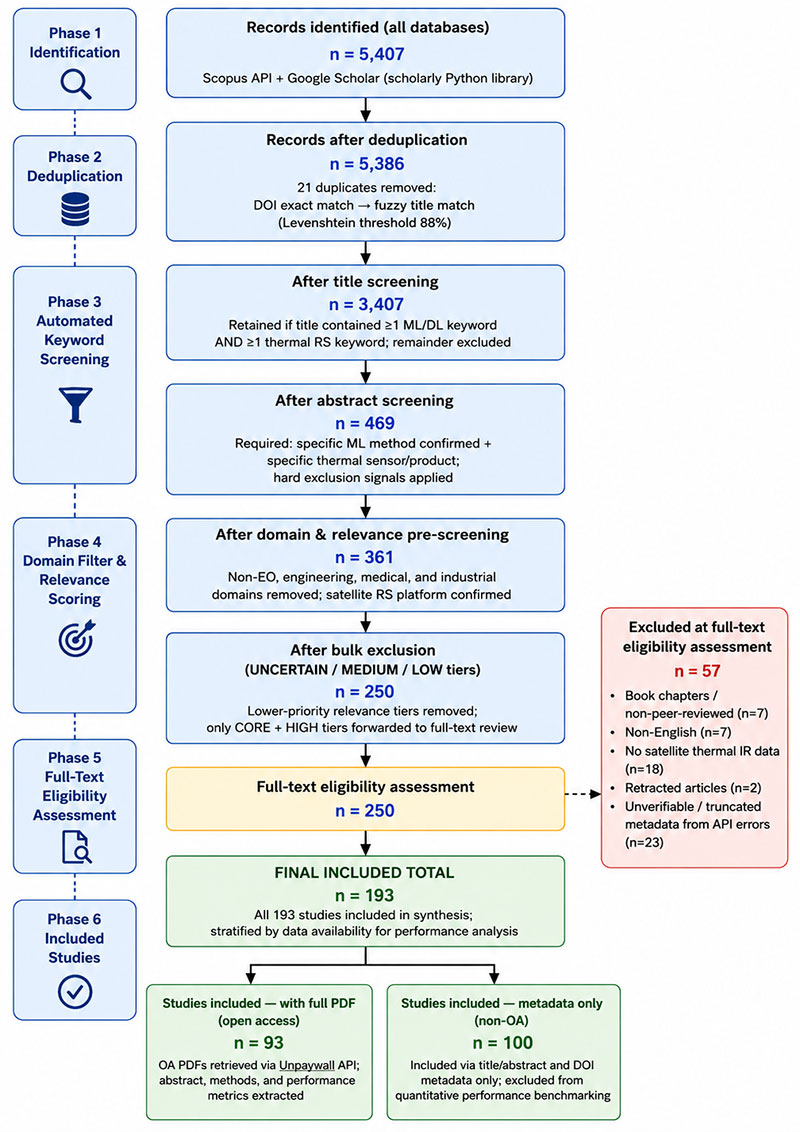
This systematic review, conducted in accordance with the PRISMA 2020 guidelines, maps the applications of machine learning (ML) and deep learning (DL) within thermal remote sensing (RS) from January 2018 to March 2026. Despite significant growth in this field driven by high-resolution satellite missions and open-source frameworks, no comprehensive PRISMA-compliant synthesis has previously focused exclusively on this domain during the post-2018 period. Through a structured search of Scopus and Google Scholar, we identified 193 peer-reviewed studies meeting inclusion criteria, of which 93 provided full-text access for in-depth methodological appraisal and 100 were analyzed at the metadata level. Our analysis reveals a concentrated architectural landscape, with convolutional neural networks (CNNs), long short-term memory networks (LSTM/BiLSTM), and support vector machines/regression (SVR/SVM) predominating. Application-wise, the literature skews heavily toward sea surface temperature (SST) forecasting and land surface temperature (LST) retrieval and downscaling, while critical areas such as wildfire detection, evapotranspiration estimation, and permafrost monitoring remain notably understudied. A key concern is the severe deficit in open science practices: fewer than 5% of the full-text accessible studies reported code availability, raising substantial reproducibility challenges. While the field demonstrates technical maturity, it remains architecturally conservative, presenting clear opportunities for exploring emerging approaches like physics-informed neural networks and transformer-based models. The findings underscore an urgent need for the community to address reproducibility gaps and to expand ML/DL applications into underserved domains, thereby broadening the scientific impact and operational utility of thermal RS in the coming years.
Graphical Abstract
Keywords
Data Availability Statement
Funding
Conflicts of Interest
AI Use Statement
Ethical Approval and Consent to Participate
References
- Li, Z. L., Tang, B. H., Wu, H., Ren, H., Yan, G., Wan, Z., ... & Sobrino, J. A. (2013). Satellite-derived land surface temperature: Current status and perspectives. Remote sensing of environment, 131, 14-37.
[CrossRef] [Google Scholar] - Norman, J. M., & Becker, F. (1995). Terminology in thermal infrared remote sensing of natural surfaces. Agricultural and Forest Meteorology, 77(3-4), 153-166.
[CrossRef] [Google Scholar] - Reynolds, R. W., Rayner, N. A., Smith, T. M., Stokes, D. C., & Wang, W. (2002). An improved in situ and satellite SST analysis for climate. Journal of climate, 15(13), 1609-1625.
[CrossRef] [Google Scholar] - Wan, Z., & Dozier, J. (1996). A generalized split-window algorithm for retrieving land-surface temperature from space. IEEE Transactions on geoscience and remote sensing, 34(4), 892-905.
[CrossRef] [Google Scholar] - Gillespie, A., Rokugawa, S., Matsunaga, T., Cothern, J. S., Hook, S., & Kahle, A. B. (1998). A temperature and emissivity separation algorithm for Advanced Spaceborne Thermal Emission and Reflection Radiometer (ASTER) images. IEEE transactions on geoscience and remote sensing, 36(4), 1113-1126.
[CrossRef] [Google Scholar] - Fisher, J. B., Lee, B., Purdy, A. J., Halverson, G. H., Dohlen, M. B., Cawse‐Nicholson, K., ... & Hook, S. (2020). ECOSTRESS: NASA's next generation mission to measure evapotranspiration from the international space station. Water Resources Research, 56(4), e2019WR026058.
[CrossRef] [Google Scholar] - Xu, S., Wang, D., Liang, S., Jia, A., Li, R., Wang, Z., & Liu, Y. (2024). A novel approach to estimate land surface temperature from Landsat top-of-atmosphere reflective and emissive data using transfer-learning neural network. Science of the Total Environment, 955, 176783.
[CrossRef] [Google Scholar] - Chang, Y., Cao, Y., & Weng, Q. (2024, July). Generating hourly 70-m land surface temperature from goes-r observations: A comparison of statistical downscaling and deep learning methods. In IGARSS 2024-2024 IEEE International Geoscience and Remote Sensing Symposium (pp. 918-920). IEEE.
[CrossRef] [Google Scholar] - He, X., Liu, X., Ru, C., Deng, X., Zhao, R., & Yu, W. (2025). Evaluating spatial representativeness across multiple scales for a comprehensive ground validation network using Landsat land surface temperature data and random forest. IEEE Transactions on Geoscience and Remote Sensing, 63, 1-14.
[CrossRef] [Google Scholar] - LeCun, Y., Bengio, Y., & Hinton, G. (2015). Deep learning. Nature, 521(7553), 436–444.
[CrossRef] [Google Scholar] - Zhu, X. X., Tuia, D., Mou, L., Xia, G. S., Zhang, L., Xu, F., & Fraundorfer, F. (2017). Deep learning in remote sensing: A comprehensive review and list of resources. IEEE geoscience and remote sensing magazine, 5(4), 8-36.
[CrossRef] [Google Scholar] - Ye, X., Wang, P., Zhu, J., Duan, Y., & Yang, B. (2025). Land Surface Temperature end-to-end retrieval considering the topographic effect using radiative transfer model-driven convolutional neural network. IEEE Transactions on Geoscience and Remote Sensing, 63, 1-10.
[CrossRef] [Google Scholar] - Jia, H., Yang, D., Deng, W., Wei, Q., & Jiang, W. (2021). Predicting land surface temperature with geographically weighed regression and deep learning. Wiley Interdisciplinary Reviews: Data Mining and Knowledge Discovery, 11(1), e1396.
[CrossRef] [Google Scholar] - Wang, M., Chen, X., Wang, G., Wang, R., Du, L., & Zhang, Z. (2026). MSDCN-LSTF: A Multiscale and Multidimensional Collaboration Network for Land Surface Temperature Spatiotemporal Fusion Based on Transformer and Convolution. IEEE Transactions on Geoscience and Remote Sensing, 64, 1-22.
[CrossRef] [Google Scholar] - Zhang, H., Hu, T., Tang, B. H., Mallick, K., Zheng, X., Wang, M., ... & Sobrino, J. A. (2025). Deep learning coupled with split window and temperature-emissivity separation (DL-SW-TES) method improves clear-sky high-resolution land surface temperature estimation. ISPRS Journal of Photogrammetry and Remote Sensing, 225, 1-18.
[CrossRef] [Google Scholar] - Fu, Y., Song, J., Guo, J., Fu, Y., & Cai, Y. (2024). Prediction and analysis of sea surface temperature based on LSTM-transformer model. Regional Studies in Marine Science, 78, 103726.
[CrossRef] [Google Scholar] - Song, D., Dai, S., Li, W., Ren, T., Wei, Z., & Liu, A. A. (2024). STVformer: A spatial-temporal-variable transformer with auxiliary knowledge for sea surface temperature prediction. Applied Ocean Research, 153, 104218.
[CrossRef] [Google Scholar] - Rasul, A., Balzter, H., Smith, C., Remedios, J.
[Google Scholar] - Zhou, D., Xiao, J., Bonafoni, S., Berger, C., Deilami, K., Zhou, Y., ... & Sobrino, J. A. (2018). Satellite remote sensing of surface urban heat islands: Progress, challenges, and perspectives. Remote Sensing, 11(1), 48.
[CrossRef] [Google Scholar] - Page, M. J., McKenzie, J. E., Bossuyt, P. M., Boutron, I., Hoffmann, T. C., Mulrow, C. D., ... & Moher, D. (2021). The PRISMA 2020 statement: an updated guideline for reporting systematic reviews. bmj, 372.
[CrossRef] [Google Scholar] - Tanoori, G., Soltani, A., & Modiri, A. (2024). Predicting urban land use and mitigating land surface temperature: Exploring the role of urban configuration with convolutional neural networks. Journal of Urban Planning and Development, 150(3), 04024029.
[CrossRef] [Google Scholar] - Zhang, Z., Mao, K., Zhai, S., & Shi, J. (2026). U-MoE: A Novel Adaptive Mixture-of-Experts U-Net Framework for Land Surface Temperature Reconstruction. IEEE Geoscience and Remote Sensing Letters, 23, 1-5.
[CrossRef] [Google Scholar] - Sun, Z., & Wang, Y. (2025). A coordination attention residual U-Net model for enhanced short and mid-term sea surface temperature prediction. Environmental Modelling & Software, 183, 106251.
[CrossRef] [Google Scholar] - Qi, T., Tang, S., & Ye, H. (2026). RVDCU-Net: A Modular Deep Learning Framework for Spatiotemporal Reconstruction of Satellite-Derived Sea Surface Temperature. Marine Geodesy, 49(3), 439-464.
[CrossRef] [Google Scholar] - Wang, Y., Huang, G., Pan, B., Lin, P., Boers, N., Tao, W., ... & Li, H. (2024). Correcting climate model sea surface temperature simulations with generative adversarial networks: Climatology, interannual variability, and extremes. Advances in Atmospheric Sciences, 41(7), 1299-1312.
[CrossRef] [Google Scholar] - Jalbuena, R., Yee, J. J., Yun, G. Y., & Raj, S. (2025). Addressing landcover bias in spatial downscaling of MODIS land surface temperature using generative adversarial network-based regression model (RGAN). Advances in Space Research, 76(6), 3445–3464.
[CrossRef] [Google Scholar] - Sundar, G., Patchaiammal, P., Lakkshmanan, A., Ramya, S., Pallavi, L., & Thiagarajan, R. (2024). Comprehensive earth system analysis for advancing community resilience: integrating remote sensing with hybrid GAN-RNN techniques. Remote Sensing in Earth Systems Sciences, 7(4), 788-803.
[CrossRef] [Google Scholar] - Barth, A., Alvera-Azcárate, A., Licer, M., & Beckers, J. M. (2020). DINCAE 1.0: A convolutional neural network with error estimates to reconstruct sea surface temperature satellite observations. Geoscientific Model Development, 13(3), 1609–1622.
[CrossRef] [Google Scholar] - Cai, Z., Ren, K., Li, B., Guo, W., Hui, G., & Zhang, X. (2025, June). Study on Sea Surface Temperature Prediction of South China Sea Based on EMD-LSTM. In 2025 IEEE 2nd International Conference on Big Data Science and Engineering (ICBDSE) (pp. 1-6). IEEE.
[CrossRef] [Google Scholar] - Li, R., Zhang, Y., & Chen, X. (2026). Urban land surface temperature prediction by integrating LSTM and geospatial information: A case study of Kunming, China. Journal of Cleaner Production, 548, 147856.
[CrossRef] [Google Scholar] - Yin, H., Zhang, D., Liu, R., & Li, H. (2025). AIGR-LSTM: Land Surface Temperature Interpolation Using Adaptive Inductive Graph Representation Learning. IEEE Geoscience and Remote Sensing Letters, 22, 1-5.
[CrossRef] [Google Scholar] - El Azhary, F. Z., & Minaoui, K. (2025). EDDA-ConvLSTM: Encoder-Decoder Dual Attention ConvLSTM for Moroccan Coastal Sea Surface Temperature Prediction. IEEE Geoscience and Remote Sensing Letters, 22, 1-5.
[CrossRef] [Google Scholar] - Jia, W., Guan, S., & Xue, Y. (2024). TL-iTransformer: Revolutionizing sea surface temperature prediction through iTransformer and transfer learning. Earth Science Informatics, 17(5), 4847-4857.
[CrossRef] [Google Scholar] - Hu, P., Pan, X., Yang, Y., Dai, Y., & Chen, Y. (2025). A two-stage hierarchical spatiotemporal fusion network for land surface temperature with transformer. IEEE Transactions on Geoscience and Remote Sensing, 63, 1-20.
[CrossRef] [Google Scholar] - Guo, Y., Song, J., Cao, X., & Leng, H. (2025). A physics-guided hierarchical transformer framework for sea surface temperature forecasting and marine heatwave detection. IEEE Geoscience and Remote Sensing Letters, 23, 1-5.
[CrossRef] [Google Scholar] - Khalil, M., & Kumar, J. S. (2025). Predictive modeling of land surface temperature dynamics in Damascus, Syria using google earth engine: a remote sensing and random forest approach. Earth Science Informatics, 18(3), 328.
[CrossRef] [Google Scholar] - Shatnawi, N., & Abu Qdais, H. (2019). Mapping urban land surface temperature using remote sensing techniques and artificial neural network modelling. International Journal of Remote Sensing, 40(10), 3968-3983.
[CrossRef] [Google Scholar] - Dong, S., Li, Y., Yin, X., Xu, Q., & Mao, P. (2026). Physics-guided deep learning for global sea surface temperature forecasting: Balancing accuracy and stability across timescales. Geoscience Frontiers, 102255.
[CrossRef] [Google Scholar] - Shi, B., Feng, L., He, H., Hao, Y., Peng, Y., Liu, M., ... & Liu, J. (2024). A physics-guided attention-based neural network for sea surface temperature prediction. IEEE Transactions on Geoscience and Remote Sensing, 62, 1-13.
[CrossRef] [Google Scholar] - Choe, Y. J., & Yom, J. H. (2020). Improving accuracy of land surface temperature prediction model based on deep-learning. Spatial Information Research, 28(3), 377-382.
[CrossRef] [Google Scholar] - Zhang, W., Jia, Z., Li, B., Liu, Q., Zhu, X., Jia, C., & Yu, T. (2024). Research on Landsat 8 land surface temperature retrieval and spatial–temporal migration capabilities based on random forest model. Advances in Space Research, 74(2), 610–627.
[CrossRef] [Google Scholar] - Han, J., Fang, S., Mi, Q., Wang, X., Yu, Y., Zhuo, W., & Peng, X. (2024). A time-continuous land surface temperature (LST) data fusion approach based on deep learning with microwave remote sensing and high-density ground truth observations. Science of the Total Environment, 914, 169992.
[CrossRef] [Google Scholar] - He, Q., Cao, J., Saide, P. E., Ye, T., & Wang, W. (2024). Unraveling the influence of satellite-observed land surface temperature on high-resolution mapping of ground-level ozone using interpretable machine learning. Environmental Science & Technology, 58(36), 15938-15948.
[CrossRef] [Google Scholar] - Qi, J. F., Xie, B. W., Yang, D. Z., Li, D. L., & Yin, B. S. (2024). Deep learning-driven forecasting of daily sea surface temperatures in the South China Sea. In 2024 Photonics & Electromagnetics Research Symposium (PIERS) (pp. 1–6). IEEE.
[CrossRef] [Google Scholar] - Krestenitis, M., Androulidakis, Y., & Krestenitis, Y. (2024). Deep learning-based forecasting of sea surface temperature in the interim future: application over the Aegean, Ionian, and Cretan Seas (NE Mediterranean Sea). Ocean Dynamics, 74(2), 149-168.
[CrossRef] [Google Scholar] - Zhang, T., Lin, P., Liu, H., Wang, P., Wang, Y., Xu, K., ... & Zhao, L. (2025). A coupled transformer-CNN network: Advancing sea surface temperature forecast accuracy. IEEE Transactions on Geoscience and Remote Sensing, 63, 4207414.
[CrossRef] [Google Scholar] - Khalilabadi, M. R., & Sadati, S. (2025). A new hybrid deep learning-based method for sea surface temperature prediction. Ships and Offshore Structures, 1-8.
[CrossRef] [Google Scholar] - Jin, K., He, X., Yang, J., Jin, R., & Fu, F. (2025). Decoupled Dynamic Spatial–Temporal Graph Neural Network for Sea Surface Temperature Prediction. IEEE Geoscience and Remote Sensing Letters, 22, 1-5.
[CrossRef] [Google Scholar] - Zhao, H., He, X., & Li, W. (2026). Dynamic Graph Contrastive Learning Neural Network for Sea Surface Temperature Prediction. IEEE Geoscience and Remote Sensing Letters, 23, 1-5.
[CrossRef] [Google Scholar] - Patil, J., Maithani, S., & Sharma, S. K. (2024). Exploring effect of scale dependency in LST downscaling–using convolution neural network-extreme learning machine (CNN-ELM). Earth Science Informatics, 17(2), 1093-1104.
[CrossRef] [Google Scholar] - ROGALSKI, S., & ILUNGA, M. (2025). Predicting land surface temperature from rainfall and elevation remotely sensed data using random forest machine learning in Google Earth Engine. In Proceedings of the International Multi-Conference on Complexity, Informatics and Cybernetics (IMCIC 2025) (pp. 119-126).
[CrossRef] [Google Scholar] - Khanifar, J., & Khademalrasoul, A. (2022). Modeling of land surface temperature–multiscale curvatures relationship using XGBoost algorithm (Case study: Southwestern Iran). International Journal of Environmental Science and Technology, 19(12), 11763-11774.
[CrossRef] [Google Scholar] - Wei, L., Guan, L., & Zou, R. (2025). The Regional Sea Surface Temperature Analysis With Ultrahigh Resolution Produced by a Deep Learning-Driven Variational Scheme. IEEE Transactions on Geoscience and Remote Sensing, 63, 1-10.
[CrossRef] [Google Scholar] - Zhang, X., Zhang, R., Wang, P., Dong, K., Qu, L., & Jiang, L. (2024, April). Estimation of 1-km all-sky land surface temperature by integration of passive microwave and thermal infrared remote sensing data through random forest. In 2024 Photonics & Electromagnetics Research Symposium (PIERS) (pp. 1-7). IEEE.
[CrossRef] [Google Scholar] - Ge, S., Zhan, W., Li, J., Li, L., Dong, P., Li, X., ... & Gao, Y. (2025). Prediction of next-day 1-km canopy urban heat island by integrating a multi-block convolutional neural network with satellite-and ground-based observations. Sustainable Cities and Society, 106701.
[CrossRef] [Google Scholar] - Singh, A. K., Deepika, C. L., Shahnaz, K. V., Bhagyalakshmi, L., Sharada, K., Sarupriya, S., & Suman, S. K. (2025). Hybrid Xception-LSTM Model for Remote Sensing: Advanced Urban Heat Island and Land Use Analysis. Remote Sensing in Earth Systems Sciences, 8(1), 132-144.
[CrossRef] [Google Scholar] - Lin, H. (2025). Urban heat island distribution observation by integrating remote sensing technology and deep learning. International Journal of Image and Data Fusion, 16(1), 1-17.
[CrossRef] [Google Scholar] - Gong, P., Lan, L., Guo, C., & Guo, R. (2025). A spatiotemporal deep learning approach to enhance air temperature estimation based on the sole input of land surface temperature. Journal of Cleaner Production, 532, 146887.
[CrossRef] [Google Scholar] - Li, J. (2024). Evaluating the correlation between impacting factors and land surface temperature via spatial regression model and random forest. The Professional Geographer, 76(6), 740-755.
[CrossRef] [Google Scholar] - Lu, Y., Cheng, X., Yang, Y., & Wang, H. (2025). Thresholds and synergies: how 3D urban configurations shape thermal environment optimization in Chengdu's core—a multidimensional analysis with ECOSTRESS and Random Forest. Energy and Buildings, 116815.
[CrossRef] [Google Scholar] - Chen, K., Tian, M., Zhang, J., Xu, X., & Yuan, L. (2023). Evaluating the seasonal effects of building form and street view indicators on street-level land surface temperature using random forest regression. Building and Environment, 245, 110884.
[CrossRef] [Google Scholar] - Jawad, M., Behrangi, A., Farmani, M. A., Qiu, Y., Sohi, H. Y., Gupta, A., & Niu, G. Y. (2025). Improved evapotranspiration estimation using the Penman-Monteith equation with a deep learning (DNN) model over the dry southwestern US: Comparison with ECOSTRESS, MODIS, and OpenET. Journal of Hydrology, 660, 133460.
[CrossRef] [Google Scholar] - Zhao, G., Song, L., Zhao, L., & Tao, S. (2024). A comparison of different machine learning methods to reconstruct daily evapotranspiration time series estimated by thermal–infrared remote sensing. Remote Sensing, 16(3), 509.
[CrossRef] [Google Scholar] - Karimian, R., Rangzan, K., Karimi, D., & Einali, G. (2024). Spatiotemporal monitoring of land use-land cover and its relationship with land surface temperature changes based on remote sensing, GIS, and deep learning. Journal of the Indian Society of Remote Sensing, 52(11), 2461-2481.
[CrossRef] [Google Scholar] - Li, J., Yan, Y., & Stouffs, R. (2025). Simulating land surface temperature impacts of proposed land use and land cover plans using an integrated deep neural network approach. Energy and Buildings, 332, 115437.
[CrossRef] [Google Scholar] - Wang, J., Zhang, N., Zhang, L., Jing, H., Yan, Y., Wu, S., & Liu, R. (2024). Spatial downscaling of nighttime land surface temperature based on geographically neural network weighted regression kriging. Remote Sensing, 16(14), 2542.
[CrossRef] [Google Scholar] - Liang, M., Zhang, L., Wu, S., Zhu, Y., Dai, Z., Wang, Y., ... & Du, Z. (2023). A high-resolution land surface temperature downscaling method based on geographically weighted neural network regression. Remote Sensing, 15(7), 1740.
[CrossRef] [Google Scholar] - Khedher, I., Favreau, J. M., Miguet, S., & Gesquière, G. (2023, December). A multimodal deep learning approach for high-resolution Land Surface Temperature estimation. In International Conference on Applied Soft Computing and Communication Networks (pp. 363-377). Singapore: Springer Nature Singapore.
[CrossRef] [Google Scholar] - Wang, H., Mao, K., Yuan, Z., Shi, J., Cao, M., Qin, Z., ... & Tang, B. (2021). A method for land surface temperature retrieval based on model-data-knowledge-driven and deep learning. Remote sensing of environment, 265, 112665.
[CrossRef] [Google Scholar] - Lan, X., & Yang, X. (2023). Retrieving land surface temperatures from IASI hyperspectral thermal infrared data using an AFNO-transformer model. Optics Express, 31(24), 40249-40260.
[CrossRef] [Google Scholar] - Fu, H., Shao, Z., Fu, P., Huang, X., Cheng, T., & Fan, Y. (2022). Combining ATC and 3D-CNN for reconstructing spatially and temporally continuous land surface temperature. International Journal of Applied Earth Observation and Geoinformation, 108, 102733.
[CrossRef] [Google Scholar] - Rani, B. S., Narayanan, D. S., Jasmine, M. S., Krishnamoorthy, N. R., Raman, M. R., Lotliker, A. A., & Chatterjee, A. (2025). Deep learning for sea surface temperature prediction in the Indian Ocean: A comparative study using 1D-CNN, LSTM, 1DCNN-LSTM and attention based 1DCNN-LSTM architectures. Dynamics of Atmospheres and Oceans, 101632.
[CrossRef] [Google Scholar] - Xu, T., Zhou, Z., Li, Y., Wang, C., Liu, Y., & Rong, T. (2023). Short-term prediction of global sea surface temperature using deep learning networks. Journal of Marine Science and Engineering, 11(7), 1352.
[CrossRef] [Google Scholar] - Jiao, Y., Li, G., Zhao, P., Chen, X., Cao, Y., Liu, G., ... & Ji, C. (2024). Construction of sea surface temperature forecasting model for Bohai Sea and Yellow Sea coastal stations based on long short-time memory neural network. Water, 16(16), 2307.
[CrossRef] [Google Scholar] - Xie, B., Qi, J., Yang, S., Sun, G., Feng, Z., Yin, B., & Wang, W. (2024). Sea surface temperature and marine heat wave predictions in the South China Sea: A 3D U-Net deep learning model integrating multi-source data. Atmosphere, 15(1), 86.
[CrossRef] [Google Scholar] - Ji, Q., Jia, X., Jiang, L., Xie, M., Meng, Z., Wang, Y., & Lin, X. (2024). Contribution of atmospheric factors in predicting sea surface temperature in the East China Sea using the Random Forest and SA-ConvLSTM Model. Atmosphere, 15(6), 670.
[CrossRef] [Google Scholar] - Fan, D., Yang, X., He, H., He, H., & Fu, B. (2025). Bridging the cloud gap: AHI/ATMS synergy through CNN feature fusion for all-weather SST retrieval. International Journal of Applied Earth Observation and Geoinformation, 144, 104887.
[CrossRef] [Google Scholar] - Putra, D. P., & Hsu, P. C. (2024). Leveraging Transfer Learning and U-Nets Method for Improved Gap Filling in Himawari Sea Surface Temperature Data Adjacent to Taiwan. ISPRS International Journal of Geo-Information, 13(5), 162.
[CrossRef] [Google Scholar] - Tan, J., NourEldeen, N., Mao, K., Shi, J., Li, Z., Xu, T., & Yuan, Z. (2019). Deep learning convolutional neural network for the retrieval of land surface temperature from AMSR2 data in China. Sensors, 19(13), 2987.
[CrossRef] [Google Scholar] - Kporha, V. K., Fox, D. M., Banitalebi, M., Bouroubi, Y., & Fournier, R. (2026). Comparing daily and 8-day MODIS land surface temperature data for urban heat island assessment using random forest modeling in data-limited regions. Remote Sensing Applications: Society and Environment, 101904.
[CrossRef] [Google Scholar] - He, T., Liu, F., Wang, A., & Fei, Z. (2023). Estimating monthly surface air temperature using MODIS LST data and an artificial neural network in the Loess Plateau, China. Chinese Geographical Science, 33(4), 751-763.
[CrossRef] [Google Scholar] - Goh, E., Yepremyan, A., Wang, J., & Wilson, B. (2024). MAESSTRO: masked autoencoders for sea surface temperature reconstruction under occlusion. Ocean Science, 20(5), 1309-1323.
[CrossRef] [Google Scholar] - Shi, B., Lin, H., Zhu, Y., He, H., Tan, Q., Peng, Y., & Liu, J. (2026). CA-ConvLSTM: A Cross-Attention-Based Deep Learning Framework for Joint Prediction of Sea Surface Temperature and Sea Level Anomaly. IEEE Journal of Selected Topics in Applied Earth Observations and Remote Sensing, 19, 7714-7725.
[CrossRef] [Google Scholar] - Ji, C., Xu, W., Zheng, X., Ahmed, Y., Jamal, S. A., Imam, F., ... & Kucher, D. E. (2025). Transformer-based deep learning for mesoscale eddy detection in sea surface temperature maps. IEEE Journal of Selected Topics in Applied Earth Observations and Remote Sensing, 18, 15249-15264.
[CrossRef] [Google Scholar] - Liang, Q., Pan, Z., Zhang, X., Ye, Z., Zhao, Z., & Guo, S. (2025). Vision Transformer Applied for Time Series Based Prediction of Sea Surface Temperature. IEEE Access, 13, 143509-143521.
[CrossRef] [Google Scholar] - Wang, M., Liu, W., Chu, R., Wang, X., Zhu, S., & Liao, G. (2026). HiT_DS: A modular and physics-informed hierarchical transformer framework for spatial downscaling of sea surface temperature and height. Remote Sensing, 18(2), 292.
[CrossRef] [Google Scholar]
Cite This Article
TY  - JOUR
AU  - Rasul, Azad
PY  - 2026
DA  - 2026/09/20
TI  - Machine Learning and Deep Learning Approaches in Thermal Remote Sensing: A Systematic Review (2018–2026)
JO  - Journal of Geoscience and Earth Observation
T2  - Journal of Geoscience and Earth Observation
JF  - Journal of Geoscience and Earth Observation
VL  - 1
IS  - 2
SP  - 137
EP  - 157
DO  - 10.62762/JGEO.2026.270724
UR  - https://www.icck.org/article/abs/JGEO.2026.270724
KW  - thermal remote sensing
KW  - machine learning
KW  - deep learning
KW  - land surface temperature
KW  - PRISMA 2020
KW  - convolutional neural network
AB  - This systematic review, conducted in accordance with the PRISMA 2020 guidelines, maps the applications of machine learning (ML) and deep learning (DL) within thermal remote sensing (RS) from January 2018 to March 2026. Despite significant growth in this field driven by high-resolution satellite missions and open-source frameworks, no comprehensive PRISMA-compliant synthesis has previously focused exclusively on this domain during the post-2018 period. Through a structured search of Scopus and Google Scholar, we identified 193 peer-reviewed studies meeting inclusion criteria, of which 93 provided full-text access for in-depth methodological appraisal and 100 were analyzed at the metadata level. Our analysis reveals a concentrated architectural landscape, with convolutional neural networks (CNNs), long short-term memory networks (LSTM/BiLSTM), and support vector machines/regression (SVR/SVM) predominating. Application-wise, the literature skews heavily toward sea surface temperature (SST) forecasting and land surface temperature (LST) retrieval and downscaling, while critical areas such as wildfire detection, evapotranspiration estimation, and permafrost monitoring remain notably understudied. A key concern is the severe deficit in open science practices: fewer than 5% of the full-text accessible studies reported code availability, raising substantial reproducibility challenges. While the field demonstrates technical maturity, it remains architecturally conservative, presenting clear opportunities for exploring emerging approaches like physics-informed neural networks and transformer-based models. The findings underscore an urgent need for the community to address reproducibility gaps and to expand ML/DL applications into underserved domains, thereby broadening the scientific impact and operational utility of thermal RS in the coming years.
SN  - pending
PB  - Institute of Central Computation and Knowledge
LA  - English
ER  -
@article{Rasul2026Machine,
  author = {Azad Rasul},
  title = {Machine Learning and Deep Learning Approaches in Thermal Remote Sensing: A Systematic Review (2018–2026)},
  journal = {Journal of Geoscience and Earth Observation},
  year = {2026},
  volume = {1},
  number = {2},
  pages = {137-157},
  doi = {10.62762/JGEO.2026.270724},
  url = {https://www.icck.org/article/abs/JGEO.2026.270724},
  abstract = {This systematic review, conducted in accordance with the PRISMA 2020 guidelines, maps the applications of machine learning (ML) and deep learning (DL) within thermal remote sensing (RS) from January 2018 to March 2026. Despite significant growth in this field driven by high-resolution satellite missions and open-source frameworks, no comprehensive PRISMA-compliant synthesis has previously focused exclusively on this domain during the post-2018 period. Through a structured search of Scopus and Google Scholar, we identified 193 peer-reviewed studies meeting inclusion criteria, of which 93 provided full-text access for in-depth methodological appraisal and 100 were analyzed at the metadata level. Our analysis reveals a concentrated architectural landscape, with convolutional neural networks (CNNs), long short-term memory networks (LSTM/BiLSTM), and support vector machines/regression (SVR/SVM) predominating. Application-wise, the literature skews heavily toward sea surface temperature (SST) forecasting and land surface temperature (LST) retrieval and downscaling, while critical areas such as wildfire detection, evapotranspiration estimation, and permafrost monitoring remain notably understudied. A key concern is the severe deficit in open science practices: fewer than 5\% of the full-text accessible studies reported code availability, raising substantial reproducibility challenges. While the field demonstrates technical maturity, it remains architecturally conservative, presenting clear opportunities for exploring emerging approaches like physics-informed neural networks and transformer-based models. The findings underscore an urgent need for the community to address reproducibility gaps and to expand ML/DL applications into underserved domains, thereby broadening the scientific impact and operational utility of thermal RS in the coming years.},
  keywords = {thermal remote sensing, machine learning, deep learning, land surface temperature, PRISMA 2020, convolutional neural network},
  issn = {pending},
  publisher = {Institute of Central Computation and Knowledge}
}
Article Metrics
Publisher's Note
ICCK stays neutral with regard to jurisdictional claims in published maps and institutional affiliations.
Rights and Permissions
 Copyright © 2026 by the Author(s). Published by Institute of Central Computation and Knowledge. This article is an open access article distributed under the terms and conditions of the Creative Commons Attribution (CC BY) license (https://creativecommons.org/licenses/by/4.0/), which permits use, sharing, adaptation, distribution and reproduction in any medium or format, as long as you give appropriate credit to the original author(s) and the source, provide a link to the Creative Commons licence, and indicate if changes were made.


Portico
