

The Integration of Stiff Systems of Ordinary Differential Equations Using a Time-Stepping Algorithm with Off-Step Points





Article Information
Abstract
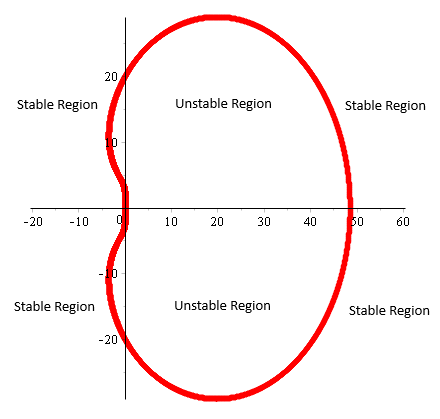
Stiff systems of ordinary differential equations (ODEs) arise frequently in science, engineering, and applied mathematics, and their numerical solutions require methods with strong stability properties to avoid severe step-size restrictions. This motivates the development of efficient and stable numerical schemes tailored for such problems. In this paper, a fully implicit hybrid block method, termed the Two-Point Superclass Block Backward Differentiation Formula with Off-step Points (2SBBDFO), is proposed for solving stiff ODE systems. The method extends the classical two-point block BDF by incorporating a non-zero coefficient $\beta_{k-1}$, enabling the simultaneous computation of two grid-point and two off-step solution values within each block. Theoretical analysis shows that the method is consistent, zero-stable, and convergent, with order-five accuracy. Stability analysis using the boundary-locus technique confirms that the method is nearly A-stable (A($\alpha$)-stable). The resulting nonlinear system is solved using Newton's iteration for efficient convergence. Numerical experiments on selected stiff initial value problems (IVPs) demonstrate that the method achieves higher accuracy and competitive computational efficiency compared to existing block BDF methods, particularly for smaller step sizes. These results indicate that the 2SBBDFO method is an effective and reliable tool for solving stiff ODEs.
Graphical Abstract
Keywords
Data Availability Statement
Funding
Conflicts of Interest
AI Use Statement
Ethical Approval and Consent to Participate
References
- Suleiman, M. B., Musa, H., Ismail, F., Senu, N., & Ibrahim, Z. B. (2014). A new superclass of block backward differentiation formula for stiff ordinary differential equations. Asian-european journal of mathematics, 7(01), 1350034.
[CrossRef] [Google Scholar] - Curtiss, C. F., & Hirschfelder, J. O. (1952). Integration of stiff equations. Proceedings of the national academy of sciences, 38(3), 235-243.
[CrossRef] [Google Scholar] - Wanner, G., & Hairer, E. (1996). Solving ordinary differential equations II (Vol. 375, p. 98). New York: Springer Berlin Heidelberg.
[CrossRef] [Google Scholar] - Gear, C. W. (1971). Numerical initial value problems in ordinary differential equations. Prentice Hall PTR. https://dl.acm.org/doi/abs/10.5555/540426
[Google Scholar] - Cash, J. R. (2000). Modified extended backward differentiation formulae for the numerical solution of stiff initial value problems in ODEs and DAEs. Journal of Computational and Applied Mathematics, 125(1-2), 117-130.
[CrossRef] [Google Scholar] - Cash, J. R. (1980). On the integration of stiff systems of ODEs using extended backward differentiation formulae. Numerische Mathematik, 34(3), 235-246.
[CrossRef] [Google Scholar] - Ibrahim, Z. B., Othman, K. I., & Suleiman, M. (2007). Implicit r-point block backward differentiation formula for solving first-order stiff ODEs. Applied Mathematics and Computation, 186(1), 558-565.
[CrossRef] [Google Scholar] - Abasi, N., Suleiman, M., Abbasi, N., & Musa, H. (2014). 2-point block BDF method with off-step points for solving stiff ODEs. Journal of Soft Computing and Applications, 2014, 1-15.
[CrossRef] [Google Scholar] - Zawawi, I. S. M., Ibrahim, Z. B., & Othman, K. I. (2015). Derivation of diagonally implicit block backward differentiation formulas for solving stiff initial value problems. Mathematical Problems in Engineering, 2015, 1--13.
[CrossRef] [Google Scholar] - Musa, H., & Alhassan, B. (2025, December). Fully implicit 2-point super class of block extended backward differentiation formula for solving stiff ordinary differential equations. In AIP Conference Proceedings (Vol. 3338, No. 1, p. 040002). AIP Publishing LLC.
[CrossRef] [Google Scholar] - Yatim, S. A. M., Ibrahim, Z. B., Othman, K. I., & Suleiman, M. B. (2011). A quantitative comparison of numerical method for solving stiff ordinary differential equations. Mathematical Problems in Engineering, 2011(1), 193691.
[CrossRef] [Google Scholar] - Widlund, O. B. (1967). A note on unconditionally stable linear multistep methods. BIT Numerical Mathematics, 7(1), 65-70.
[CrossRef] [Google Scholar] - Enright, W. H. (1974). Second derivative multistep methods for stiff ordinary differential equations. SIAM Journal on Numerical Analysis, 11(2), 321-331.
[CrossRef] [Google Scholar] - Butcher, J. C. (2016). Numerical methods for ordinary differential equations. John Wiley & Sons.
[CrossRef] [Google Scholar] - Iserles, A. (2009). A First Course in the Numerical Analysis of Differential Equations (2nd ed.). Cambridge University Press, Cambridge.
[CrossRef] [Google Scholar] - Ibrahim, Z.~B., Suleiman, M.~B., & Othman, K.~I. (2008). Fixed coefficients block backward differentiation formulas for the numerical solution of stiff ordinary differential equations. European Journal of Scientific Research, 21(3), 508-520. https://www.researchgate.net/publication/265475902
[Google Scholar] - Abdulrahman, A., & Hamisu, M. (2025). An Improved Extended 2-Point Super Class of Block Backward Differentiation Formula for Solving Stiff Initial Value Problems. Journal of Science and Technology, 17(1), 11-22.
[CrossRef] [Google Scholar] - Ibrahim, Z. B., Mohd Noor, N., & Othman, K. I. (2019). Fixed coefficient A ($\alpha$) stable block backward differentiation formulas for stiff ordinary differential equations. Symmetry, 11(7), 846.
[CrossRef] [Google Scholar] - Henrici, P. (1962). Discrete variable methods in ordinary differential equations. New York: Wiley. https://archive.org/details/discretevariable0000henr/page/n3/mode/2up
[Google Scholar] - Lambert, J.~D. (1973). Computational Methods in Ordinary Differential Equations. John Wiley & Sons, London. https://archive.org/details/computationalmet0000lamb/page/n5/mode/2up
[Google Scholar] - Lambert, J. D. (1991). Numerical methods for ordinary differential systems: the initial value problem. John Wiley & Sons, Inc.. https://dl.acm.org/doi/abs/10.5555/129839
[Google Scholar] - Dahlquist, G. (1956). Convergence and stability in the numerical integration of ordinary differential equations. Mathematica Scandinavica, 33-53.
[CrossRef] [Google Scholar] - Fatunla, S. O. (1991). Block methods for second-order ODEs. International Journal of Computer Mathematics, 40, 55--63.
[CrossRef] [Google Scholar] - Hairer, E., Wanner, G., & Nørsett, S. P. (1993). Solving ordinary differential equations I: Nonstiff problems. Berlin, Heidelberg: Springer Berlin Heidelberg.
[CrossRef] [Google Scholar] - Nasir, N. A. A. M., Ibrahim, Z. B., Othman, K. I., & Suleiman, M. (2012). Numerical solution of first order stiff ordinary differential equations using fifth order block backward differentiation formulas. Sains Malaysiana, 41(4), 489-492. https://www.ukm.my/jsm/pdf_files/SM-PDF-41-4-2012/15%20Nor%20Ain.pdf
[Google Scholar] - Cheney, W., & Kincaid, D. (1998). Numerical mathematics and computing. International Thomson Publishing. https://dl.acm.org/doi/abs/10.5555/552652
[Google Scholar] - Enright, W. H., Hull, T. E., & Lindberg, B. (1975). Comparing numerical methods for stiff systems of ODE: s. BIT Numerical Mathematics, 15(1), 10-48.
[CrossRef] [Google Scholar]
Cite This Article
TY  - JOUR
AU  - Abdulrahman, Adamu
AU  - Alhassan, Buhari
AU  - Hamisu, Musa
AU  - Kantsi, Abubakar Kabiru
PY  - 2026
DA  - 2026/09/18
TI  - The Integration of Stiff Systems of Ordinary Differential Equations Using a Time-Stepping Algorithm with Off-Step Points
JO  - Journal of Numerical Simulations in Physics and Mathematics
T2  - Journal of Numerical Simulations in Physics and Mathematics
JF  - Journal of Numerical Simulations in Physics and Mathematics
VL  - 2
IS  - 2
SP  - 104
EP  - 116
DO  - 10.62762/JNSPM.2026.264715
UR  - https://www.icck.org/article/abs/JNSPM.2026.264715
KW  - Stiff ODEs
KW  - Block Methods
KW  - Backward Differentiation Formula
KW  - A-stability
KW  - Newton Iteration
AB  - Stiff systems of ordinary differential equations (ODEs) arise frequently in science, engineering, and applied mathematics, and their numerical solutions require methods with strong stability properties to avoid severe step-size restrictions. This motivates the development of efficient and stable numerical schemes tailored for such problems. In this paper, a fully implicit hybrid block method, termed the Two-Point Superclass Block Backward Differentiation Formula with Off-step Points (2SBBDFO), is proposed for solving stiff ODE systems. The method extends the classical two-point block BDF by incorporating a non-zero coefficient $\beta_{k-1}$, enabling the simultaneous computation of two grid-point and two off-step solution values within each block. Theoretical analysis shows that the method is consistent, zero-stable, and convergent, with order-five accuracy. Stability analysis using the boundary-locus technique confirms that the method is nearly A-stable (A($\alpha$)-stable). The resulting nonlinear system is solved using Newton's iteration for efficient convergence. Numerical experiments on selected stiff initial value problems (IVPs) demonstrate that the method achieves higher accuracy and competitive computational efficiency compared to existing block BDF methods, particularly for smaller step sizes. These results indicate that the 2SBBDFO method is an effective and reliable tool for solving stiff ODEs.
SN  - 3068-9082
PB  - Institute of Central Computation and Knowledge
LA  - English
ER  -
@article{Abdulrahman2026The,
  author = {Adamu Abdulrahman and Buhari Alhassan and Musa Hamisu and Abubakar Kabiru Kantsi},
  title = {The Integration of Stiff Systems of Ordinary Differential Equations Using a Time-Stepping Algorithm with Off-Step Points},
  journal = {Journal of Numerical Simulations in Physics and Mathematics},
  year = {2026},
  volume = {2},
  number = {2},
  pages = {104-116},
  doi = {10.62762/JNSPM.2026.264715},
  url = {https://www.icck.org/article/abs/JNSPM.2026.264715},
  abstract = {Stiff systems of ordinary differential equations (ODEs) arise frequently in science, engineering, and applied mathematics, and their numerical solutions require methods with strong stability properties to avoid severe step-size restrictions. This motivates the development of efficient and stable numerical schemes tailored for such problems. In this paper, a fully implicit hybrid block method, termed the Two-Point Superclass Block Backward Differentiation Formula with Off-step Points (2SBBDFO), is proposed for solving stiff ODE systems. The method extends the classical two-point block BDF by incorporating a non-zero coefficient \$\beta\_{k-1}\$, enabling the simultaneous computation of two grid-point and two off-step solution values within each block. Theoretical analysis shows that the method is consistent, zero-stable, and convergent, with order-five accuracy. Stability analysis using the boundary-locus technique confirms that the method is nearly A-stable (A(\$\alpha\$)-stable). The resulting nonlinear system is solved using Newton's iteration for efficient convergence. Numerical experiments on selected stiff initial value problems (IVPs) demonstrate that the method achieves higher accuracy and competitive computational efficiency compared to existing block BDF methods, particularly for smaller step sizes. These results indicate that the 2SBBDFO method is an effective and reliable tool for solving stiff ODEs.},
  keywords = {Stiff ODEs, Block Methods, Backward Differentiation Formula, A-stability, Newton Iteration},
  issn = {3068-9082},
  publisher = {Institute of Central Computation and Knowledge}
}
Article Metrics
Publisher's Note
ICCK stays neutral with regard to jurisdictional claims in published maps and institutional affiliations.
Rights and Permissions
 Copyright © 2026 by the Author(s). Published by Institute of Central Computation and Knowledge. This article is an open access article distributed under the terms and conditions of the Creative Commons Attribution (CC BY) license (https://creativecommons.org/licenses/by/4.0/), which permits use, sharing, adaptation, distribution and reproduction in any medium or format, as long as you give appropriate credit to the original author(s) and the source, provide a link to the Creative Commons licence, and indicate if changes were made.


Portico
