

Mathematical Modeling and NSFD Numerical Investigation of Rabies Transmission Dynamics with Immigration Factors



Article Information
Abstract
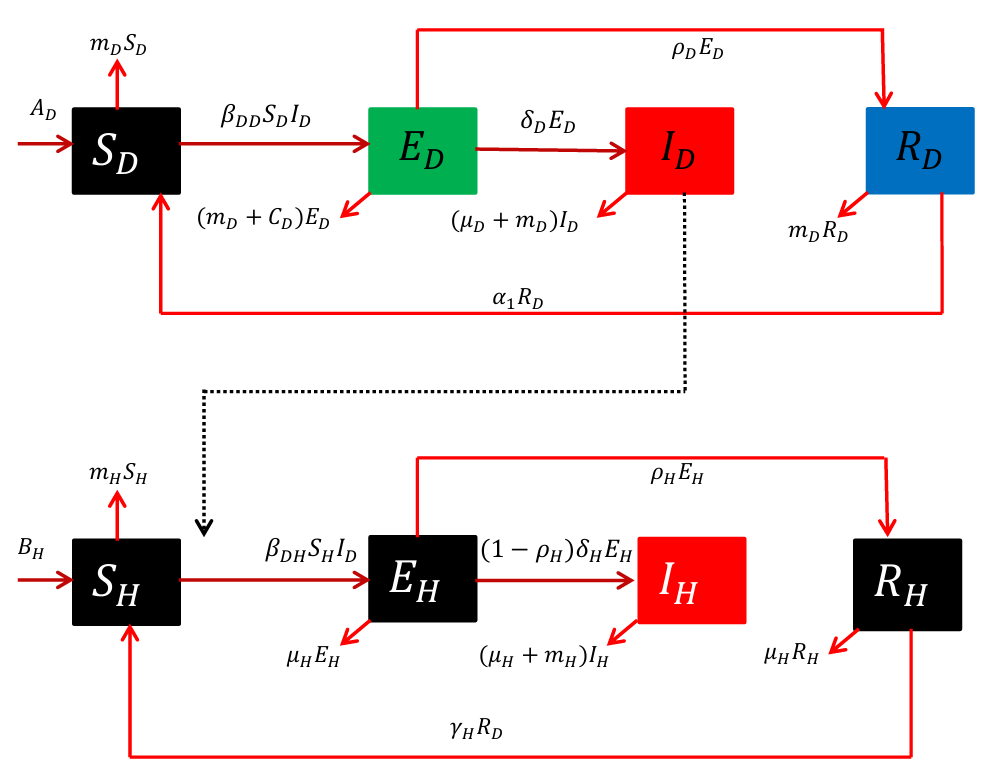
In this study, a compartmental mathematical model is developed to study the rabies transmission process from dog to human. The model consists of eight compartments: susceptible, exposed, infected, recovered groups for dogs and humans $(S_D, E_D, I_D, R_D, S_H, E_H, I_H, R_H)$. The basic reproduction number $R_0$ is derived, and sensitivity analysis is performed to identify the most influential epidemiological parameters. Disease-free equilibrium stability analysis is also carried out to identify the conditions for rabies eradication. One of the main goals of this work is to compare the disease dynamics in vaccinated and unvaccinated cases, which is carried out with the support of numerical simulations. Both the fourth-order Runge--Kutta (RK4) and Nonstandard Finite Difference (NSFD) methods are used to solve the system. Numerical simulations demonstrate that vaccination substantially reduces the infected populations and increases the partially immune populations in both species. Furthermore, the importance of the transmission rate $\beta_{DH}$ of the dog to human transmission is explored to gain insight into the role of this transmission route in the incidence of human rabies. In general, the results point to vaccination as a very potent control measure and show that NSFD method maintains the qualitative features of the system and yields results similar to the classical RK4 method.
Graphical Abstract
Keywords
Data Availability Statement
Funding
Conflicts of Interest
AI Use Statement
Ethical Approval and Consent to Participate
References
- Younas, H., Ahmad, I., Ali, N., Haq, I. U., Albalwi, M. D., Muhammad, S., Shuaib, S., & Muhammad, M. (2024). Modeling rabies dynamics: The impact of vaccination and infectious immigrants on public health. Contemporary Mathematics, 3255-3279.
[CrossRef] [Google Scholar] - WHO Rabies Modelling Consortium. (2020). Zero human deaths from dog-mediated rabies by 2030: perspectives from quantitative and mathematical modelling. Gates Open Research, 3, 1564.
[CrossRef] [Google Scholar] - Hankins, D. G., & Rosekrans, J. A. (2004). Overview, prevention, and treatment of rabies. Mayo Clinic Proceedings, 79(5), 671-676.
[CrossRef] [Google Scholar] - Demirci, E. (2014). A new mathematical approach for rabies endemy. Applied Mathematical Sciences, 8(2), 59-67. http://dx.doi.org/10.12988/ams.2014.39525
[Google Scholar] - Layan, M., Dellicour, S., Baele, G., Cauchemez, S., & Bourhy, H. (2021). Mathematical modelling and phylodynamics for the study of dog rabies dynamics and control: A scoping review. PLOS Neglected Tropical Diseases, 15(5), e0009449.
[CrossRef] [Google Scholar] - Jehangir, H., Ali, N., Ahmad, I., Younas, H., Ahmad, Z., & El-Agamy, R. F. (2024). Global dynamics and numerical simulation of a vaccinated mathematical model for rabies disease. Global Journal of Sciences, 1(1), 14-27.
[CrossRef] [Google Scholar] - Hailemichael, D. D., Edessa, G. K., & Koya, P. R. (2023). Mathematical modeling of dog rabies transmission dynamics using optimal control analysis. Contemporary Mathematics, 296-319.
[CrossRef] [Google Scholar] - Charles, M., Masanja, V. G., Torres, D. F., Mfinanga, S. G., & Lyakurwa, G. A. (2024). Mathematical model to assess the impact of contact rate and environment factor on transmission dynamics of rabies in humans and dogs. Heliyon, 10(11).
[CrossRef] [Google Scholar] - Zarin, R., Raouf, A., Humphries, U. W., & Khan, A. (2023). Numerical solutions of fractional order rabies mathematical model via Newton polynomial. Alexandria Engineering Journal, 77, 419-434.
[CrossRef] [Google Scholar] - Abdulmajid, S., & Hassan, A. S. (2021). Analysis of time delayed rabies model in human and dog populations with controls. Afrika Matematika, 32(5), 1067-1085.
[CrossRef] [Google Scholar] - Panjeti, V. G., & Real, L. A. (2011). Mathematical models for rabies. Advances in Virus Research, 79, 377-395.
[CrossRef] [Google Scholar] - Huang, Y., & Li, M. (2020). Application of a mathematical model in determining the spread of the rabies virus: Simulation study. JMIR Medical Informatics, 8(5), e18627.
[CrossRef] [Google Scholar] - Kadowaki, H., Hampson, K., Tojinbara, K., Yamada, A., & Makita, K. (2018). The risk of rabies spread in Japan: A mathematical modelling assessment. Epidemiology and Infection, 146(10), 1245-1252.
[CrossRef] [Google Scholar] - Jothi, N. K., Muruganandham, A., Kumar, P. S., & Dayalan, S. K. (2025). Modeling rabies transmission dynamics with fractional order analysis: Examining stability, susceptibility, and vaccination impact. AIP Advances, 15(5).
[CrossRef] [Google Scholar] - Sinan, M., & Khan, A. (2020). Analytic approximate solution of rabies transmission dynamics using homotopy perturbation method. Matrix Science Mathematics (MSMK), 4(1), 01-05. http://doi.org/10.26480/msmk.01.2020.01.05
[Google Scholar] - Pantha, B., Joshi, H. R., & Vaidya, N. K. (2020). Controlling rabies epidemics in Nepal with limited resources: Optimal control theory approach. Mathematics in Applied Sciences and Engineering, 1(4).
[CrossRef] [Google Scholar] - Zhang, J., Jin, Z., Sun, G. Q., Zhou, T., & Ruan, S. (2011). Analysis of rabies in China: transmission dynamics and control. PLoS one, 6(7), e20891.
[CrossRef] [Google Scholar] - Hampson, K., Dushoff, J., Cleaveland, S., Haydon, D. T., Kaare, M., Packer, C., & Dobson, A. (2009). Transmission dynamics and prospects for the elimination of canine rabies. PLoS biology, 7(3), e1000053.
[CrossRef] [Google Scholar] - Minghui, R., Stone, M., Semedo, M. H., & Nel, L. (2018). New global strategic plan to eliminate dog-mediated rabies by 2030. The Lancet global health, 6(8), e828-e829.
[CrossRef] [Google Scholar] - Van den Driessche, P., & Watmough, J. (2002). Reproduction numbers and sub-threshold endemic equilibria for compartmental models of disease transmission. Mathematical biosciences, 180(1-2), 29-48.
[CrossRef] [Google Scholar] - Chitnis, N., Hyman, J. M., & Cushing, J. M. (2008). Determining important parameters in the spread of malaria through the sensitivity analysis of a mathematical model. Bulletin of mathematical biology, 70(5), 1272-1296.
[CrossRef] [Google Scholar] - Castillo-Chavez, C., & Song, B. (2004). Dynamical models of tuberculosis and their applications. Mathematical biosciences and engineering, 1(2), 361. https://www.aimspress.com/aimspress-data/mbe/2004/2/PDF/1551-0018_2004_2_361.pdf
[Google Scholar] - Mickens, R. E. (Ed.). (1993). Nonstandard finite difference models of differential equations. World scientific.
[CrossRef] [Google Scholar] - Mehdizadeh Khalsaraei, M., Shokri, A., Noeiaghdam, S., & Molayi, M. (2021). Nonstandard finite difference schemes for an SIR epidemic model. Mathematics, 9(23), 3082.
[CrossRef] [Google Scholar]
Cite This Article
TY  - JOUR
AU  - Younas, Hazrat
AU  - Ahmad, Imtiaz
AU  - Haq, Naseer Ul
AU  - Rahman, Azizur
AU  - Ullah, Hanif
PY  - 2026
DA  - 2026/09/30
TI  - Mathematical Modeling and NSFD Numerical Investigation of Rabies Transmission Dynamics with Immigration Factors
JO  - Journal of Numerical Simulations in Physics and Mathematics
T2  - Journal of Numerical Simulations in Physics and Mathematics
JF  - Journal of Numerical Simulations in Physics and Mathematics
VL  - 3
IS  - 1
SP  - 1
EP  - 18
DO  - 10.62762/JNSPM.2026.292872
UR  - https://www.icck.org/article/abs/JNSPM.2026.292872
KW  - rabies
KW  - stability analysis
KW  - RK-4 vs NSFD method
AB  - In this study, a compartmental mathematical model is developed to study the rabies transmission process from dog to human. The model consists of eight compartments: susceptible, exposed, infected, recovered groups for dogs and humans $(S_D, E_D, I_D, R_D, S_H, E_H, I_H, R_H)$. The basic reproduction number $R_0$ is derived, and sensitivity analysis is performed to identify the most influential epidemiological parameters. Disease-free equilibrium stability analysis is also carried out to identify the conditions for rabies eradication. One of the main goals of this work is to compare the disease dynamics in vaccinated and unvaccinated cases, which is carried out with the support of numerical simulations. Both the fourth-order Runge--Kutta (RK4) and Nonstandard Finite Difference (NSFD) methods are used to solve the system. Numerical simulations demonstrate that vaccination substantially reduces the infected populations and increases the partially immune populations in both species. Furthermore, the importance of the transmission rate $\beta_{DH}$ of the dog to human transmission is explored to gain insight into the role of this transmission route in the incidence of human rabies. In general, the results point to vaccination as a very potent control measure and show that NSFD method maintains the qualitative features of the system and yields results similar to the classical RK4 method.
SN  - 3068-9082
PB  - Institute of Central Computation and Knowledge
LA  - English
ER  -
@article{Younas2026Mathematic,
  author = {Hazrat Younas and Imtiaz Ahmad and Naseer Ul Haq and Azizur Rahman and Hanif Ullah},
  title = {Mathematical Modeling and NSFD Numerical Investigation of Rabies Transmission Dynamics with Immigration Factors},
  journal = {Journal of Numerical Simulations in Physics and Mathematics},
  year = {2026},
  volume = {3},
  number = {1},
  pages = {1-18},
  doi = {10.62762/JNSPM.2026.292872},
  url = {https://www.icck.org/article/abs/JNSPM.2026.292872},
  abstract = {In this study, a compartmental mathematical model is developed to study the rabies transmission process from dog to human. The model consists of eight compartments: susceptible, exposed, infected, recovered groups for dogs and humans \$(S\_D, E\_D, I\_D, R\_D, S\_H, E\_H, I\_H, R\_H)\$. The basic reproduction number \$R\_0\$ is derived, and sensitivity analysis is performed to identify the most influential epidemiological parameters. Disease-free equilibrium stability analysis is also carried out to identify the conditions for rabies eradication. One of the main goals of this work is to compare the disease dynamics in vaccinated and unvaccinated cases, which is carried out with the support of numerical simulations. Both the fourth-order Runge--Kutta (RK4) and Nonstandard Finite Difference (NSFD) methods are used to solve the system. Numerical simulations demonstrate that vaccination substantially reduces the infected populations and increases the partially immune populations in both species. Furthermore, the importance of the transmission rate \$\beta\_{DH}\$ of the dog to human transmission is explored to gain insight into the role of this transmission route in the incidence of human rabies. In general, the results point to vaccination as a very potent control measure and show that NSFD method maintains the qualitative features of the system and yields results similar to the classical RK4 method.},
  keywords = {rabies, stability analysis, RK-4 vs NSFD method},
  issn = {3068-9082},
  publisher = {Institute of Central Computation and Knowledge}
}
Article Metrics
Publisher's Note
ICCK stays neutral with regard to jurisdictional claims in published maps and institutional affiliations.
Rights and Permissions
 Copyright © 2026 by the Author(s). Published by Institute of Central Computation and Knowledge. This article is an open access article distributed under the terms and conditions of the Creative Commons Attribution (CC BY) license (https://creativecommons.org/licenses/by/4.0/), which permits use, sharing, adaptation, distribution and reproduction in any medium or format, as long as you give appropriate credit to the original author(s) and the source, provide a link to the Creative Commons licence, and indicate if changes were made.


Portico
