ICCK

Hazrat Younas

University of Malakand

Section 01

Academic Profile

No academic profile information available at the moment.

Section 02

Editorial Roles

This user currently does not serve as an editor for any ICCK journals.

Section 03

ICCK Publications

Open Access | Research Article | 30 September 2026
Mathematical Modeling and NSFD Numerical Investigation of Rabies Transmission Dynamics with Immigration Factors
Journal of Numerical Simulations in Physics and Mathematics | Volume 3, Issue 1: 1-18, 2026 | DOI: 10.62762/JNSPM.2026.292872
Abstract
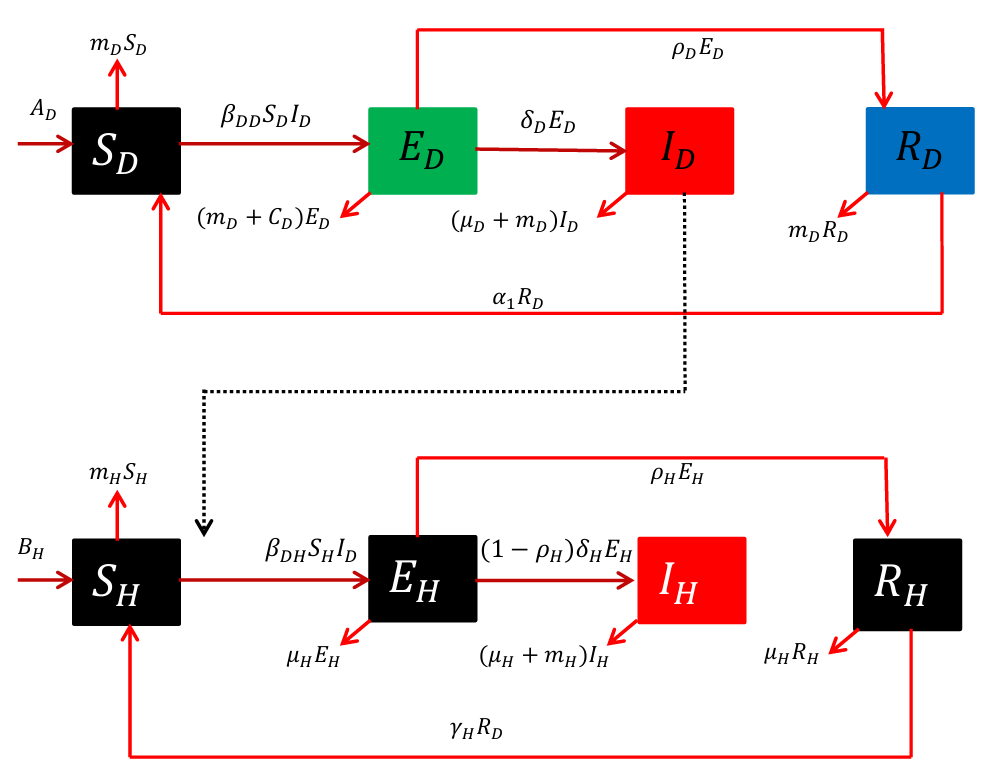
In this study, a compartmental mathematical model is developed to study the rabies transmission process from dog to human. The model consists of eight compartments: susceptible, exposed, infected, recovered groups for dogs and humans $(S_D, E_D, I_D, R_D, S_H, E_H, I_H, R_H)$. The basic reproduction number $R_0$ is derived, and sensitivity analysis is performed to identify the most influential epidemiological parameters. Disease-free equilibrium stability analysis is also carried out to identify the conditions for rabies eradication. One of the main goals of this work is to compare the disease dynamics in vaccinated and unvaccinated cases, which is carried out with the support of numerical s... More >

Graphical Abstract
Mathematical Modeling and NSFD Numerical Investigation of Rabies Transmission Dynamics with Immigration Factors
Open Access | Research Article | 27 July 2025 | Cited: Crossref logo  1 , Scopus 1
Bifurcation and Stability Analysis of Transmission Dynamics of Ebola Virus Using Seirvh Model
ICCK Journal of Applied Mathematics | Volume 1, Issue 2: 41-51, 2025 | DOI: 10.62762/JAM.2025.550087
Abstract
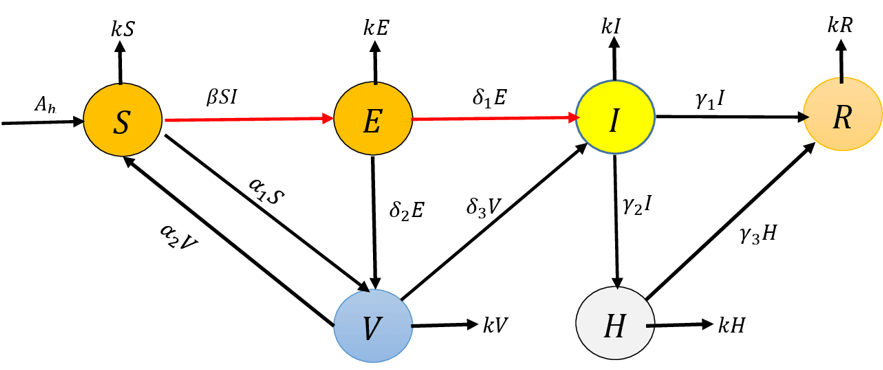
This study presents a mathematical framework to analyze the transmission dynamics of the Ebola Virus Disease (EVD) using an extended SEIRVH model. The model incorporates vaccinated and hospitalized compartments, addressing critical factors such as vaccination efficacy, healthcare interventions, and natural disease progression. Differential equations describe the transitions between six population compartments. The study evaluates model stability and bifurcation through well-posedness, positivity, and boundedness analyzes, ensuring realistic and biologically valid solutions. The basic reproduction number, R0, derived from the next generation matrix, serves as a threshold for outbreak control.... More >

Graphical Abstract
Bifurcation and Stability Analysis of Transmission Dynamics of Ebola Virus Using Seirvh Model