

Carbon Ion Hadron Therapy: Analytical Formulation of Tumor Regression in Pancreatic Cancer by Computed Tomography



Article Information
Abstract
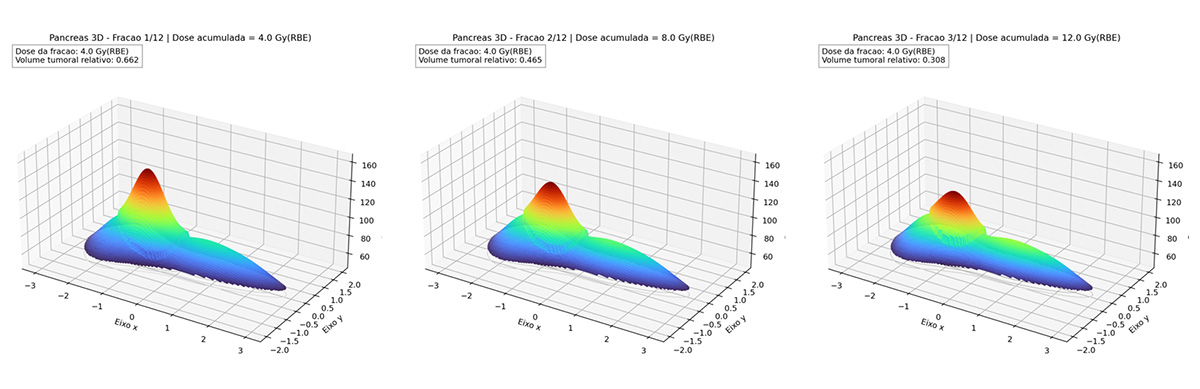
This study formulates a mathematical and computational model of tumor-cell-density regression in pancreatic cancer treated with carbon-ion hadron therapy. A reaction-diffusion equation with logistic proliferation and a local radiation-induced loss term is derived term by term, discretized with a two-dimensional finite-difference scheme and forward Euler time stepping, and implemented in Python. The treatment input follows a published carbon-ion schedule of 48~Gy(RBE) in 12 fractions of 4~Gy(RBE). The simulation produces sequential two- and three-dimensional maps of the modeled tumor-cell density as a function of accumulated dose; in the three-dimensional reconstruction the relative tumor volume falls from 0.662 after the first fraction to 0.001 after the twelfth, while the two-dimensional density maps reach a thresholded value of zero from fraction six onward. The diffusion coefficient is held constant (homogeneous-medium approximation) and the dose response is linear; both are stated as simplifications, not as complete radiobiological descriptions. Possible translational uses, namely patient-specific parameter estimation, CT-derived geometry, dose optimization and treatment adaptation, are discussed together with the calibration and validation that would be required before any clinical decision-support application.
Graphical Abstract
Keywords
Data Availability Statement
Funding
Conflicts of Interest
AI Use Statement
Ethical Approval and Consent to Participate
References
- World Health Organization. (2024). Global cancer burden growing, amidst mounting need for services. Retrieved from https://www.who.int/news/item/01-02-2024-global-cancer-burden-growing--amidst-mounting-need-for-services
[Google Scholar] - Bray, F., Laversanne, M., Sung, H., Ferlay, J., Siegel, R. L., Soerjomataram, I., & Jemal, A. (2024). Global cancer statistics 2022: GLOBOCAN estimates of incidence and mortality worldwide for 36 cancers in 185 countries. CA: A Cancer Journal for Clinicians, 74(3), 229-263.
[CrossRef] [Google Scholar] - Rawla, P., Sunkara, T., & Gaduputi, V. (2019). Epidemiology of pancreatic cancer: Global trends, etiology and risk factors. World Journal of Oncology, 10(1), 10-27.
[CrossRef] [Google Scholar] - Instituto Nacional de Cancer (INCA). (n.d.). Brasil - estimativa dos casos novos. Retrieved from https://www.gov.br/inca/pt-br/assuntos/cancer/numeros/estimativa/estado-capital/brasil
[Google Scholar] - Instituto Nacional de Câncer (INCA). (n.d.). Neoplasia maligna do Pâncreas (taxas brutas). Retrieved from https://www.gov.br/inca/pt-br/assuntos/cancer/numeros/estimativa/por-neoplasia-taxas-brutas/pancreas
[Google Scholar] - Silva, D. R. M. E., OLIVEIRA, M. M. D., Fernandes, G. A., & Curado, M. P. (2023). Pancreatic cancer mortality trends and correlation with human development index (HDI) in Brazil over 40 years. Arquivos de Gastroenterologia, 60(1), 30-38.
[CrossRef] [Google Scholar] - Lotufo, P. A. (2019). The burden of pancreatic cancer is rising in Brazil. Sao Paulo Medical Journal, 137(5), 389-390.
[CrossRef] [Google Scholar] - Martins, L. F. L., Chaves, G. V., Oliveira, J. F. P., Souza, L. B. L. D., Chagas Neto, P., Carvalho, F. N. D., ... & Mello, M. S. D. C. (2026). Epidemiological profile of cancer incidence in Brazil and regions: estimates for the 2026-2028 triennium. Revista Brasileira de Cancerologia, 72, e-025587.
[CrossRef] [Google Scholar] - Durante, M., Orecchia, R., & Loeffler, J. S. (2017). Charged-particle therapy in cancer: clinical uses and future perspectives. Nature Reviews Clinical Oncology, 14(8), 483-495.
[CrossRef] [Google Scholar] - Schardt, D., Elsässer, T., & Schulz-Ertner, D. (2010). Heavy-ion tumor therapy: Physical and radiobiological benefits. Reviews of modern physics, 82(1), 383-425.
[CrossRef] [Google Scholar] - Malouff, T. D., Mahajan, A., Krishnan, S., Beltran, C., Seneviratne, D. S., & Trifiletti, D. M. (2020). Carbon ion therapy: a modern review of an emerging technology. Frontiers in oncology, 10, 497476.
[CrossRef] [Google Scholar] - Karger, C. P., & Peschke, P. (2018). RBE and related modeling in carbon-ion therapy. Physics in Medicine & Biology, 63(1), 01TR02.
[CrossRef] [Google Scholar] - Matsui, Y., Asano, T., Kenmochi, T., Iwakawa, M., Imai, T., & Ochiai, T. (2004). Effects of carbon-ion beams on human pancreatic cancer cell lines that differ in genetic status. American journal of clinical oncology, 27(1), 24-28.
[CrossRef] [Google Scholar] - Karger, C. P., Jäkel, O., Palmans, H., & Kanai, T. (2010). Dosimetry for ion beam radiotherapy. Physics in Medicine & Biology, 55(21), R193-R234.
[CrossRef] [Google Scholar] - International Commission on Radiation Units and Measurements. (2016). ICRU Report 93: Prescribing, recording, and reporting light ion beam therapy. Journal of the ICRU, 16(1-2). https://journals.sagepub.com/toc/crua/16/1-2
[Google Scholar] - Lin, L. C., Jiang, G. L., Ohri, N., Wang, Z., Lu, J. J., Garg, M., ... & Wu, X. (2020). Evaluating dosimetric constraints for carbon ion radiotherapy in the treatment of locally advanced pancreatic cancer. Radiation Oncology, 15(1), 101.
[CrossRef] [Google Scholar] - Enderling, H., & AJ Chaplain, M. (2014). Mathematical modeling of tumor growth and treatment. Current pharmaceutical design, 20(30), 4934-4940.
[CrossRef] [Google Scholar] - Rockne, R., Rockhill, J. K., Mrugala, M., Spence, A. M., Kalet, I., Hendrickson, K., ... & Swanson, K. R. (2010). Predicting the efficacy of radiotherapy in individual glioblastoma patients in vivo: a mathematical modeling approach. Physics in Medicine & Biology, 55(12), 3271-3285.
[CrossRef] [Google Scholar] - Griffiths, D. J. (2008). Introduction to elementary particles (2nd ed.). Weinheim: Wiley-VCH. https://experimentationlab.berkeley.edu/sites/default/files/Muon/References/04-Introduction_to_Elementary_Particles.pdf
[Google Scholar] - Navas, S., Amsler, C., Gutsche, T., Hanhart, C., Lourenço, C., Masoni, A., ... & Scott, D. (2024). Review of particle physics. Physical Review D, 110(3).
[CrossRef] [Google Scholar] - Krane, K. S. (1991). Introductory nuclear physics. John Wiley & Sons.
[Google Scholar] - Podgorsak, E. B. (2003). Review of radiation oncology physics: a handbook for teachers and students. Vienna, Austria: IAE Agency, 19(133), 13. https://recherche-expertise.asnr.fr/sites/default/files/documents/professionnels_sante/documentation/syllabus_sommaire.pdf
[Google Scholar] - Durante, M., & Paganetti, H. (2016). Nuclear physics in particle therapy: A review. Reports on Progress in Physics, 79(9), 096702.
[CrossRef] [Google Scholar] - Iwata, Y., Noda, K., Shirai, T., Murakami, T., Furukawa, T., Mori, S., ... & Watanabe, I. (2012). Design of a superconducting rotating gantry for heavy-ion therapy. Physical Review Special Topics—Accelerators and Beams, 15(4), 044701.
[CrossRef] [Google Scholar] - Kusano, Y., Katoh, H., Minohara, S., Fujii, H., Miyasaka, Y., Takayama, Y., ... & Yoshida, D. (2022). Robust treatment planning in scanned carbon-ion radiotherapy for pancreatic cancer: clinical verification using in-room computed tomography images. Frontiers in oncology, 12, 974728.
[CrossRef] [Google Scholar] - Okamoto, M., Shiba, S., Kobayashi, D., Miyasaka, Y., Okazaki, S., Shibuya, K., & Ohno, T. (2023). Carbon-ion radiotherapy combined with concurrent chemotherapy for locally advanced pancreatic cancer: a retrospective case series analysis. Cancers, 15(10), 2857.
[CrossRef] [Google Scholar] - Borasi, G., & Nahum, A. (2016). Modelling the radiotherapy effect in the reaction-diffusion equation. Physica Medica, 32(9), 1175-1179.
[CrossRef] [Google Scholar] - Kutuva, A. R., Caudell, J. J., Yamoah, K., Enderling, H., & Zahid, M. U. (2023). Mathematical modeling of radiotherapy: Impact of model selection on estimating minimum radiation dose for tumor control. Frontiers in Oncology, 13, 1130966.
[CrossRef] [Google Scholar] - LeVeque, R. J. (2007). Finite difference methods for ordinary and partial differential equations: Steady-state and time-dependent problems. Philadelphia: SIAM.
[CrossRef] [Google Scholar] - Chen, J., Weihs, D., & Vermolen, F. J. (2020). Computational modeling of therapy on pancreatic cancer in its early stages. Biomechanics and Modeling in Mechanobiology, 19(2), 427-444.
[CrossRef] [Google Scholar] - International Atomic Energy Agency. (2004). Commissioning and quality assurance of computerized planning systems for radiation treatment of cancer (Technical Reports Series No. 430). Vienna: IAEA. Retrieved from https://international.anl.gov/Training/materials/AX/Publications/TRS%20No%20430%20-%20Commissioning%20and%20Quality%20Assurance%20of%20Computerized%20Planning%20Systems%20for%20Radiation%20Treatmen.pdf
[Google Scholar] - Torres, N. V., & Santos, G. (2015). The (mathematical) modeling process in biosciences. Frontiers in Genetics, 6, 354.
[CrossRef] [Google Scholar] - Van Leeuwen, C. M., Oei, A. L., Crezee, J., Bel, A., Franken, N. A., Stalpers, L. J., & Kok, H. P. (2018). The alfa and beta of tumours: a review of parameters of the linear-quadratic model, derived from clinical radiotherapy studies. Radiation oncology, 13(1), 96.
[CrossRef] [Google Scholar] - Liermann, J., Naumann, P., Weykamp, F., Hoegen, P., Debus, J., & Herfarth, K. (2021). Effectiveness of carbon ion radiation in locally advanced pancreatic cancer. Frontiers in oncology, 11, 708884.
[CrossRef] [Google Scholar]
Cite This Article
TY  - JOUR
AU  - Farias, Matheus dos Santos
PY  - 2026
DA  - 2026/10/16
TI  - Carbon Ion Hadron Therapy: Analytical Formulation of Tumor Regression in Pancreatic Cancer by Computed Tomography
JO  - Journal of Numerical Simulations in Physics and Mathematics
T2  - Journal of Numerical Simulations in Physics and Mathematics
JF  - Journal of Numerical Simulations in Physics and Mathematics
VL  - 3
IS  - 1
SP  - 38
EP  - 50
DO  - 10.62762/JNSPM.2026.765432
UR  - https://www.icck.org/article/abs/JNSPM.2026.765432
KW  - pancreatic cancer
KW  - carbon-ion therapy
KW  - reaction-diffusion model
KW  - finite-difference method
KW  - Euler method
KW  - computational simulation
AB  - This study formulates a mathematical and computational model of tumor-cell-density regression in pancreatic cancer treated with carbon-ion hadron therapy. A reaction-diffusion equation with logistic proliferation and a local radiation-induced loss term is derived term by term, discretized with a two-dimensional finite-difference scheme and forward Euler time stepping, and implemented in Python. The treatment input follows a published carbon-ion schedule of 48~Gy(RBE) in 12 fractions of 4~Gy(RBE). The simulation produces sequential two- and three-dimensional maps of the modeled tumor-cell density as a function of accumulated dose; in the three-dimensional reconstruction the relative tumor volume falls from 0.662 after the first fraction to 0.001 after the twelfth, while the two-dimensional density maps reach a thresholded value of zero from fraction six onward. The diffusion coefficient is held constant (homogeneous-medium approximation) and the dose response is linear; both are stated as simplifications, not as complete radiobiological descriptions. Possible translational uses, namely patient-specific parameter estimation, CT-derived geometry, dose optimization and treatment adaptation, are discussed together with the calibration and validation that would be required before any clinical decision-support application.
SN  - 3068-9082
PB  - Institute of Central Computation and Knowledge
LA  - English
ER  -
@article{Farias2026Carbon,
  author = {Matheus dos Santos Farias},
  title = {Carbon Ion Hadron Therapy: Analytical Formulation of Tumor Regression in Pancreatic Cancer by Computed Tomography},
  journal = {Journal of Numerical Simulations in Physics and Mathematics},
  year = {2026},
  volume = {3},
  number = {1},
  pages = {38-50},
  doi = {10.62762/JNSPM.2026.765432},
  url = {https://www.icck.org/article/abs/JNSPM.2026.765432},
  abstract = {This study formulates a mathematical and computational model of tumor-cell-density regression in pancreatic cancer treated with carbon-ion hadron therapy. A reaction-diffusion equation with logistic proliferation and a local radiation-induced loss term is derived term by term, discretized with a two-dimensional finite-difference scheme and forward Euler time stepping, and implemented in Python. The treatment input follows a published carbon-ion schedule of 48~Gy(RBE) in 12 fractions of 4~Gy(RBE). The simulation produces sequential two- and three-dimensional maps of the modeled tumor-cell density as a function of accumulated dose; in the three-dimensional reconstruction the relative tumor volume falls from 0.662 after the first fraction to 0.001 after the twelfth, while the two-dimensional density maps reach a thresholded value of zero from fraction six onward. The diffusion coefficient is held constant (homogeneous-medium approximation) and the dose response is linear; both are stated as simplifications, not as complete radiobiological descriptions. Possible translational uses, namely patient-specific parameter estimation, CT-derived geometry, dose optimization and treatment adaptation, are discussed together with the calibration and validation that would be required before any clinical decision-support application.},
  keywords = {pancreatic cancer, carbon-ion therapy, reaction-diffusion model, finite-difference method, Euler method, computational simulation},
  issn = {3068-9082},
  publisher = {Institute of Central Computation and Knowledge}
}
Article Metrics
Publisher's Note
ICCK stays neutral with regard to jurisdictional claims in published maps and institutional affiliations.
Rights and Permissions
 Copyright © 2026 by the Author(s). Published by Institute of Central Computation and Knowledge. This article is an open access article distributed under the terms and conditions of the Creative Commons Attribution (CC BY) license (https://creativecommons.org/licenses/by/4.0/), which permits use, sharing, adaptation, distribution and reproduction in any medium or format, as long as you give appropriate credit to the original author(s) and the source, provide a link to the Creative Commons licence, and indicate if changes were made.


Portico
