


Low FOXA2 Expression Is Associated With ECM Remodeling, FAK--YAP-Related Transcriptional Features, and a Macrophage-Enriched Immune-Stromal Microenvironment in Hepatocellular Carcinoma


Article Information
Abstract
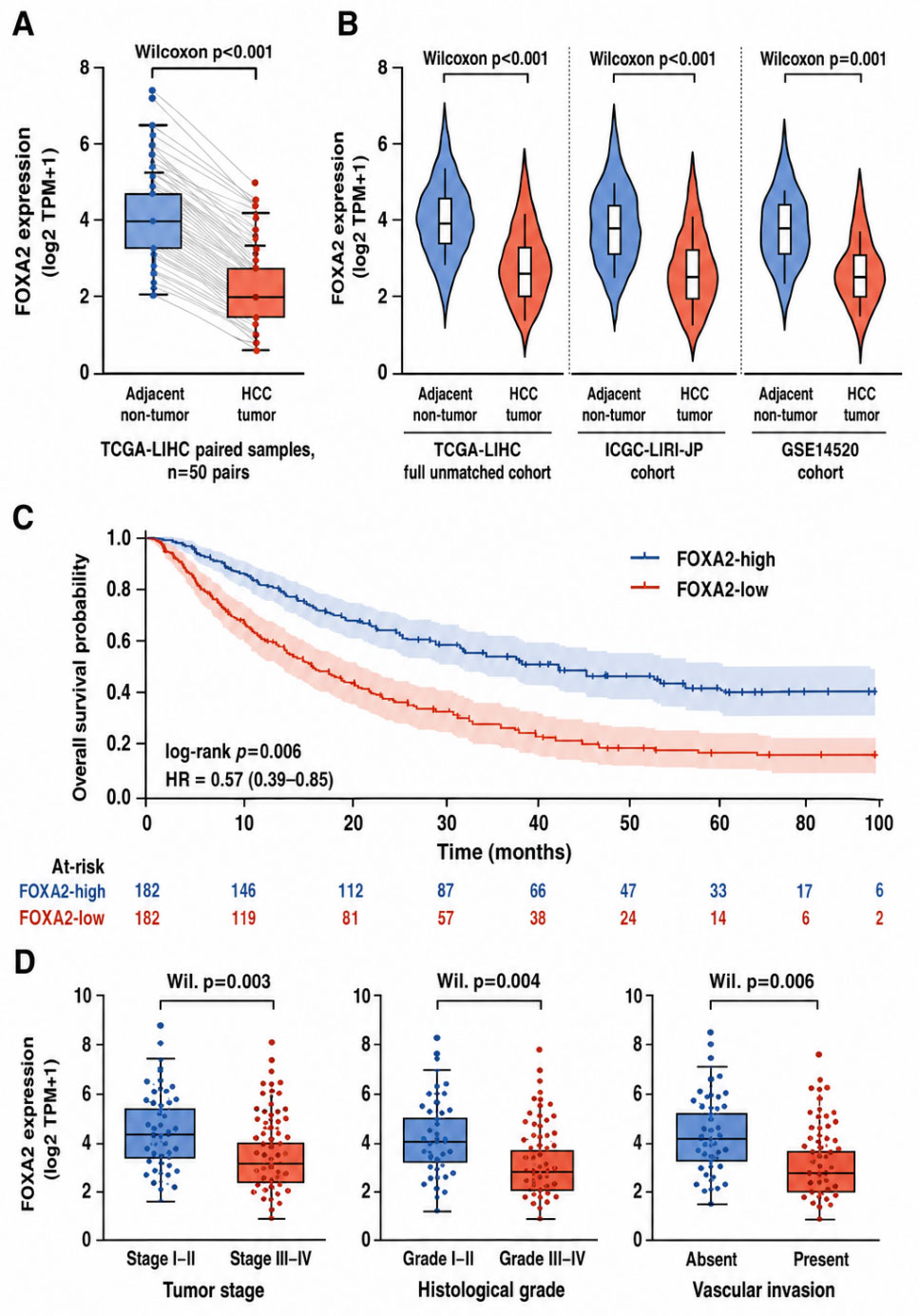
Tumor-associated macrophages and extracellular matrix remodeling are important components shaping the microenvironment of hepatocellular carcinoma (HCC). This study examined whether forkhead box A2 (FOXA2) expression is associated with extracellular matrix (ECM)/stromal remodeling, focal adhesion kinase (FAK)--Yes-associated protein (YAP)-related transcriptional features, and immune-stromal characteristics in HCC. Using The Cancer Genome Atlas liver hepatocellular carcinoma (TCGA-LIHC) cohort for discovery and the ICGC-LIRI-JP and GSE14520 datasets for expression validation, we performed differential expression, enrichment analysis, single-sample gene set scoring, ESTIMATE-based microenvironment assessment, and Cox regression, with FOXA2-high and FOXA2-low groups defined by the cohort-specific median. FOXA2 expression was consistently reduced in HCC tissues and associated with unfavorable overall survival (log-rank $P = 0.006$). FOXA2-low tumors showed higher ECM/stromal remodeling and FAK--YAP-related scores, enrichment of fibroblast, M2 macrophage, regulatory T-cell, endothelial, and immune checkpoint-related signatures, and decreased CD8-positive T-cell and M1 macrophage signatures; exploratory enrichment also indicated altered lipid metabolism-related programs. These co-occurring bulk features do not establish a causal FOXA2--ECM--FAK--YAP--immune pathway. Low FOXA2 expression therefore marks an HCC transcriptional state characterized by stromal remodeling, mechanotransduction-related features, and immunosuppressive signatures. Single-cell, spatial, protein-level, and functional validation is required to determine the underlying cellular origin and mechanism.
Graphical Abstract
Keywords
Data Availability Statement
Funding
Conflicts of Interest
AI Use Statement
Ethical Approval and Consent to Participate
References
- Feng, F., & Zhao, Y. (2024). Hepatocellular carcinoma: Prevention, diagnosis, and treatment. Medical Principles and Practice, 33(5), 414-423.
[CrossRef] [Google Scholar] - Roy, A. M., Iyer, R., & Chakraborty, S. (2023). The extracellular matrix in hepatocellular carcinoma: Mechanisms and therapeutic vulnerability. Cell Reports Medicine, 4(9), 101170.
[CrossRef] [Google Scholar] - Hong, J., Yu, J., Buratto, D., Chen, W., Zhou, R., Ling, S., & Xu, X. (2024). Unveiling the role of mechanical microenvironment in hepatocellular carcinoma: molecular mechanisms and implications for therapeutic strategies. International Journal of Biological Sciences, 20(13), 5239.
[CrossRef] [Google Scholar] - Zhang, M., & Zhang, B. (2025). Extracellular matrix stiffness: mechanisms in tumor progression and therapeutic potential in cancer. Experimental hematology & oncology, 14(1), 54.
[CrossRef] [Google Scholar] - Mai, Z., Lin, Y., Lin, P., Zhao, X., & Cui, L. (2024). Modulating extracellular matrix stiffness: A strategic approach to boost cancer immunotherapy. Cell Death & Disease, 15(5), 307.
[CrossRef] [Google Scholar] - Li, S., Hao, L., Li, N., Hu, X., Yan, H., Dai, E., & Shi, X. (2024). Targeting the Hippo/YAP1 signaling pathway in hepatocellular carcinoma: From mechanisms to therapeutic drugs (Review). International Journal of Oncology, 65(3), 88.
[CrossRef] [Google Scholar] - Gao, Y., Gong, Y., Lu, J., Hao, H., & Shi, X. (2024). Targeting YAP1 to improve the efficacy of immune checkpoint inhibitors in liver cancer: mechanism and strategy. Frontiers in Immunology, 15, 1377722.
[CrossRef] [Google Scholar] - Xia, Y., Liang, P., Cui, L., & Cao, Y. (2026). FOXA2 in cancer: from fundamental biology to clinical translation. Frontiers in Oncology, 16, 1854448.
[CrossRef] [Google Scholar] - Liu, N., Wang, A., Xue, M., Zhu, X., Liu, Y., & Chen, M. (2024). FOXA1 and FOXA2: the regulatory mechanisms and therapeutic implications in cancer. Cell death discovery, 10(1), 172.
[CrossRef] [Google Scholar] - Wang, Z., Shen, J., Chen, C., Wen, T., & Li, C. (2023). FOXA2 plays a critical role in hepatocellular carcinoma progression and lenvatinib-associated drug resistance. BioScience Trends, 17(2), 136-147.
[CrossRef] [Google Scholar] - Ally, A., Balasundaram, M., Carlsen, R., Chuah, E., Clarke, A., Dhalla, N., ... & Ferguson, M. L. (2017). Comprehensive and integrative genomic characterization of hepatocellular carcinoma. Cell, 169(7), 1327-1341.
[CrossRef] [Google Scholar] - Fujimoto, A., Furuta, M., Totoki, Y., Tsunoda, T., Kato, M., Shiraishi, Y., ... & Nakagawa, H. (2016). Whole-genome mutational landscape and characterization of noncoding and structural mutations in liver cancer. Nature genetics, 48(5), 500-509.
[CrossRef] [Google Scholar] - Roessler, S., Jia, H. L., Budhu, A., Forgues, M., Ye, Q. H., Lee, J. S., ... & Wang, X. W. (2010). A unique metastasis gene signature enables prediction of tumor relapse in early-stage hepatocellular carcinoma patients. Cancer Research, 70(24), 10202-10212.
[CrossRef] [Google Scholar] - Subramanian, A., Tamayo, P., Mootha, V. K., Mukherjee, S., Ebert, B. L., Gillette, M. A., ... & Mesirov, J. P. (2005). Gene set enrichment analysis: a knowledge-based approach for interpreting genome-wide expression profiles. Proceedings of the National Academy of Sciences, 102(43), 15545-15550.
[CrossRef] [Google Scholar] - Li, H., Zhang, J., Shi, Y., Wang, H., Yang, R., Wu, S., ... & Sun, L. (2025). Identification of matrix stiffness-related molecular subtypes in HCC via integrating multi-omics analysis and machine learning algorithms. Journal of Translational Medicine, 23(1), 716.
[CrossRef] [Google Scholar] - Shen, Y., Chen, J., Zhou, Z., Wu, J., Hu, X., Xu, Y., ... & Xu, X. (2024). Matrix stiffness-related extracellular matrix signatures and the DYNLL1 protein promote hepatocellular carcinoma progression through the Wnt/$\beta$-catenin pathway. BMC Cancer, 24(1), 1211.
[CrossRef] [Google Scholar] - Liu, H. H., Xu, Y., Gao, W. Q., Li, J. J., Zhang, R., Chen, M. P., ... & Chen, R. X. (2025). Matrix Stiffness Promotes Invasion and Metastasis of Hepatocellular Carcinoma via a New Mechanoresponsive SCD1/HMMR Pathway. The FASEB Journal, 39(11), e70716.
[CrossRef] [Google Scholar] - Wang, Z., Wang, W., Luo, Q., & Song, G. (2025). High matrix stiffness accelerates migration of hepatocellular carcinoma cells through the integrin $\beta$1-Plectin-F-actin axis. BMC Biology, 23(1), 8.
[CrossRef] [Google Scholar] - Barbie, D. A., Tamayo, P., Boehm, J. S., Kim, S. Y., Moody, S. E., Dunn, I. F., ... & Hahn, W. C. (2009). Systematic RNA interference reveals that oncogenic KRAS-driven cancers require TBK1. Nature, 462(7269), 108-112.
[CrossRef] [Google Scholar] - Yan, W., Xiao, G. H., Wang, L. J., Zhou, Y., Yang, F., & Mou, K. H. (2025). CAFs activated by YAP1 upregulate cancer matrix stiffness to mediate hepatocellular carcinoma progression. Journal of translational medicine, 23(1), 450.
[CrossRef] [Google Scholar] - Kim, H. S., & Nam, J. S. (2025). The multifaceted role of YAP in the tumor microenvironment and its therapeutic implications in cancer. Experimental & Molecular Medicine, 57(10), 2201-2213.
[CrossRef] [Google Scholar] - Yoshihara, K., Shahmoradgoli, M., Martínez, E., Vegesna, R., Kim, H., Torres-Garcia, W., ... & Verhaak, R. G. (2013). Inferring tumour purity and stromal and immune cell admixture from expression data. Nature communications, 4(1), 2612.
[CrossRef] [Google Scholar] - Newman, A. M., Liu, C. L., Green, M. R., Gentles, A. J., Feng, W., Xu, Y., ... & Alizadeh, A. A. (2015). Robust enumeration of cell subsets from tissue expression profiles. Nature methods, 12(5), 453-457.
[CrossRef] [Google Scholar] - Shen, K. Y., Zhu, Y., Xie, S. Z., & Qin, L. X. (2024). Immunosuppressive tumor microenvironment and immunotherapy of hepatocellular carcinoma: current status and prospectives. Journal of hematology & oncology, 17(1), 25.
[CrossRef] [Google Scholar] - Fu, Y., Guo, X., Sun, L., Cui, T., Wu, C., Wang, J., ... & Liu, L. (2024). Exploring the role of the immune microenvironment in hepatocellular carcinoma: Implications for immunotherapy and drug resistance. Elife, 13, e95009.
[CrossRef] [Google Scholar] - Ma, L., Hernandez, M. O., Zhao, Y., Mehta, M., Tran, B., Kelly, M., ... & Wang, X. W. (2019). Tumor cell biodiversity drives microenvironmental reprogramming in liver cancer. Cancer cell, 36(4), 418-430.
[CrossRef] [Google Scholar] - Wu, R., Guo, W., Qiu, X., Wang, S., Sui, C., Lian, Q., ... & Chen, L. (2021). Comprehensive analysis of spatial architecture in primary liver cancer. Science advances, 7(51), eabg3750.
[CrossRef] [Google Scholar] - Wederell, E. D., Bilenky, M., Cullum, R., Thiessen, N., Dagpinar, M., Delaney, A., ... & Hoodless, P. A. (2008). Global analysis of in vivo Foxa2-binding sites in mouse adult liver using massively parallel sequencing. Nucleic acids research, 36(14), 4549-4564.
[CrossRef] [Google Scholar] - Sleeboom, J. J. F., van Tienderen, G. S., Schenke-Layland, K., van der Laan, L. J. W., Khalil, A. A., & Verstegen, M. M. A. (2024). The extracellular matrix as hallmark of cancer and metastasis: From biomechanics to therapeutic targets. Science Translational Medicine, 16(728), eadg3840.
[CrossRef] [Google Scholar] - Dupont, S., Morsut, L., Aragona, M., Enzo, E., Giulitti, S., Cordenonsi, M., ... & Piccolo, S. (2011). Role of YAP/TAZ in mechanotransduction. Nature, 474(7350), 179-183.
[CrossRef] [Google Scholar] - Long, F., Zhong, W., Zhao, F., Xu, Y., Hu, X., Jia, G., ... & Wang, F. (2024). DAB2+ macrophages support FAP+ fibroblasts in shaping tumor barrier and inducing poor clinical outcomes in liver cancer. Theranostics, 14(12), 4822.
[CrossRef] [Google Scholar] - Liu, Y., Xun, Z., Ma, K., Liang, S., Li, X., Zhou, S., ... & Liu, L. (2023). Identification of a tumour immune barrier in the HCC microenvironment that determines the efficacy of immunotherapy. Journal of hepatology, 78(4), 770-782.
[CrossRef] [Google Scholar] - Li, Z., Pai, R., Gupta, S., Currenti, J., Guo, W., Di Bartolomeo, A., ... & Sharma, A. (2024). Presence of onco-fetal neighborhoods in hepatocellular carcinoma is associated with relapse and response to immunotherapy. Nature Cancer, 5(1), 167-186.
[CrossRef] [Google Scholar]
Cite This Article
TY  - JOUR
AU  - Wang, Zhanwei
AU  - Xue, Siming
AU  - Li, Yuxing
AU  - Zhou, Judi
PY  - 2026
DA  - 2026/09/24
TI  - Low FOXA2 Expression Is Associated With ECM Remodeling, FAK--YAP-Related Transcriptional Features, and a Macrophage-Enriched Immune-Stromal Microenvironment in Hepatocellular Carcinoma
JO  - Oncology Communications
T2  - Oncology Communications
JF  - Oncology Communications
VL  - 1
IS  - 2
SP  - 95
EP  - 107
DO  - 10.62762/OC.2026.549981
UR  - https://www.icck.org/article/abs/OC.2026.549981
KW  - Hepatocellular carcinoma
KW  - FOXA2
KW  - extracellular matrix
KW  - mechanotransduction
KW  - tumor microenvironment
AB  - Tumor-associated macrophages and extracellular matrix remodeling are important components shaping the microenvironment of hepatocellular carcinoma (HCC). This study examined whether forkhead box A2 (FOXA2) expression is associated with extracellular matrix (ECM)/stromal remodeling, focal adhesion kinase (FAK)--Yes-associated protein (YAP)-related transcriptional features, and immune-stromal characteristics in HCC. Using The Cancer Genome Atlas liver hepatocellular carcinoma (TCGA-LIHC) cohort for discovery and the ICGC-LIRI-JP and GSE14520 datasets for expression validation, we performed differential expression, enrichment analysis, single-sample gene set scoring, ESTIMATE-based microenvironment assessment, and Cox regression, with FOXA2-high and FOXA2-low groups defined by the cohort-specific median. FOXA2 expression was consistently reduced in HCC tissues and associated with unfavorable overall survival (log-rank $P = 0.006$). FOXA2-low tumors showed higher ECM/stromal remodeling and FAK--YAP-related scores, enrichment of fibroblast, M2 macrophage, regulatory T-cell, endothelial, and immune checkpoint-related signatures, and decreased CD8-positive T-cell and M1 macrophage signatures; exploratory enrichment also indicated altered lipid metabolism-related programs. These co-occurring bulk features do not establish a causal FOXA2--ECM--FAK--YAP--immune pathway. Low FOXA2 expression therefore marks an HCC transcriptional state characterized by stromal remodeling, mechanotransduction-related features, and immunosuppressive signatures. Single-cell, spatial, protein-level, and functional validation is required to determine the underlying cellular origin and mechanism.
SN  - 3142-8894
PB  - Institute of Central Computation and Knowledge
LA  - English
ER  -
@article{Wang2026Low,
  author = {Zhanwei Wang and Siming Xue and Yuxing Li and Judi Zhou},
  title = {Low FOXA2 Expression Is Associated With ECM Remodeling, FAK--YAP-Related Transcriptional Features, and a Macrophage-Enriched Immune-Stromal Microenvironment in Hepatocellular Carcinoma},
  journal = {Oncology Communications},
  year = {2026},
  volume = {1},
  number = {2},
  pages = {95-107},
  doi = {10.62762/OC.2026.549981},
  url = {https://www.icck.org/article/abs/OC.2026.549981},
  abstract = {Tumor-associated macrophages and extracellular matrix remodeling are important components shaping the microenvironment of hepatocellular carcinoma (HCC). This study examined whether forkhead box A2 (FOXA2) expression is associated with extracellular matrix (ECM)/stromal remodeling, focal adhesion kinase (FAK)--Yes-associated protein (YAP)-related transcriptional features, and immune-stromal characteristics in HCC. Using The Cancer Genome Atlas liver hepatocellular carcinoma (TCGA-LIHC) cohort for discovery and the ICGC-LIRI-JP and GSE14520 datasets for expression validation, we performed differential expression, enrichment analysis, single-sample gene set scoring, ESTIMATE-based microenvironment assessment, and Cox regression, with FOXA2-high and FOXA2-low groups defined by the cohort-specific median. FOXA2 expression was consistently reduced in HCC tissues and associated with unfavorable overall survival (log-rank \$P = 0.006\$). FOXA2-low tumors showed higher ECM/stromal remodeling and FAK--YAP-related scores, enrichment of fibroblast, M2 macrophage, regulatory T-cell, endothelial, and immune checkpoint-related signatures, and decreased CD8-positive T-cell and M1 macrophage signatures; exploratory enrichment also indicated altered lipid metabolism-related programs. These co-occurring bulk features do not establish a causal FOXA2--ECM--FAK--YAP--immune pathway. Low FOXA2 expression therefore marks an HCC transcriptional state characterized by stromal remodeling, mechanotransduction-related features, and immunosuppressive signatures. Single-cell, spatial, protein-level, and functional validation is required to determine the underlying cellular origin and mechanism.},
  keywords = {Hepatocellular carcinoma, FOXA2, extracellular matrix, mechanotransduction, tumor microenvironment},
  issn = {3142-8894},
  publisher = {Institute of Central Computation and Knowledge}
}
Article Metrics
Publisher's Note
ICCK stays neutral with regard to jurisdictional claims in published maps and institutional affiliations.
Rights and Permissions
 Copyright © 2026 by the Author(s). Published by Institute of Central Computation and Knowledge. This article is an open access article distributed under the terms and conditions of the Creative Commons Attribution (CC BY) license (https://creativecommons.org/licenses/by/4.0/), which permits use, sharing, adaptation, distribution and reproduction in any medium or format, as long as you give appropriate credit to the original author(s) and the source, provide a link to the Creative Commons licence, and indicate if changes were made.

