

A Data-Driven Framework for Personalized Learning Using Machine Learning Techniques in Rwanda


Article Information
Abstract
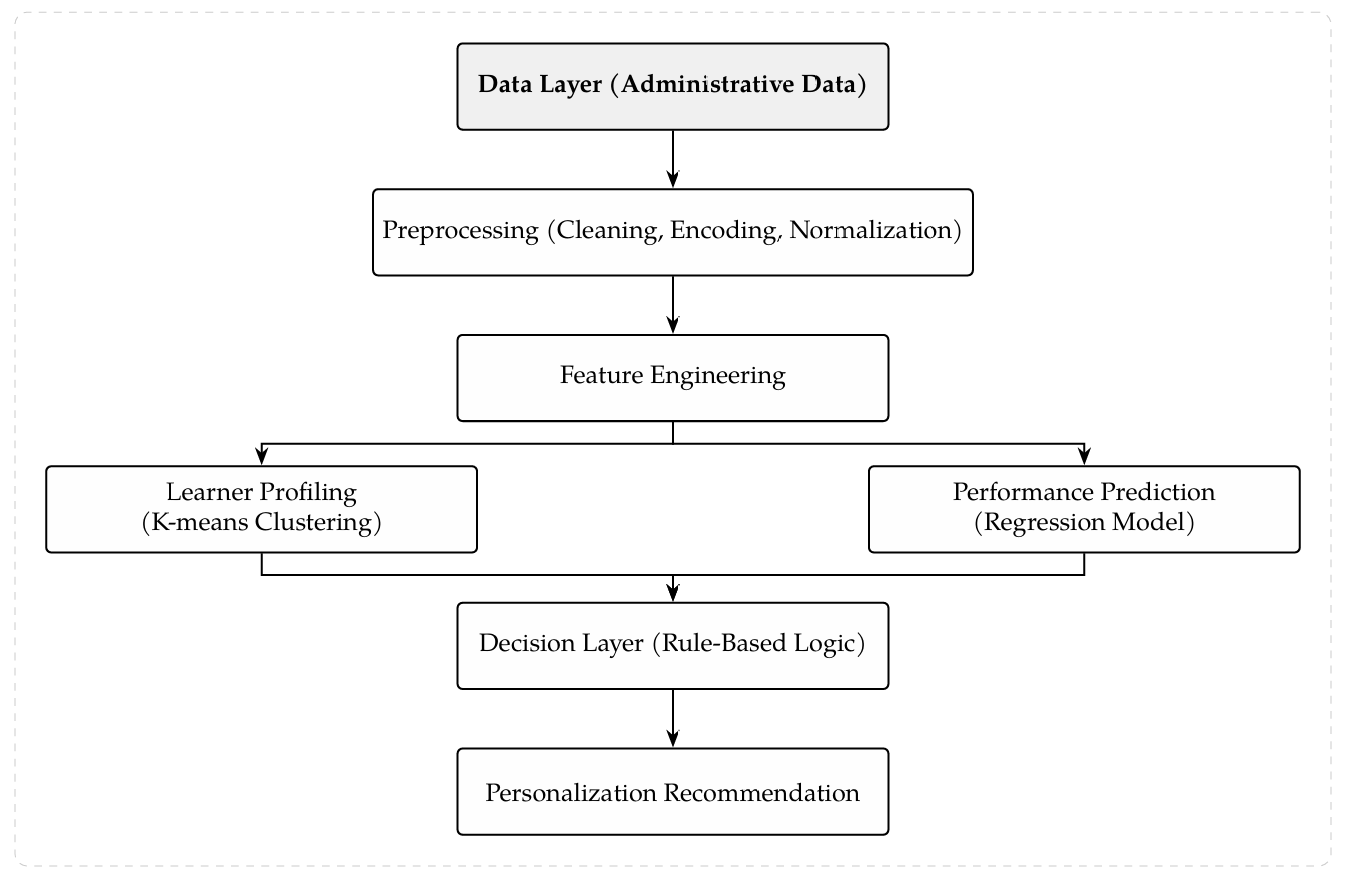
Personalized learning has become a popular term in education to address learner diversity and enhance student performance. However, its implementation remains a practical challenge in many developing countries due to the lack of fine-grained learning data and platforms. This study proposes a data-driven machine learning approach for personalized learning using routine administrative education data from Rwanda. The approach is scalable, interpretable, and aligned with existing national education information systems. Following a design science research approach, the study combines unsupervised learner profiling via clustering and supervised performance prediction via regression models. The proposed framework enables differentiated instructional planning and informed policy-making at the system level. Evaluated using administrative data from the Rwandan Ministry of Education, the results show that meaningful learner profiles can be derived from aggregate data, while regression models provide useful directional performance insights despite limited explanatory power. This demonstrates the technical and conceptual feasibility of supporting personalized learning in data-poor education systems without requiring detailed learning interaction data. The framework requires further practical testing and large-scale validation to confirm its impact on learning performance. This study contributes to the Artificial Intelligence in Education field by proposing a context-aware approach that addresses interpretability, scalability, and policy alignment.
Graphical Abstract
Keywords
Data Availability Statement
Funding
Conflicts of Interest
AI Use Statement
Ethical Approval and Consent to Participate
References
- Hattie, J., & Timperley, H. (2007). The power of feedback. Review of Educational Research, 77(1), 81–112.
[CrossRef] [Google Scholar] - Bodily, R., & Verbert, K. (2017). Review of research on student-facing learning analytics dashboards and educational recommender systems. IEEE Transactions on Learning Technologies, 10(4), 405-418.
[CrossRef] [Google Scholar] - Chen, L., Chen, P., & Lin, Z. (2020). Artificial intelligence in education: A review. IEEE Access, 8, 75264–75278.
[CrossRef] [Google Scholar] - Baker, R. S., Martin, T., & Rossi, L. M. (2016). Educational data mining and learning analytics. The Wiley handbook of cognition and assessment: Frameworks, methodologies, and applications, 379-396.
[CrossRef] [Google Scholar] - Hevner, A. R., March, S. T., Park, J., & Ram, S. (2004). Design science in information systems research. MIS Quarterly, 28(1), 75–105.
[CrossRef] [Google Scholar] - Ifenthaler, D., & Yau, J. Y. K. (2020). Utilising learning analytics to support study success in higher education: a systematic review. Educational technology research and development, 68(4), 1961-1990.
[CrossRef] [Google Scholar] - Klašnja-Milićević, A., Vesin, B., Ivanović, M., & Budimac, Z. (2016). E-learning personalization based on hybrid recommendation strategy and learning style identification. Computers & Education, 56(3), 885–899.
[CrossRef] [Google Scholar] - Romero, C., & Ventura, S. (2013). Data mining in education. Wiley Interdisciplinary Reviews: Data Mining and Knowledge Discovery, 3(1), 12–27.
[CrossRef] [Google Scholar] - UNESCO. (2021). Artificial intelligence and education: Guidance for policy-makers. UNESCO Publishing. https://unesdoc.unesco.org/ark:/48223/pf0000376709
[Google Scholar] - Holmes, W., & Miao, F. (2023). Guidance for generative AI in education and research. Unesco Publishing.
[CrossRef] [Google Scholar] - UNICEF. (2024). The State of the World’s Children 2024: The future of childhood in a changing world. UNICEF.
[Google Scholar] - UNICEF. (2025). Digital education strategy 2025–2030. UNICEF.
[Google Scholar] - UNICEF. (2023). Guidance on artificial intelligence and data for children in education systems. UNICEF. Retrieved from https://www.unicef.org/globalinsight/reports/ai-children
[Google Scholar] - Pedro, F., Subosa, M., Rivas, A., & Valverde, P. (2019). Artificial intelligence in education: Challenges and opportunities for sustainable development.
[Google Scholar] - Zawacki-Richter, O., Marín, V. I., Bond, M., & Gouverneur, F. (2019). Systematic review of research on artificial intelligence applications in higher education–where are the educators?. International journal of educational technology in higher education, 16(1), 39.
[CrossRef] [Google Scholar] - Luckin, R. (2008). The learner centric ecology of resources: A framework for using technology to scaffold learning. Computers & Education, 50(2), 449–462.
[CrossRef] [Google Scholar]
Cite This Article
TY  - JOUR
AU  - Ephrem, Tuyisenge
AU  - Bhalalusesa, Rogers
AU  - Kamaghe, Juliana
PY  - 2026
DA  - 2026/03/31
TI  - A Data-Driven Framework for Personalized Learning Using Machine Learning Techniques in Rwanda
JO  - ICCK Transactions on Educational Data Mining
T2  - ICCK Transactions on Educational Data Mining
JF  - ICCK Transactions on Educational Data Mining
VL  - 2
IS  - 1
SP  - 38
EP  - 51
DO  - 10.62762/TEDM.2026.319371
UR  - https://www.icck.org/article/abs/TEDM.2026.319371
KW  - personalized learning
KW  - machine learning framework
KW  - learning analytics
KW  - administrative education data
KW  - Rwanda education system
AB  - Personalized learning has become a popular term in education to address learner diversity and enhance student performance. However, its implementation remains a practical challenge in many developing countries due to the lack of fine-grained learning data and platforms. This study proposes a data-driven machine learning approach for personalized learning using routine administrative education data from Rwanda. The approach is scalable, interpretable, and aligned with existing national education information systems. Following a design science research approach, the study combines unsupervised learner profiling via clustering and supervised performance prediction via regression models. The proposed framework enables differentiated instructional planning and informed policy-making at the system level. Evaluated using administrative data from the Rwandan Ministry of Education, the results show that meaningful learner profiles can be derived from aggregate data, while regression models provide useful directional performance insights despite limited explanatory power. This demonstrates the technical and conceptual feasibility of supporting personalized learning in data-poor education systems without requiring detailed learning interaction data. The framework requires further practical testing and large-scale validation to confirm its impact on learning performance. This study contributes to the Artificial Intelligence in Education field by proposing a context-aware approach that addresses interpretability, scalability, and policy alignment.
SN  - 3070-5843
PB  - Institute of Central Computation and Knowledge
LA  - English
ER  -
@article{Ephrem2026A,
  author = {Tuyisenge Ephrem and Rogers Bhalalusesa and Juliana Kamaghe},
  title = {A Data-Driven Framework for Personalized Learning Using Machine Learning Techniques in Rwanda},
  journal = {ICCK Transactions on Educational Data Mining},
  year = {2026},
  volume = {2},
  number = {1},
  pages = {38-51},
  doi = {10.62762/TEDM.2026.319371},
  url = {https://www.icck.org/article/abs/TEDM.2026.319371},
  abstract = {Personalized learning has become a popular term in education to address learner diversity and enhance student performance. However, its implementation remains a practical challenge in many developing countries due to the lack of fine-grained learning data and platforms. This study proposes a data-driven machine learning approach for personalized learning using routine administrative education data from Rwanda. The approach is scalable, interpretable, and aligned with existing national education information systems. Following a design science research approach, the study combines unsupervised learner profiling via clustering and supervised performance prediction via regression models. The proposed framework enables differentiated instructional planning and informed policy-making at the system level. Evaluated using administrative data from the Rwandan Ministry of Education, the results show that meaningful learner profiles can be derived from aggregate data, while regression models provide useful directional performance insights despite limited explanatory power. This demonstrates the technical and conceptual feasibility of supporting personalized learning in data-poor education systems without requiring detailed learning interaction data. The framework requires further practical testing and large-scale validation to confirm its impact on learning performance. This study contributes to the Artificial Intelligence in Education field by proposing a context-aware approach that addresses interpretability, scalability, and policy alignment.},
  keywords = {personalized learning, machine learning framework, learning analytics, administrative education data, Rwanda education system},
  issn = {3070-5843},
  publisher = {Institute of Central Computation and Knowledge}
}
Article Metrics
Publisher's Note
ICCK stays neutral with regard to jurisdictional claims in published maps and institutional affiliations.
Rights and Permissions


Portico
