

A Jellyfish Search Optimizer-Based Optimization Framework for Student Performance Prediction



Article Information
Abstract
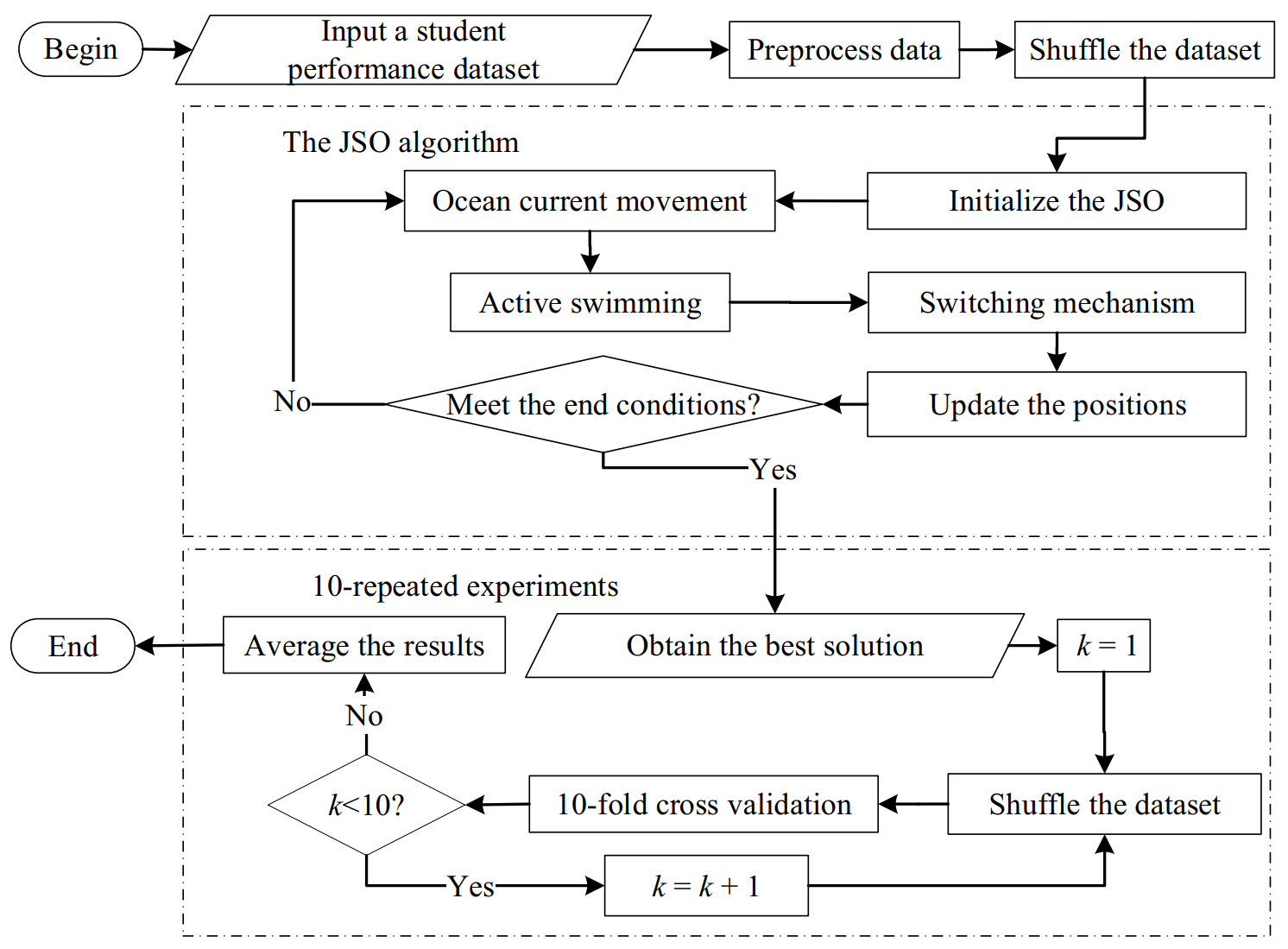
Student performance prediction represents a core task in educational data mining, facilitating early interventions, personalized learning support, and data-driven decision-making. While machine learning models have demonstrated strong predictive capabilities in this domain, their effectiveness remains constrained by hyperparameter selection. To overcome this limitation, we introduce an automated hyperparameter optimization framework that leverages the jellyfish search optimizer to identify optimal configurations. To mitigate the variability introduced by data partitioning, we adopt 10-fold cross-validation with 10 repeated trials. Experimental results indicate that the proposed framework significantly enhances the performance of baseline models across all evaluated metrics. Leveraging this superior performance, the framework provides a robust tool for student performance prediction and a wide array of educational analytics applications.
Graphical Abstract
Keywords
Data Availability Statement
Funding
Conflicts of Interest
Ethical Approval and Consent to Participate
References
- Bai, X., Zhang, F., Li, J., Guo, T., Aziz, A., Jin, A., & Xia, F. (2021). Educational big data: Predictions, applications and challenges. Big Data Research, 26, 100270.
[CrossRef] [Google Scholar] - Rabelo, A., Rodrigues, M. W., Nobre, C., Isotani, S., & Zárate, L. (2024). Educational data mining and learning analytics: A review of educational management in e-learning. Information Discovery and Delivery, 52(2), 149-163.
[CrossRef] [Google Scholar] - Kalita, E., Oyelere, S. S., Gaftandzhieva, S., Rajesh, K. N., Jagatheesaperumal, S. K., Mohamed, A., ... & Ali, T. (2025). Educational data mining: a 10-year review. Discover Computing, 28(1), 81.
[CrossRef] [Google Scholar] - Hemdanou, A. L., Sefian, M. L., Achtoun, Y., & Tahiri, I. (2024). Comparative analysis of feature selection and extraction methods for student performance prediction across different machine learning models. Computers and Education: Artificial Intelligence, 7, 100301.
[CrossRef] [Google Scholar] - Öz, E., Bulut, O., Cellat, Z. F., & Yürekli, H. (2025). Stacking: An ensemble learning approach to predict student performance in PISA 2022. Education and Information Technologies, 30(6), 7753-7779.
[CrossRef] [Google Scholar] - Cao, W., & Mai, N. (2025). Predictive Analytics for Student Success: AI-Driven Early Warning Systems and Intervention Strategies for Educational Risk Management. Educational Research and Human Development, 2(2), 36-48.
[CrossRef] [Google Scholar] - Bañeres, D., Rodríguez-González, M. E., Guerrero-Roldán, A. E., & Cortadas, P. (2023). An early warning system to identify and intervene online dropout learners. International Journal of Educational Technology in Higher Education, 20(1), 3.
[CrossRef] [Google Scholar] - Maiya, A. K., & Aithal, P. S., (2023). A Review based Research Topic Identification on How to Improve the Quality Services of Higher Education Institutions in Academic, Administrative, and Research Areas. International Journal of Management, Technology, and Social Sciences (IJMTS), 8(3), 103-153.
[CrossRef] [Google Scholar] - Fan, Z., Gou, J., & Wang, C. (2025). An error complementarity-based iterative learning approach via categorical boosting for student performance prediction. Engineering Applications of Artificial Intelligence, 161, 112192.
[CrossRef] [Google Scholar] - Ahmed, E. (2024). Student performance prediction using machine learning algorithms. Applied computational intelligence and soft computing, 2024(1), 4067721.
[CrossRef] [Google Scholar] - Hong, Y. Z., Rani, M. N. A., Radzuan, N. F. M., Yen, L. H., & Nagalingam, S. A. R. A. S. V. A. T. H. I. (2024). An early warning system for students at risk using supervised machine learning. Journal of Engineering Science and Technology, 19(1), 131-139.
[Google Scholar] - Cheng, B., Liu, Y., & Jia, Y. (2024). Evaluation of students' performance during the academic period using the XG-Boost Classifier-Enhanced AEO hybrid model. Expert Systems with Applications, 238, 122136.
[CrossRef] [Google Scholar] - Fan, Z., Gou, J., & Weng, S. (2025). Complementary CatBoost based on residual error for student performance prediction. Pattern Recognition, 161, 111265.
[CrossRef] [Google Scholar] - Fan, Z., Gou, J., & Wang, C. (2023). Predicting secondary school student performance using a double particle swarm optimization-based categorical boosting model. Engineering Applications of Artificial Intelligence, 124, 106649.
[CrossRef] [Google Scholar] - Mahawar, K., & Rattan, P. (2025). Empowering education: Harnessing ensemble machine learning approach and ACO-DT classifier for early student academic performance prediction. Education and Information Technologies, 30(4), 4639-4667.
[CrossRef] [Google Scholar] - Roy, P., & Chowdhury, C. (2024). A region-wise indoor localization system based on unsupervised learning and ant colony optimization technique. Applied Soft Computing, 157, 111509.
[CrossRef] [Google Scholar] - Mohamedshareef, R., Abapour, M., Hosseini, S. H., & Seyydi, H. (2024). Optimizing directional overcurrent relay coordination with jellyfish search algorithm. Electrical Engineering, 106(6), 7103-7115.
[CrossRef] [Google Scholar] - Alwakeel, A. S., Ismail, M. I., Fouda, M. M., Shaheen, A. M., & Khaled, A. (2024). Improved artificial rabbits algorithm for positioning optimization and energy control in RIS multiuser wireless communication systems. IEEE Internet of Things Journal, 11(11), 20605-20618.
[CrossRef] [Google Scholar] - Ahmed, D., Ebeed, M., Kamel, S., Nasrat, L., Ali, A., Shaaban, M. F., & Hussien, A. G. (2024). An enhanced jellyfish search optimizer for stochastic energy management of multi-microgrids with wind turbines, biomass and PV generation systems considering uncertainty. Scientific Reports, 14(1), 15558.
[CrossRef] [Google Scholar] - Nadimi-Shahraki, M. H., Banaie-Dezfouli, M., & Zamani, H. (2025). Conscious Neighborhood-Based Jellyfish Search Optimizer for Solving Optimal Power Flow Problems. Mathematics, 13(19), 3068.
[CrossRef] [Google Scholar] - Tanveer, M., Tiwari, A., Akhtar, M., & Lin, C. T. (2025). Enhancing imbalance learning: A novel slack-factor fuzzy SVM approach. IEEE Transactions on Emerging Topics in Computational Intelligence.
[CrossRef] [Google Scholar] - Speiser, J. L., Miller, M. E., Tooze, J., & Ip, E. (2019). A comparison of random forest variable selection methods for classification prediction modeling. Expert systems with applications, 134, 93-101.
[CrossRef] [Google Scholar] - Zhang, P., Jia, Y., & Shang, Y. (2022). Research and application of XGBoost in imbalanced data. International Journal of Distributed Sensor Networks, 18(6), 15501329221106935.
[CrossRef] [Google Scholar] - Fan, Z., Gou, J., & Weng, S. (2024). A feature importance-based multi-layer catboost for student performance prediction. IEEE Transactions on Knowledge and Data Engineering, 36(11), 5495-5507.
[CrossRef] [Google Scholar] - Fan, Z., Wu, F., & Tang, Y. (2023). A hierarchy-based machine learning model for happiness prediction. Applied Intelligence, 53(6), 7108-7117.
[CrossRef] [Google Scholar] - Cortez, P. (2008). Student Performance [Dataset]. UCI Machine Learning Repository.
[CrossRef] [Google Scholar] - Fan, Z., Chiong, R., Hu, Z., & Lin, Y. (2020). A fuzzy weighted relative error support vector machine for reverse prediction of concrete components. Computers & Structures, 230, 106171.
[CrossRef] [Google Scholar] - Zheng, X., & Li, C. (2024). Predicting students’ academic performance through machine learning classifiers: a study employing the Naive Bayes classifier (NBC). International Journal of Advanced Computer Science and Applications, 15(1).
[CrossRef] [Google Scholar]
Cite This Article
TY  - JOUR
AU  - Weng, Shaoyuan
AU  - Liu, Zimeng
AU  - Zheng, Yuanyuan
AU  - Zhang, Chao
PY  - 2025
DA  - 2025/11/22
TI  - A Jellyfish Search Optimizer-Based Optimization Framework for Student Performance Prediction
JO  - ICCK Transactions on Educational Data Mining
T2  - ICCK Transactions on Educational Data Mining
JF  - ICCK Transactions on Educational Data Mining
VL  - 1
IS  - 1
SP  - 6
EP  - 15
DO  - 10.62762/TEDM.2025.736642
UR  - https://www.icck.org/article/abs/TEDM.2025.736642
KW  - automatic parameter optimization
KW  - jellyfish search optimizer
KW  - student performance prediction
KW  - educational data mining
AB  - Student performance prediction represents a core task in educational data mining, facilitating early interventions, personalized learning support, and data-driven decision-making. While machine learning models have demonstrated strong predictive capabilities in this domain, their effectiveness remains constrained by hyperparameter selection. To overcome this limitation, we introduce an automated hyperparameter optimization framework that leverages the jellyfish search optimizer to identify optimal configurations. To mitigate the variability introduced by data partitioning, we adopt 10-fold cross-validation with 10 repeated trials. Experimental results indicate that the proposed framework significantly enhances the performance of baseline models across all evaluated metrics. Leveraging this superior performance, the framework provides a robust tool for student performance prediction and a wide array of educational analytics applications.
SN  - 3070-5843
PB  - Institute of Central Computation and Knowledge
LA  - English
ER  -
@article{Weng2025A,
  author = {Shaoyuan Weng and Zimeng Liu and Yuanyuan Zheng and Chao Zhang},
  title = {A Jellyfish Search Optimizer-Based Optimization Framework for Student Performance Prediction},
  journal = {ICCK Transactions on Educational Data Mining},
  year = {2025},
  volume = {1},
  number = {1},
  pages = {6-15},
  doi = {10.62762/TEDM.2025.736642},
  url = {https://www.icck.org/article/abs/TEDM.2025.736642},
  abstract = {Student performance prediction represents a core task in educational data mining, facilitating early interventions, personalized learning support, and data-driven decision-making. While machine learning models have demonstrated strong predictive capabilities in this domain, their effectiveness remains constrained by hyperparameter selection. To overcome this limitation, we introduce an automated hyperparameter optimization framework that leverages the jellyfish search optimizer to identify optimal configurations. To mitigate the variability introduced by data partitioning, we adopt 10-fold cross-validation with 10 repeated trials. Experimental results indicate that the proposed framework significantly enhances the performance of baseline models across all evaluated metrics. Leveraging this superior performance, the framework provides a robust tool for student performance prediction and a wide array of educational analytics applications.},
  keywords = {automatic parameter optimization, jellyfish search optimizer, student performance prediction, educational data mining},
  issn = {3070-5843},
  publisher = {Institute of Central Computation and Knowledge}
}
Article Metrics
Publisher's Note
ICCK stays neutral with regard to jurisdictional claims in published maps and institutional affiliations.
Rights and Permissions


Portico
