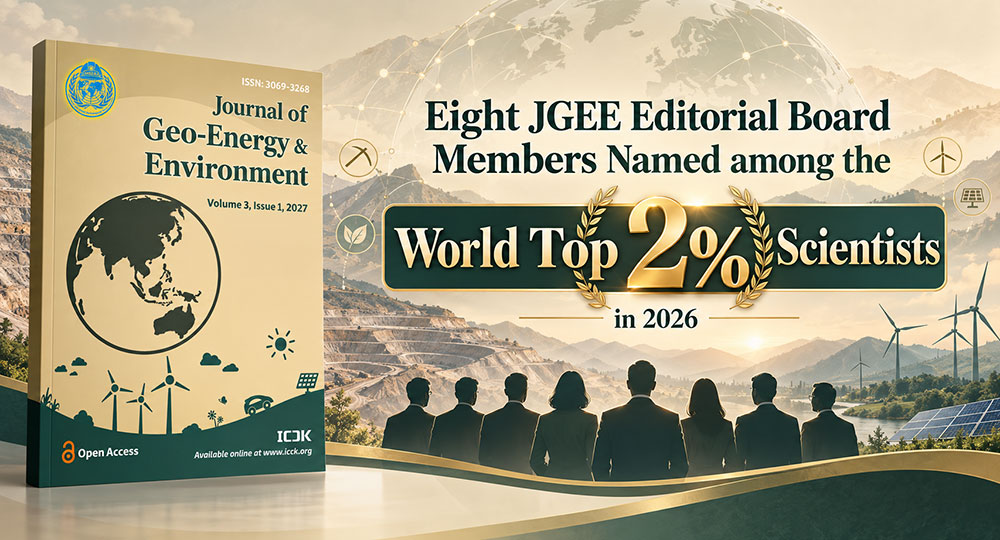

We are pleased to announce that eight members of the Editorial Board of the Journal of Geo-Energy and Environment (JGEE) have been included in the 2026 edition of the World’s Top 2% Scientists database. Released on 7 October 2026 in the Elsevier Data Repository, this edition provides citation-based indicators of researchers’ influence across scientific disciplines.
We extend our warm congratulations to Editor-in-Chief Hu Li, Honorary Editor-in-Chief Ahmed E. Radwan, and Associate Editors Bassem S. Nabawy, Chaojun Fan, Hamzeh Mehrabi, Hamzeh Ghorbani, Mohammad Abdelfattah Sarhan, and Ruyue Wang. We are grateful for their contributions to the research community and their service to JGEE.
Name | Editorial Role | Affiliation and Country |
Hu Li | Editor-in-Chief | Sichuan University of Science & Engineering, China |
Ahmed E. Radwan | Honorary Editor-in-Chief | Wroclaw University of Science and Technology, Poland |
Bassem S. Nabawy | Associate Editor | National Research Centre, Egypt |
Chaojun Fan | Associate Editor | Liaoning Technical University, China |
Hamzeh Mehrabi | Associate Editor | University of Tehran, Iran |
Hamzeh Ghorbani | Associate Editor | Islamic Azad University, Ahvaz Branch, Iran |
Mohammad Abdelfattah Sarhan | Associate Editor | Damietta University, Egypt |
Ruyue Wang | Associate Editor | Sinopec Petroleum Exploration and Production Research Institute, China |
Their inclusion offers an occasion to celebrate the citation impact of their research and to thank them for sharing their expertise with the journal’s authors, reviewers, and readers.
About the 2026 Database
Commonly known as the Stanford–Elsevier World’s Top 2% Scientists list, the database was developed by John P. A. Ioannidis of Stanford University and collaborators. It draws on Scopus records and groups researchers into 20 scientific fields and 174 subfields. Indicators include citations, the h-index, a coauthorship-adjusted h-index, and a composite citation score that accounts for author position.
The 2026 edition reports career-long citation impact through the end of 2025 and single-year impact based on citations received in 2025. Selection uses the top 100,000 researchers by composite score, with or without self-citations, or the top 2% within a subfield. These indicators provide a bibliometric perspective on research influence.
Research Expertise Supporting JGEE
The eight members bring expertise in petroleum geology, reservoir characterization, petrophysics, and geo-energy engineering. Their research addresses questions that are central to JGEE’s readership, including how geological conditions control energy resources and how subsurface systems can be understood and managed. This experience helps editors assess the scientific contribution of submissions and identify suitable reviewers.
We thank these colleagues for contributing their time and judgment to editorial work. A journal depends on careful decisions about research questions, methods, and evidence. Their involvement supports JGEE’s aim of publishing studies that are useful to researchers and practitioners working on geo-energy and its associated environmental challenges.
About the Journal
The Journal of Geo-Energy and Environment is an international, peer-reviewed, open-access journal published by ICCK in the United States. It focuses on geo-energy resources and environmental challenges associated with their exploration, development, use, and storage. Its scope includes oil and gas, geothermal energy, subsurface energy storage, geologically relevant hydrogen research, carbon capture and geological storage, and environmental management of geo-energy systems.
JGEE welcomes theoretical, experimental, field-based, and computational research. The journal has been accepted for inclusion in Chemical Abstracts Service (CAS). We invite researchers to explore the published articles and submit original studies within the journal’s scope.
Congratulations once again to all eight members. We also thank the wider Editorial Board, our authors, reviewers, and readers for their continued support of JGEE. We look forward to sharing further research that improves understanding of geo-energy systems and informs responsible resource development.
Journal website: https://www.icck.org/jgee
Editorial Board: https://www.icck.org/jgee/editors
2026 database: https://elsevier.digitalcommonsdata.com/datasets/btchxktzyw/9