Volume 2, Issue 3 (In Progress)


In Progress
Citations: Crossref logo 0,   0   |   Viewed: 844, Download: 457

Table of Contents

Open Access | Review Article | 20 September 2026
Federated Fine-Tuning of Large Language Models on Resource-Constrained Clients: Technical Approaches, Resource Costs, and Applicability
Journal of Reliable and Secure Computing | Volume 2, Issue 3: 194-211, 2026 | DOI: 10.62762/JRSC.2026.225854
Abstract
Federated fine-tuning adapts language models to distributed data and is widely adopted as a privacy-preserving alternative to centralized training, yet constrained clients must still store model weights and training states, execute updates, and communicate with a server. This review examines four composable routes---parameter-efficient and quantized adaptation, backpropagation-free adaptation, proxy or submodel adaptation, and split federated adaptation---through a common framework that traces the objects each endpoint retains, exchanges, and discloses. When a client retains the complete base, reducing adapter state leaves a base-storage floor; boundary communication depends on input dimensi... More >

Graphical Abstract
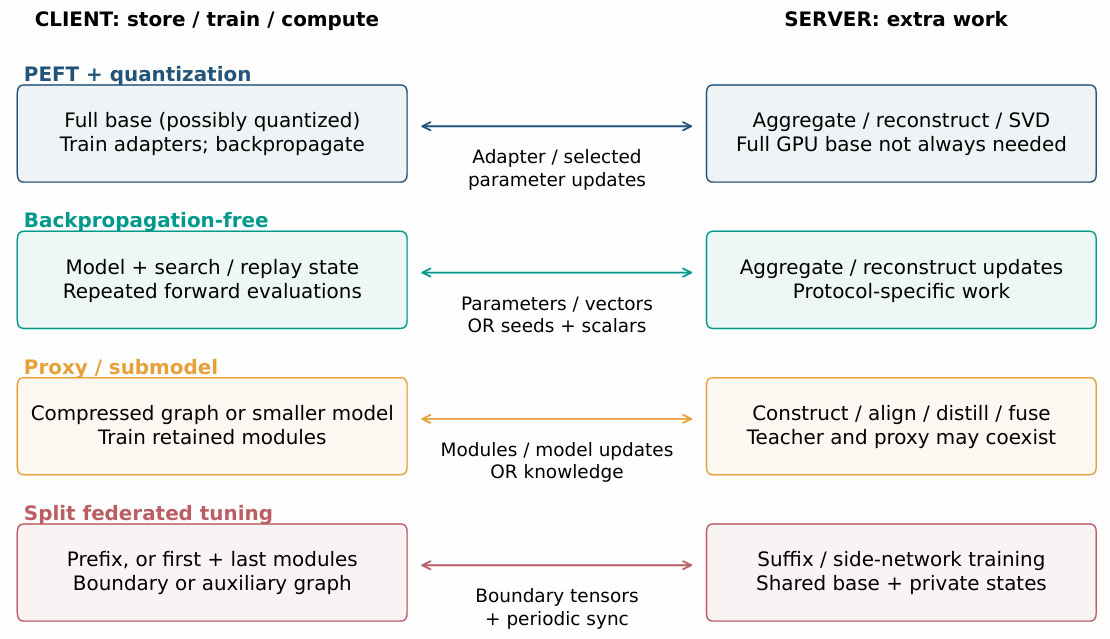
Federated Fine-Tuning of Large Language Models on Resource-Constrained Clients: Technical Approaches, Resource Costs, and Applicability
Open Access | Research Article | 19 September 2026
TrustCompute: Result Validation, Reputation-Aware Scheduling and Quality-Based Payments for Outsourced LoRA Fine-Tuning
Journal of Reliable and Secure Computing | Volume 2, Issue 3: 179-193, 2026 | DOI: 10.62762/JRSC.2026.867713
Abstract
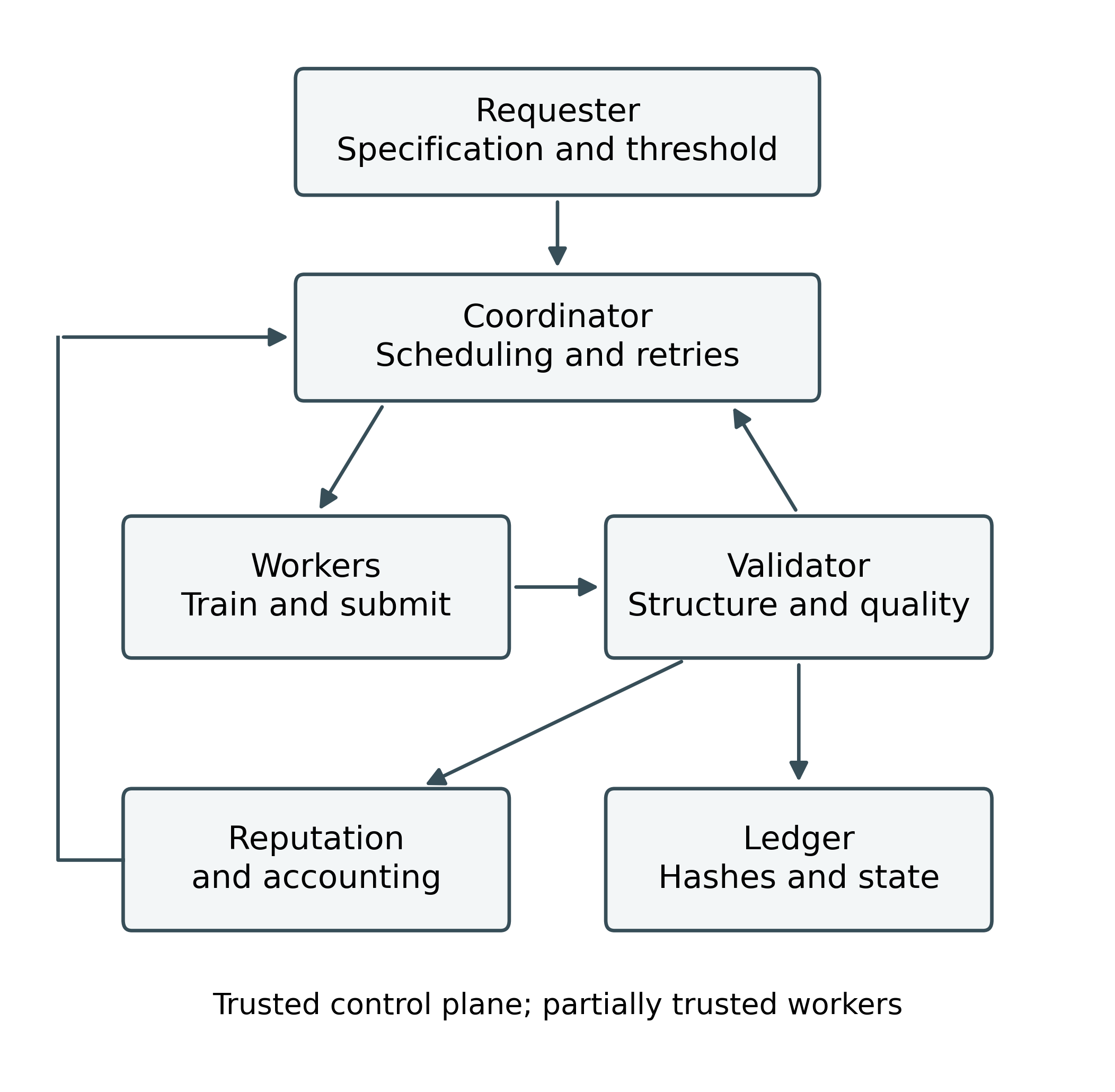
Outsourced model fine-tuning requires reliable task allocation, result validation, and incentives for quality. We present TrustCompute, a compute-sharing platform integrating two-stage adapter verification, reputation-aware scheduling, quality-based payments, and auditable ledger records for LoRA fine-tuning. Our evaluation combines synthetic workloads, real GPU-based fine-tuning, and a local Ethereum Virtual Machine (EVM) environment. Across 440 validation cases, all 400 invalid submissions were rejected and all 40 valid submissions were accepted. With 50% unreliable workers, reputation-aware scheduling achieved 100% task completion and reduced the mean failed-attempt time by 89% relative t... More >

Graphical Abstract
TrustCompute: Result Validation, Reputation-Aware Scheduling and Quality-Based Payments for Outsourced LoRA Fine-Tuning
Open Access | Research Article | 21 July 2026
Data Governance and Policy Support for Secure AI-Driven Corporate Digital Transformation
Journal of Reliable and Secure Computing | Volume 2, Issue 3: 164-178, 2026 | DOI: 10.62762/JRSC.2026.326448
Abstract
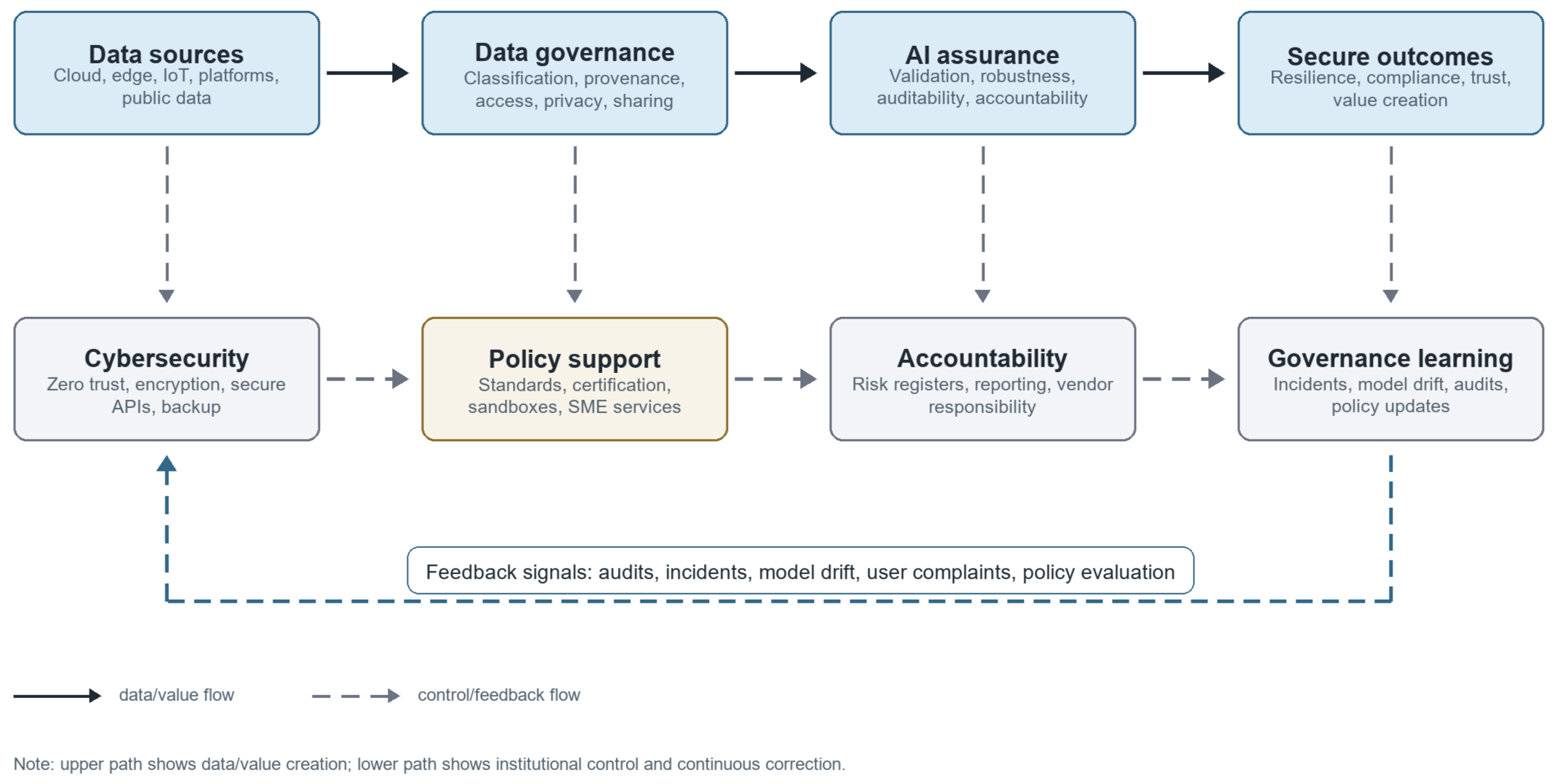
Artificial intelligence is becoming a core engine of corporate digital transformation, but its value depends first on secure, reliable, and accountable data and model infrastructures. As firms combine cloud platforms, edge devices, IoT sensors, digital twins, platform data, and algorithmic decision systems, they also expand the attack surface, privacy exposure, model security risk, and compliance burden. This paper develops a security-aware data and AI governance framework for AI-driven corporate digital transformation. It positions the framework as a unified governance model rather than a narrow extension of data management: data governance controls data classification, provenance, access,... More >

Graphical Abstract
Data Governance and Policy Support for Secure AI-Driven Corporate Digital Transformation