

TrustCompute: Result Validation, Reputation-Aware Scheduling and Quality-Based Payments for Outsourced LoRA Fine-Tuning




Article Information
Abstract
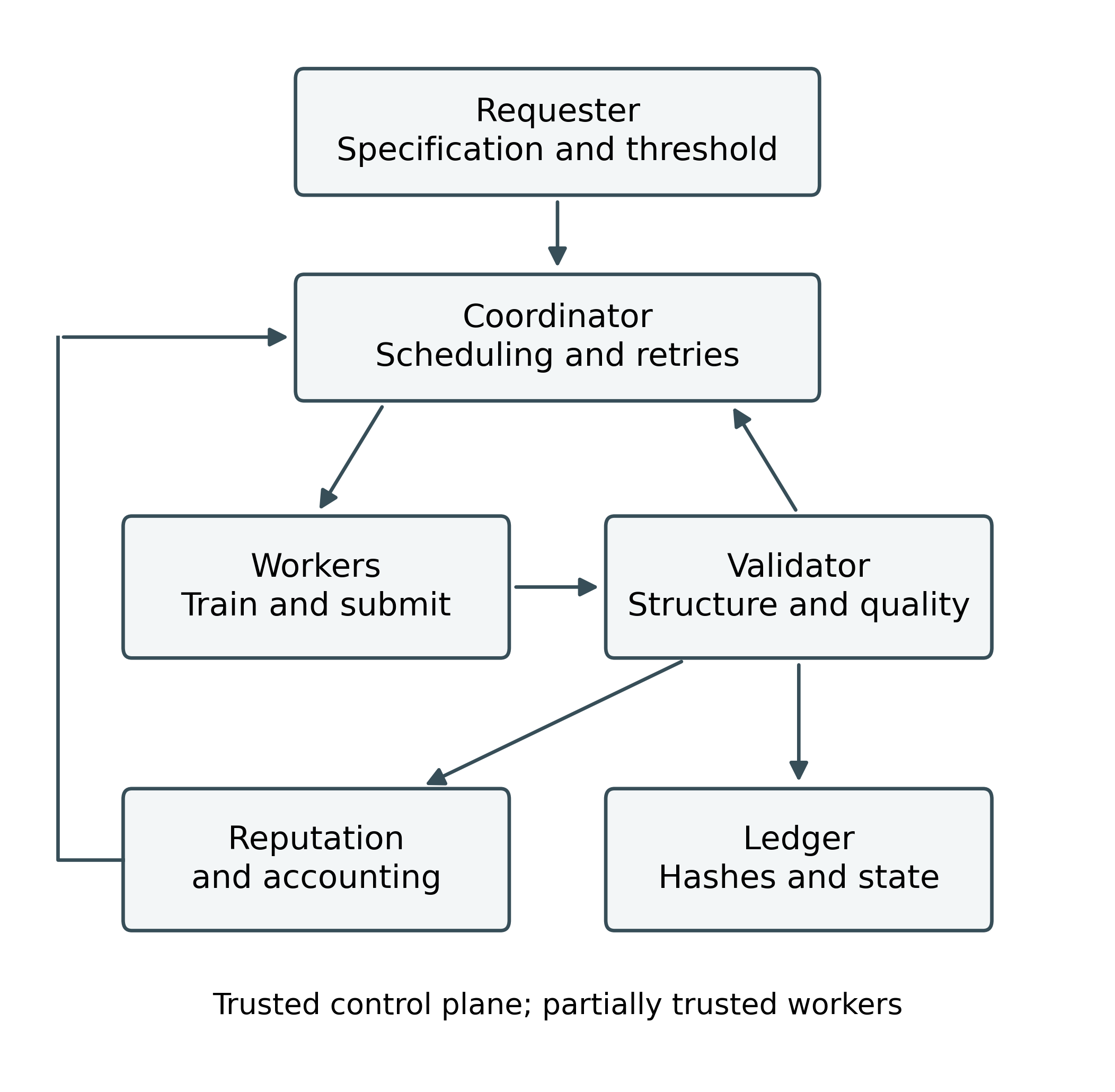
Outsourced model fine-tuning requires reliable task allocation, result validation, and incentives for quality. We present TrustCompute, a compute-sharing platform integrating two-stage adapter verification, reputation-aware scheduling, quality-based payments, and auditable ledger records for LoRA fine-tuning. Our evaluation combines synthetic workloads, real GPU-based fine-tuning, and a local Ethereum Virtual Machine (EVM) environment. Across 440 validation cases, all 400 invalid submissions were rejected and all 40 valid submissions were accepted. With 50% unreliable workers, reputation-aware scheduling achieved 100% task completion and reduced the mean failed-attempt time by 89% relative to round-robin scheduling. An integration experiment completed 120 real fine-tuning tasks. Additional simulations showed that identity resets can exploit exploration and that quality proportional payments can improve strategic workers’ delivered quality. These findings support jointly designing verification, scheduling, and payment mechanisms. TrustCompute verifies compliance with result acceptance criteria, but does not prove adherence to a prescribed training procedure.
Graphical Abstract
Keywords
Data Availability Statement
Funding
Conflicts of Interest
AI Use Statement
Ethical Approval and Consent to Participate
References
- Hu, E. J., Shen, Y., Wallis, P., Allen-Zhu, Z., Li, Y., Wang, S., ... & Chen, W. (2021). Lora: Low-rank adaptation of large language models. arXiv preprint arXiv:2106.09685.
[CrossRef] [Google Scholar] - Kang, J., Xiong, Z., Niyato, D., Xie, S., & Zhang, J. (2019). Incentive mechanism for reliable federated learning: A joint optimization approach to combining reputation and contract theory. IEEE Internet of Things Journal, 6(6), 10700-10714.
[CrossRef] [Google Scholar] - Anderson, D. P. (2004, November). Boinc: A system for public-resource computing and storage. In Fifth IEEE/ACM international workshop on grid computing (pp. 4-10). IEEE.
[CrossRef] [Google Scholar] - Borzunov, A., Baranchuk, D., Dettmers, T., Riabinin, M., Belkada, Y., Chumachenko, A., ... & Raffel, C. (2023, July). Petals: Collaborative inference and fine-tuning of large models. In Proceedings of the 61st Annual Meeting of the Association for Computational Linguistics (Volume 3: System Demonstrations) (pp. 558-568).
[CrossRef] [Google Scholar] - Ryabinin, M., & Gusev, A. (2020). Towards crowdsourced training of large neural networks using decentralized mixture-of-experts. Advances in Neural Information Processing Systems, 33, 3659-3672.
[Google Scholar] - Weng, J., Weng, J., Zhang, J., Li, M., Zhang, Y., & Luo, W. (2019). Deepchain: Auditable and privacy-preserving deep learning with blockchain-based incentive. IEEE Transactions on Dependable and Secure Computing, 18(5), 2438-2455.
[CrossRef] [Google Scholar] - Parno, B., Howell, J., Gentry, C., & Raykova, M. (2016). Pinocchio: Nearly practical verifiable computation. Communications of the ACM, 59(2), 103-112.
[CrossRef] [Google Scholar] - Tramer, F., & Boneh, D. (2018). Slalom: Fast, verifiable and private execution of neural networks in trusted hardware. arXiv preprint arXiv:1806.03287.
[CrossRef] [Google Scholar] - Zhao, L., Wang, Q., Wang, C., Li, Q., Shen, C., & Feng, B. (2021). Veriml: Enabling integrity assurances and fair payments for machine learning as a service. IEEE Transactions on Parallel and Distributed Systems, 32(10), 2524-2540.
[CrossRef] [Google Scholar] - Jia, H., Yaghini, M., Choquette-Choo, C. A., Dullerud, N., Thudi, A., Chandrasekaran, V., & Papernot, N. (2021, May). Proof-of-learning: Definitions and practice. In 2021 IEEE Symposium on Security and Privacy (SP) (pp. 1039-1056). IEEE.
[CrossRef] [Google Scholar] - Körbel, B., Sigwart, M., Frauenthaler, P., Sober, M., & Schulte, S. (2021, November). Blockchain-based result verification for computation offloading. In International Conference on Service-Oriented Computing (pp. 99-115). Cham: Springer International Publishing.
[CrossRef] [Google Scholar] - Kamvar, S. D., Schlosser, M. T., & Garcia-Molina, H. (2003). The EigenTrust algorithm for reputation management in P2P networks. Proceedings of the 12th International Conference on World Wide Web, 640–651.
[CrossRef] [Google Scholar] - Josang, A., & Ismail, R. (2002, June). The beta reputation system. In Proceedings of the 15th bled electronic commerce conference (Vol. 5, pp. 324-337). https://domino.fov.um.si/proceedings.nsf/Proceedings/D9E48B66F32A7DFFC1256E9F00355B37/$File/josang.pdf
[Google Scholar] - Auer, P., Cesa-Bianchi, N., & Fischer, P. (2002). Finite-time analysis of the multiarmed bandit problem. Machine learning, 47(2), 235-256.
[CrossRef] [Google Scholar] - Daniel, J. R., Benjamin, V. R., Abbas, K., Ian, O., & Zheng, W. (2018). A tutorial on thompson sampling. Foundations and trends® in machine learning, 11(1), 1-99.
[CrossRef] [Google Scholar] - Friedman, E. J., & Resnick, P. (2001). The social cost of cheap pseudonyms. Journal of Economics & Management Strategy, 10(2), 173-199.
[CrossRef] [Google Scholar] - Douceur, J. R. (2002, March). The sybil attack. In International workshop on peer-to-peer systems (pp. 251-260). Berlin, Heidelberg: Springer Berlin Heidelberg.
[CrossRef] [Google Scholar] - Ding, N., Fang, Z., & Huang, J. (2020). Optimal contract design for efficient federated learning with multi-dimensional private information. IEEE Journal on Selected Areas in Communications, 39(1), 186-200.
[CrossRef] [Google Scholar] - Qwen Team. (2024). Qwen2.5 technical report. arXiv preprint arXiv:2412.15115.
[CrossRef] [Google Scholar] - Merity, S., Xiong, C., Bradbury, J., & Socher, R. (2016). Pointer sentinel mixture models. arXiv preprint arXiv:1609.07843.
[CrossRef] [Google Scholar]
Cite This Article
TY  - JOUR
AU  - Lee, Lin-Fa
AU  - Chang, Yi-Yu
AU  - Yeh, Kuo-Hui
PY  - 2026
DA  - 2026/09/19
TI  - TrustCompute: Result Validation, Reputation-Aware Scheduling and Quality-Based Payments for Outsourced LoRA Fine-Tuning
JO  - Journal of Reliable and Secure Computing
T2  - Journal of Reliable and Secure Computing
JF  - Journal of Reliable and Secure Computing
VL  - 2
IS  - 3
SP  - 179
EP  - 193
DO  - 10.62762/JRSC.2026.867713
UR  - https://www.icck.org/article/abs/JRSC.2026.867713
KW  - outsourced computing
KW  - LoRA fine-tuning
KW  - result validation
KW  - reputation-aware scheduling
KW  - quality-based payment
KW  - auditable ledger
AB  - Outsourced model fine-tuning requires reliable task allocation, result validation, and incentives for quality. We present TrustCompute, a compute-sharing platform integrating two-stage adapter verification, reputation-aware scheduling, quality-based payments, and auditable ledger records for LoRA fine-tuning. Our evaluation combines synthetic workloads, real GPU-based fine-tuning, and a local Ethereum Virtual Machine (EVM) environment. Across 440 validation cases, all 400 invalid submissions were rejected and all 40 valid submissions were accepted. With 50% unreliable workers, reputation-aware scheduling achieved 100% task completion and reduced the mean failed-attempt time by 89% relative to round-robin scheduling. An integration experiment completed 120 real fine-tuning tasks. Additional simulations showed that identity resets can exploit exploration and that quality proportional payments can improve strategic workers’ delivered quality. These findings support jointly designing verification, scheduling, and payment mechanisms. TrustCompute verifies compliance with result acceptance criteria, but does not prove adherence to a prescribed training procedure.
SN  - 3070-6424
PB  - Institute of Central Computation and Knowledge
LA  - English
ER  -
@article{Lee2026TrustCompu,
  author = {Lin-Fa Lee and Yi-Yu Chang and Kuo-Hui Yeh},
  title = {TrustCompute: Result Validation, Reputation-Aware Scheduling and Quality-Based Payments for Outsourced LoRA Fine-Tuning},
  journal = {Journal of Reliable and Secure Computing},
  year = {2026},
  volume = {2},
  number = {3},
  pages = {179-193},
  doi = {10.62762/JRSC.2026.867713},
  url = {https://www.icck.org/article/abs/JRSC.2026.867713},
  abstract = {Outsourced model fine-tuning requires reliable task allocation, result validation, and incentives for quality. We present TrustCompute, a compute-sharing platform integrating two-stage adapter verification, reputation-aware scheduling, quality-based payments, and auditable ledger records for LoRA fine-tuning. Our evaluation combines synthetic workloads, real GPU-based fine-tuning, and a local Ethereum Virtual Machine (EVM) environment. Across 440 validation cases, all 400 invalid submissions were rejected and all 40 valid submissions were accepted. With 50\% unreliable workers, reputation-aware scheduling achieved 100\% task completion and reduced the mean failed-attempt time by 89\% relative to round-robin scheduling. An integration experiment completed 120 real fine-tuning tasks. Additional simulations showed that identity resets can exploit exploration and that quality proportional payments can improve strategic workers’ delivered quality. These findings support jointly designing verification, scheduling, and payment mechanisms. TrustCompute verifies compliance with result acceptance criteria, but does not prove adherence to a prescribed training procedure.},
  keywords = {outsourced computing, LoRA fine-tuning, result validation, reputation-aware scheduling, quality-based payment, auditable ledger},
  issn = {3070-6424},
  publisher = {Institute of Central Computation and Knowledge}
}
Article Metrics
Publisher's Note
ICCK stays neutral with regard to jurisdictional claims in published maps and institutional affiliations.
Rights and Permissions
 Copyright © 2026 by the Author(s). Published by Institute of Central Computation and Knowledge. This article is an open access article distributed under the terms and conditions of the Creative Commons Attribution (CC BY) license (https://creativecommons.org/licenses/by/4.0/), which permits use, sharing, adaptation, distribution and reproduction in any medium or format, as long as you give appropriate credit to the original author(s) and the source, provide a link to the Creative Commons licence, and indicate if changes were made.


Portico
