

Blockchain Consensus Mechanisms and Enhancement Techniques for Federated Learning-Based Intrusion Detection Systems in IoT Smart Homes



Article Information
Abstract
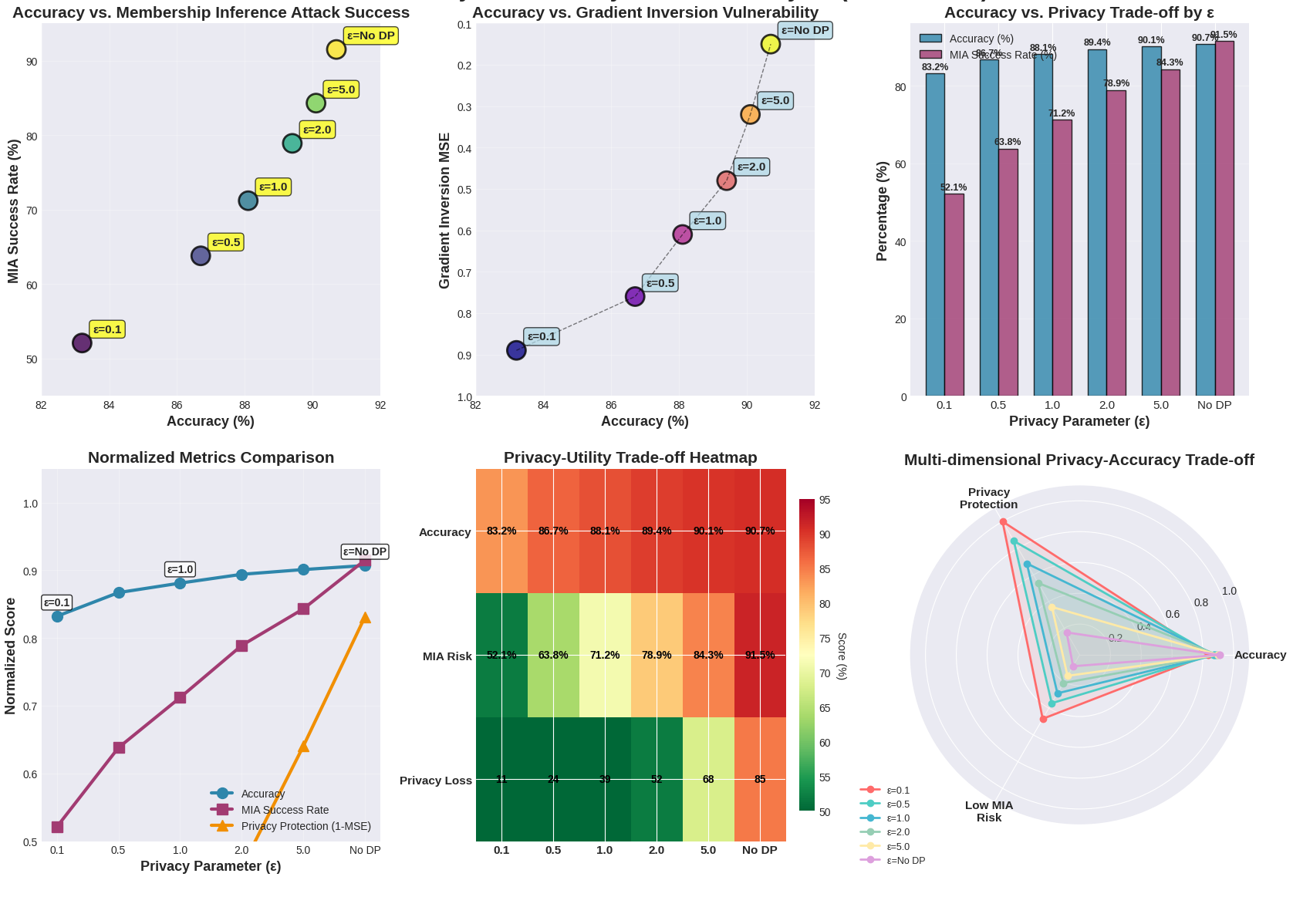
The rapid proliferation of smart home IoT devices has introduced unprecedented cybersecurity vulnerabilities, necessitating scalable and privacy-preserving intrusion detection systems (IDS). Federated Learning (FL) offers a promising decentralized approach by training models locally without sharing raw data, but it remains susceptible to poisoning attacks and relies on a vulnerable central aggregator. This paper presents a novel blockchain-enhanced FL framework tailored for smart home IDS, integrating multiple consensus mechanisms—Proof-of-Stake (PoS), Practical Byzantine Fault Tolerance (PBFT), and Proof-of-Authority (PoA)—for the first time in this context. Our approach uniquely combines differential privacy (DP) and secure aggregation (SA) within a blockchain-managed workflow to mitigate gradient inversion and membership inference attacks while ensuring tamper-resistant, decentralized trust. Experimental evaluation using the N-BaIoT dataset demonstrates that the proposed system achieves up to 88.3% detection accuracy with manageable latency (~200 ms/round) and formal privacy guarantees ($\varepsilon$=1.0 DP). The framework introduces 52.8% system overhead compared to vanilla FL—a reasonable trade-off for enhanced security and privacy. This work establishes a robust, transparent, and scalable security infrastructure for smart homes, effectively addressing the limitations of both centralized and conventional FL-based IDS.
Graphical Abstract
Keywords
Data Availability Statement
Funding
Conflicts of Interest
AI Use Statement
Ethical Approval and Consent to Participate
References
- Alruwaili, F. F. (2024). Blockchain-powered deep learning for the Internet of Things with cloud-assisted secure smart home networks. IEEE Access, 12, 119927 - 119936.
[CrossRef] [Google Scholar] - Begum, K., Mozumder, M. A. I., Joo, M. I., & Kim, H. C. (2024). BFLIDS: Blockchain-driven federated learning for intrusion detection in IoMT networks. Sensors, 24(14), 4591.
[CrossRef] [Google Scholar] - Bhasker, B., Rao, P. M., Saraswathi, P., Patro, S. G. K., Bhutto, J. K., Islam, S., ... & Emma, A. F. (2025). Blockchain framework with IoT device using federated learning for sustainable healthcare systems. Scientific Reports, 15(1), 26736.
[CrossRef] [Google Scholar] - Govindaram, A., & A, J. (2025). Flbc-ids: a federated learning and blockchain-based intrusion detection system for secure iot environments. Multimedia Tools and Applications, 84(17), 17229-17251.
[CrossRef] [Google Scholar] - Kumar, M., Samriya, J. K., Walia, G. K., Verma, P., Wu, H., & Gill, S. S. (2025). Blockchain empowered secure federated learning for consumer IoT applications in cloud-edge collaborative environment. IEEE Transactions on Consumer Electronics, 71(2), 3986 - 3996.
[CrossRef] [Google Scholar] - Shalan, M., Hasan, M. R., Bai, Y., & Li, J. (2025). Enhancing Smart Home Security: Blockchain-Enabled Federated Learning with Knowledge Distillation for Intrusion Detection. Smart Cities (2624-6511), 8(1).
[CrossRef] [Google Scholar] - Mothukuri, V., Parizi, R. M., Pouriyeh, S., Huang, Y., Dehghantanha, A., & Srivastava, G. (2021). A survey on security and privacy of federated learning. Future Generation Computer Systems, 115, 619-640.
[CrossRef] [Google Scholar] - Zhang, C., Xie, Y., Bai, H., Yu, B., Li, W., & Gao, Y. (2021). A survey on federated learning. Knowledge-Based Systems, 216, 106775.
[CrossRef] [Google Scholar] - Naif, A. (2025). A verifiably secure and lightweight device-to-device (D2D) authentication protocol for the resource-constrained IoT networks. IEEE Access, 13, 92982–92996.
[CrossRef] [Google Scholar] - Liang, F., Hatcher, W. G., Liao, W., Gao, W., & Yu, W. (2019). Machine learning for security and the internet of things: the good, the bad, and the ugly. IEEE Access, 7, 158126-158147.
[CrossRef] [Google Scholar] - Sharma, G., Verma, N., Jain, S., & Sharma, R. S. (2025). A hybrid framework for secure IoT communication using lightweight cryptography and machine learning-based authentication. Peer-to-Peer Networking and Applications, 18(6), 1-18.
[CrossRef] [Google Scholar] - Keshta, I. (2025). A cloud-assisted key agreement protocol for the E-healthcare system. PLoS One, 20(6), e0322313.
[CrossRef] [Google Scholar] - Santhosh Kumar, S. V. N., Selvi, M., & Kannan, A. (2023). A comprehensive survey on machine learning‐based intrusion detection systems for secure communication in internet of things. Computational Intelligence and Neuroscience, 2023(1), 8981988.
[CrossRef] [Google Scholar] - Alzahrani, A. (2024). Developing a provable secure and cloud-centric authentication protocol for the e-healthcare system. IEEE Access, 12, 183665–183687.
[CrossRef] [Google Scholar] - Xu, R., Nikouei, S. Y., Chen, Y., Polunchenko, A., Song, S., Deng, C., & Faughnan, T. R. (2018, May). Real-time human objects tracking for smart surveillance at the edge. In 2018 IEEE International conference on communications (ICC) (pp. 1-6). IEEE.
[CrossRef] [Google Scholar] - Algarni, F. (2024). A lightweight and secure authentication protocol for visually impaired and handicapped people in the telehealth system. Alexandria Engineering Journal, 106, 793–808.
[CrossRef] [Google Scholar] - Dai, H. N., Zheng, Z., & Zhang, Y. (2019). Blockchain for Internet of Things: A survey. IEEE internet of things journal, 6(5), 8076-8094.
[CrossRef] [Google Scholar] - Hieu, V. T. T., Quyen, N. H., Do Hoang, H., Duy, P. T., & Pham, V. H. (2025). PoFQ: a blockchain consensus protocol for decentralized federated learning-based threat hunting approach in a trustless computing landscape. Cluster Computing, 28(9), 571.
[CrossRef] [Google Scholar] - Zaabar, B., Cheikhrouhou, O., & Abid, M. (2022, November). Intrusion detection system for IoMT through blockchain-based federated learning. In 2022 15th International Conference on Security of Information and Networks (SIN) (pp. 01-08). IEEE.
[CrossRef] [Google Scholar] - Binbusayyis, A., & Sha, M. (2025). Secure and privacy-preserving intrusion detection in smart networks via blockchain-based federated learning and optimized deep learning models. High-Confidence Computing, 100355.
[CrossRef] [Google Scholar] - Nandanwar, H., & Katarya, R. (2024, December). A secure and privacy-preserving ids for iot networks using hybrid blockchain and federated learning. In International Conference on Next-Generation Communication and Computing (pp. 207-219). Singapore: Springer Nature Singapore.
[CrossRef] [Google Scholar] - Palaparthy, H., Gudala, L., Shaik, M., Chitta, S., & Saini, V. (2022). Securing IoT in Resource-Constrained Settings: A Comparative Analysis of Lightweight Protocols. Nanotechnology Perceptions, 18, 283-300.
[Google Scholar] - Sagar, S., Li, C. S., Loke, S. W., & Choi, J. (2023). Poisoning attacks and defenses in federated learning: A survey. arXiv preprint arXiv:2301.05795.
[Google Scholar] - Zhang, J., Guo, S., Qu, Z., Zeng, D., Zhan, Y., Liu, Q., & Akerkar, R. (2021). Adaptive federated learning on non-iid data with resource constraint. IEEE Transactions on Computers, 71(7), 1655-1667.
[CrossRef] [Google Scholar] - Mothukuri, V., Khare, P., & Parizi, R. M. (2021). A survey on security and privacy of federated learning. Future Generation Computer Systems, 115, 619–640.
[CrossRef] [Google Scholar] - Whig, P., Sharma, R., Yathiraju, N., Jain, A., & Sharma, S. (2025). Blockchain‐enabled secure federated learning systems for advancing privacy and trust in decentralized AI. Model Optimization Methods for Efficient and Edge AI: Federated Learning Architectures, Frameworks and Applications, 321-340.
[CrossRef] [Google Scholar] - Vangala, A., Das, A. K., Park, Y., & Jamal, S. S. (2022). Blockchain-based robust data security scheme in IoT-enabled smart home. Computers, Materials & Continua, 72(2), 3549-3570.
[CrossRef] [Google Scholar] - El Ouadrhiri, A., & Abdelhadi, A. (2022). Differential privacy for deep and federated learning: A survey. IEEE Access, 10, 22359-22380.
[CrossRef] [Google Scholar] - Kaur, J., & Singh, G. (2022). A blockchain-based machine learning intrusion detection system for internet of things. In Principles and Practice of Blockchains (pp. 119-134). Cham: Springer International Publishing.
[CrossRef] [Google Scholar] - Fan, S., Zhang, H., Zeng, Y., & Cai, W. (2020). Hybrid blockchain-based resource trading system for federated learning in edge computing. IEEE Internet of Things Journal, 8(4), 2252-2264.
[CrossRef] [Google Scholar] - Mansouri, M., Önen, M., Jaballah, W. B., & Conti, M. (2023). Sok: Secure aggregation based on cryptographic schemes for federated learning. Proceedings on Privacy Enhancing Technologies.
[CrossRef] [Google Scholar] - Govindaram, A., & A, J. (2025). Flbc-ids: a federated learning and blockchain-based intrusion detection system for secure iot environments. Multimedia Tools and Applications, 84(17), 17229-17251.
[CrossRef] [Google Scholar] - Wang, Z., Hu, Q., Li, R., Xu, M., & Xiong, Z. (2023). Incentive mechanism design for joint resource allocation in blockchain-based federated learning. IEEE Transactions on Parallel and Distributed Systems, 34(5), 1536-1547.
[CrossRef] [Google Scholar] - Lao, L., Li, Z., Hou, S., Xiao, B., Guo, S., & Yang, Y. (2020). A survey of IoT applications in blockchain systems: Architecture, consensus, and traffic modeling. ACM Computing Surveys (CSUR), 53(1), 1-32.
[CrossRef] [Google Scholar] - Li, T., Sahu, A. K., Talwalkar, A., & Smith, V. (2020). Federated learning: Challenges, methods, and future directions. IEEE signal processing magazine, 37(3), 50-60.
[CrossRef] [Google Scholar] - Fahim, S., Rahman, S. K., & Mahmood, S. (2023). Blockchain: A comparative study of consensus algorithms PoW, PoS, PoA, PoV. Int. J. Math. Sci. Comput, 3(1), 46-57.
[CrossRef] [Google Scholar] - Nguyen, D. C., Ding, M., Pathirana, P. N., Seneviratne, A., Li, J., & Poor, H. V. (2021). Federated learning for internet of things: A comprehensive survey. IEEE communications surveys & tutorials, 23(3), 1622-1658.
[CrossRef] [Google Scholar] - Wang, L., Li, Y., & Zuo, L. (2025). Trust management for IoT devices based on federated learning and blockchain. Journal of Supercomputing, 81(1).
[CrossRef] [Google Scholar] - Okey, O. D., Rodriguez, D. Z., & Kleinschmidt, J. H. (2024, July). Enhancing IoT Intrusion Detection with Federated Learning-Based CNN-GRU and LSTM-GRU Ensembles. In 2024 19th International Symposium on Wireless Communication Systems (ISWCS) (pp. 1-6). IEEE.
[CrossRef] [Google Scholar] - Sefati, S. S., Craciunescu, R., Arasteh, B., Halunga, S., Fratu, O., & Tal, I. (2024). Cybersecurity in a scalable smart city framework using blockchain and federated learning for internet of things (iot). Smart Cities, 7(5), 2802-2841.
[CrossRef] [Google Scholar]
Cited By (4)
-
Wenhao Cai, Ying Chen. TransGraphNet: A Transformer‐Graph Hybrid Deep Learning Model for DDoS Attack Detection in Heterogeneous Networks.
SECURITY AND PRIVACY, 2026 , 9 (6).
[CrossRef] -
Oluyemisi A Oyedemi, Micheal O Ajinaja, Yetunde E Ogunwale. <p>A Hybrid Federated Learning and Blockchain Framework for Privacy-Preserving Intrusion Detection in IoT Networks</p>.
Cureus Journal of Computer Science, 2026 .
[CrossRef] -
Nafiz Ahmed Chisty, Mohammad Shorif Uddin, Mohammad Alif Arman, M. Shamim Kaiser, Kanad Ray. Revolutionizing Residential Living: A Systematic Review of IoT Applications, Challenges, and Future Trends in Smart-Home Automation.
Information, 2026 , 17 (9).
[CrossRef] -
Vinay Kumar Singh, Bharati Rathore, Raja Saeed Iqbal, Dinesh Prasad Sahu, Shiv Prakash, Vishal Krishna Singh. An EEG-Based Human Emotion Recognition Model Using Attention Hierarchical Variational EEGNet.
IEEE Journal of Selected Areas in Sensors, 2026 , 3 .
[CrossRef]
Cite This Article
TY  - JOUR
AU  - Alghamdi, Amro
AU  - Keshta, Ismail
PY  - 2026
DA  - 2026/01/28
TI  - Blockchain Consensus Mechanisms and Enhancement Techniques for Federated Learning-Based Intrusion Detection Systems in IoT Smart Homes
JO  - Journal of Reliable and Secure Computing
T2  - Journal of Reliable and Secure Computing
JF  - Journal of Reliable and Secure Computing
VL  - 2
IS  - 1
SP  - 1
EP  - 26
DO  - 10.62762/JRSC.2025.761390
UR  - https://www.icck.org/article/abs/JRSC.2025.761390
KW  - smart home security
KW  - internet of things (IoT)
KW  - intrusion detection system (IDS)
KW  - federated learning (FL)
KW  - blockchain
KW  - consensus mechanisms
KW  - privacy-preserving machine learning
KW  - decentralized trust
KW  - model poisoning
KW  - cyber security
AB  - The rapid proliferation of smart home IoT devices has introduced unprecedented cybersecurity vulnerabilities, necessitating scalable and privacy-preserving intrusion detection systems (IDS). Federated Learning (FL) offers a promising decentralized approach by training models locally without sharing raw data, but it remains susceptible to poisoning attacks and relies on a vulnerable central aggregator. This paper presents a novel blockchain-enhanced FL framework tailored for smart home IDS, integrating multiple consensus mechanisms—Proof-of-Stake (PoS), Practical Byzantine Fault Tolerance (PBFT), and Proof-of-Authority (PoA)—for the first time in this context. Our approach uniquely combines differential privacy (DP) and secure aggregation (SA) within a blockchain-managed workflow to mitigate gradient inversion and membership inference attacks while ensuring tamper-resistant, decentralized trust. Experimental evaluation using the N-BaIoT dataset demonstrates that the proposed system achieves up to 88.3% detection accuracy with manageable latency (~200 ms/round) and formal privacy guarantees ($\varepsilon$=1.0 DP). The framework introduces 52.8% system overhead compared to vanilla FL—a reasonable trade-off for enhanced security and privacy. This work establishes a robust, transparent, and scalable security infrastructure for smart homes, effectively addressing the limitations of both centralized and conventional FL-based IDS.
SN  - 3070-6424
PB  - Institute of Central Computation and Knowledge
LA  - English
ER  -
@article{Alghamdi2026Blockchain,
  author = {Amro Alghamdi and Ismail Keshta},
  title = {Blockchain Consensus Mechanisms and Enhancement Techniques for Federated Learning-Based Intrusion Detection Systems in IoT Smart Homes},
  journal = {Journal of Reliable and Secure Computing},
  year = {2026},
  volume = {2},
  number = {1},
  pages = {1-26},
  doi = {10.62762/JRSC.2025.761390},
  url = {https://www.icck.org/article/abs/JRSC.2025.761390},
  abstract = {The rapid proliferation of smart home IoT devices has introduced unprecedented cybersecurity vulnerabilities, necessitating scalable and privacy-preserving intrusion detection systems (IDS). Federated Learning (FL) offers a promising decentralized approach by training models locally without sharing raw data, but it remains susceptible to poisoning attacks and relies on a vulnerable central aggregator. This paper presents a novel blockchain-enhanced FL framework tailored for smart home IDS, integrating multiple consensus mechanisms—Proof-of-Stake (PoS), Practical Byzantine Fault Tolerance (PBFT), and Proof-of-Authority (PoA)—for the first time in this context. Our approach uniquely combines differential privacy (DP) and secure aggregation (SA) within a blockchain-managed workflow to mitigate gradient inversion and membership inference attacks while ensuring tamper-resistant, decentralized trust. Experimental evaluation using the N-BaIoT dataset demonstrates that the proposed system achieves up to 88.3\% detection accuracy with manageable latency (~200 ms/round) and formal privacy guarantees (\$\varepsilon\$=1.0 DP). The framework introduces 52.8\% system overhead compared to vanilla FL—a reasonable trade-off for enhanced security and privacy. This work establishes a robust, transparent, and scalable security infrastructure for smart homes, effectively addressing the limitations of both centralized and conventional FL-based IDS.},
  keywords = {smart home security, internet of things (IoT), intrusion detection system (IDS), federated learning (FL), blockchain, consensus mechanisms, privacy-preserving machine learning, decentralized trust, model poisoning, cyber security},
  issn = {3070-6424},
  publisher = {Institute of Central Computation and Knowledge}
}
Publisher's Note
ICCK stays neutral with regard to jurisdictional claims in published maps and institutional affiliations.
Rights and Permissions
 Copyright © 2026 by the Author(s). Published by Institute of Central Computation and Knowledge. This article is an open access article distributed under the terms and conditions of the Creative Commons Attribution (CC BY) license (https://creativecommons.org/licenses/by/4.0/), which permits use, sharing, adaptation, distribution and reproduction in any medium or format, as long as you give appropriate credit to the original author(s) and the source, provide a link to the Creative Commons licence, and indicate if changes were made.


Portico
