Volume 2, Issue 1 (In Progress)


In Progress
Citations: 0, 0,  0   |   Viewed: 1222, Download: 244

Table of Contents

Open Access | Research Article | 07 February 2026
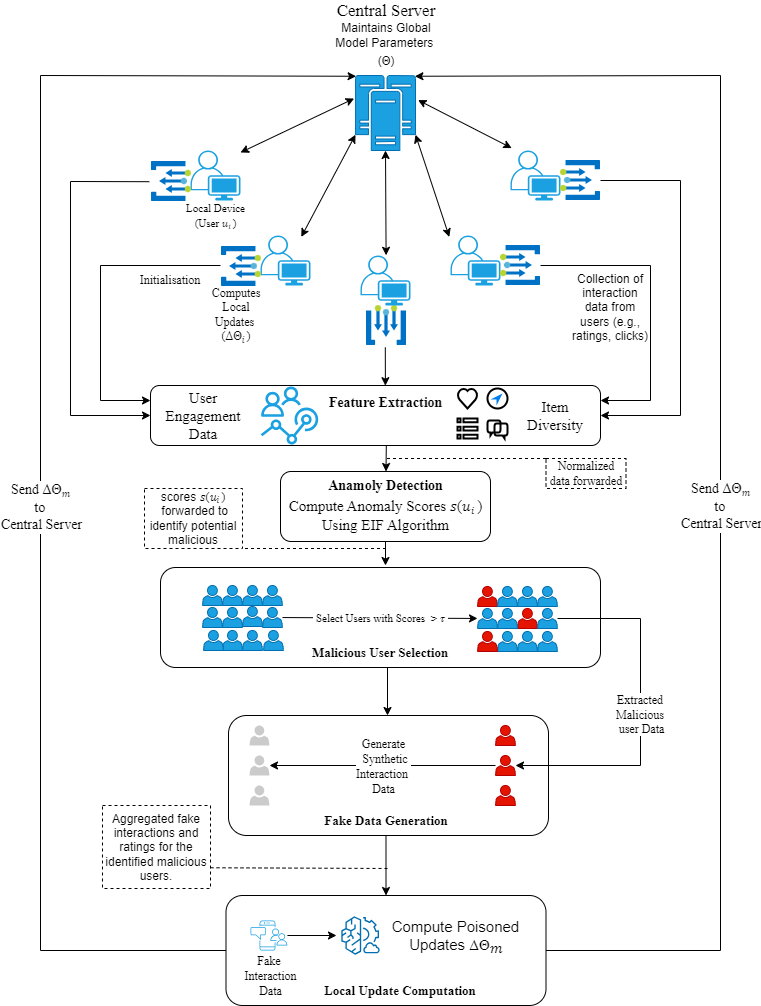
A Novel System for Detecting Model Poisoning Attacks in Federated Learning
Journal of Reliable and Secure Computing | Volume 2, Issue 1: 27-38, 2026 | DOI: 10.62762/JRSC.2025.385825
Abstract
Federated learning (FL) enables decentralized model training and enhances user privacy by keeping data on local devices. Despite these advantages, FL remains vulnerable to sophisticated adversarial attacks. Federated recommender systems (FRS), an important application of FL, are particularly susceptible to threats such as model poisoning. In this paper, we propose DyMUSA, a novel model poisoning attack tailored for FRS. DyMUSA exploits systemic vulnerabilities through dynamic user selection and adaptive poisoning strategies. Specifically, it leverages the Isolation Forest algorithm to identify anomalous users and generate poisoned gradients that compromise the integrity of the recommender sy... More >

Graphical Abstract
A Novel System for Detecting Model Poisoning Attacks in Federated Learning
Open Access | Research Article | 28 January 2026
Blockchain Consensus Mechanisms and Enhancement Techniques for Federated Learning-Based Intrusion Detection Systems in IoT Smart Homes
Journal of Reliable and Secure Computing | Volume 2, Issue 1: 1-26, 2026 | DOI: 10.62762/JRSC.2025.761390
Abstract
The rapid proliferation of smart home IoT devices has introduced unprecedented cybersecurity vulnerabilities, necessitating scalable and privacy-preserving intrusion detection systems (IDS). Federated Learning (FL) offers a promising decentralized approach by training models locally without sharing raw data, but it remains susceptible to poisoning attacks and relies on a vulnerable central aggregator. This paper presents a novel blockchain-enhanced FL framework tailored for smart home IDS, integrating multiple consensus mechanisms—Proof-of-Stake (PoS), Practical Byzantine Fault Tolerance (PBFT), and Proof-of-Authority (PoA)—for the first time in this context. Our approach uniquely combin... More >

Graphical Abstract
Blockchain Consensus Mechanisms and Enhancement Techniques for Federated Learning-Based Intrusion Detection Systems in IoT Smart Homes