ICCK

Saru Kumari

Chaudhary Charan Singh University, India

Section 01

Academic Profile

No academic profile information available at the moment.

Section 02

Editorial Roles

This user currently does not serve as an editor for any ICCK journals.

Section 03

ICCK Publications

Open Access | Commentary | 19 June 2026
Comments on CSAP-IoD: A Chaotic Map-Based Secure Authentication Protocol for Internet of Drones
Journal of Reliable and Secure Computing | Volume 2, Issue 2: 156-160, 2026 | DOI: 10.62762/JRSC.2026.503368
Abstract
Recently, Zahednejad and Gao (2025 Journal of Information Security and Applications, Elsevier, https://doi.org/10.1016/j.jisa.2025.104083,) identified key compromise impersonation (KCI) in both, a two-factor, and a three-factor authentication protocols for IoT devices. They further proposed a lightweight authentication scheme designed to mitigate the identified KCI threats. Subsequently, Zhang et al. (2025, IEEE Transactions on Information Forensics and Security, https://doi.org/10.1109/TIFS.2025.3599678) introduced a chaotic map-based authentication protocol for the Internet of Drones, claiming that their design is resilient to a wide range of security attacks. Earlier, Kumari et al. (2019)... More >
Open Access | Research Article | 24 March 2026 | Cited: Crossref logo  1 , Scopus 2
A Conditional Privacy-Preserving Short Signature Scheme for Industrial Internet of Things
Journal of Reliable and Secure Computing | Volume 2, Issue 1: 39-49, 2026 | DOI: 10.62762/JRSC.2026.376190
Abstract
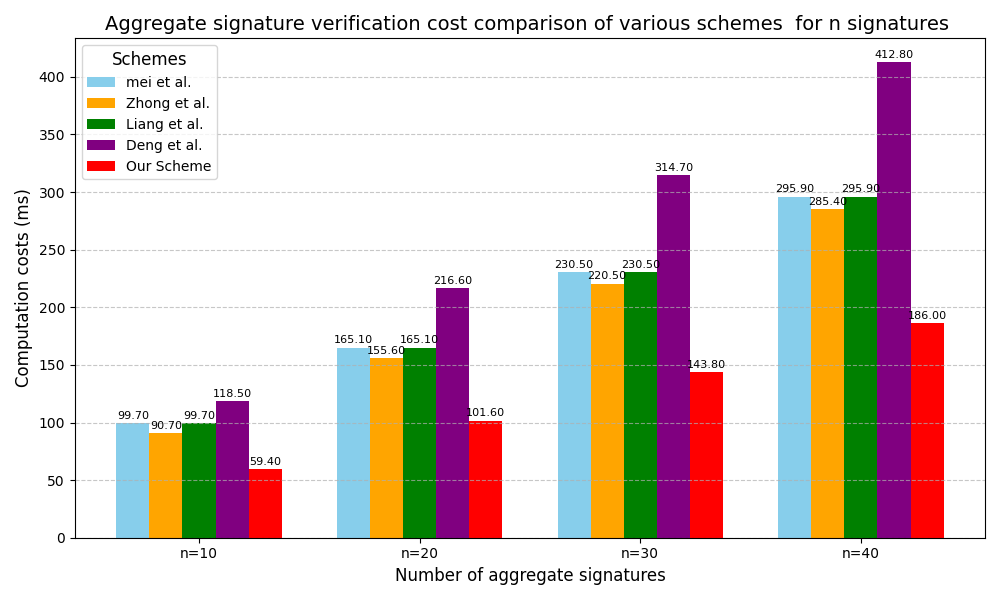
Securely transmitting a large amount of data in a short time is a serious challenge in today's digital age. Cryptographic primitives can significantly alleviate this problem. The invention of digital signatures represents a major advance in this area. The Certificateless Aggregate Signature (CLAS) scheme is a cryptographic primitive that greatly reduces the computation cost by aggregating several signatures into a single short signature. However, the costs of aggregate signatures have not been reduced to the desired extent. In this paper, we propose a certificateless aggregate signature scheme that requires only two bilinear pairing operations to verify both a single signature and an aggrega... More >

Graphical Abstract
A Conditional Privacy-Preserving Short Signature Scheme for Industrial Internet of Things
Open Access | Research Article | 07 February 2026
A Novel System for Detecting Model Poisoning Attacks in Federated Learning
Journal of Reliable and Secure Computing | Volume 2, Issue 1: 27-38, 2026 | DOI: 10.62762/JRSC.2025.385825
Abstract
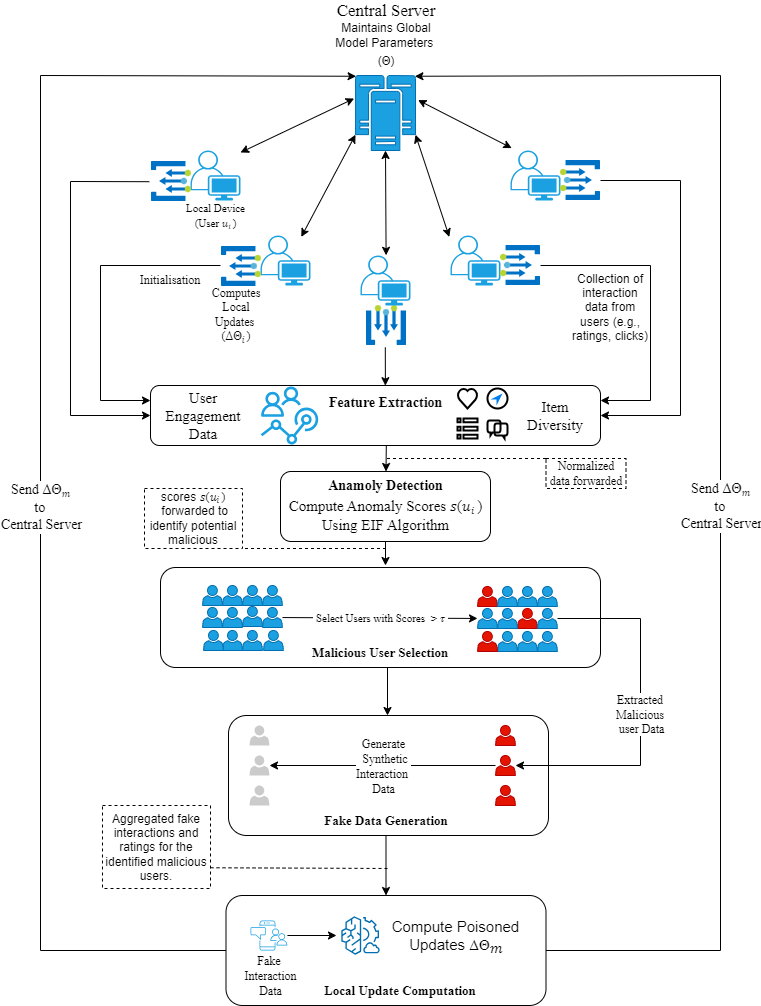
Federated learning (FL) enables decentralized model training and enhances user privacy by keeping data on local devices. Despite these advantages, FL remains vulnerable to sophisticated adversarial attacks. Federated recommender systems (FRS), an important application of FL, are particularly susceptible to threats such as model poisoning. In this paper, we propose DyMUSA, a novel model poisoning attack tailored for FRS. DyMUSA exploits systemic vulnerabilities through dynamic user selection and adaptive poisoning strategies. Specifically, it leverages the Isolation Forest algorithm to identify anomalous users and generate poisoned gradients that compromise the integrity of the recommender sy... More >

Graphical Abstract
A Novel System for Detecting Model Poisoning Attacks in Federated Learning
Open Access | Editorial | 29 September 2025
Inaugural Editorial for the Journal of Reliable and Secure Computing
Journal of Reliable and Secure Computing | Volume 1, Issue 1: 1-3, 2025 | DOI: 10.62762/JRSC.2025.220451
Abstract
Presents the introductory editorial for the inaugural issue of this title. More >