



Department of Computer Science and Engineering, Sant Longowal Institute of Engineering and Technology, Longowal, India (Deemed-to-be-University, Under Ministry of Education, Government of India)
Dr. Jagdeep Singh (SM IEEE) is an Assistant Professor in the Department of Computer Science and Engineering at Sant Longowal Institute of Engineering and Technology (SLIET), Longowal. He earned his Ph.D. in Computer Engineering from the University of Delhi. His research interests span Artificial Intelligence, Machine Learning, Delay-Tolerant Networks, and Cybersecurity. He is an AICTE-certified Master Trainer in High-Performance Computing and has published extensively in reputed journals such as IEEE Internet of Things, Journal of Ambient Intelligence and Humanized Computing, IET, and the International Journal of Communication Systems. He has also presented his work at several flagship international conferences, including IEEE ICC, IEEE Globecom, AINA, and IEEE CITS. Dr. Singh is a Senior Member of IEEE and INAE, and a member of the International Association of Engineers. He actively contributes to the research community through technical program committees and reviews for top-tier journals like IEEE IoT, IEEE TIFS, IEEE Access, and Wiley journals. He has organized multiple academic programs and has also received funding from AICTE for conducting advanced-level FDPs and short-term training programs. He is a recipient of the Shastri Conference and Lecture Series Grant (2021–22) and led Team EMMET to victory in the Prototype and Ideation Stages of the Indian Web Browser Development Challenge by MeitY, securing ₹12,00,000. He was selected as a young faculty presenter in the AI theme at ESTIC 2025, organized by DST, Government of India, at Bharat Mandapam. He has delivered numerous expert lectures on cybersecurity and AI-based technologies in various national programs.
Editorial Roles
No Editorial Roles
This user currently does not serve as an editor for any ICCK journals.
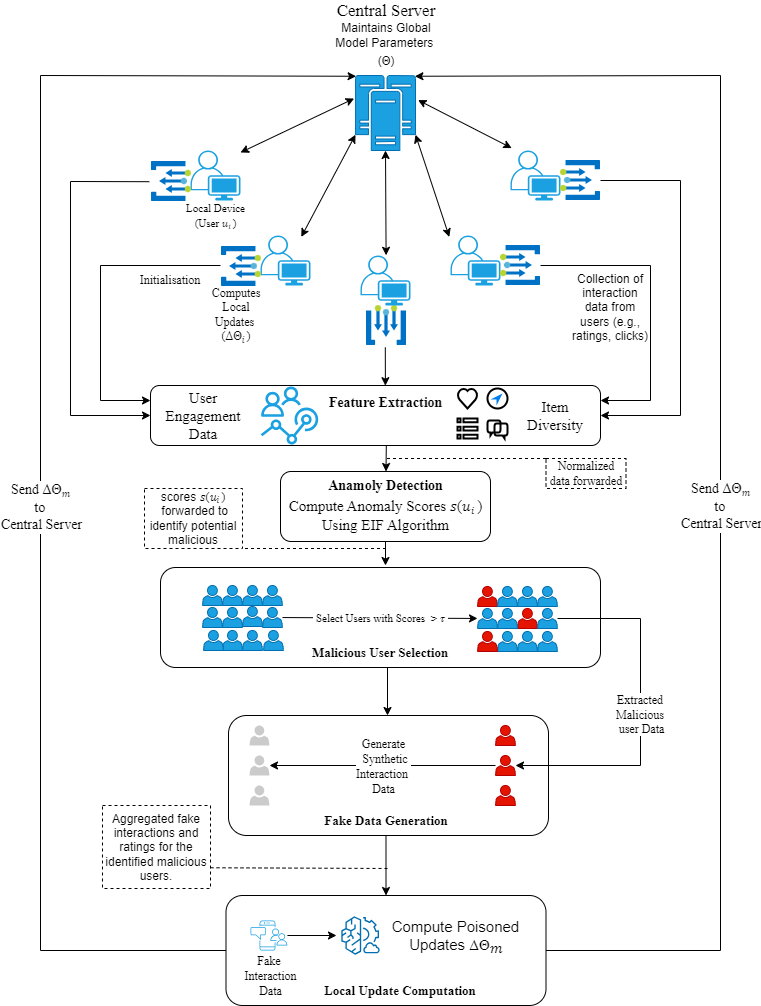
Federated learning (FL) enables decentralized model training and enhances user privacy by keeping data on local devices. Despite these advantages, FL remains vulnerable to sophisticated adversarial attacks. Federated recommender systems (FRS), an important application of FL, are particularly susceptible to threats such as model poisoning. In this paper, we propose DyMUSA, a novel model poisoning attack tailored for FRS. DyMUSA exploits systemic vulnerabilities through dynamic user selection and adaptive poisoning strategies. Specifically, it leverages the Isolation Forest algorithm to identify anomalous users and generate poisoned gradients that compromise the integrity of the recommender sy... More >
Graphical Abstract
We use cookies to improve your experience. By continuing to browse, you agree to our use of essential cookies.
Learn more