

A Conditional Privacy-Preserving Short Signature Scheme for Industrial Internet of Things




Article Information
Abstract
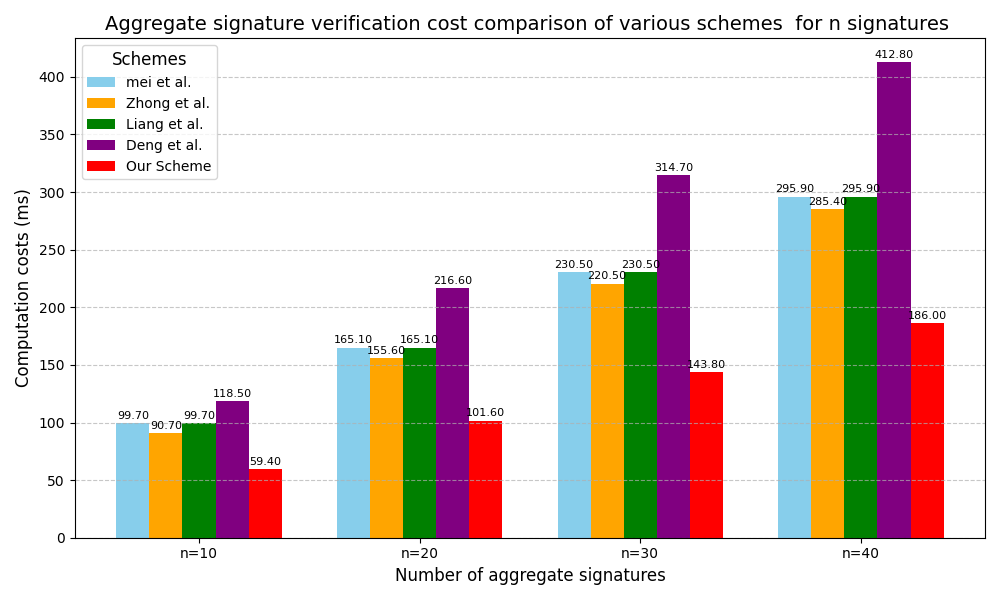
Securely transmitting a large amount of data in a short time is a serious challenge in today's digital age. Cryptographic primitives can significantly alleviate this problem. The invention of digital signatures represents a major advance in this area. The Certificateless Aggregate Signature (CLAS) scheme is a cryptographic primitive that greatly reduces the computation cost by aggregating several signatures into a single short signature. However, the costs of aggregate signatures have not been reduced to the desired extent. In this paper, we propose a certificateless aggregate signature scheme that requires only two bilinear pairing operations to verify both a single signature and an aggregate signature, regardless of the number of signers. This makes the scheme highly suitable for low-cost IoT applications. In this scheme, we also present a Type I attack on Horng et al.'s scheme and provide an improved version.
Graphical Abstract
Keywords
Data Availability Statement
Funding
Conflicts of Interest
AI Use Statement
Ethical Approval and Consent to Participate
References
- Li, S., Xu, L., & Zhao, S. (2015). The internet of things: A survey. Information Systems Frontiers, 17(2), 243-259.
[CrossRef] [Google Scholar] - Diffie, W., & Hellman, M. (1976). New directions in cryptography. IEEE Transactions on Information Theory, 22(6), 644-654.
[CrossRef] [Google Scholar] - Shamir, A. (1984, August). Identity-based cryptosystems and signature schemes. In Workshop on the theory and application of cryptographic techniques (pp. 47-53). Berlin, Heidelberg: Springer Berlin Heidelberg.
[CrossRef] [Google Scholar] - Zhang, L., & Zhang, F. (2009). A new certificateless aggregate signature scheme. Computer Communications, 32(6), 1079-1085.
[CrossRef] [Google Scholar] - Al-Riyami, S. S., & Paterson, K. G. (2003, November). Certificateless public key cryptography. In International conference on the theory and application of cryptology and information security (pp. 452-473). Berlin, Heidelberg: Springer Berlin Heidelberg.
[CrossRef] [Google Scholar] - Raya, M., & Hubaux, J. P. (2007). Securing vehicular ad hoc networks. Journal of computer security, 15(1), 39-68.
[CrossRef] [Google Scholar] - He, D., Zeadally, S., Xu, B., & Huang, X. (2015). An efficient identity-based conditional privacy-preserving authentication scheme for vehicular ad hoc networks. IEEE Transactions on Information Forensics and Security, 10(12), 2681-2691.
[CrossRef] [Google Scholar] - Zhong, H., Han, S., Cui, J., Zhang, J., & Xu, Y. (2019). Privacy-preserving authentication scheme with full aggregation in VANET. Information Sciences, 476, 211-221.
[CrossRef] [Google Scholar] - Wang, H., Wang, L., Zhang, K., Li, J., & Luo, Y. (2022). A conditional privacy-preserving certificateless aggregate signature scheme in the standard model for VANETs. IEEE Access, 10, 15605-15618.
[CrossRef] [Google Scholar] - Li, J., Yuan, H., & Zhang, Y. (2016). Cryptanalysis and improvement of certificateless aggregate signature with conditional privacy-preserving for vehicular sensor networks. Cryptology ePrint Archive.
[Google Scholar] - Yang, X., Wang, W., Tian, T., & Wang, C. (2023). Cryptanalysis and improvement of a blockchain-based certificateless signature for IIoT devices. IEEE Transactions on Industrial Informatics, 20(2), 1884-1894.
[CrossRef] [Google Scholar] - Shim, K. A. (2024). A secure certificateless signature scheme for cloud-assisted Industrial IoT. IEEE Transactions on Industrial Informatics, 20(4), 6834-6843.
[CrossRef] [Google Scholar] - Boneh, D., Gentry, C., Lynn, B., & Shacham, H. (2003, May). Aggregate and verifiably encrypted signatures from bilinear maps. In International conference on the theory and applications of cryptographic techniques (pp. 416-432). Berlin, Heidelberg: Springer Berlin Heidelberg.
[CrossRef] [Google Scholar] - Peter, O., Pradhan, A., & Mbohwa, C. (2023). Industrial internet of things (IIoT): Opportunities, challenges, and requirements in manufacturing businesses in emerging economies. Procedia Computer Science, 217, 856-865.
[CrossRef] [Google Scholar] - Hou, K., Diao, X., Shi, H., Ding, H., Zhou, H., & De Vaulx, C. (2023). Trends and challenges in AIoT/IIoT/IoT implementation. Sensors, 23(11), 5074.
[CrossRef] [Google Scholar] - Olanrele, O., Ajagbe, S., Ilori, A., & Adeyemi, O. (2025). The industrial internet of things (IIoT): Overview, architecture, challenges, and possible solutions. Computational Intelligence in Industry 4.0 and 5.0 Applications, 37-60.
[Google Scholar] - Gentry, C., & Ramzan, Z. (2006). Identity-based aggregate signatures. International Workshop on Public Key Cryptography, 257-273.
[CrossRef] [Google Scholar] - Gong, Z., Long, Y., Hong, X., & Chen, K. (2007, July). Two certificateless aggregate signatures from bilinear maps. In Eighth ACIS international conference on software engineering, artificial intelligence, networking, and parallel/distributed computing (SNPD 2007) (Vol. 3, pp. 188-193). IEEE.
[CrossRef] [Google Scholar] - Huang, X., Mu, Y., Susilo, W., Wong, D. S., & Wu, W. (2007, July). Certificateless signature revisited. In Australasian conference on information security and privacy (pp. 308-322). Berlin, Heidelberg: Springer Berlin Heidelberg.
[CrossRef] [Google Scholar] - Xiong, H., Guan, Z., Chen, Z., & Li, F. (2013). An efficient certificateless aggregate signature with constant pairing computations. Information Sciences, 219, 225-235.
[CrossRef] [Google Scholar] - Horng, S., Tzeng, S., Huang, P., Wang, X., Li, T., & Khan, M. (2015). An efficient certificateless aggregate signature with conditional privacy-preserving for vehicular sensor networks. Information Sciences, 317, 48-66.
[CrossRef] [Google Scholar] - Thumbur, G., Rao, G., Reddy, P., Gayathri, N., Reddy, D., & Padmavathamma, M. (2020). Efficient and secure certificateless aggregate signature-based authentication scheme for vehicular ad hoc networks. IEEE Internet of Things Journal, 8(3), 1908-1920.
[CrossRef] [Google Scholar] - Kar, J., Liu, X., & Li, F. (2021). CL-ASS: An efficient and low-cost certificateless aggregate signature scheme for wireless sensor networks. Journal of Information Security and Applications, 61, 102905.
[CrossRef] [Google Scholar] - Vashishtha, P., & Kumari, S. (2025). Cryptanalysis and improvement on low-cost CL-ASS for wireless sensor networks. International Conference on Network Security and Blockchain Technology, 19-29.
[CrossRef] [Google Scholar] - Xiong, W., Wang, R., Wang, Y., Wei, Y., Zhou, F., & Luo, X. (2022). Improved certificateless aggregate signature scheme against collusion attacks for VANETs. IEEE Systems Journal, 17(1), 1098-1109.
[CrossRef] [Google Scholar] - Vashishtha, P., & Kumari, S. (2025). An improved collusion resistant certificateless aggregate signature scheme for VANETs. International Conference on Mathematics and Computing, 13-24.
[CrossRef] [Google Scholar] - Pointcheval, D., & Stern, J. (1996). Security proofs for signature schemes. International Conference on the Theory and Applications of Cryptographic Techniques, 387-398.
[CrossRef] [Google Scholar] - Mei, Q., Xiong, H., Chen, J., Yang, M., Kumari, S., & Khan, M. (2020). Efficient certificateless aggregate signature with conditional privacy preservation in IoV. IEEE Systems Journal, 15(1), 245-256.
[CrossRef] [Google Scholar] - Liang, Y., & Liu, Y. (2022). Analysis and improvement of an efficient certificateless aggregate signature with conditional privacy preservation in VANETs. IEEE Systems Journal, 17(1), 664-672.
[CrossRef] [Google Scholar] - Deng, L., Wen, J., Gao, Y., Wang, N., Huang, H., & Li, S. (2024). Certificateless aggregate signature scheme with security proofs in the standard model suitable for Internet of Vehicles. IEEE Internet of Things Journal, 11(17), 28765-28773.
[CrossRef] [Google Scholar] - Chen, C., Li, Z., Das, A., Chaudhry, S., & Lorenz, P. (2024). Provably secure authentication scheme for fog computing-enabled intelligent social internet of vehicles. IEEE Transactions on Vehicular Technology, 73(9), 13600-13610.
[CrossRef] [Google Scholar]
Cited By (3)
-
Yang Yang, Haiyang Yu, Yilong Ren, Ming Chen, Yanan Zhao, Chien-Ming Chen. Certificateless Dual-Layer Anonymous Privacy-Preserving Authentication Scheme for the IoV Environment.
IEEE Internet of Things Journal, 2026 , 13 (17).
[CrossRef] -
Xin Sun, Tingting Yang, Xiufeng Zhang. Privacy-Preserving U-Shaped Split Federated Learning for Space–Air–Ground–Sea Integrated Networks.
Mathematics, 2026 , 14 (8).
[CrossRef] -
Pushpendra Kumar Vashishtha, Saru Kumari, Ming-Hour Yang, Amel Ksibi, Fan Wu, Chien Ming Chen. An Energy-Efficient, Conditional Privacy-Preserving, and Blockchain-Assisted CLAS Scheme for VANETs With Immediate Revocation.
IEEE Internet of Things Journal, 2026 , 13 (19).
[CrossRef]
Cite This Article
TY  - JOUR
AU  - Vashishtha, Pushpendra Kumar
AU  - Kumari, Saru
PY  - 2026
DA  - 2026/03/24
TI  - A Conditional Privacy-Preserving Short Signature Scheme for Industrial Internet of Things
JO  - Journal of Reliable and Secure Computing
T2  - Journal of Reliable and Secure Computing
JF  - Journal of Reliable and Secure Computing
VL  - 2
IS  - 1
SP  - 39
EP  - 49
DO  - 10.62762/JRSC.2026.376190
UR  - https://www.icck.org/article/abs/JRSC.2026.376190
KW  - certificateless
KW  - aggregate signature
KW  - low cost
KW  - Type I attack
KW  - conditional privacy
AB  - Securely transmitting a large amount of data in a short time is a serious challenge in today's digital age. Cryptographic primitives can significantly alleviate this problem. The invention of digital signatures represents a major advance in this area. The Certificateless Aggregate Signature (CLAS) scheme is a cryptographic primitive that greatly reduces the computation cost by aggregating several signatures into a single short signature. However, the costs of aggregate signatures have not been reduced to the desired extent. In this paper, we propose a certificateless aggregate signature scheme that requires only two bilinear pairing operations to verify both a single signature and an aggregate signature, regardless of the number of signers. This makes the scheme highly suitable for low-cost IoT applications. In this scheme, we also present a Type I attack on Horng et al.'s scheme and provide an improved version.
SN  - 3070-6424
PB  - Institute of Central Computation and Knowledge
LA  - English
ER  -
@article{Vashishtha2026A,
  author = {Pushpendra Kumar Vashishtha and Saru Kumari},
  title = {A Conditional Privacy-Preserving Short Signature Scheme for Industrial Internet of Things},
  journal = {Journal of Reliable and Secure Computing},
  year = {2026},
  volume = {2},
  number = {1},
  pages = {39-49},
  doi = {10.62762/JRSC.2026.376190},
  url = {https://www.icck.org/article/abs/JRSC.2026.376190},
  abstract = {Securely transmitting a large amount of data in a short time is a serious challenge in today's digital age. Cryptographic primitives can significantly alleviate this problem. The invention of digital signatures represents a major advance in this area. The Certificateless Aggregate Signature (CLAS) scheme is a cryptographic primitive that greatly reduces the computation cost by aggregating several signatures into a single short signature. However, the costs of aggregate signatures have not been reduced to the desired extent. In this paper, we propose a certificateless aggregate signature scheme that requires only two bilinear pairing operations to verify both a single signature and an aggregate signature, regardless of the number of signers. This makes the scheme highly suitable for low-cost IoT applications. In this scheme, we also present a Type I attack on Horng et al.'s scheme and provide an improved version.},
  keywords = {certificateless, aggregate signature, low cost, Type I attack, conditional privacy},
  issn = {3070-6424},
  publisher = {Institute of Central Computation and Knowledge}
}
Publisher's Note
ICCK stays neutral with regard to jurisdictional claims in published maps and institutional affiliations.
Rights and Permissions
 Copyright © 2026 by the Author(s). Published by Institute of Central Computation and Knowledge. This article is an open access article distributed under the terms and conditions of the Creative Commons Attribution (CC BY) license (https://creativecommons.org/licenses/by/4.0/), which permits use, sharing, adaptation, distribution and reproduction in any medium or format, as long as you give appropriate credit to the original author(s) and the source, provide a link to the Creative Commons licence, and indicate if changes were made.


Portico
