

Energy-Optimized Blockchain Architectures for Sustainable Distributed Computing




Article Information
Abstract
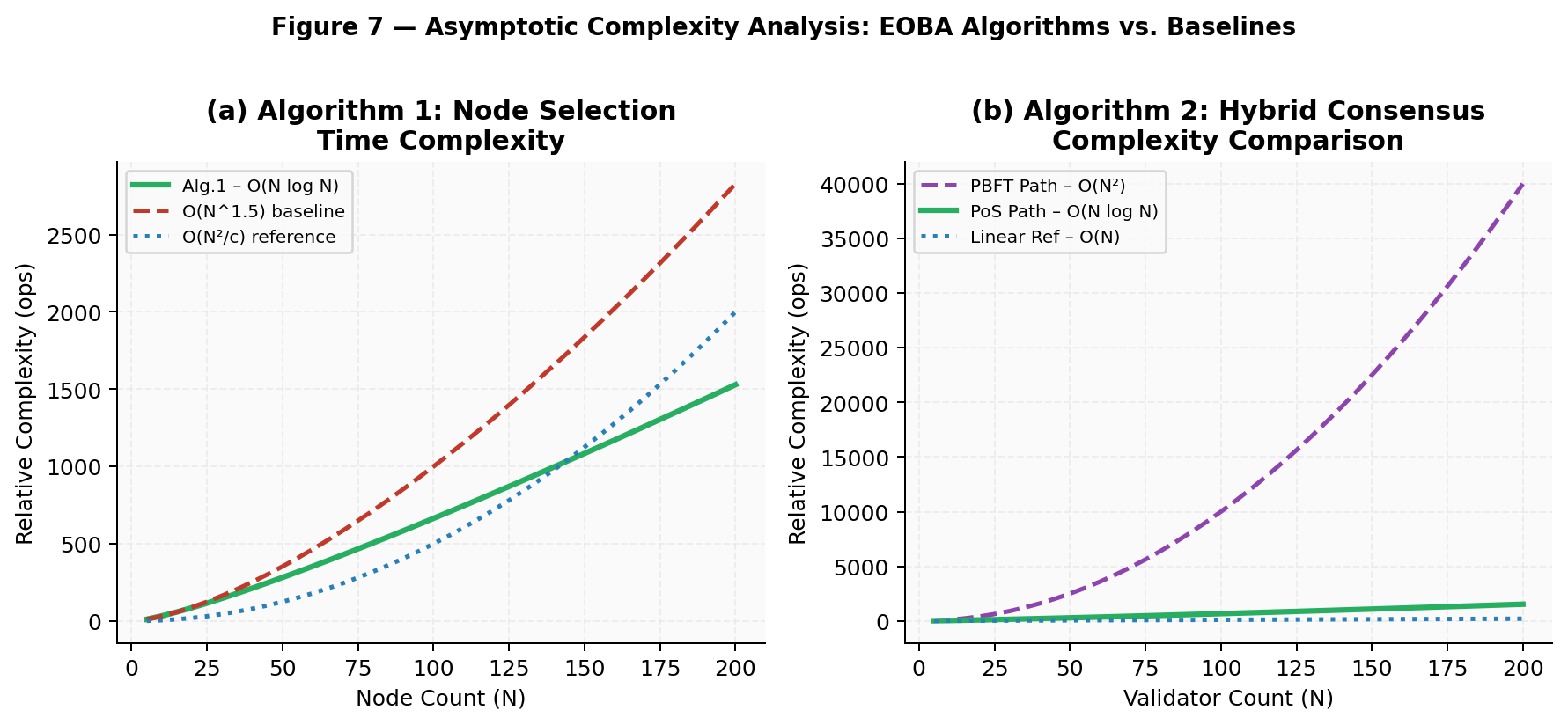
Blockchain technology offers transformative potential across distributed computing domains; however, dominant consensus mechanisms such as Proof of Work (PoW) impose severe energy and carbon costs, and existing research addresses only isolated components—consensus, storage, or sharding—rather than the full architectural system. This paper introduces the Energy-Optimized Blockchain Architecture (EOBA), the first nine-layer framework in which energy awareness is a foundational, cross-cutting design principle embedded across all architectural layers. EOBA integrates energy monitoring, hybrid energy-aware consensus, energy-guided task scheduling, dynamic sharding, hybrid on-chain/off-chain storage, and operational carbon footprint accounting within a single cohesive system. Two formally specified algorithms underpin the framework: Algorithm 1 (Energy-Efficient Node Selection, O(N log N)) and Algorithm 2 (Hybrid Energy-Optimized Consensus combining PBFT and PoS with dynamic switching). Monte Carlo simulation results over 10–200-node networks demonstrate 56.5% energy reduction versus standard PoS, 77% carbon emission reduction versus PoW, 2.4× throughput improvement, and 58% latency improvement at 200-node scale. The carbon accounting subsystem generates per-round immutable on-chain emission records as a byproduct of consensus operation. These results establish that sustainable blockchain systems require architecture-level co-optimisation, not isolated protocol improvements.
Graphical Abstract
Keywords
Data Availability Statement
Funding
Conflicts of Interest
AI Use Statement
Ethical Approval and Consent to Participate
References
- Zimba, A., Phiri, K. O., Mulenga, M., & Mukupa, G. (2025). A systematic literature review of blockchain technology and energy efficiency based on consensus mechanisms, architectural innovations, and sustainable solutions. Discover Analytics, 3(1), 14.
[CrossRef] [Google Scholar] - Mora, C., Rollins, R. L., Taladay, K., Kantar, M. B., Chock, M. K., Shimada, M., & Franklin, E. C. (2018). Bitcoin emissions alone could push global warming above 2 C. Nature Climate Change, 8(11), 931-933.
[CrossRef] [Google Scholar] - Habibullah, S. M., Alam, S., Ghosh, S., Dey, A., & De, A. (2024). Blockchain-based energy consumption approaches in IoT. Scientific Reports, 14(1), 28088.
[CrossRef] [Google Scholar] - Yao, Z., Fang, Y., Pan, H., Wang, X., & Si, X. (2024). A secure and highly efficient blockchain PBFT consensus algorithm for microgrid power trading. Scientific Reports, 14(1), 8300.
[CrossRef] [Google Scholar] - Sedlmeir, J., Buhl, H. U., Fridgen, G., & Keller, R. (2020). The Energy Consumption of Blockchain Technology: Beyond Myth. Business & Information Systems Engineering, 62(6), 599-608.
[CrossRef] [Google Scholar] - Nezami, Z., Li, Z., Qin, C., Banaie, F., Khalid, R., & Pournaras, E. (2025). Blockchain and edge computing nexus: A large-scale systematic literature review. Distributed Ledger Technologies: Research and Practice.
[CrossRef] [Google Scholar] - Taherdoost, H. (2024). Blockchain integration and its impact on renewable energy. Computers, 13(4), 107.
[CrossRef] [Google Scholar] - De Vries, A., Gallersdörfer, U., Klaaßen, L., & Stoll, C. (2022). Revisiting Bitcoin’s carbon footprint. Joule, 6(3), 498-502.
[CrossRef] [Google Scholar] - Nguyen, C. T., Hoang, D. T., Nguyen, D. N., Niyato, D., Nguyen, H. T., & Dutkiewicz, E. (2019). Proof-of-stake consensus mechanisms for future blockchain networks: fundamentals, applications and opportunities. IEEE Access, 7, 85727-85745.
[CrossRef] [Google Scholar] - Wadhwa, S., Rani, S., Verma, S., Shafi, J., & Wozniak, M. (2022). Energy efficient consensus approach of blockchain for IoT networks with edge computing. Sensors, 22(10), 3733.
[CrossRef] [Google Scholar] - Al Shareef, A. M., Seçkiner, S., Eid, B., & Abumeteir, H. (2024). Integration of blockchain with artificial intelligence technologies in the energy sector: a systematic review. Frontiers in Energy Research, 12, 1377950.
[CrossRef] [Google Scholar] - Pasi, A., & Siddavatam, I. N. (2024, October). Efficient Blockchain Energy Management: Strategies for Sustainable Blockchain Systems. In International Joint Conference on Advances in Computational Intelligence (pp. 19-32). Singapore: Springer Nature Singapore.
[CrossRef] [Google Scholar] - Bhavana, G. B., Anand, R., Ramprabhakar, J., Guerrero, J. M., Thakkar, N., & Ambikapathy, A. (2025). Comparative evaluation and simulation of blockchain consensus mechanisms for secure and scalable peer to peer energy trading in microgrids. Scientific Reports, 15(1), 43546.
[CrossRef] [Google Scholar] - Asif, R., & Hassan, S. R. (2023). Shaping the future of Ethereum: Exploring energy consumption in Proof-of-Work and Proof-of-Stake consensus. Frontiers in Blockchain, 6, 1151724.
[CrossRef] [Google Scholar] - Pandit, A. R., Singh, A., Keshav, & Kanika. (2025). Predicting Blockchain Energy Consumption: A Step Towards a Sustainable Future. In Blockchain and Machine Learning Innovations: Breaking Barriers with Distributed Intelligence (pp. 35-53). Cham: Springer Nature Switzerland.
[CrossRef] [Google Scholar] - Jhariya, M. K., Dehalwar, V., Bharti, J., & Kumar, L. (2026). Energy efficient transactions for blockchain networks using adaptive global best–worst particle swarm optimization. Scientific Reports, 16(1), 1643.
[CrossRef] [Google Scholar] - Bulgakov, A. L., Aleshina, A. V., Smirnov, S. D., Demidov, A. D., Milyutin, M. A., & Xin, Y. (2024). Scalability and security in blockchain networks: Evaluation of sharding algorithms and prospects for decentralized data storage. Mathematics, 12(23), 3860.
[CrossRef] [Google Scholar] - Chacko, N. M., VG, N., Balachandra, M., & T, M. (2025). Lightweight Consensus in Blockchain: A Systematic Literature Review. ACM Computing Surveys, 58(3), 1-37.
[CrossRef] [Google Scholar] - Haque, E. U., Abbasi, W., Almogren, A., Choi, J., Altameem, A., Rehman, A. U., & Hamam, H. (2024). Performance enhancement in blockchain based IoT data sharing using lightweight consensus algorithm. Scientific reports, 14(1), 26561.
[CrossRef] [Google Scholar] - Rammohan, S. R., Chakravarthi, K., Sharma, N., Sharma, S., & Natarajan, M. (2025). Systematic Survey on Energy Conservation Using Blockchain for Sustainable Computing Challenges and Roadmaps. International Journal of Adaptive Control and Signal Processing, 39(2), 247-265.
[CrossRef] [Google Scholar] - Castro, M., & Liskov, B. (1999). Practical Byzantine fault tolerance. In Proceedings of the Third Symposium on Operating Systems Design and Implementation (OSDI) (pp. 173-186). USENIX.
[Google Scholar] - Nakamoto, S. (2008). Bitcoin: A peer-to-peer electronic cash system [PDF document]. https://assets.pubpub.org/d8wct41f/31611263538139.pdf
[Google Scholar] - Buterin, V. (2014). A next-generation smart contract and decentralized application platform. white paper, 3(37), 2-1. https://cryptorating.eu/whitepapers/Ethereum/Ethereum_white_paper.pdf
[Google Scholar] - Yin, M., Malkhi, D., Reiter, M. K., Gueta, G. G., & Abraham, I. (2019, July). HotStuff: BFT consensus with linearity and responsiveness. In Proceedings of the 2019 ACM symposium on principles of distributed computing (pp. 347-356).
[CrossRef] [Google Scholar] - European Parliament and Council. (2023). Regulation (EU) 2023/1114 on markets in crypto-assets (MiCA). Official Journal of the European Union, L 150, 1-102. https://eur-lex.europa.eu/legal-content/EN/TXT/?uri=CELEX:32023R1114
[Google Scholar] - Carter, E. (2024). AI-powered consensus mechanisms in blockchain: Enhancing security and reducing energy consumption. Journal of Artificial Intelligence Research, 4(2), 86-93. https://thesciencebrigade.com/JAIR/article/view/411
[Google Scholar]
Cite This Article
TY  - JOUR
AU  - Yogi, Manas Kumar
AU  - Snehitha, Jajimoggala
PY  - 2026
DA  - 2026/05/31
TI  - Energy-Optimized Blockchain Architectures for Sustainable Distributed Computing
JO  - Journal of Reliable and Secure Computing
T2  - Journal of Reliable and Secure Computing
JF  - Journal of Reliable and Secure Computing
VL  - 2
IS  - 2
SP  - 83
EP  - 103
DO  - 10.62762/JRSC.2026.157158
UR  - https://www.icck.org/article/abs/JRSC.2026.157158
KW  - green blockchain
KW  - sustainable distributed computing
KW  - energy-efficient consensus
KW  - carbon-neutral infrastructure
KW  - Proof-of-Stake
KW  - byzantine fault tolerance
KW  - distributed ledger technology
KW  - edge computing
KW  - IoT blockchain
KW  - carbon footprint accounting
AB  - Blockchain technology offers transformative potential across distributed computing domains; however, dominant consensus mechanisms such as Proof of Work (PoW) impose severe energy and carbon costs, and existing research addresses only isolated components—consensus, storage, or sharding—rather than the full architectural system. This paper introduces the Energy-Optimized Blockchain Architecture (EOBA), the first nine-layer framework in which energy awareness is a foundational, cross-cutting design principle embedded across all architectural layers. EOBA integrates energy monitoring, hybrid energy-aware consensus, energy-guided task scheduling, dynamic sharding, hybrid on-chain/off-chain storage, and operational carbon footprint accounting within a single cohesive system. Two formally specified algorithms underpin the framework: Algorithm 1 (Energy-Efficient Node Selection, O(N log N)) and Algorithm 2 (Hybrid Energy-Optimized Consensus combining PBFT and PoS with dynamic switching). Monte Carlo simulation results over 10–200-node networks demonstrate 56.5% energy reduction versus standard PoS, 77% carbon emission reduction versus PoW, 2.4× throughput improvement, and 58% latency improvement at 200-node scale. The carbon accounting subsystem generates per-round immutable on-chain emission records as a byproduct of consensus operation. These results establish that sustainable blockchain systems require architecture-level co-optimisation, not isolated protocol improvements.
SN  - 3070-6424
PB  - Institute of Central Computation and Knowledge
LA  - English
ER  -
@article{Yogi2026EnergyOpti,
  author = {Manas Kumar Yogi and Jajimoggala Snehitha},
  title = {Energy-Optimized Blockchain Architectures for Sustainable Distributed Computing},
  journal = {Journal of Reliable and Secure Computing},
  year = {2026},
  volume = {2},
  number = {2},
  pages = {83-103},
  doi = {10.62762/JRSC.2026.157158},
  url = {https://www.icck.org/article/abs/JRSC.2026.157158},
  abstract = {Blockchain technology offers transformative potential across distributed computing domains; however, dominant consensus mechanisms such as Proof of Work (PoW) impose severe energy and carbon costs, and existing research addresses only isolated components—consensus, storage, or sharding—rather than the full architectural system. This paper introduces the Energy-Optimized Blockchain Architecture (EOBA), the first nine-layer framework in which energy awareness is a foundational, cross-cutting design principle embedded across all architectural layers. EOBA integrates energy monitoring, hybrid energy-aware consensus, energy-guided task scheduling, dynamic sharding, hybrid on-chain/off-chain storage, and operational carbon footprint accounting within a single cohesive system. Two formally specified algorithms underpin the framework: Algorithm 1 (Energy-Efficient Node Selection, O(N log N)) and Algorithm 2 (Hybrid Energy-Optimized Consensus combining PBFT and PoS with dynamic switching). Monte Carlo simulation results over 10–200-node networks demonstrate 56.5\% energy reduction versus standard PoS, 77\% carbon emission reduction versus PoW, 2.4× throughput improvement, and 58\% latency improvement at 200-node scale. The carbon accounting subsystem generates per-round immutable on-chain emission records as a byproduct of consensus operation. These results establish that sustainable blockchain systems require architecture-level co-optimisation, not isolated protocol improvements.},
  keywords = {green blockchain, sustainable distributed computing, energy-efficient consensus, carbon-neutral infrastructure, Proof-of-Stake, byzantine fault tolerance, distributed ledger technology, edge computing, IoT blockchain, carbon footprint accounting},
  issn = {3070-6424},
  publisher = {Institute of Central Computation and Knowledge}
}
Article Metrics
Publisher's Note
ICCK stays neutral with regard to jurisdictional claims in published maps and institutional affiliations.
Rights and Permissions
 Copyright © 2026 by the Author(s). Published by Institute of Central Computation and Knowledge. This article is an open access article distributed under the terms and conditions of the Creative Commons Attribution (CC BY) license (https://creativecommons.org/licenses/by/4.0/), which permits use, sharing, adaptation, distribution and reproduction in any medium or format, as long as you give appropriate credit to the original author(s) and the source, provide a link to the Creative Commons licence, and indicate if changes were made.


Portico
