
ICCK

Manas Kumar Yogi

Pragati Engineering College(A),Surampalem, India

Section 01

Academic Profile

No academic profile information available at the moment.

Section 02

Editorial Roles

This user currently does not serve as an editor for any ICCK journals.

Section 03

ICCK Publications

Open Access | Research Article | 17 June 2026
Scalable Trust through Strategic Verification: A Game-Theoretic Framework for Multi-Agent Systems
Next-Generation Computing Systems and Technologies | Volume 2, Issue 2: 35-50, 2026 | DOI: 10.62762/NGCST.2026.430053
Abstract
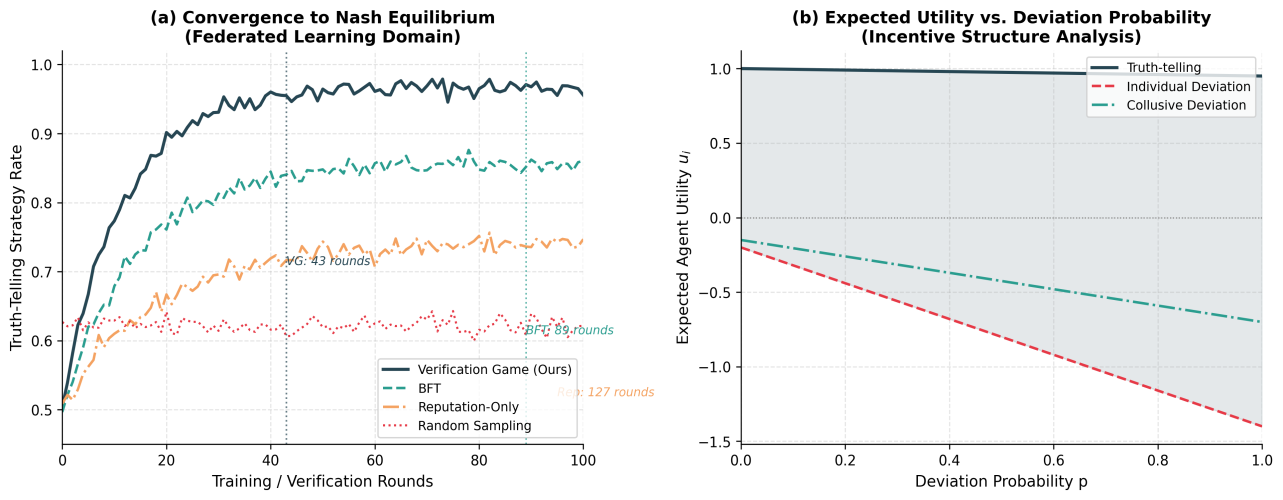
These days, many eco-systems related to federated learning, blockchain, self-driving cars, and scientific computing have many agents working together, each doing its own part. Using a single central system to check if all the agents are doing their work correctly is slow and gets more expensive as more agents are added. This paper introduces a new way called the Verification Game (VG). The agents don’t depend on a central system. The agents check each other’s work. If the agents are honest, they get rewards, so telling the truth is the best option. This type of method also saves a lot of computing power because it doesn’t check every single task. We also came up with a method called Ad... More >

Graphical Abstract
Scalable Trust through Strategic Verification: A Game-Theoretic Framework for Multi-Agent Systems
Open Access | Research Article | 31 May 2026
Energy-Optimized Blockchain Architectures for Sustainable Distributed Computing
Journal of Reliable and Secure Computing | Volume 2, Issue 2: 83-103, 2026 | DOI: 10.62762/JRSC.2026.157158
Abstract
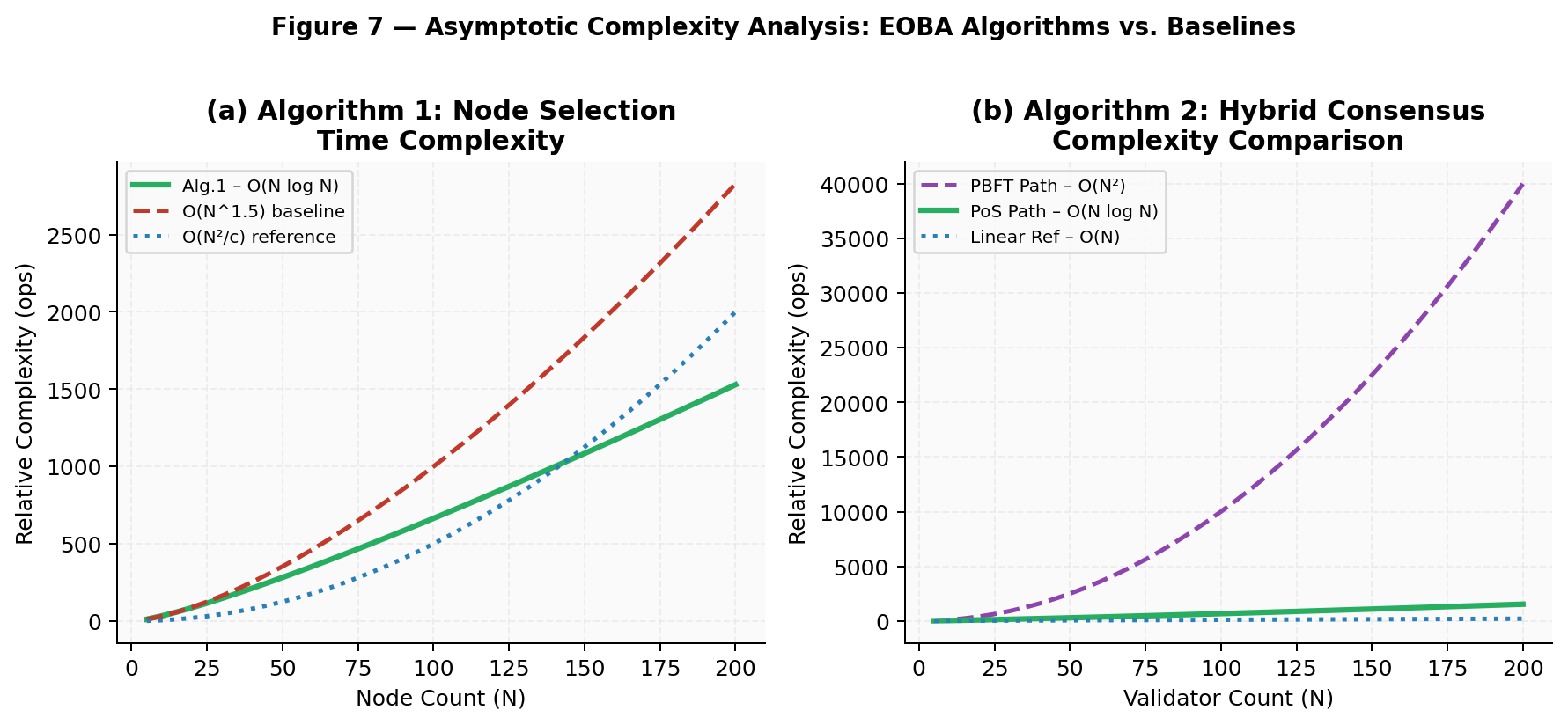
Blockchain technology offers transformative potential across distributed computing domains; however, dominant consensus mechanisms such as Proof of Work (PoW) impose severe energy and carbon costs, and existing research addresses only isolated components—consensus, storage, or sharding—rather than the full architectural system. This paper introduces the Energy-Optimized Blockchain Architecture (EOBA), the first nine-layer framework in which energy awareness is a foundational, cross-cutting design principle embedded across all architectural layers. EOBA integrates energy monitoring, hybrid energy-aware consensus, energy-guided task scheduling, dynamic sharding, hybrid on-chain/off-chain s... More >

Graphical Abstract
Energy-Optimized Blockchain Architectures for Sustainable Distributed Computing
Open Access | Research Article | 12 May 2026
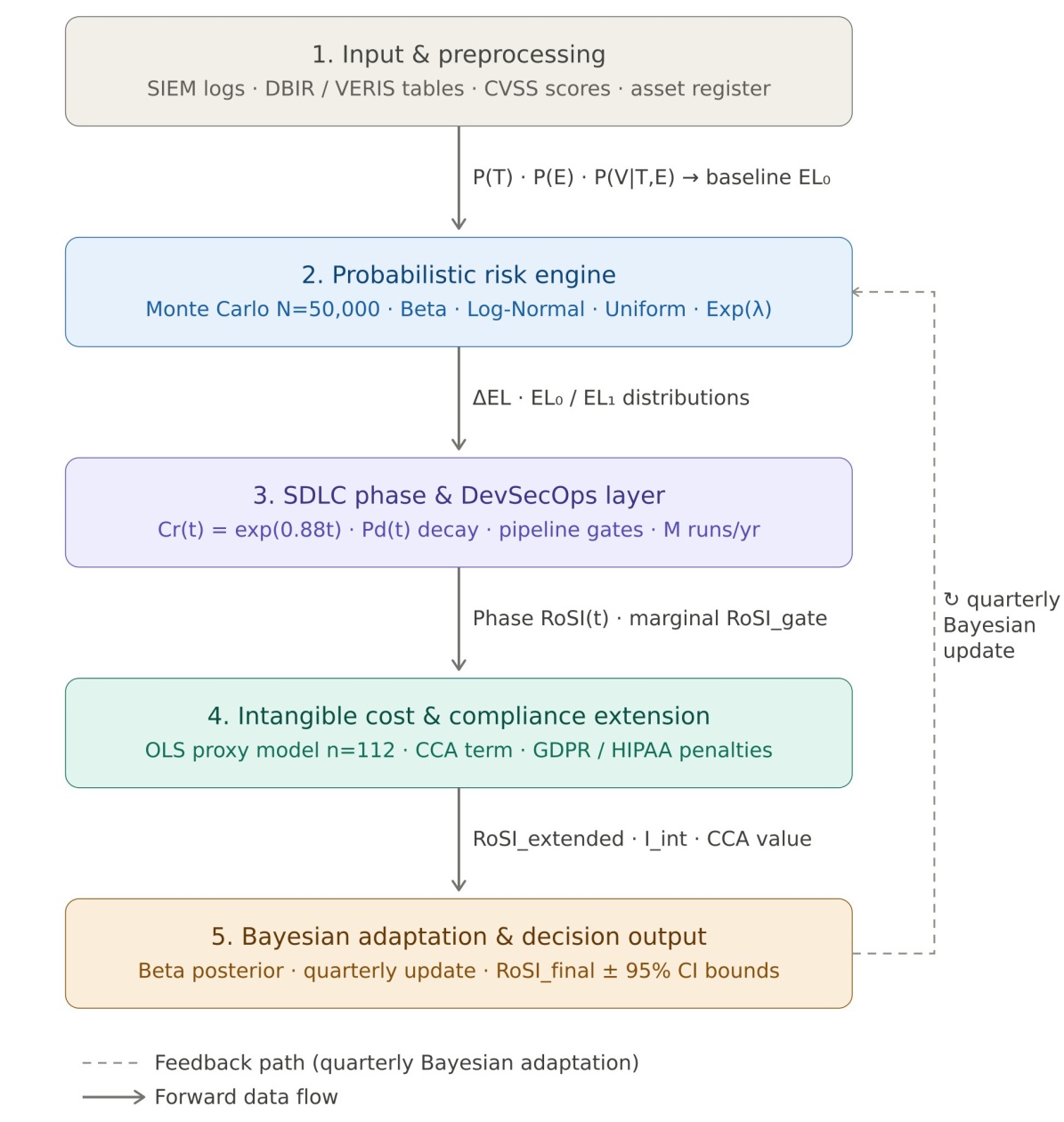
A Quantitative Framework for Return-on-Security-Investment (RoSI) in Secure Software Engineering: Integrating Probabilistic Risk, Lifecycle Dynamics, and Data-Driven Adaptation
ICCK Journal of Software Engineering | Volume 2, Issue 2: 121-137, 2026 | DOI: 10.62762/JSE.2026.472228
Abstract
The concept of Return on Security Investment (RoSI) has evolved from a mere financial indicator into a comprehensive system for informed decision-making. Software-intensive organisations face mounting pressure to justify security expenditure in financially rigorous terms. Existing Return-on-Security-Investment (RoSI) models rely on deterministic approximations that ignore probability distributions over threats, temporal decay of vulnerability windows, and intangible cost categories. This paper presents a probabilistic RoSI framework grounded in the FAIR taxonomy that integrates: (i) expected-loss differentials with Bayesian updating; (ii) shift-left cost amplification across the software dev... More >

Graphical Abstract
A Quantitative Framework for Return-on-Security-Investment (RoSI) in Secure Software Engineering: Integrating Probabilistic Risk, Lifecycle Dynamics, and Data-Driven Adaptation
Free Access | Research Article | 18 April 2026
Swarm-Enhanced Federated Learning with XAI for Robust and Interpretable Cyber Threat Detection
ICCK Transactions on Cybersecurity | Volume 1, Issue 2: 58-74, 2026 | DOI: 10.62762/TC.2026.123135
Abstract
As cyberattacks grow more advanced and privacy laws become stricter, security systems must be powerful, transparent, and privacy-friendly. This paper introduces SwarmFL-XAI, a new framework that blends nature-inspired intelligence, collaborative learning, and explainable AI to deliver secure, scalable, and trustworthy threat detection. By using an ant-based strategy for sharing and updating models across devices, the system handles uneven data and malicious behaviour while avoiding the risks of a central server. Tools like SHAP and LIME explain why decisions are made, giving analysts clear insights and greater confidence. Tests on the UNSW-NB15 and CICIDS2017 datasets show strong results, wi... More >

Graphical Abstract
Swarm-Enhanced Federated Learning with XAI for Robust and Interpretable Cyber Threat Detection
Free Access | Research Article | 25 December 2025
From Phishing to Prompt Bombing: Innovative Game-Theoretic Solutions for Modern Cyber Threats
ICCK Transactions on Cybersecurity | Volume 1, Issue 2: 35-57, 2025 | DOI: 10.62762/TC.2025.969565
Abstract
The rise of multi-factor authentication (MFA) has significantly enhanced cybersecurity postures, yet its effectiveness is increasingly challenged by sophisticated social engineering attacks, particularly those exploiting MFA fatigue. MFA fatigue, a tactic where attackers inundate users with authentication prompts, aims to induce erroneous approvals, as notably exemplified by the 2022 Uber breach. This phenomenon undermines the very security MFA is designed to provide by leveraging human vulnerabilities. Game theory, a powerful mathematical framework for analyzing strategic decision-making, offers a robust methodology to model the dynamic interactions between attackers and defenders. By apply... More >

Graphical Abstract
From Phishing to Prompt Bombing: Innovative Game-Theoretic Solutions for Modern Cyber Threats
  • 1
  • 2