
A Comprehensive Review of Differential Privacy with Federated Meta-Learning for Privacy-Preserving Medical IoT




Article Information
Abstract
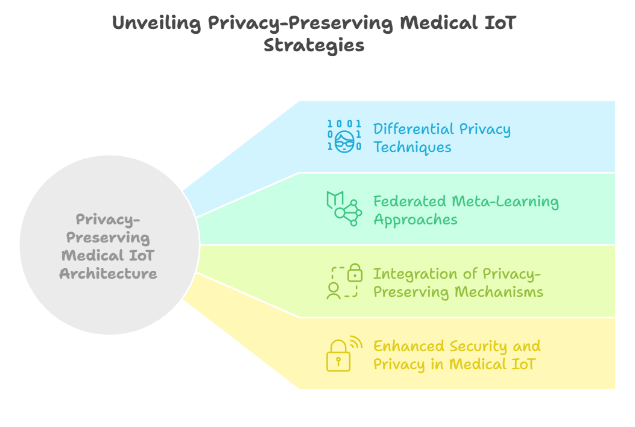
The widespread uptake of the Internet of Medical Things (IoMT) has transformed healthcare by facilitating real-time monitoring and data-driven decision-making, but maintaining data privacy and security is a vital challenge because data breaches and unauthorized access are on the rise. Differential Privacy (DP) and Federated Meta-Learning (FML) are being seen as promising candidates to tackle these issues with the model performance maintained, wherein DP adds noise to sensitive data in a controlled manner for rigorous privacy assurance, and FML allows for personalized learning across distributed IoMT devices without the need for patient data centralization. This survey delves into the combination of DP and FML for preserving privacy in medical IoT use cases by presenting noteworthy methodologies like noise mechanisms, adaptive privacy budgets, and meta-learning strategies designed for diverse healthcare data. We also review state-of-the-art techniques, assessing their performance in maintaining privacy, avoiding adversarial threats, and maximizing model utility while presenting challenges like computational overhead, communication efficiency, and the privacy-accuracy trade-offs.
Graphical Abstract
Keywords
Data Availability Statement
Funding
Conflicts of Interest
Ethical Approval and Consent to Participate
References
- Thilakarathne, N. N., Muneeswari, G., Parthasarathy, V., Alassery, F., Hamam, H., Mahendran, R. K., & Shafiq, M. (2022). Federated learning for privacy-preserved medical internet of things. Intell. Autom. Soft Comput, 33(1), 157-172.
[Google Scholar] - Adnan, M., Kalra, S., Cresswell, J. C., Taylor, G. W., & Tizhoosh, H. R. (2022). Federated learning and differential privacy for medical image analysis. Scientific reports, 12(1), 1953.
[CrossRef] [Google Scholar] - Aouedi, O., Sacco, A., Piamrat, K., & Marchetto, G. (2022). Handling privacy-sensitive medical data with federated learning: challenges and future directions. IEEE journal of biomedical and health informatics, 27(2), 790-803.
[CrossRef] [Google Scholar] - Pfitzner, B., Steckhan, N., & Arnrich, B. (2021). Federated learning in a medical context: a systematic literature review. ACM Transactions on Internet Technology (TOIT), 21(2), 1-31.
[CrossRef] [Google Scholar] - Chronis, C., Varlamis, I., Himeur, Y., Sayed, A. N., Al-Hasan, T. M., Nhlabatsi, A., . . .& Dimitrakopoulos, G. (2024). A survey on the use of federated learning in privacy-preserving recommender systems. IEEE Open Journal of the Computer Society.
[CrossRef] [Google Scholar] - Chaddad, A., Wu, Y., & Desrosiers, C. (2023). Federated learning for healthcare applications. IEEE internet of things journal, 11(5), 7339-7358.
[CrossRef] [Google Scholar] - Afzal, M. U., Abdellatif, A. A., Zubair, M., Mehmood, M. Q., & Massoud, Y. (2023). Privacy and security in distributed learning: A review of challenges, solutions, and open research issues. IEEE Access, 11, 114562-114581.
[CrossRef] [Google Scholar] - Wang, Q., Yin, H., Chen, T., Yu, J., Zhou, A., & Zhang, X. (2022). Fast-adapting and privacy-preserving federated recommender system. The VLDB Journal, 31(5), 877-896.
[CrossRef] [Google Scholar] - Annappa, B., Hegde, S., Abhijit, C. S., & Ambesange, S. (2024). Fedcure: A heterogeneity-aware personalized federated learning framework for intelligent healthcare applications in iomt environments. IEEE Access, 12, 15867-15883.
[CrossRef] [Google Scholar] - Li, H., Ge, L., & Tian, L. (2024). Survey: federated learning data security and privacy-preserving in edge-Internet of Things. Artificial Intelligence Review, 57(5), 130.
[CrossRef] [Google Scholar] - Amiri, Z., Heidari, A., Navimipour, N. J., Esmaeilpour, M., & Yazdani, Y. (2024). The deep learning applications in IoT-based bio-and medical informatics: a systematic literature review. Neural Computing and Applications, 36(11), 5757-5797.
[CrossRef] [Google Scholar] - Saha, S., Hota, A., Chattopadhyay, A. K., Nag, A., & Nandi, S. (2024). A multifaceted survey on privacy preservation of federated learning: progress, challenges, and opportunities. Artificial Intelligence Review, 57(7), 184.
[CrossRef] [Google Scholar] - Abbas, Z., Ahmad, S. F., Syed, M. H., Anjum, A., & Rehman, S. (2023). Exploring Deep Federated Learning for the Internet of Things: A GDPR-Compliant Architecture. IEEE Access, 12, 10548-10574.
[CrossRef] [Google Scholar] - Wei, K., Li, J., Ding, M., Ma, C., Yang, H. H., Farokhi, F., \ldots & Poor, H. V. (2020). Federated learning with differential privacy: Algorithms and performance analysis. IEEE transactions on information forensics and security, 15, 3454-3469.
[CrossRef] [Google Scholar] - Qi, P., Chiaro, D., Guzzo, A., Ianni, M., Fortino, G., & Piccialli, F. (2024). Model aggregation techniques in federated learning: A comprehensive survey. Future Generation Computer Systems, 150, 272-293.
[CrossRef] [Google Scholar] - Tan, A. Z., Yu, H., Cui, L., & Yang, Q. (2022). Towards personalized federated learning. IEEE transactions on neural networks and learning systems, 34(12), 9587-9603.
[CrossRef] [Google Scholar]
Cite This Article
TY  - JOUR
AU  - Telkar, Subha Sri
AU  - Yogi, Manas Kumar
PY  - 2025
DA  - 2025/06/25
TI  - A Comprehensive Review of Differential Privacy with Federated Meta-Learning for Privacy-Preserving Medical IoT
JO  - ICCK Transactions on Wireless Networks
T2  - ICCK Transactions on Wireless Networks
JF  - ICCK Transactions on Wireless Networks
VL  - 1
IS  - 1
SP  - 16
EP  - 31
DO  - 10.62762/TWN.2025.327420
UR  - https://www.icck.org/article/abs/twn.2025.327420
KW  - differential privacy
KW  - federated
KW  - meta-learning
KW  - internet of medical things (IoMT)
KW  - privacy-preserving machine learning
AB  - The widespread uptake of the Internet of Medical Things (IoMT) has transformed healthcare by facilitating real-time monitoring and data-driven decision-making, but maintaining data privacy and security is a vital challenge because data breaches and unauthorized access are on the rise. Differential Privacy (DP) and Federated Meta-Learning (FML) are being seen as promising candidates to tackle these issues with the model performance maintained, wherein DP adds noise to sensitive data in a controlled manner for rigorous privacy assurance, and FML allows for personalized learning across distributed IoMT devices without the need for patient data centralization. This survey delves into the combination of DP and FML for preserving privacy in medical IoT use cases by presenting noteworthy methodologies like noise mechanisms, adaptive privacy budgets, and meta-learning strategies designed for diverse healthcare data. We also review state-of-the-art techniques, assessing their performance in maintaining privacy, avoiding adversarial threats, and maximizing model utility while presenting challenges like computational overhead, communication efficiency, and the privacy-accuracy trade-offs.
SN  - 3068-7721
PB  - Institute of Central Computation and Knowledge
LA  - English
ER  -
@article{Telkar2025A,
  author = {Subha Sri Telkar and Manas Kumar Yogi},
  title = {A Comprehensive Review of Differential Privacy with Federated Meta-Learning for Privacy-Preserving Medical IoT},
  journal = {ICCK Transactions on Wireless Networks},
  year = {2025},
  volume = {1},
  number = {1},
  pages = {16-31},
  doi = {10.62762/TWN.2025.327420},
  url = {https://www.icck.org/article/abs/twn.2025.327420},
  abstract = {The widespread uptake of the Internet of Medical Things (IoMT) has transformed healthcare by facilitating real-time monitoring and data-driven decision-making, but maintaining data privacy and security is a vital challenge because data breaches and unauthorized access are on the rise. Differential Privacy (DP) and Federated Meta-Learning (FML) are being seen as promising candidates to tackle these issues with the model performance maintained, wherein DP adds noise to sensitive data in a controlled manner for rigorous privacy assurance, and FML allows for personalized learning across distributed IoMT devices without the need for patient data centralization. This survey delves into the combination of DP and FML for preserving privacy in medical IoT use cases by presenting noteworthy methodologies like noise mechanisms, adaptive privacy budgets, and meta-learning strategies designed for diverse healthcare data. We also review state-of-the-art techniques, assessing their performance in maintaining privacy, avoiding adversarial threats, and maximizing model utility while presenting challenges like computational overhead, communication efficiency, and the privacy-accuracy trade-offs.},
  keywords = {differential privacy, federated, meta-learning, internet of medical things (IoMT), privacy-preserving machine learning},
  issn = {3068-7721},
  publisher = {Institute of Central Computation and Knowledge}
}
Article Metrics
Publisher's Note
ICCK stays neutral with regard to jurisdictional claims in published maps and institutional affiliations.
Rights and Permissions
 Copyright © 2025 by the Author(s). Published by Institute of Central Computation and Knowledge. This article is an open access article distributed under the terms and conditions of the Creative Commons Attribution (CC BY) license (https://creativecommons.org/licenses/by/4.0/), which permits use, sharing, adaptation, distribution and reproduction in any medium or format, as long as you give appropriate credit to the original author(s) and the source, provide a link to the Creative Commons licence, and indicate if changes were made.


Portico
