
Volume 1, Issue 2 (In Progress)


In Progress
Citations: Crossref logo 0,   0   |   Viewed: 1252, Download: 527

Table of Contents

Open Access | Perspective | 27 June 2026
Server Consolidation: Balancing Scalability, Overhead, and Workload Dependencies
Journal of Systems Scalability | Volume 1, Issue 2: 50-54, 2026 | DOI: 10.62762/JSS.2025.511991
Abstract
Server consolidation through virtualization is the primary strategy for optimizing data centres, aiming to maximize server efficiency and reduce costs. However, the long-term success of this strategy is compromised by three interconnected factors: virtualization overhead, the difficulty of modelling representative workloads with dependencies, and scalability limitations. This perspective article argues that scalability in consolidated environments is not a hardware problem, but rather a systems engineering problem, requiring a deep understanding of the interactions and constraints imposed by hypervisor overhead. More >
Open Access | Perspective | 09 June 2026
Scalability and High-Availability Architectural Strategies for Apigee in Hybrid and Multicloud Environments
Journal of Systems Scalability | Volume 1, Issue 2: 43-49, 2026 | DOI: 10.62762/JSS.2025.584098
Abstract
API management platforms have become critical components for operational resilience in distributed enterprise architectures. This article analyzes scalability and high-availability (HA) strategies applicable to Apigee, with particular emphasis on its Apigee X deployment model (Google Cloud–hosted SaaS) and Apigee Hybrid (a hybrid platform with a cloud-hosted control plane and a self-managed data plane). The state of the art in multi-region and multicloud deployments is presented, detailing active–active versus active–passive patterns and their impact on latency and disaster recovery objectives. Key technical components are examined, ranging from the use of Private Service Connect (PSC)... More >
Open Access | Perspective | 30 April 2026
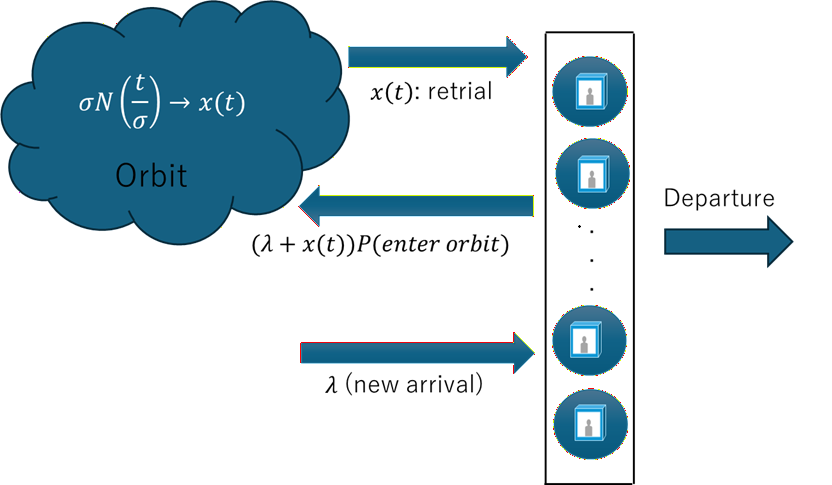
Retrial Queues: Scaling Limits
Journal of Systems Scalability | Volume 1, Issue 2: 39-42, 2026 | DOI: 10.62762/JSS.2025.500072
Abstract
Retrial queues arise in various applications such as call centers, services, and computer networks. The study of retrial queues is an important research branch of Queueing Theory. Retrial queues are characterized by the feature that customers who cannot receive service upon arrival do not queue but retry to enter the server after some random time. This makes the analysis of retrial queues more difficult than that of corresponding models without retrials. While the latter can be considered the limit of the former as the retrial time tends to infinity, some scaling limits are needed to obtain a scaled version of the number of retrial customers as the retrial time tends to zero, because the num... More >

Graphical Abstract
Retrial Queues: Scaling Limits