


Journal of Systems Scalability

Publishing Model:
ISSN:
ISSN: 3142-7855
Journal of Systems Scalability is a peer-reviewed international journal focused on the design, analysis, and optimization of scalable systems across computing, engineering, and complex infrastructures.
DOI Prefix: 10.62762/JSS

Journal Metrics

-
Impact Factor
-
CiteScore

Recent Articles

Open Access | Perspective | 09 June 2026
Scalability and High-Availability Architectural Strategies for Apigee in Hybrid and Multicloud Environments
Journal of Systems Scalability | Volume 1, Issue 2: 43-49, 2026 | DOI: 10.62762/JSS.2025.584098
Abstract
API management platforms have become critical components for operational resilience in distributed enterprise architectures. This article analyzes scalability and high-availability (HA) strategies applicable to Apigee, with particular emphasis on its Apigee X deployment model (Google Cloud–hosted SaaS) and Apigee Hybrid (a hybrid platform with a cloud-hosted control plane and a self-managed data plane). The state of the art in multi-region and multicloud deployments is presented, detailing active–active versus active–passive patterns and their impact on latency and disaster recovery objectives. Key technical components are examined, ranging from the use of Private Service Connect (PSC)... More >
Open Access | Perspective | 30 April 2026
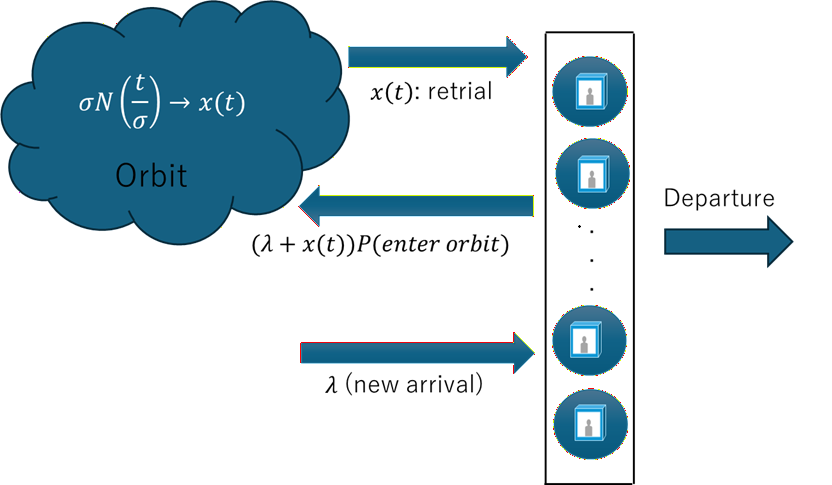
Retrial Queues: Scaling Limits
Journal of Systems Scalability | Volume 1, Issue 2: 39-42, 2026 | DOI: 10.62762/JSS.2025.500072
Abstract
Retrial queues arise in various applications such as call centers, services, and computer networks. The study of retrial queues is an important research branch of Queueing Theory. Retrial queues are characterized by the feature that customers who cannot receive service upon arrival do not queue but retry to enter the server after some random time. This makes the analysis of retrial queues more difficult than that of corresponding models without retrials. While the latter can be considered the limit of the former as the retrial time tends to infinity, some scaling limits are needed to obtain a scaled version of the number of retrial customers as the retrial time tends to zero, because the num... More >

Graphical Abstract
Retrial Queues: Scaling Limits
Open Access | News & Buzz | 30 March 2026
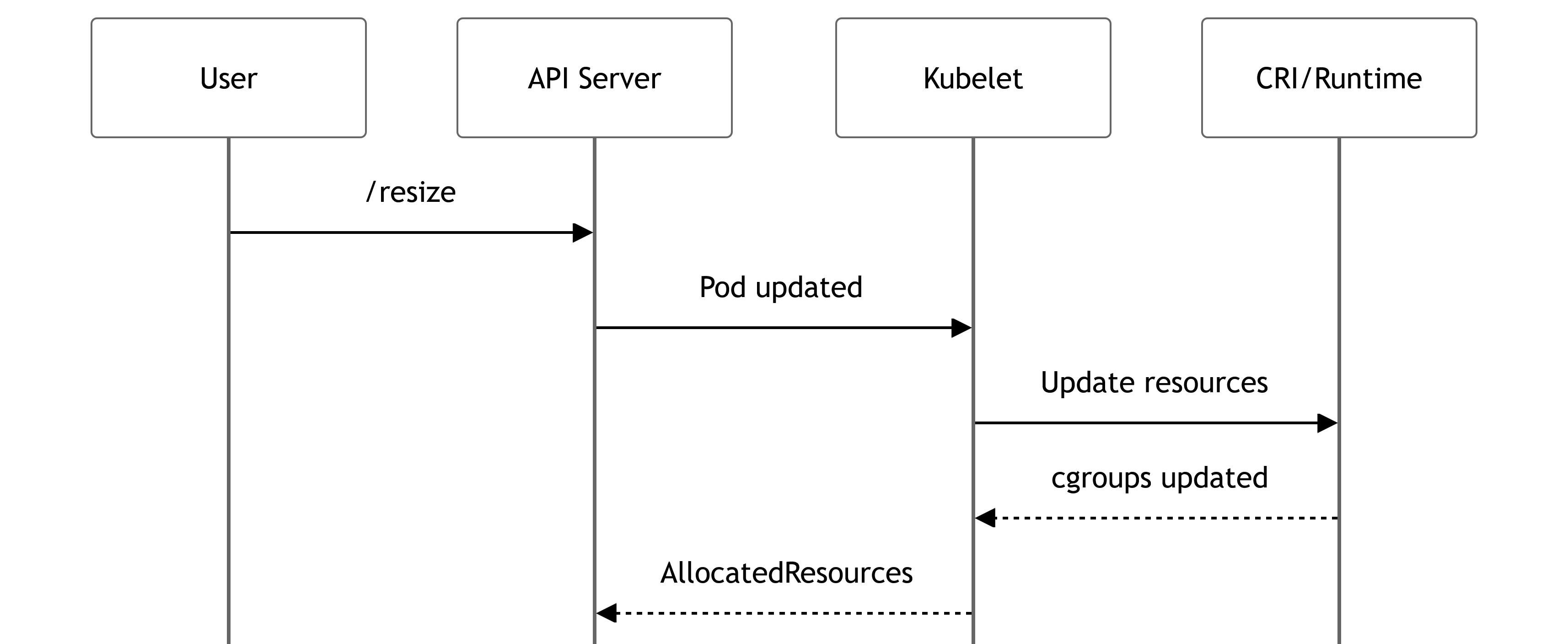
In-Place Pod Resize in Kubernetes: Enabling Non-Disruptive Vertical Scaling
Journal of Systems Scalability | Volume 1, Issue 1: 35-38, 2026 | DOI: 10.62762/JSS.2025.776624
Abstract
Kubernetes now supports In-Place Pod Resize, a mechanism that allows CPU and memory adjustments without restarting Pods. This removes a key limitation of vertical scaling and reduces disruption for stateful or latency-sensitive workloads. In this News \& Buzz article, we explain how the feature works, its integration with the Kubelet and container runtimes, and its impact on the Vertical Pod Autoscaler and hybrid autoscaling. Finally, we highlight open research directions, including scheduler coordination, application adaptation, and real-world performance evaluation. More >

Graphical Abstract
In-Place Pod Resize in Kubernetes: Enabling Non-Disruptive Vertical Scaling
Open Access | Perspective | 25 March 2026
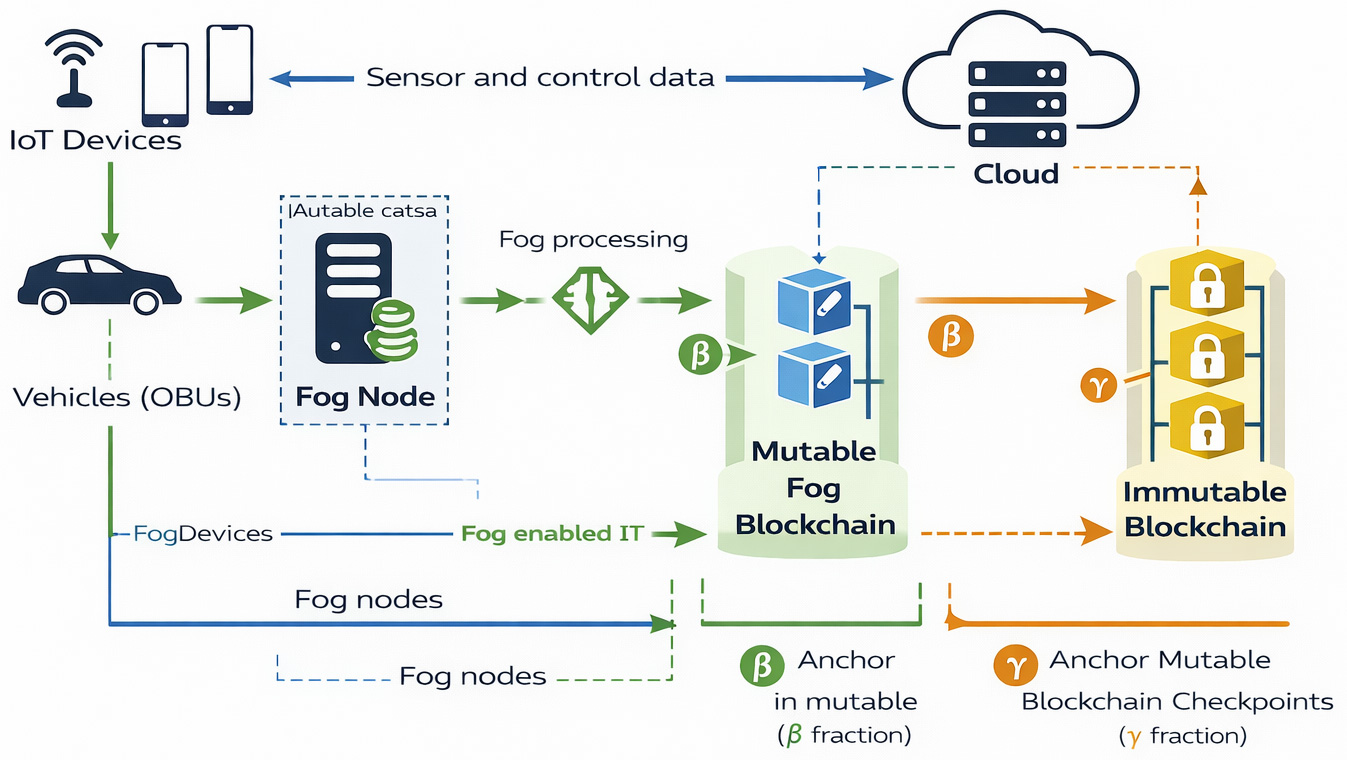
From Fog-Enabled IoT to Cognitive Internet of Vehicles: A Perspective on Mutable–Immutable Blockchain Architectures
Journal of Systems Scalability | Volume 1, Issue 1: 29-34, 2026 | DOI: 10.62762/JSS.2025.861548
Abstract
Fog-enabled Internet of Things (IoT-Fog) architectures and the Cognitive Internet of Vehicles (Cognitive IOV) are becoming key enablers for next-generation intelligent transport systems. At the same time, Blockchain is used to support integrity, transparency, and trust in distributed vehicular services. In this perspective article, we link these domains by discussing a hybrid Mutable-Immutable Blockchain Architecture in which mutable ledgers at the fog layer are combined with an immutable ledger in the cloud. We first outline an analytical model for Cognitive IOV over IoT-Fog, and then extend it to include Blockchain-related delays, throughput, and tamper resistance in the hybrid architectur... More >

Graphical Abstract
From Fog-Enabled IoT to Cognitive Internet of Vehicles: A Perspective on Mutable–Immutable Blockchain Architectures
Open Access | Perspective | 23 March 2026 | Cited: Scopus 1
Can Sidechains and AI Save the Edge? A Perspective on Scalability and Security in IoT-Fog Blockchains
Journal of Systems Scalability | Volume 1, Issue 1: 23-28, 2026 | DOI: 10.62762/JSS.2025.237121
Abstract
IoT-Fog networks create big challenges in scalability, latency, and security at the edge. This paper gives a simple perspective on how sidechains and artificial intelligence (AI) can help. Sidechains process local transactions near devices, increase throughput, and reduce delay. AI methods, such as Random Forest, detect abnormal traffic, predict workload peaks, and adjust network settings (for example, block time and number of validators). We present clear, small formulas for throughput, latency, checkpoint cost, and security, and we show how these formulas guide design choices (block time $T_b$, confirmations $k$, checkpoint period $\tau$). The goal is an easy model that links design choice... More >
Open Access | Research Article | 15 March 2026
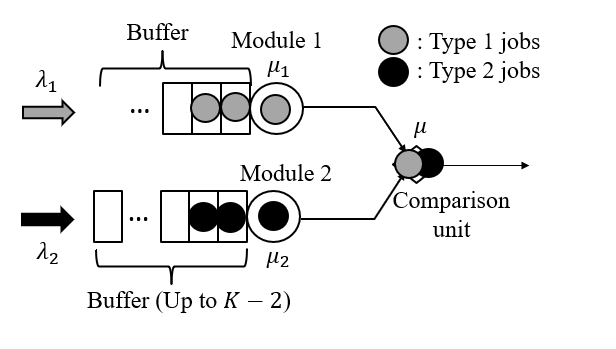
Performance Analysis of Energy-Efficient Reliable AIoT System Architectures
Journal of Systems Scalability | Volume 1, Issue 1: 6-22, 2026 | DOI: 10.62762/JSS.2025.386670
Abstract
As many IoT systems deploy machine learning models to implement intelligent functions, the reliability and performance assurance of artificial intelligence and the Internet of Things (AIoT) system is becoming a crucial issue. While reliability of AIoT system outputs can be improved by redundancy using multiple input data, the system involves performance and energy overheads that may be unacceptable in real deployment under limited computing resources. To ensure the performance and energy-efficiency of AIoT systems, this paper proposes the queueing models for multi-input AIoT systems in two different architectures, namely the parallel and the shared architectures, and compares them with respe... More >

Graphical Abstract
Performance Analysis of Energy-Efficient Reliable AIoT System Architectures
Open Access | Perspective | 10 March 2026
Energy Scalability in the Training of AI Models for Image Processing: The Role of Hyperparameters
Journal of Systems Scalability | Volume 1, Issue 1: 1-5, 2026 | DOI: 10.62762/JSS.2025.960646
Abstract
This perspective article argues that hyperparameters such as learning rate, batch size, numerical precision, and training workers are key determinants of energy scalability in CNN training. These parameters directly influence convergence dynamics, hardware utilization, and training duration, leading to substantially different energy profiles even when comparable accuracy is achieved. Moreover, hyperparameter search itself introduces a significant cumulative energy cost, often exceeding that of the final selected model. By analyzing the interaction between convergence behavior and energy consumption, this work highlights the need to treat energy as an explicit scalability metric and to integr... More >

Journal Statistics

12
Authors
3
Countries / Regions
7
Articles
Scopus: 1
Citations
2025
Published Since
3,824
Article Views
1,279
Article Downloads
Journal of Systems Scalability
eISSN: 3142-7855
Crossref
Crossref
Member of Crossref
Visit Crossref →