


Performance Analysis of Energy-Efficient Reliable AIoT System Architectures


Article Information
Abstract
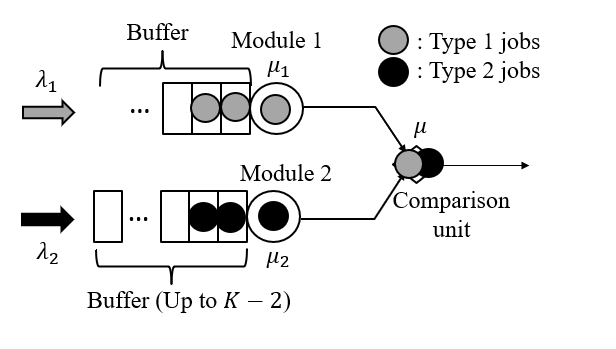
As many IoT systems deploy machine learning models to implement intelligent functions, the reliability and performance assurance of artificial intelligence and the Internet of Things (AIoT) system is becoming a crucial issue. While reliability of AIoT system outputs can be improved by redundancy using multiple input data, the system involves performance and energy overheads that may be unacceptable in real deployment under limited computing resources. To ensure the performance and energy-efficiency of AIoT systems, this paper proposes the queueing models for multi-input AIoT systems in two different architectures, namely the parallel and the shared architectures, and compares them with respect to several performance metrics. Through numerical and simulation studies, we show that the shared architecture has advantages in response time and energy consumption while maintaining the same reliability as the parallel architecture. Furthermore, we show that the proposed models yield more precise performance estimates than analyses based on simple queueing models, which do not capture the comparison process among multiple inference results.
Graphical Abstract
Keywords
Data Availability Statement
Funding
Conflicts of Interest
AI Use Statement
Ethical Approval and Consent to Participate
References
- Goodfellow, I. J., Shlens, J., & Szegedy, C. (2014). Explaining and harnessing adversarial examples. arXiv preprint arXiv:1412.6572.
[Google Scholar] - Huang, X., Kwiatkowska, M., Wang, S., & Wu, M. (2017, July). Safety verification of deep neural networks. In International conference on computer aided verification (pp. 3-29). Cham: Springer International Publishing.
[CrossRef] [Google Scholar] - Wong, E., & Kolter, Z. (2018, July). Provable defenses against adversarial examples via the convex outer adversarial polytope. In International conference on machine learning (pp. 5286-5295). PMLR.
[Google Scholar] - Zhang, J. M., Harman, M., Ma, L., & Liu, Y. (2020). Machine learning testing: Survey, landscapes and horizons. IEEE Transactions on Software Engineering, 48(1), 1–36.
[CrossRef] [Google Scholar] - Tian, Y., Pei, K., Jana, S., & Ray, B. (2018, May). Deeptest: Automated testing of deep-neural-network-driven autonomous cars. In Proceedings of the 40th international conference on software engineering (pp. 303-314).
[CrossRef] [Google Scholar] - Riccio, V., Jahangirova, G., Stocco, A., Humbatova, N., Weiss, M., & Tonella, P. (2020). Testing machine learning based systems: a systematic mapping. Empirical Software Engineering, 25(6), 5193-5254.
[CrossRef] [Google Scholar] - Machida, F. (2019, June). N-version machine learning models for safety critical systems. In 2019 49th Annual IEEE/IFIP International Conference on Dependable Systems and Networks Workshops (DSN-W) (pp. 48-51). IEEE.
[CrossRef] [Google Scholar] - Machida, F. (2023). Using diversities to model the reliability of two-version machine learning systems. IEEE Transactions on Emerging Topics in Computing, 12(3), 810-825.
[CrossRef] [Google Scholar] - Xie, M., Dai, Y. S., & Poh, K. L. (2004). Computing system reliability: models and analysis. Boston, MA: Springer Us.
[CrossRef] [Google Scholar] - Machida, F. (2019, December). On the diversity of machine learning models for system reliability. In 2019 IEEE 24th Pacific Rim International Symposium on Dependable Computing (PRDC) (pp. 276-27609). IEEE.
[CrossRef] [Google Scholar] - Takahashi, M., Machida, F., & Wen, Q. (2022, November). How data diversification benefits the reliability of three-version image classification systems. In 2022 IEEE 27th Pacific Rim International Symposium on Dependable Computing (PRDC) (pp. 34-42). IEEE.
[CrossRef] [Google Scholar] - Latifi, S., Zamirai, B., & Mahlke, S. (2020, June). Polygraphmr: Enhancing the reliability and dependability of cnns. In 2020 50th Annual IEEE/IFIP International Conference on Dependable Systems and Networks (DSN) (pp. 99-112). IEEE.
[CrossRef] [Google Scholar] - Makino, Y., Phung-Duc, T., & Machida, F. (2021, June). A queueing analysis of multi-model multi-input machine learning systems. In 2021 51st Annual IEEE/IFIP International Conference on Dependable Systems and Networks Workshops (DSN-W) (pp. 141-149). IEEE.
[CrossRef] [Google Scholar] - Soyata, T., Muraleedharan, R., Funai, C., Kwon, M., & Heinzelman, W. (2012, July). Cloud-vision: Real-time face recognition using a mobile-cloudlet-cloud acceleration architecture. In 2012 IEEE symposium on computers and communications (ISCC) (pp. 000059-000066). IEEE.
[CrossRef] [Google Scholar] - Powers, N., Alling, A., Osolinsky, K., Soyata, T., Zhu, M., Wang, H., Ba, H., Heinzelman, W., Shi, J., & Kwon, M. (2015). The cloudlet accelerator: Bringing mobile-cloud face recognition into real-time. In 2015 IEEE Globecom Workshops (GC Wkshps) (pp. 1–7). IEEE.
[CrossRef] [Google Scholar] - Collin, A., Siddiqi, A., Imanishi, Y., Rebentisch, E., Tanimichi, T., & de Weck, O. L. (2020). Autonomous driving systems hardware and software architecture exploration: optimizing latency and cost under safety constraints. Systems Engineering, 23(3), 327-337.
[CrossRef] [Google Scholar] - Zhao, H., Hari, S. K. S., Tsai, T., Sullivan, M. B., Keckler, S. W., & Zhao, J. (2021, October). Suraksha: A framework to analyze the safety implications of perception design choices in avs. In 2021 IEEE 32nd International Symposium on Software Reliability Engineering (ISSRE) (pp. 434-445). IEEE.
[CrossRef] [Google Scholar] - Verma, A., & Ranga, V. (2020). Machine learning based intrusion detection systems for IoT applications. Wireless Personal Communications, 111(4), 2287-2310.
[CrossRef] [Google Scholar] - Nishihara, R., Moritz, P., Wang, S., Tumanov, A., Paul, W., Schleier-Smith, J., Liaw, R., Niknami, M., Jordan, M. I., & Stoica, I. (2017). Real-time machine learning: The missing pieces. In Proceedings of the 16th Workshop on Hot Topics in Operating Systems (pp. 106–110). Association for Computing Machinery.
[CrossRef] [Google Scholar] - Huang, J., Rathod, V., Sun, C., Zhu, M., Korattikara, A., Fathi, A., ... & Murphy, K. (2017, July). Speed/Accuracy Trade-Offs for Modern Convolutional Object Detectors. In 2017 IEEE Conference on Computer Vision and Pattern Recognition (CVPR) (pp. 3296-3297). IEEE.
[CrossRef] [Google Scholar] - Trivedi, K. S., & Bobbio, A. (2017). Reliability and availability engineering: Modeling, analysis, and applications. Cambridge University Press.
[Google Scholar] - Latouche, G., & Ramaswami, V. (1999). Introduction to matrix analytic methods in stochastic modeling. Society for Industrial and Applied Mathematics.
[Google Scholar] - Phung-Duc, T., Akutsu, K., Kawanishi, K. I., Salameh, O., & Wittevrongel, S. (2022). Queueing models for cognitive wireless networks with sensing time of secondary users. Annals of Operations Research, 310(2), 641-660.
[CrossRef] [Google Scholar] - Akutsu, K., Phung-Duc, T., Lai, Y. C., & Lin, Y. D. (2022). Analyzing vertical and horizontal offloading in federated cloud and edge computing systems. Telecommunication Systems, 79(3), 447-459.
[CrossRef] [Google Scholar] - Wakigami, K., Machida, F., & Phung-Duc, T. (2024). Empirical architecture comparison of two-input machine learning systems for vision tasks. Formal Aspects of Computing, 36(4), 1-19.
[CrossRef] [Google Scholar]
Cite This Article
TY  - JOUR
AU  - Nishio, Shoma
AU  - Makino, Yuta
AU  - Phung-Duc, Tuan
AU  - Machida, Fumio
PY  - 2026
DA  - 2026/03/15
TI  - Performance Analysis of Energy-Efficient Reliable AIoT System Architectures
JO  - Journal of Systems Scalability
T2  - Journal of Systems Scalability
JF  - Journal of Systems Scalability
VL  - 1
IS  - 1
SP  - 6
EP  - 22
DO  - 10.62762/JSS.2025.386670
UR  - https://www.icck.org/article/abs/JSS.2025.386670
KW  - AIoT system
KW  - energy consumption
KW  - performance
KW  - queueing model
KW  - redundant architecture
AB  - As many IoT systems deploy machine learning models to implement intelligent functions, the reliability and performance assurance of artificial intelligence and the Internet of Things (AIoT) system is becoming a crucial issue. While reliability of AIoT system outputs can be improved by redundancy using multiple input data, the system involves performance and energy overheads that may be unacceptable in real deployment under limited computing resources. To ensure the performance and energy-efficiency of AIoT systems, this paper proposes the queueing models for multi-input AIoT systems in two different architectures, namely the parallel and the shared architectures, and compares them with respect to several performance metrics. Through numerical and simulation studies, we show that the shared architecture has advantages in response time and energy consumption while maintaining the same reliability as the parallel architecture. Furthermore, we show that the proposed models yield more precise performance estimates than analyses based on simple queueing models, which do not capture the comparison process among multiple inference results.
SN  - pending
PB  - Institute of Central Computation and Knowledge
LA  - English
ER  -
@article{Nishio2026Performanc,
  author = {Shoma Nishio and Yuta Makino and Tuan Phung-Duc and Fumio Machida},
  title = {Performance Analysis of Energy-Efficient Reliable AIoT System Architectures},
  journal = {Journal of Systems Scalability},
  year = {2026},
  volume = {1},
  number = {1},
  pages = {6-22},
  doi = {10.62762/JSS.2025.386670},
  url = {https://www.icck.org/article/abs/JSS.2025.386670},
  abstract = {As many IoT systems deploy machine learning models to implement intelligent functions, the reliability and performance assurance of artificial intelligence and the Internet of Things (AIoT) system is becoming a crucial issue. While reliability of AIoT system outputs can be improved by redundancy using multiple input data, the system involves performance and energy overheads that may be unacceptable in real deployment under limited computing resources. To ensure the performance and energy-efficiency of AIoT systems, this paper proposes the queueing models for multi-input AIoT systems in two different architectures, namely the parallel and the shared architectures, and compares them with respect to several performance metrics. Through numerical and simulation studies, we show that the shared architecture has advantages in response time and energy consumption while maintaining the same reliability as the parallel architecture. Furthermore, we show that the proposed models yield more precise performance estimates than analyses based on simple queueing models, which do not capture the comparison process among multiple inference results.},
  keywords = {AIoT system, energy consumption, performance, queueing model, redundant architecture},
  issn = {pending},
  publisher = {Institute of Central Computation and Knowledge}
}
Article Metrics
Publisher's Note
ICCK stays neutral with regard to jurisdictional claims in published maps and institutional affiliations.
Rights and Permissions
 Copyright © 2026 by the Author(s). Published by Institute of Central Computation and Knowledge. This article is an open access article distributed under the terms and conditions of the Creative Commons Attribution (CC BY) license (https://creativecommons.org/licenses/by/4.0/), which permits use, sharing, adaptation, distribution and reproduction in any medium or format, as long as you give appropriate credit to the original author(s) and the source, provide a link to the Creative Commons licence, and indicate if changes were made.

