ICCK

Sarita Pippal

panjab University

Section 01

Academic Profile

No academic profile information available at the moment.

Section 02

ICCK Publications

Open Access | Research Article | 18 October 2026
Polynomial-Based Kudryashov Analytical Methods for a Generalized Sharma–Tasso–Olver Equation with Non-Integer Nonlinearity
Journal of Numerical Simulations in Physics and Mathematics | Volume 3, Issue 1: 51-59, 2026 | DOI: 10.62762/JNSPM.2026.980251
Abstract
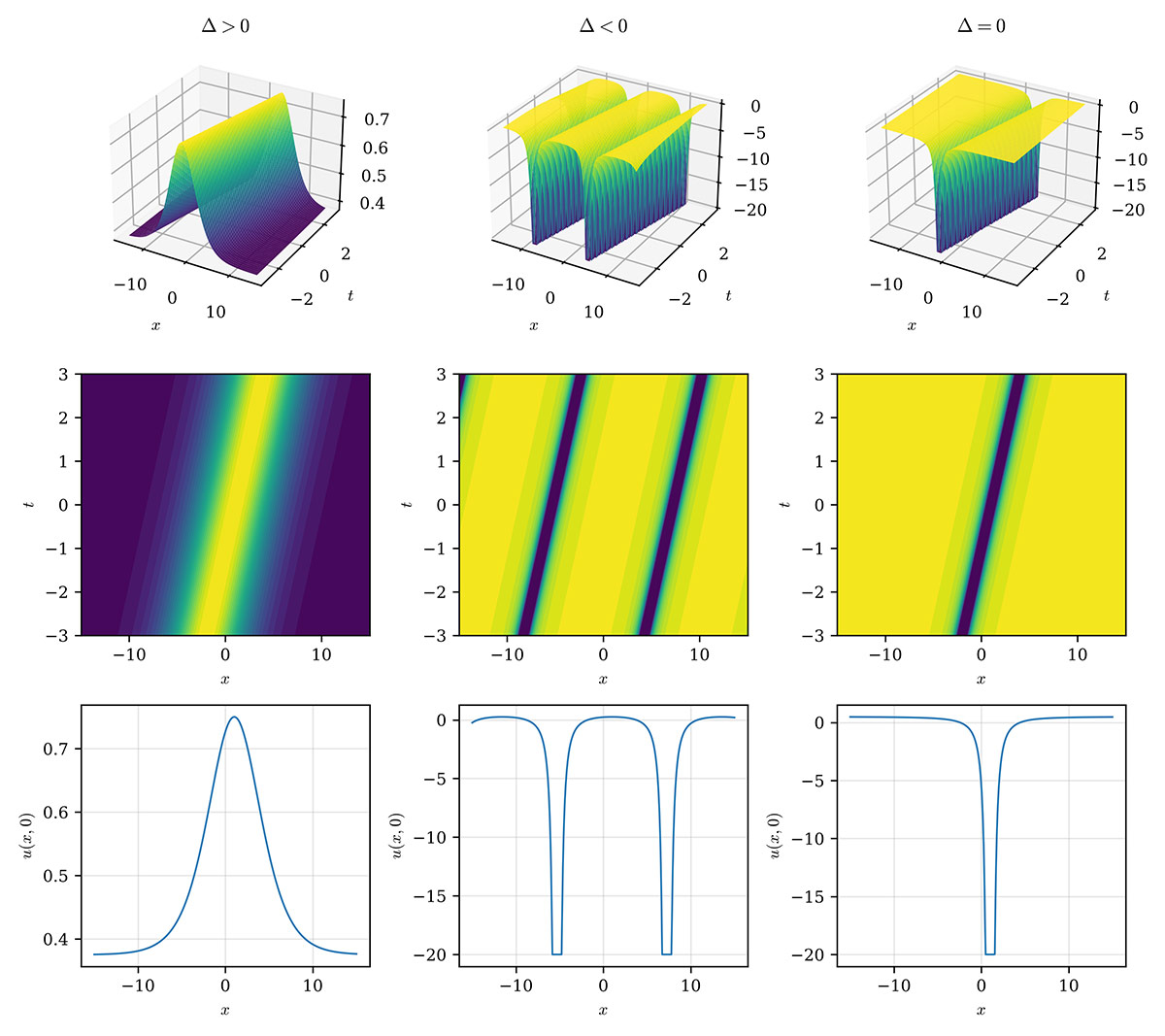
We study travelling-wave solutions of the generalized Sharma-Tasso-Olver (GSTO) equation $u_t+\lambda(u^{r})_x+\mu(u^{s})_{xx}+\nu u_{xxx}=0$, in which the exponents $r,s>0$ need not be integers. The classical, modified and generalized Kudryashov methods are applied to the reduced ordinary differential equation. A balance argument shows that the convective term fixes the degree of the expansion through $N=2/(r-1)$, whereas the nonlinear diffusion term requires $N=1/(s-1)$; the two requirements are compatible only when $r=2s-1$, a condition satisfied by the classical STO equation ($r=3$, $s=2$). For the representative non-integer cases $(r,s)=(2,\tfrac32)$ and $(\tfrac32,2)$ we show that boun... More >

Graphical Abstract
Polynomial-Based Kudryashov Analytical Methods for a Generalized Sharma–Tasso–Olver Equation with Non-Integer Nonlinearity
Open Access | Research Article | 17 September 2026
New Iteration Method (NIM) for Solving Fourth-Order Two-Point Nonlinear Boundary Value Problems
Journal of Numerical Simulations in Physics and Mathematics | Volume 2, Issue 2: 90-103, 2026 | DOI: 10.62762/JNSPM.2026.798641
Abstract
In this study, the New Iteration Method (NIM) is employed to obtain approximate analytical solutions of nonlinear fourth-order ordinary differential equations of the general form \[ \mathcal{L}(u) + \mathcal{N}(u) = g(x), \qquad x \in [a,b], \] subject to the two-point boundary conditions \[ \mathcal{B}_1(u)=0, \qquad \mathcal{B}_2(u)=0, \] where $\mathcal{L}$ denotes a linear differential operator, $\mathcal{N}$ represents a nonlinear operator, and $g(x)$ is a given continuous function. The NIM framework constructs a rapidly convergent iterative sequence $\{u_n\}_{n=0}^{\infty}$ whose limit approximates the exact solution. The convergence behavior and numerical performan... More >
Open Access | Research Article | 24 July 2026
Modeling Marital Stability: A Dynamical Systems Analysis of Extramarital Affairs and Divorce
Journal of Mathematics and Interdisciplinary Applications | Volume 2, Issue 3: 164-191, 2026 | DOI: 10.62762/JMIA.2026.666866
Abstract
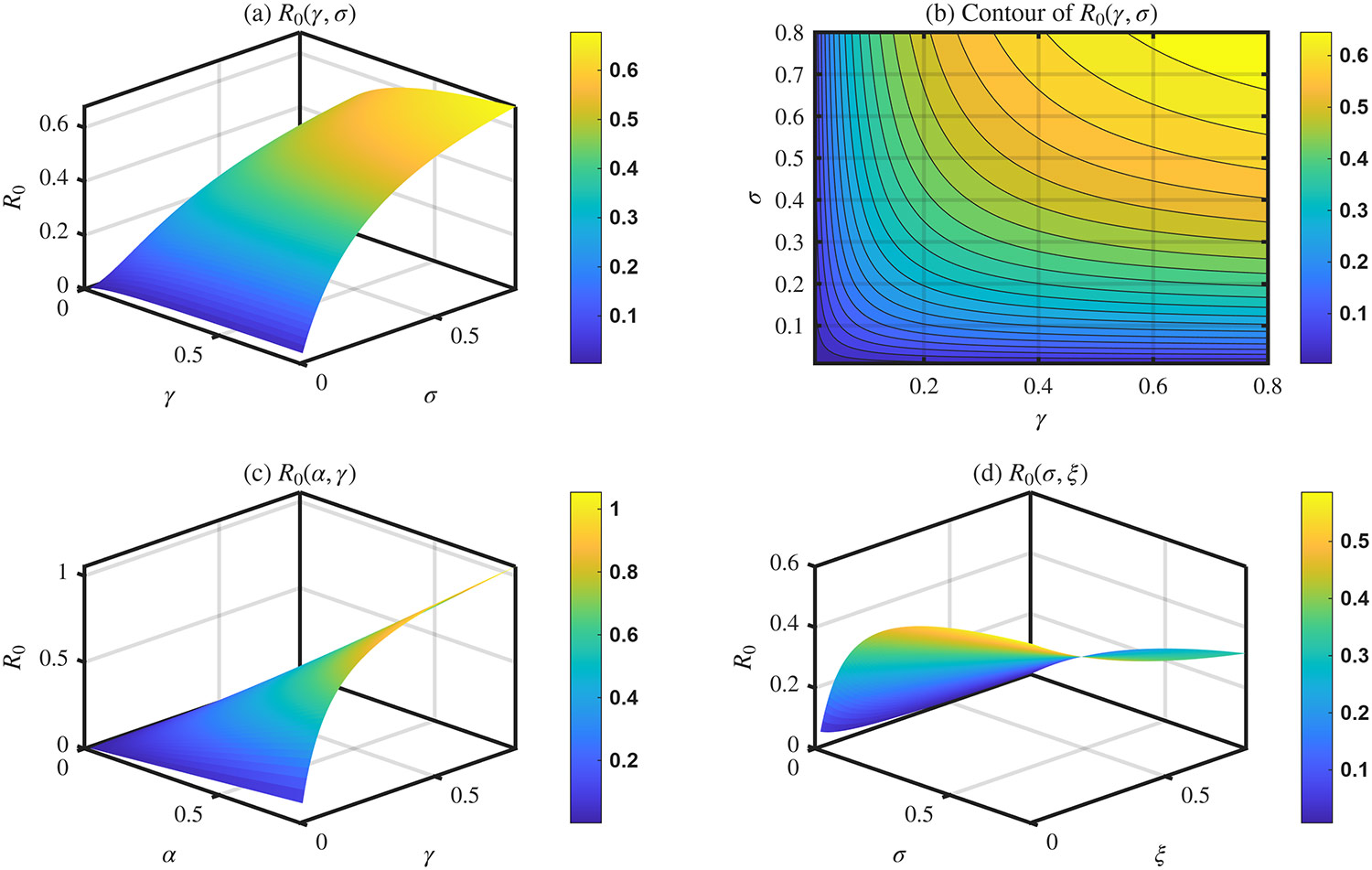
This study develops and analyzes a nonlinear mathematical model to describe the dynamics of marriage, extramarital affairs, marital breakdown, and divorce. The population is divided into five compartments: single $S(t)$, married $M(t)$, individuals in extramarital affairs $A(t)$, broken marriages $B(t)$, and divorced $D(t)$. The model is formulated as a system of nonlinear ordinary differential equations capturing transitions between these states through parameters representing marriage formation, affair initiation, reconciliation, separation, and divorce. Basic qualitative properties, including positivity and boundedness of solutions, are established to ensure the model is well posed. Equil... More >

Graphical Abstract
Modeling Marital Stability: A Dynamical Systems Analysis of Extramarital Affairs and Divorce
Open Access | Research Article | 28 May 2026
Social Change and Escalation of Crime: A Statistical Study of Delhi $vs$ India (2010-2020)
Journal of Social Systems and Policy Analysis | Volume 3, Issue 3: 109-120, 2026 | DOI: 10.62762/JSSPA.2026.887509
Abstract
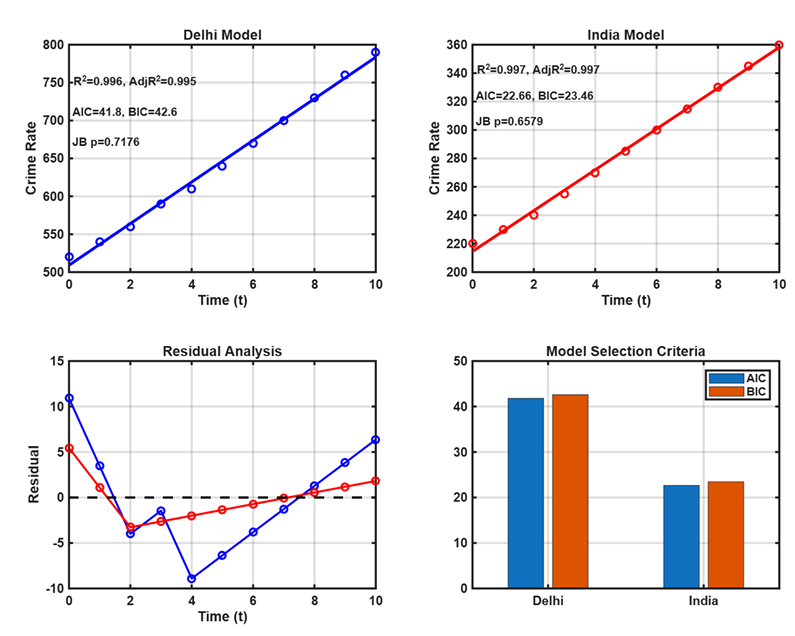
Rapid social transformation in metropolitan regions has significantly reshaped crime dynamics, particularly in large urban centers such as Delhi. Understanding whether crime escalation reflects structural social change or random fluctuation is crucial for policy formulation. This study investigates the relationship between social transformation and crime escalation in Delhi within the broader national context of India over the period 2010-2020. The analysis employs a quantitative time-series and econometric framework, including trend analysis, regression modeling, correlation, elasticity estimation, and structural diagnostics. Secondary data are obtained from the National Crime Records Burea... More >

Graphical Abstract
Social Change and Escalation of Crime: A Statistical Study of Delhi $vs$ India (2010-2020)
Open Access | Research Article | 28 May 2026
Semi-Analytical Solution of the Fractional Wazwaz-Benjamin-Bona-Mahony (WBBM) System via the Laplace Transform Adomian Decomposition Method
Journal of Numerical Simulations in Physics and Mathematics | Volume 2, Issue 1: 59-68, 2026 | DOI: 10.62762/JNSPM.2026.197265
Abstract
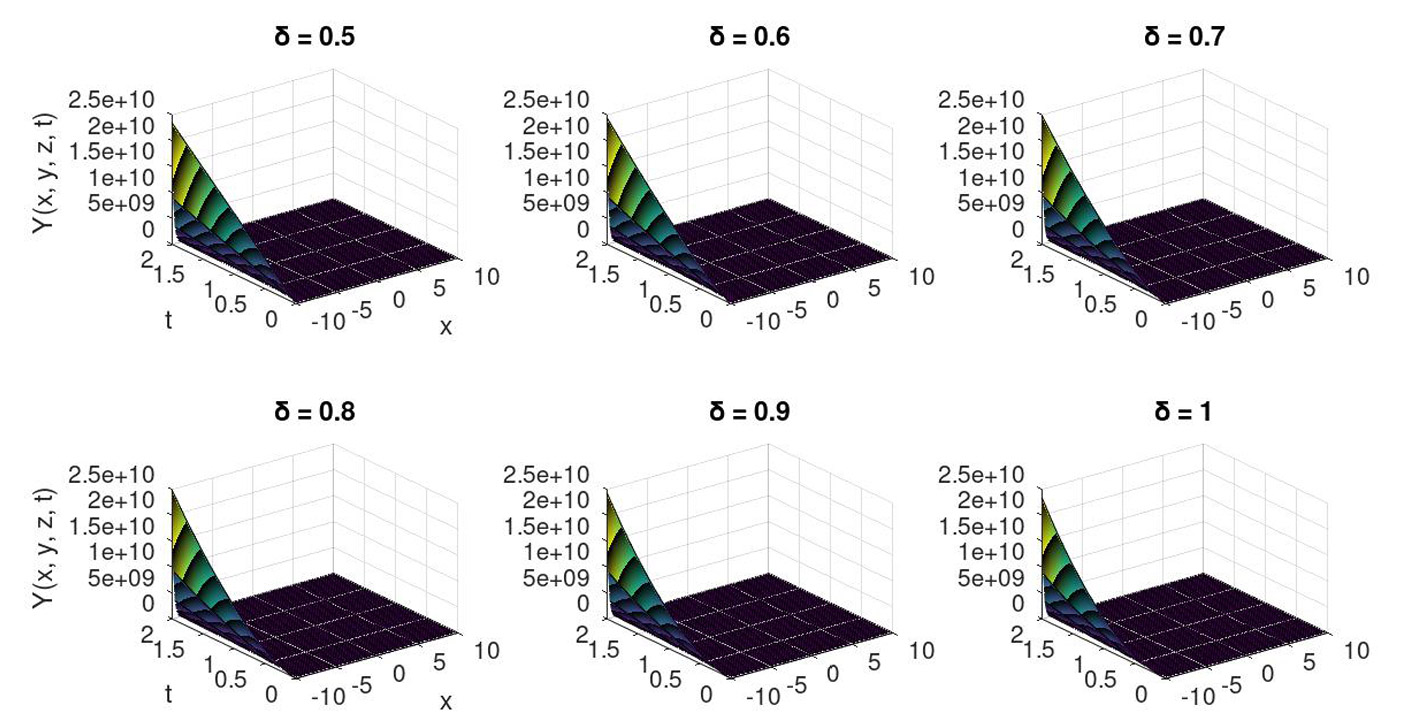
This study explores the application of the Adomian Decomposition Method (ADM), combined with the Laplace transform, to obtain approximate solutions of the time--fractional Wazwaz--Benjamin--Bona--Mahony (WBBM) equations. These equations, which describe wave phenomena in fluid dynamics within a fractional--time framework, present significant analytical challenges. By integrating the Laplace transform with ADM, a modified technique---referred to as the Laplace Transform Adomian Decomposition Method (LTADM)---is introduced. The time--fractional WBBM equations are solved using LTADM, and three--dimensional solution plots are generated for six different values of the fractional order \( \delta \)... More >

Graphical Abstract
Semi-Analytical Solution of the Fractional Wazwaz-Benjamin-Bona-Mahony (WBBM) System via the Laplace Transform Adomian Decomposition Method
  • 1
  • 2