
Md. Najmul Hossain (Senior Member, IEEE) was born in Rajshahi, Bangladesh, in 1984. He received the B.Sc. and M.Sc. degrees in Applied Physics and Electronic Engineering (currently named Electrical and Electronic Engineering) from the University of Rajshahi, Rajshahi, in 2007 and 2008, respectively, and the Ph.D. degree in advanced wireless communication systems from the Graduate School of Science and Engineering, Saitama University, Saitama, Japan, in 2020. He is currently working as an Associate Professor with the Department of Electrical, Electronic and Communication Engineering, Pabna University of Science and Technology, Pabna, Bangladesh. His current research interests include computer vision, antenna and wave propagation, advanced wireless communications, and corresponding signal processing, especially for OFDM, OTFS, OCDM, MIMO, and future-generation wireless communication networks. In 2010, he was awarded a Gold Medal for his excellent academic performance. He is a member of the IEEE Communications Society (ComSoc). He is collaboratively conducting research with several renowned professors, such as Prof. Shimamura, Saitama University, Japan; Prof. Shin, University of Aizu, Japan; Prof. Heung-Gyoon Ryu, Chungbuk National University, South Korea; Prof. Raad, University of Wollongong, Wollongong, Australia; and Prof. Nisar, Prince Sattam bin Abdulaziz University, Saudi Arabia. He has served as a Reviewer of several SCI/SCIE/Scopus journals and international conferences. In addition, he served as an Editor for the Journal of Engineering Advancements.
Editorial Roles
No Editorial Roles
This user currently does not serve as an editor for any ICCK journals.
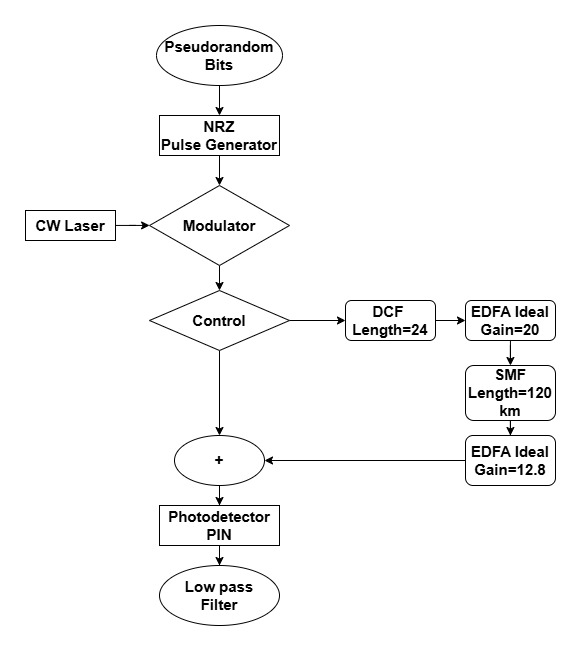
Designing a reliable fiber optic communication network is crucial. High-speed optical networks are now a vital part of the communication system and the foundation of wireless and mobile networks, driven by their constant expansion and increasing demand. The high transmission rate improves spectral utilization, increases system capacity, and reduces overall system expenditure. To improve the communication channel and achieve high transmission performance and data rates, a spread-spectrum compensation scheme is required. The goal of fiber optic communication systems is to transmit as many bits per second as possible over the longest possible distance at an acceptable data rate. Two methods are... More >
Graphical Abstract
We use cookies to improve your experience. By continuing to browse, you agree to our use of essential cookies.
Learn more