
Volume 2, Issue 1, ICCK Transactions on Advanced Computing and Systems
Volume 2, Issue 1, 2026
Submit Manuscript Edit a Special Issue
Article QR Code
Article QR Code
Scan the QR code for reading
Popular articles
ICCK Transactions on Advanced Computing and Systems, Volume 2, Issue 1, 2026: 53-60

Open Access | Research Article | 13 January 2026
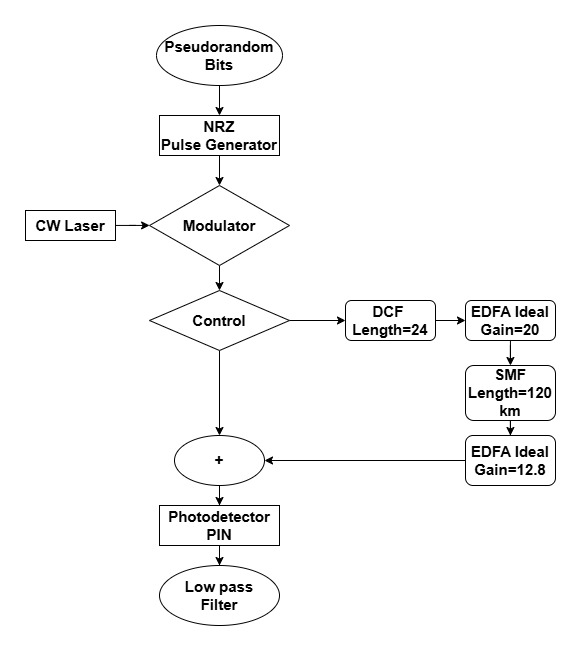
Dispersion-Compensating Method for High-Capacity Fiber-Optic Communication System
1 IMT Atlantique / Lab-STICC, CNRS, UMR 6285, Technopole Brest 29238, France
2 Inter-Cloud Limited, Dhaka, Bangladesh
3 University of California, Davis, CA 95616, United States
4 Department of Electrical, Electronic and Communication Engineering, Pabna University of Science and Technology, Pabna 6600, Bangladesh
* Corresponding Author: Md. Najmul Hossain, [email protected]
ARK: ark:/57805/tacs.2025.603512
Received: 29 June 2025, Accepted: 22 December 2025, Published: 13 January 2026  
Abstract
Designing a reliable fiber optic communication network is crucial. High-speed optical networks are now a vital part of the communication system and the foundation of wireless and mobile networks, driven by their constant expansion and increasing demand. The high transmission rate improves spectral utilization, increases system capacity, and reduces overall system expenditure. To improve the communication channel and achieve high transmission performance and data rates, a spread-spectrum compensation scheme is required. The goal of fiber optic communication systems is to transmit as many bits per second as possible over the longest possible distance at an acceptable data rate. Two methods are presented, and the DCF diagram is shown in the first and second configurations. The simulation evaluates the communication performance at different speeds or bit rates, including (2.5, 10) Gbps. In the other system, the simulation is performed at various bit rates and cable lengths.

Graphical Abstract
Dispersion-Compensating Method for High-Capacity Fiber-Optic Communication System

Keywords
fiber optic
high-capacity
SNR
optical dispersion
BER

Data Availability Statement
Data will be made available on request.

Funding
This work was supported without any funding.

Conflicts of Interest
Md. Nazmul Alam is affiliated with the Inter-Cloud Limited, Dhaka, Bangladesh. The authors declare that this affiliation had no influence on the study design, data collection, analysis, interpretation, or the decision to publish, and that no other competing interests exist.

Ethical Approval and Consent to Participate
Not applicable.

References
  1. Kazaura, K., Wakamori, K., Matsumoto, M., Higashino, T., Tsukamoto, K., & Komaki, S. (2010). RoFSO: a universal platform for convergence of fiber and free-space optical communication networks. IEEE Communications Magazine, 48(2), 130-137.
    [CrossRef]   [Google Scholar]
  2. Xia, P., Zhang, L. H., & Lin, Y. (2019, April). Simulation study of dispersion compensation in optical communication systems based on optisystem. In Journal of Physics: Conference Series (Vol. 1187, No. 4, p. 042011). IOP Publishing.
    [CrossRef]   [Google Scholar]
  3. Agrawal, G. P. (2012). Fiber-optic communication systems. John Wiley & Sons.
    [CrossRef]   [Google Scholar]
  4. Alam, S. J., Alam, M. R., Hu, G., & Mehrab, M. Z. (2011). Bit error rate optimization in fiber optic communications. International Journal of Machine Learning and Computing, 1(5), 435.
    [Google Scholar]
  5. Keiser, G. (2021). Optical fiber communications (6th ed.). McGraw-Hill.
    [Google Scholar]
  6. Rahman, M. M., Islam, M. S., Tanvir, M. M., Rubayan, S., & Pabna, B. (2019). Study and design of A high capacity fiber‐optic communication link by analyzing and comparing different dispersion techniques using DCF. Asian Journal of Technology & Management Research, 9(2).
    [Google Scholar]
  7. Ramaswami, R., & Sivarajan, K. (2001). Optical networks: a practical perspective. Elsevier.
    [Google Scholar]
  8. Shaalan, I. E., Selmy, M. I., Aly, M. H., & Abdallah, R. M. (2025). Optical fiber dispersion compensation: supervised machine learning with regression approach. Optical and Quantum Electronics, 57(5), 303.
    [CrossRef]   [Google Scholar]
  9. Kazovsky, L. G. (1997). Advanced Optical Fiber Communication Systems. Retrieved from https://apps.dtic.mil/sti/html/tr/ADA255424/
    [Google Scholar]
  10. Prabu, R. T., Pandian, M. M., Prabu, A. S., Kumar, A. K., Battula, R. S. S. R., Subha, T. D., & Adel, M. H. (2025). Fiber optic system dispersion compensation management within optical fiber communication channels through the control of all hybrid optical amplifiers: simulative study. Journal of Optical Communications.
    [CrossRef]   [Google Scholar]
  11. Essiambre, R. J., Kramer, G., Winzer, P. J., Foschini, G. J., & Goebel, B. (2010). Capacity limits of optical fiber networks. Journal of Lightwave technology, 28(4), 662-701.
    [CrossRef]   [Google Scholar]
  12. Gopalan, A., Arulmozhi, A. K., Pandian, M. M., Mohanadoss, P., Dorairajan, N., Balaji, M., & Taher, A. M. (2024). Performance parameters estimation of high speed Silicon/Germanium/InGaAsP avalanche photodiodes wide bandwidth capability in ultra high speed optical communication system. Journal of Optical Communications, (0).
    [CrossRef]   [Google Scholar]
  13. Winzer, P. J., & Essiambre, R. J. (2006). Advanced modulation formats for high-capacity optical transport networks. Journal of Lightwave Technology, 24(12), 4711-4728.
    [CrossRef]   [Google Scholar]
  14. Allam, M. A., Ali, T. A., & Rafat, N. H. (2024). Broadband dispersion compensation and high birefringence photonic crystal fiber for CWDM/DWDM networks. Optical and Quantum Electronics, 56(6), 1023.
    [CrossRef]   [Google Scholar]
  15. Ogudo, K. A., Mthethwa, M. H., & Nestor, D. M. J. (2019, August). Comparative Analysis of Fibre Optic and Copper Cables for High-Speed Communication: South African Context. In 2019 International Conference on Advances in Big Data, Computing and Data Communication Systems (icABCD) (pp. 1-8). IEEE.
    [CrossRef]   [Google Scholar]
  16. Shtaif, M., Antonelli, C., Mecozzi, A., & Chen, X. (2022). Challenges in estimating the information capacity of the fiber-optic channel. Proceedings of the IEEE, 110(11), 1655–1678.
    [CrossRef]   [Google Scholar]
  17. Sadeghi, R., Correia, B., Virgillito, E., Napoli, A., Costa, N., Pedro, J., & Curri, V. (2021, June). Comparison of transceiver and C+ L band upgrades: network traffic and energy assessment. In 2021 International Conference on Electrical, Communication, and Computer Engineering (ICECCE) (pp. 1-6). IEEE.
    [CrossRef]   [Google Scholar]
  18. Pan, X., Wang, X., Tian, B., Wang, C., Zhang, H., & Guizani, M. (2021). Machine-learning-aided optical fiber communication system. IEEE Network, 35(4), 136-142.
    [CrossRef]   [Google Scholar]
  19. Patri, S. K., Autenrieth, A., Elbers, J. P., & Mas-Machuca, C. (2022). Multi-band transparent optical network planning strategies for 6G-ready European networks. Optical Fiber Technology, 74, 103118.
    [CrossRef]   [Google Scholar]
  20. Cheng, J., Xie, C., Chen, Y., Chen, X., Tang, M., & Fu, S. (2019, March). Comparison of coherent and IMDD transceivers for intra datacenter optical interconnects. In 2019 Optical Fiber Communications Conference and Exhibition (OFC) (pp. 1-3). IEEE.
    [CrossRef]   [Google Scholar]

Cite This Article
APA Style
Rahman, M. M., Alam, M. N., Faisal, T. M., & Hossain, M. N. (2026). Dispersion-Compensating Method for High-Capacity Fiber-Optic Communication System. ICCK Transactions on Advanced Computing and Systems, 2(1), 53–60. https://doi.org/10.62762/TACS.2025.603512
Export Citation
RIS Format
Compatible with EndNote, Zotero, Mendeley, and other reference managers
RIS format data for reference managers
TY  - JOUR
AU  - Rahman, Md. Moklesur
AU  - Alam, Md. Nazmul
AU  - Faisal, Tarek Mah
AU  - Hossain, Md. Najmul
PY  - 2026
DA  - 2026/01/13
TI  - Dispersion-Compensating Method for High-Capacity Fiber-Optic Communication System
JO  - ICCK Transactions on Advanced Computing and Systems
T2  - ICCK Transactions on Advanced Computing and Systems
JF  - ICCK Transactions on Advanced Computing and Systems
VL  - 2
IS  - 1
SP  - 53
EP  - 60
DO  - 10.62762/TACS.2025.603512
UR  - https://www.icck.org/article/abs/TACS.2025.603512
KW  - fiber optic
KW  - high-capacity
KW  - SNR
KW  - optical dispersion
KW  - BER
AB  - Designing a reliable fiber optic communication network is crucial. High-speed optical networks are now a vital part of the communication system and the foundation of wireless and mobile networks, driven by their constant expansion and increasing demand. The high transmission rate improves spectral utilization, increases system capacity, and reduces overall system expenditure. To improve the communication channel and achieve high transmission performance and data rates, a spread-spectrum compensation scheme is required. The goal of fiber optic communication systems is to transmit as many bits per second as possible over the longest possible distance at an acceptable data rate. Two methods are presented, and the DCF diagram is shown in the first and second configurations. The simulation evaluates the communication performance at different speeds or bit rates, including (2.5, 10) Gbps. In the other system, the simulation is performed at various bit rates and cable lengths.
SN  - 3068-7969
PB  - Institute of Central Computation and Knowledge
LA  - English
ER  - 
BibTeX Format
Compatible with LaTeX, BibTeX, and other reference managers
BibTeX format data for LaTeX and reference managers
@article{Rahman2026Dispersion,
  author = {Md. Moklesur Rahman and Md. Nazmul Alam and Tarek Mah Faisal and Md. Najmul Hossain},
  title = {Dispersion-Compensating Method for High-Capacity Fiber-Optic Communication System},
  journal = {ICCK Transactions on Advanced Computing and Systems},
  year = {2026},
  volume = {2},
  number = {1},
  pages = {53-60},
  doi = {10.62762/TACS.2025.603512},
  url = {https://www.icck.org/article/abs/TACS.2025.603512},
  abstract = {Designing a reliable fiber optic communication network is crucial. High-speed optical networks are now a vital part of the communication system and the foundation of wireless and mobile networks, driven by their constant expansion and increasing demand. The high transmission rate improves spectral utilization, increases system capacity, and reduces overall system expenditure. To improve the communication channel and achieve high transmission performance and data rates, a spread-spectrum compensation scheme is required. The goal of fiber optic communication systems is to transmit as many bits per second as possible over the longest possible distance at an acceptable data rate. Two methods are presented, and the DCF diagram is shown in the first and second configurations. The simulation evaluates the communication performance at different speeds or bit rates, including (2.5, 10) Gbps. In the other system, the simulation is performed at various bit rates and cable lengths.},
  keywords = {fiber optic, high-capacity, SNR, optical dispersion, BER},
  issn = {3068-7969},
  publisher = {Institute of Central Computation and Knowledge}
}

Article Metrics
Citations:

Crossref

0

Scopus

0

Web of Science

0
Article Access Statistics:
Views: 125
PDF Downloads: 40

Publisher's Note
ICCK stays neutral with regard to jurisdictional claims in published maps and institutional affiliations.

Rights and Permissions
CC BY Copyright © 2026 by the Author(s). Published by Institute of Central Computation and Knowledge. This article is an open access article distributed under the terms and conditions of the Creative Commons Attribution (CC BY) license (https://creativecommons.org/licenses/by/4.0/), which permits use, sharing, adaptation, distribution and reproduction in any medium or format, as long as you give appropriate credit to the original author(s) and the source, provide a link to the Creative Commons licence, and indicate if changes were made.
ICCK Transactions on Advanced Computing and Systems

ICCK Transactions on Advanced Computing and Systems

ISSN: 3068-7969 (Online)

Email: [email protected]

Portico

Portico

All published articles are preserved here permanently:
https://www.portico.org/publishers/icck/