ICCK

Chinedu C.C. Anyene

Federal Polytechnic Oko, Anambra State, Nigeria/ Department of Agricultural and Bioenvironmental Engineering, Federal Polytechnic, Oko, 420001, Nigeria

Section 01

Academic Profile

Engr. Anyene Chinedu Chukwuemeka Christian holds a Higher National Diploma in Agricultural Engineering with a specialization in Farm Power and Machinery, a Post Graduate Diploma in Agricultural and Bioresources Engineering, and a Master of Engineering in Agricultural and Bioresources Engineering with a focus on Food and Bioprocess Engineering. With over 13 years of professional experience, Engr. Chinedu serves as a Lecturer in the Department of Agricultural and Bioenvironmental Engineering at the Federal Polytechnic, Oko, Anambra State, Nigeria. Their academic and research interests span farm machinery systems, food processing technologies, and sustainable bioresource utilization. Through a blend of teaching, research, and industry engagement, Engr. Chinedu has contributed to advancing agricultural engineering education and fostering innovations aimed at improving productivity and sustainability in the agricultural sector.

Section 02

Editorial Roles

This user currently does not serve as an editor for any ICCK journals.

Section 03

ICCK Publications

Open Access | Research Article | 15 June 2026
Agrivoltaics Potentials for Food Processing and Water Supply in Rural Electrification-deficient Areas: A Case Study of Anambra Agricultural Zones, Nigeria
Agricultural Science and Food Processing | Volume 3, Issue 2: 95-119, 2026 | DOI: 10.62762/ASFP.2026.324107
Abstract
Reliable electricity remains a significant barrier to agricultural productivity in rural Nigeria. This case study investigated the potential of agrivoltaic systems, combining solar energy generation with crop production, to address food processing and water supply challenges in the Anambra State Agricultural Zones. Drawing on the Technology Acceptance Model (TAM), a cross-sectional survey was administered to 845 respondents, of whom 840 returned valid questionnaires, food processors, and water facility operators across 16 communities using probability-proportional-to-size sampling (design effect = 2.0). Descriptive statistics and ordinal logistic regression were used to assess perceptions an... More >

Graphical Abstract
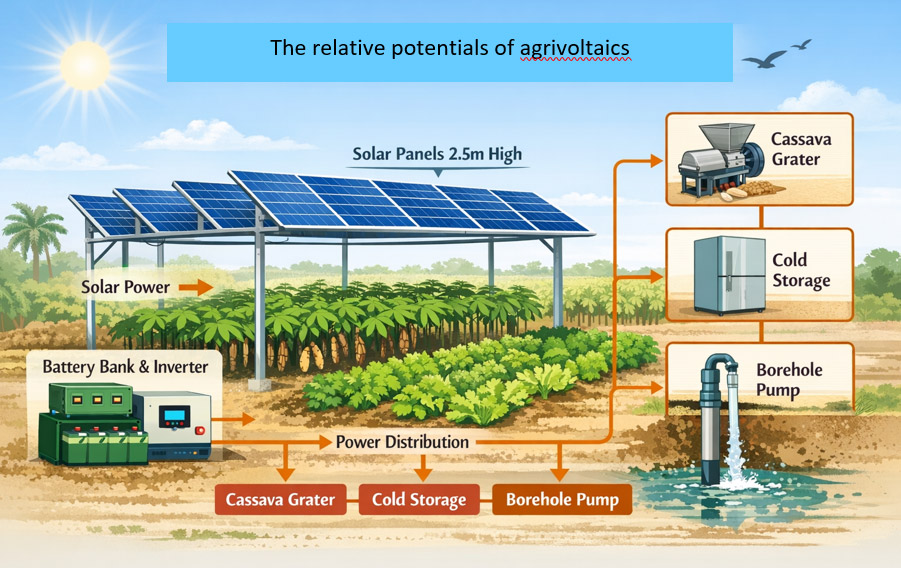
Agrivoltaics Potentials for Food Processing and Water Supply in Rural Electrification-deficient Areas: A Case Study of Anambra Agricultural Zones, Nigeria
Open Access | Research Article | 10 May 2026
Response Surface Methodology Study of the Synergistic Effects of Soaking Pretreatment and Microwave Power on the Proximate Composition of Tiger nut (Cyperus esculentus L.)
Agricultural Science and Food Processing | Volume 3, Issue 2: 73-94, 2026 | DOI: 10.62762/ASFP.2026.613613
Abstract
Despite its nutritional potential, Tiger nut remains under-utilized. This study examined the interactive effects of soaking time (24–72\,h) and microwave power (100–280\,W) on its proximate composition using response surface methodology. Commercial tubers (14.33% moisture) were rehydrated to 38.6–46.8% moisture via soaking and then microwave-dried at 2.45\,GHz. Proximate composition was determined by AOAC methods. Ash, fat and carbohydrate followed linear models (\(p<0.0001\)); fiber followed a two-factor interaction model (\(p<0.0001\)); protein showed quadratic behavior (\(p=0.0006\)). Multi-response optimization identified 48\,h soaking and 190\,W power as optimal (desirability=0.87... More >

Graphical Abstract
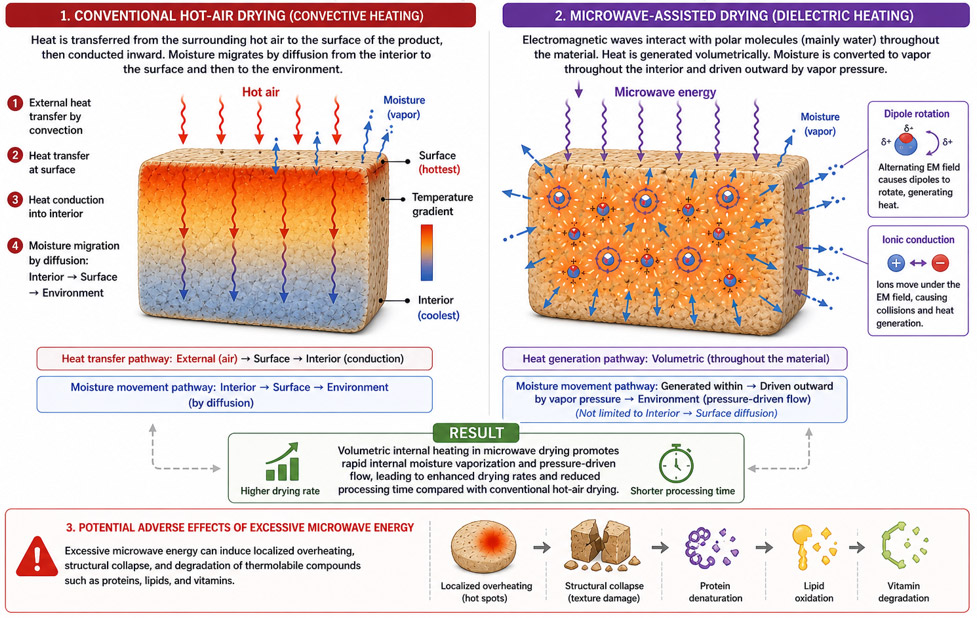
Response Surface Methodology Study of the Synergistic Effects of Soaking Pretreatment and Microwave Power on the Proximate Composition of Tiger nut (Cyperus esculentus L.)
Open Access | Review Article | 08 December 2025 | Cited: Crossref logo  3 , Scopus 2
Prospects of Agrivoltaics as a Sustainable Mitigation Solution to the Nomadic Cattle Rearing Crisis in Nigeria: A Review
Agricultural Science and Food Processing | Volume 2, Issue 4: 148-172, 2025 | DOI: 10.62762/ASFP.2025.763200
Abstract
The ongoing conflict between herdsmen and farmers across different regions in Nigeria over scarce natural resources continues to generate disputes that threaten the lives and property of citizens. The impact of this crisis is now escalating to a level that significantly endangers the country's socio-economic development and overall security. It is essential to explore technological solutions that can sustain both herdsmen and farmers in their respective activities while making the best use of limited land resources. This study investigates the potential of agrivoltaics as a strategy to address Nigeria's nomadic cattle rearing challenges. A review of existing literature was conducted on the s... More >

Graphical Abstract
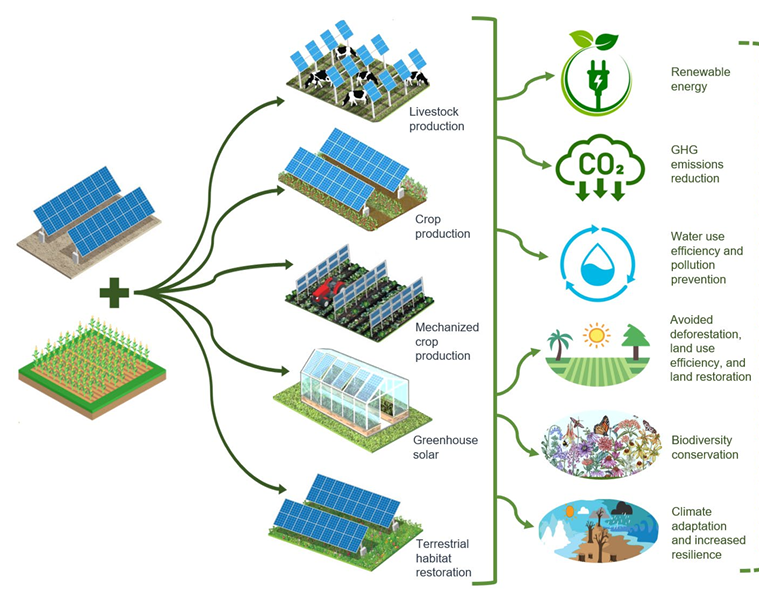
Prospects of Agrivoltaics as a Sustainable Mitigation Solution to the Nomadic Cattle Rearing Crisis in Nigeria: A Review