

Agrivoltaics Potentials for Food Processing and Water Supply in Rural Electrification-deficient Areas: A Case Study of Anambra Agricultural Zones, Nigeria



Article Information
Abstract
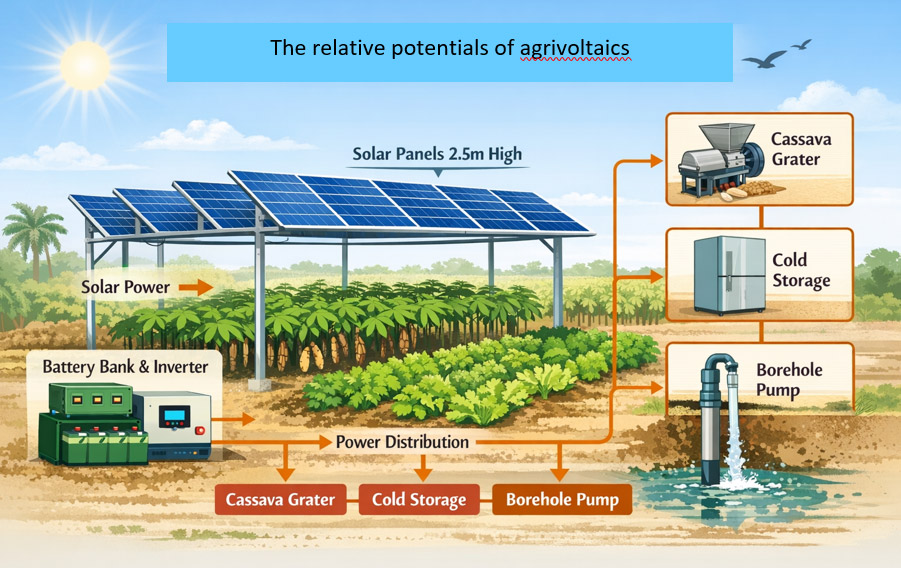
Reliable electricity remains a significant barrier to agricultural productivity in rural Nigeria. This case study investigated the potential of agrivoltaic systems, combining solar energy generation with crop production, to address food processing and water supply challenges in the Anambra State Agricultural Zones. Drawing on the Technology Acceptance Model (TAM), a cross-sectional survey was administered to 845 respondents, of whom 840 returned valid questionnaires, food processors, and water facility operators across 16 communities using probability-proportional-to-size sampling (design effect = 2.0). Descriptive statistics and ordinal logistic regression were used to assess perceptions and associations. Results showed strong agreement that agrivoltaic systems could reduce post-harvest losses (mean = 4.2) and improve water pumping consistency (mean = 4.5). Ordinal logistic regression revealed that willingness to adopt agricultural systems was significantly associated with higher perceived improvements in food processing (OR = 1.42, p < 0.01) and water supply (OR = 1.53, p < 0.01). Major barriers included high upfront costs, land tenure insecurity (42% of respondents do not hold family-owned land titles, relying instead on communal, rental, or informal arrangements), and concerns about panel damage from heavy rains and winds (mean = 4.18) as well as battery replacement costs (mean = 2.34). A simplified levelized cost of energy (LCOE) comparison found solar agricultural systems (\textnaira 80/kWh) substantially cheaper than diesel generators (\textnaira 736/kWh). All regression findings are associational, not causal, due to potential reverse causality and omitted variable bias. As a case study of Anambra's humid tropical zone, findings are not directly generalizable to semi-arid or Sahelian regions. Recommendations include government-subsidized pilot projects, community-based land tenure agreements, and local technical training.
Graphical Abstract
Keywords
Data Availability Statement
Funding
Conflicts of Interest
AI Use Statement
Ethical Approval and Consent to Participate
References
- Ezeh, M. C., Nwogwugwu, U. C. C., & Ezindu, O. N. (2020). Impact of household electricity consumption on standard of living in Nigeria. Journal of Energy Technologies and Policy, 10(1), 47-60.
[CrossRef] [Google Scholar] - Ogunleye, E. K. (2016). Political economy of Nigerian power sector reform. In The Political Economy of Clean Energy Transitions (pp. 239–254). Oxford University Press. https://www.econstor.eu/bitstream/10419/146201/1/852459440.pdf
[Google Scholar] - Olaniyan, K., McLellan, B. C., Ogata, S., & Tezuka, T. (2018). Estimating residential electricity consumption in Nigeria to support energy transitions. Sustainability, 10(5), 1440.
[CrossRef] [Google Scholar] - Onohwakpo, E. A., & Stanfast, B. S. (2022). Analyzing the economic impact of power supply instability on small and medium enterprises in Nigeria. Research Journal of Management Practice, 2(3), 69–94.
[CrossRef] [Google Scholar] - Rahman, S., & Chima, C. D. (2016). Determinants of food crop diversity and profitability in southeastern Nigeria: A multivariate Tobit approach. Agriculture, 6(2), 14.
[CrossRef] [Google Scholar] - Amissah, J. G. N., Adjei, M. Y. B., Amissah, J. N., Asem, F. E., & Kolog, J. D. (2025). Processing, preservation, and value addition of indigenous food crops in West Africa. Frontiers in Sustainable Food Systems, 9, 1657056.
[CrossRef] [Google Scholar] - Umenzekwe, P. C., Ochije, O. O., & Okenewa, O. (2025). Power supply and growth of small and medium enterprises (SMEs) in Awka South, Anambra State, Nigeria. International Journal of Social Sciences and Management Research, 11(3), 265–286. https://iiardjournals.org/get/IJSSMR/VOL.%2011%20NO.%203%202025/Power%20Supply%20and%20Growth%20265-286.pdf
[Google Scholar] - Adejumo, O., Adebola Ikudayisi, A., Omotosho, A. O., & Aderonke, O. (2025). From manual to machine: profitability and adoption of post-harvest processing technologies among cassava processors in Nigeria. Discover Agriculture, 3(1), 279.
[CrossRef] [Google Scholar] - David, T. (2024). A Comprehensive Review of Traditional Food Processing Methods and Their Effects on Food Security. International Journal of Agricultural and Life Sciences, 10(3), 440-443.
[CrossRef] [Google Scholar] - Mishra, R. K. (2023). Fresh Water availability and Its Global challenge. British Journal of Multidisciplinary and Advanced Studies, 4(3), 1-78.
[CrossRef] [Google Scholar] - Gnimadi, C. J. I., Gawou, K., Aboah, M., Owiredu, E. O., & Adusei-Gyamfi, J. (2024). Assessing the influence of hand-dug well features and management on water quality. Environmental Health Insights, 18, 11786302241249844.
[CrossRef] [Google Scholar] - Osayande, A. D., & Umukoro, I. A. (2025). Water Quality Assessment of Hand Dug Wells, Boreholes and Surface Water in Sobe, Edo State and Hand Dug Wells in Elegbeka, Ondo State, Nigeria. Journal of Geography, Environment and Earth Science International, 29(4), 22-66. https://dx.doi.org/10.9734/jgeesi/2025/v29i4878
[Google Scholar] - Anyene, C. C., Udorah, D. O., Nsofor, P. S., & Nwakuba, N. R. (2025). Prospects of agrivoltaics as a sustainable mitigation solution to the nomadic cattle rearing crisis in Nigeria: A review. Agricultural Science and Food Processing, 2(4), 148–172.
[CrossRef] [Google Scholar] - Favi, S. G., Adamou, R., Godjo, T., Giri, N. C., Kuleape, R., & Trommsdorff, M. (2024). Agrivoltaic systems offer symbiotic benefits across the water-energy-food-environment nexus in West Africa: A systematic review. Energy Research & Social Science, 117, 103737.
[CrossRef] [Google Scholar] - Sarr, A., Soro, Y. M., Diop, L., Tossa, A. K., & Samayouga, P. R. C. (2025). Agrivoltaics for sustainable energy and food production in West Africa: Profitability assessment of configurations variation (Case of Burkina Faso). Sustainability, 17(23), 10468.
[CrossRef] [Google Scholar] - Cinderby, S., Parkhill, K. A., Langford, S., & Muhoza, C. (2024). Harnessing the sun for agriculture: Pathways to the successful expansion of Agrivoltaic systems in East Africa. Energy Research & Social Science, 116, 103657.
[CrossRef] [Google Scholar] - Okwaro, J., Feistel, U., & Kettner, S. (2026). A systematic review on the role of agrivoltaics in enhancing crop productivity, livelihoods, and land-use efficiency within smallholder farming systems in Africa. Research Square.
[CrossRef] [Google Scholar] - El-Rufai, S., Barnes, N., & Tiwary, A. Agrivoltaics in Nigeria: Exploring Opportunities and Farmers’ Perceptions. Available at SSRN 4987924. https://dx.doi.org/10.2139/ssrn.4987924
[Google Scholar] - Widmer, J., Christ, B., Grenz, J., & Norgrove, L. (2024). Agrivoltaics, a promising new tool for electricity and food production: A systematic review. Renewable and Sustainable Energy Reviews, 192, 114277.
[CrossRef] [Google Scholar] - Fraunhofer Institute for Solar Energy Systems ISE. (2022). Agrivoltaics: Opportunities for agriculture and energy transition. Fraunhofer ISE. https://www.ise.fraunhofer.de/en/key-topics/integrated-photovoltaics/agrivoltaics.html
[Google Scholar] - Walston, L. J., Barley, T., Bhandari, I., Campbell, B., McCall, J., Hartmann, H. M., & Dolezal, A. G. (2022). Opportunities for agrivoltaic systems to achieve synergistic food-energy-environmental needs and address sustainability goals. Frontiers in sustainable food systems, 6, 932018.
[CrossRef] [Google Scholar] - Alharbi, S., Felemban, A., Abdelrahim, A., & Al-Dakhil, M. (2024). Agricultural and Technology-based strategies to improve water-use efficiency in Arid and Semiarid areas. Water, 16(13), 1842.
[CrossRef] [Google Scholar] - Ghasemi, S., & Sadeghkhani, I. (2025). Toward sustainable energy‐agriculture synergies: a review of agrivoltaics systems for modern farming practices. Solar RRL, 9(11), 2500041.
[CrossRef] [Google Scholar] - Babarinde, I. E., Salisu, B., Benavides, J., Pereira, E., Grodsky, S. M., & Almeida, R. M. (2026). Geospatial assessment of agrivoltaic opportunities and land use requirements in Nigeria. Scientific Reports.
[CrossRef] [Google Scholar] - Akanbi, M. B., Banjoko, I. K., Adedotun, K. J., & Raji, A. K. (2024). AI-powered smart irrigation systems and solar energy integration: A sustainable approach to enhancing agricultural productivity in Nigeria. Journal of Renewable Agricultural Technology Research, 6(1), 156–170. https://ssaapublications.com/index.php/sjratr/article/view/330
[Google Scholar] - Durga, N., Schmitter, P., Ringler, C., Mishra, S., Magombeyi, M. S., Ofosu, A., ... & Matambo, C. (2024). Barriers to the uptake of solar-powered irrigation by smallholder farmers in sub-saharan Africa: A review. Energy Strategy Reviews, 51, 101294.
[CrossRef] [Google Scholar] - Omorogiuwa, E., & Oforji, K. (2019). Cost Analysis of Proposed Solar Photovoltaic Systems Performance for Engineering Faculty, University of PortHarcourt. Journal of Asian Scientific Research, 9(11), 193-203.
[CrossRef] [Google Scholar] - Badda, A. (2025). Technology Acceptance Model (TAM): Literature Review. International Journal of Accounting Finance Auditing Management and Economics, 6(11), 459-492. https://dx.doi.org/10.5281/zenodo.17450768
[Google Scholar] - Chijindu, N. E., Rita, C. N., & Offiah, E. O. (2021). Agripreneurship development among small scale farmers In Anambra State, Nigeria. Journal of Agricultural Extension and Rural Development, 13(4), 273-279.
[CrossRef] [Google Scholar] - Adomi, E. E., Ogbomo, M. O., & Inoni, O. E. (2003). Gender factor in crop farmers’ access to agricultural information in rural areas of Delta State, Nigeria. Library review, 52(8), 388-393.
[CrossRef] [Google Scholar] - Omoja, U. C., Okpalaku, B. N., Uchechukwu, U. N., & Obiekezie, T. N. (2021). Variability of rainfall in Awka, Anambra State Nigeria. IOSR Journal of Applied Physics, 13(4), 50–56.
[CrossRef] [Google Scholar] - Omoja, U. C., Okpalaku, B. N., Uchechukwu, U. N., & Obiekezie, T. N. (2021). Trends of variability of temperature in Awka, Anambra State Nigeria. IOSR Journal of Applied Physics, 13(4), 44–49. https://www.researchgate.net/publication/353767938
[Google Scholar] - Food and Agriculture Organization of the United Nations. (2026). Agricultural season 2022/23 Nigeria: Survey brief (FAO/Andrew Eseibo; 50x2030 Initiative). FAO. https://openknowledge.fao.org/server/api/core/bitstreams/9a43b332-e6d5-4298-979e-2c66df9b3c31/content
[Google Scholar] - Lowder, S. K., Sánchez, M. V., & Bertini, R. (2019). Farms, family farms, farmland distribution and farm labour: What do we know today? (FAO Agricultural Development Economics Working Paper No. 19–08). Food and Agriculture Organization of the United Nations. https://openknowledge.fao.org/server/api/core/bitstreams/e6d7a673-cebd-4be6-9b77-686d50d9171c/content
[Google Scholar] - Lowder, S. K., Bhalla, G., & Davis, B. (2025). Decreasing farm sizes and the viability of smallholder farmers: Implications for resilient and inclusive rural transformation. Global Food Security, 45, 100854.
[CrossRef] [Google Scholar] - Ley, K., Gaines, J., & Ghatikar, A. (2015). The Nigerian energy sector: An overview with a special emphasis on renewable energy, energy efficiency and rural electrification. Deutsche Gesellschaft für Internationale Zusammenarbeit (GIZ) GmbH, Nigerian Energy Support Programme (NESP). https://www.giz.de/en/downloads/giz2015-en-nigerian-energy-sector.pdf
[Google Scholar] - Isibor, C. A., Uchelue, C. S., Nkamigbo, D. C., & Adejoh, S. O. (2024). Analysis of net off-farm income determinants among smallholder rice farmers in Anambra State, Nigeria. International Journal of Agriculture and Earth Science, 10(3), 76–87. https://www.iiardjournals.org/get/IJAES/VOL.%2010%20NO.%203%202024/ANALYSIS%20OF%20NET%20OFF-FARM%2076-87.pdf
[Google Scholar] - Olumba, C. N., Garrod, G., & Areal, F. (2025). Investigating the constraints and mitigation strategies for the adoption of sustainable land management practices in erosion-prone areas of Southeast Nigeria. Environmental Management, 75(6), 1504-1519.
[CrossRef] [Google Scholar] - Igwe, I. E., Ozioko, H. O., Harryson, I. C., Nduka, N. B., & Eze, E. E. (2025). Design of solar photovoltaic system for underground irrigation pumping water for the agricultural farmland in National Root Crops Research Institute, Umudike (NRCRI), Abia State, Nigeria. Journal of Science and Technology, 30(10).
[CrossRef] [Google Scholar] - Babalola, K. Z., Elenga, R. G., & Genovese, P. V. (2025). Energy–economic–environmental (3E) optimization of a hybrid system for a residential building in a developing country: a case of Nigeria. Sustainable Energy Research, 12(1), 66.
[CrossRef] [Google Scholar] - Adesina, L. M., Lawal, J., Ogunbiyi, O., Musa, A., Ojuolape, B. J., Balogun, M. O., & Ariyo, B. O. (2026). Optimization and techno-economic analysis of hybrid renewable systems in Nigeria. TELKOMNIKA (Telecommunication Computing Electronics and Control), 24(1), 343-358. http://doi.org/10.12928/telkomnika.v24i1.27499
[Google Scholar] - National Bureau of Statistics (NBS). (2025). Automotive gas oil (diesel) price watch – June 2025. NBS. https://microdata.nigerianstat.gov.ng/index.php/catalog/158/download/1262/AGO_Report_JUNE_2025.pdf
[Google Scholar] - Effiom, E. U., & Nnabuchi, E. J. (2026). Mathematical Modelling of Hybrid Solar–Wind Energy Systems for Sustainable Rural Electrification in Nigeria: Analytical Formulation and Numerical Simulation. Faculty of Natural and Applied Sciences Journal of Mathematical Modeling and Numerical Simulation, 3(1), 1-17.
[CrossRef] [Google Scholar] - Aliyu, M., Hassan, G., Said, S. A., Siddiqui, M. U., Alawami, A. T., & Elamin, I. M. (2018). A review of solar-powered water pumping systems. Renewable and Sustainable Energy Reviews, 87, 61-76.
[CrossRef] [Google Scholar] - Otubu, A. (2018). The land use act and land administration in 21st century Nigeria: Need for reforms. Journal of Sustainable Development Law and Policy (The), 9(1), 80-108. https://dx.doi.org/10.4314/jsdlp.v9i1.5
[Google Scholar] - Amuda-Kannike, A., Nemi-Clover, F., Jude-Akaraonye, G. O., & Amuda-Kannike, A. (2025). Land tenure, property rights, and commercial development: Examining the tensions between customary law, statutory law, and investment security in Nigeria. NAU Journal of Commercial and Property Law, 12(5), 68–79. https://journals.unizik.edu.ng/index.php/jcpl/article/view/7020
[Google Scholar] - Sanusi, S. O., Madaki, M. J., & David, H. S. (2022). Land Tenure Systems and Agricultural Productivity in Nigeria: A Case of Rice Production. International Journal of Emerging Scientific Research, 3, 23-32.
[CrossRef] [Google Scholar] - Amjad, W., Munir, A., Akram, F., Parmar, A., Precoppe, M., Asghar, F., & Mahmood, F. (2023). Decentralized solar-powered cooling systems for fresh fruit and vegetables to reduce post-harvest losses in developing regions: A review. Clean Energy, 7(3), 635–653.
[CrossRef] [Google Scholar] - Garcia, E. D. S., Quaresma, N., Aemro, Y. B., Coimbra, A. P., & De Almeida, A. T. (2024). Cooling with the sun: Empowering off-grid communities in developing countries with solar-powered cold storage systems. Energy Research & Social Science, 117, 103686.
[CrossRef] [Google Scholar] - Adelhardt, N., & Berneiser, J. (2024). Risk analysis for agrivoltaic projects in rural farming communities in SSA. Applied Energy, 362, 122933.
[CrossRef] [Google Scholar] - Sa’ad, A., Nyoungue, A. C., & Hajej, Z. (2021). Improved preventive maintenance scheduling for a photovoltaic plant under environmental constraints. Sustainability, 13(18), 10472.
[CrossRef] [Google Scholar] - Pandey, G., Lyden, S., Franklin, E., Millar, B., & Harrison, M. T. (2025). A systematic review of agrivoltaics: Productivity, profitability, and environmental co-benefits. Sustainable Production and Consumption, 56, 13-36.
[CrossRef] [Google Scholar] - Rutta, E. W. (2022). Understanding barriers impeding the deployment of solar-powered cold storage technologies for post-harvest tomato losses reduction: Insights from small-scale farmers in Tanzania. Frontiers in Sustainable Food Systems, 6, 990528.
[CrossRef] [Google Scholar]
Cite This Article
TY  - JOUR
AU  - Okpala, Chukwunonso D.
AU  - Anyene, Chinedu C. C.
PY  - 2026
DA  - 2026/06/15
TI  - Agrivoltaics Potentials for Food Processing and Water Supply in Rural Electrification-deficient Areas: A Case Study of Anambra Agricultural Zones, Nigeria
JO  - Agricultural Science and Food Processing
T2  - Agricultural Science and Food Processing
JF  - Agricultural Science and Food Processing
VL  - 3
IS  - 2
SP  - 95
EP  - 119
DO  - 10.62762/ASFP.2026.324107
UR  - https://www.icck.org/article/abs/ASFP.2026.324107
KW  - agrivoltaics
KW  - rural electrification
KW  - food processing
KW  - water supply
KW  - Anambra Agricultural Zones
AB  - Reliable electricity remains a significant barrier to agricultural productivity in rural Nigeria. This case study investigated the potential of agrivoltaic systems, combining solar energy generation with crop production, to address food processing and water supply challenges in the Anambra State Agricultural Zones. Drawing on the Technology Acceptance Model (TAM), a cross-sectional survey was administered to 845 respondents, of whom 840 returned valid questionnaires, food processors, and water facility operators across 16 communities using probability-proportional-to-size sampling (design effect = 2.0). Descriptive statistics and ordinal logistic regression were used to assess perceptions and associations. Results showed strong agreement that agrivoltaic systems could reduce post-harvest losses (mean = 4.2) and improve water pumping consistency (mean = 4.5). Ordinal logistic regression revealed that willingness to adopt agricultural systems was significantly associated with higher perceived improvements in food processing (OR = 1.42, p < 0.01) and water supply (OR = 1.53, p < 0.01). Major barriers included high upfront costs, land tenure insecurity (42% of respondents do not hold family-owned land titles, relying instead on communal, rental, or informal arrangements), and concerns about panel damage from heavy rains and winds (mean = 4.18) as well as battery replacement costs (mean = 2.34). A simplified levelized cost of energy (LCOE) comparison found solar agricultural systems (\textnaira 80/kWh) substantially cheaper than diesel generators (\textnaira 736/kWh). All regression findings are associational, not causal, due to potential reverse causality and omitted variable bias. As a case study of Anambra's humid tropical zone, findings are not directly generalizable to semi-arid or Sahelian regions. Recommendations include government-subsidized pilot projects, community-based land tenure agreements, and local technical training.
SN  - 3066-1579
PB  - Institute of Central Computation and Knowledge
LA  - English
ER  -
@article{Okpala2026Agrivoltai,
  author = {Chukwunonso D. Okpala and Chinedu C. C. Anyene},
  title = {Agrivoltaics Potentials for Food Processing and Water Supply in Rural Electrification-deficient Areas: A Case Study of Anambra Agricultural Zones, Nigeria},
  journal = {Agricultural Science and Food Processing},
  year = {2026},
  volume = {3},
  number = {2},
  pages = {95-119},
  doi = {10.62762/ASFP.2026.324107},
  url = {https://www.icck.org/article/abs/ASFP.2026.324107},
  abstract = {Reliable electricity remains a significant barrier to agricultural productivity in rural Nigeria. This case study investigated the potential of agrivoltaic systems, combining solar energy generation with crop production, to address food processing and water supply challenges in the Anambra State Agricultural Zones. Drawing on the Technology Acceptance Model (TAM), a cross-sectional survey was administered to 845 respondents, of whom 840 returned valid questionnaires, food processors, and water facility operators across 16 communities using probability-proportional-to-size sampling (design effect = 2.0). Descriptive statistics and ordinal logistic regression were used to assess perceptions and associations. Results showed strong agreement that agrivoltaic systems could reduce post-harvest losses (mean = 4.2) and improve water pumping consistency (mean = 4.5). Ordinal logistic regression revealed that willingness to adopt agricultural systems was significantly associated with higher perceived improvements in food processing (OR = 1.42, p < 0.01) and water supply (OR = 1.53, p < 0.01). Major barriers included high upfront costs, land tenure insecurity (42\% of respondents do not hold family-owned land titles, relying instead on communal, rental, or informal arrangements), and concerns about panel damage from heavy rains and winds (mean = 4.18) as well as battery replacement costs (mean = 2.34). A simplified levelized cost of energy (LCOE) comparison found solar agricultural systems (\textnaira 80/kWh) substantially cheaper than diesel generators (\textnaira 736/kWh). All regression findings are associational, not causal, due to potential reverse causality and omitted variable bias. As a case study of Anambra's humid tropical zone, findings are not directly generalizable to semi-arid or Sahelian regions. Recommendations include government-subsidized pilot projects, community-based land tenure agreements, and local technical training.},
  keywords = {agrivoltaics, rural electrification, food processing, water supply, Anambra Agricultural Zones},
  issn = {3066-1579},
  publisher = {Institute of Central Computation and Knowledge}
}
Article Metrics
Publisher's Note
ICCK stays neutral with regard to jurisdictional claims in published maps and institutional affiliations.
Rights and Permissions
 Copyright © 2026 by the Author(s). Published by Institute of Central Computation and Knowledge. This article is an open access article distributed under the terms and conditions of the Creative Commons Attribution (CC BY) license (https://creativecommons.org/licenses/by/4.0/), which permits use, sharing, adaptation, distribution and reproduction in any medium or format, as long as you give appropriate credit to the original author(s) and the source, provide a link to the Creative Commons licence, and indicate if changes were made.


Portico
