Effects of Precipitation Methods on Protease Yield and Proteolytic Activities of Protease Enzyme from Different Maturity Stages of Starfruit (Averrhoa Carambola)



Article Information
Abstract
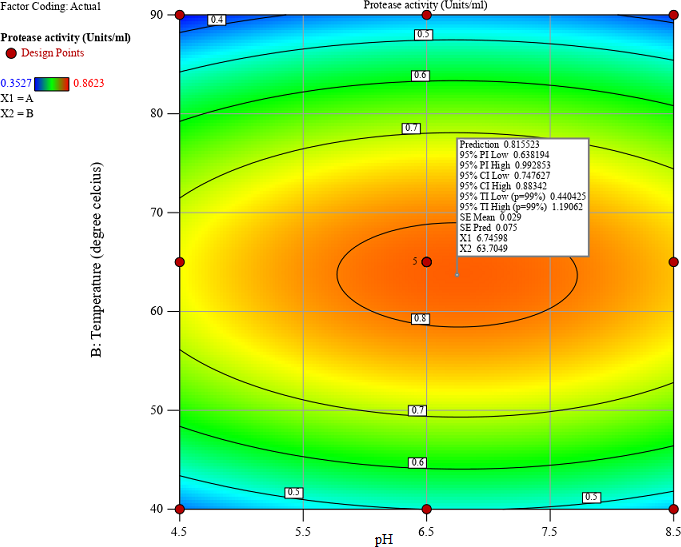
This study investigates the impact of three precipitation methods—ammonium sulfate (40%), acetone, and acetone with trichloroacetic acid (TCA)—on the yield and activity of protease extracted from Averrhoa carambola (starfruit) at different maturity stages (unripe, semi-ripe, and ripe). Response surface methodology (RSM) was used to optimize hydrolysis conditions, focusing on temperature and pH. Proteases were incubated in buffers ranging from pH 3.5 to 8.5 and at temperatures between 40°C and 90°C, and their proteolytic activity was assessed. Storage stability was monitored over 7 days at <4°C. Ammonium sulfate (40%) yielded the highest proteolytic activity (PA), especially at the unripe stage (0.34 units). In contrast, acetone with TCA gave the highest specific activity (up to 2.38 U/mg at the ripe stage), indicating more efficient enzymes despite lower total ield. Acetone precipitation showed intermediate results. Optimal activity (0.862 units/mL) was achieved at 65°C and pH 6.5. A significant decline in activity occurred during storage at <4°C. These results highlight the need to balance total activity and enzyme efficiency when selecting extraction methods. Overall, ammonium sulfate is most effective for higher yield at the unripe stage, while acetone with TCA excels in specific activity for efficiency-driven applications.
Graphical Abstract
Keywords
Data Availability Statement
Funding
Conflicts of Interest
Ethical Approval and Consent to Participate
References
- Cho, K. J., Kim, M. U., Jeong, G. J., Khan, F., Jo, D. M., & Kim, Y. M. (2024). Optimization of Protease Treatment Conditions for Chlorella pyrenoidosa Protein Extraction and Investigation of Its Potential as an Alternative Protein Source. Foods, 13(3), 366.
[CrossRef] [Google Scholar] - Neurath, H. (1964). Protein-digesting enzymes. Scientific American, 211(6), 68-79.
[Google Scholar] - Gurumallesh, P., Alagu, K., Ramakrishnan, B., & Muthusamy, S. (2019). A systematic reconsideration on proteases. International journal of biological macromolecules, 128, 254-267.
[CrossRef] [Google Scholar] - Sumantha, A., Deepa, P., Sandhya, C., Szakacs, G., Soccol, C. R., & Pandey, A. (2006). Rice bran as a substrate for proteolytic enzyme production. Brazilian archives of biology and technology, 49, 843-851.
[CrossRef] [Google Scholar] - Kumari, A., Kaur, B., Srivastava, R., & Sangwan, R. S. (2015). Isolation and immobilization of alkaline protease on mesoporous silica and mesoporous ZSM-5 zeolite materials for improved catalytic properties. Biochemistry and biophysics reports, 2, 108-114.
[CrossRef] [Google Scholar] - Gonzalez-Rabade, N., Badillo-Corona, J. A., Aranda-Barradas, J. S., & del Carmen Oliver-Salvador, M. (2011). Production of plant proteases in vivo and in vitro—a review. Biotechnology advances, 29(6), 983-996.
[CrossRef] [Google Scholar] - Ward, O. (2011). Proteases. Comprehensive biotechnology 571.
[Google Scholar] - Melim Miguel, A. S., Martins-Meyer, T. S., da Costa Figueiredo, E. V., Paulo-Lobo, P. W., & Dellamora-Ortiz, G. M. (2013). Enzymes in bakery: current and future trends.Food industry, 287-321.
[Google Scholar] - Ramundo, J., & Gray, M. (2008). Enzymatic wound debridement. Journal of Wound Ostomy & Continence Nursing, 35(3), 273-280.
[CrossRef] [Google Scholar] - Azarkan, M., El Moussaoui, A., Van Wuytswinkel, D., Dehon, G., & Looze, Y. (2003). Fractionation and purification of the enzymes stored in the latex of Carica papaya. Journal of Chromatography B, 790(1-2), 229-238.
[CrossRef] [Google Scholar] - Ismail, N., & Kharoe, M. (2013). Extraction and partial purification of protease from bilimbi (Averrhoa bilimbi L.). Scientific Research Journal, 10(2), 29-49.
[Google Scholar] - Rachana, C. R., & Jose, V. (2014). Three phase partitioning-a novel protein purification method. International Journal of ChemTech Research, 6(7), 3467-3472.
[Google Scholar] - Simpson, D. M., & Beynon, R. J. (2010). Acetone precipitation of proteins and the modification of peptides. Journal of proteome research, 9(1), 444-450.
[CrossRef] [Google Scholar] - Tartaglia, M. (2024). Extraction of Proteins from Green Tissues of Plants and Phyllosphere. In Metaproteomics: Methods and Protocols (pp. 41-47). New York, NY: Springer US.
[CrossRef] [Google Scholar] - Wingfield, P. (1998). Protein precipitation using ammonium sulfate. Current protocols in protein science, 13(1), A-3F.
[CrossRef] [Google Scholar] - Niu, L., Zhang, H., Wu, Z., Wang, Y., Liu, H., Wu, X., & Wang, W. (2018). Modified TCA/acetone precipitation of plant proteins for proteomic analysis. PloS one, 13(12), e0202238.
[CrossRef] [Google Scholar] - Muthu, N., Lee, S. Y., Phua, K. K., & Bhore, S. J. (2016). Nutritional, medicinal and toxicological attributes of star-fruits (Averrhoa carambola L.): a review. Bioinformation, 12(12), 420.
[CrossRef] [Google Scholar] - Lakmal, K., Yasawardene, P., Jayarajah, U., & Seneviratne, S. L. (2021). Nutritional and medicinal properties of Star fruit (Averrhoa carambola): A review. Food Science & Nutrition, 9(3), 1810-1823.
[CrossRef] [Google Scholar] - Paull, R. E., & Duarte, O. (2012). Other tropical Asian and Pacific fruit. In Tropical fruits, Volume 2 (pp. 255-301). Wallingford UK: CABI.
[Google Scholar] - Mokji, M. B. M. (2009). Features Contruction for Starfruit Quality Inspection. PhD Thesis.
[Google Scholar] - Song, P., Zhang, X., Wang, S., Xu, W., Wang, F., Fu, R., & Wei, F. (2023). Microbial proteases and their applications. Frontiers in microbiology, 14, 1236368.
[CrossRef] [Google Scholar] - Setyabudi, D. A. (2022, May). Postharvest physiology and technology of tropical fruits (Indonesia). In IOP Conference Series: Earth and Environmental Science (Vol. 1024, No. 1, p. 012052). IOP Publishing.
[CrossRef] [Google Scholar] - Gul, A., Siddiqui, M., Arain, H., Khan, S., Khan, H., & Ishrat, U. (2021). Extraction, partial purification and characterization of bromelain from pineapple (Ananas Comosus) crown, core and peel waste. Brazilian Archives of Biology and Technology, 64, e21200639.
[CrossRef] [Google Scholar] - He, N., Li, Q., Sun, D., & Ling, X. (2008). Isolation, purification and characterization of superoxide dismutase from garlic. Biochemical Engineering Journal, 38(1), 33-38.
[CrossRef] [Google Scholar] - Li, X., Kuchinski, L. M., Park, A., Murphy, G. S., Soto, K. C., & Schuster, B. S. (2024). Enzyme purification and sustained enzyme activity for pharmaceutical biocatalysis by fusion with phase‐separating intrinsically disordered protein. Biotechnology and Bioengineering, 121(10), 3155-3168.
[CrossRef] [Google Scholar] - Gomaa, A. (2018). Application of enzymes in brewing. J. Nutr. Food Sci. Forecast, 1(5).
[Google Scholar] - Satpathy, L., Dash, D., Sahoo, P., Anwar, T. S., & Parida, S. P. (2020). Quantitation of total protein content in some common edible food sources by lowry protein assay. Letters in Applied NanoBioScience, 9(3), 1275-1283.
[CrossRef] [Google Scholar] - Normah, I., & Asmah, A. H. (2016). Characterization of green mussel (Perna viridis) hydrolysate prepared using alcalase and starfruit (Averrhoa carambola. L) protease. International Food Research Journal, 23(4).
[Google Scholar] - Ismail, N., & Zainuddin, E. Z. (2015). Effects of precipitation methods on the properties of protease extracted from starfruit (Averrhoa carambola L.) of different maturity index. Scientific Research Journal, 12(1), 11-23.
[Google Scholar] - Corzo, C. A., Waliszewski, K. N., & Welti-Chanes, J. (2012). Pineapple fruit bromelain affinity to different protein substrates. Food Chemistry, 133(3), 631-635.
[CrossRef] [Google Scholar] - Banik, S., Biswas, S., & Karmakar, S. (2018). Extraction, purification, and activity of protease from the leaves of Moringa oleifera. F1000Research, 7, 1151.
[CrossRef] [Google Scholar] - El‐Beltagy, A. E., El‐Adawy, T. A., Rahma, E. H., & El‐Bedawey, A. A. (2005). Purification and characterization of an alkaline protease from the viscera of bolti fish (Tilapia nilotica). Journal of food biochemistry, 29(5), 445-458.
[CrossRef] [Google Scholar] - Chaurasiya, R. S., & Hebbar, H. U. (2013). Extraction of bromelain from pineapple core and purification by RME and precipitation methods. Separation and Purification Technology, 111, 90-97.
[CrossRef] [Google Scholar] - Onat, S., & Savaş, E. (2019). Immobilization and characterization of β-glucosidase from gemlik olive (Olea europea l.) responsible for hydrolization of oleuropein.
[Google Scholar] - Koak, J. H., Kim, H. S., Choi, Y. J., Baik, M. Y., & Kim, B. Y. (2011). Characterization of a protease from over-matured fruits and development of a tenderizer using an optimization technique. Food Science and Biotechnology, 20, 485-490.
[CrossRef] [Google Scholar] - Vallés, D., Furtado, S., & Cantera, A. M. B. (2007). Characterization of news proteolytic enzymes from ripe fruits of Bromelia antiacantha Bertol.(Bromeliaceae). Enzyme and Microbial Technology, 40(3), 409-413.
[CrossRef] [Google Scholar]
Cited By (2)
-
Yufei Yang, Huijun Ma, Dongpei Wang, Ziyou Jiang, Xinyue Wang, Yujing Zhao, Ruiheng Li, Chunming Xu. Rational design for improved thermostability of methionine adenosyltransferase based on FoldX, Rosetta, and multidimensional virtual screening.
Food Research International, 2026 , 239 .
[CrossRef] -
Weiwei Jiang, Junwei Yuan, Ziting Zhang, Yifan Gu, Sheng Tao, Xiaoyu Liu, Peng Wang, Kuo He, Haifen Wang, Yao Tang, Yuqian Jiang. Surface-interior browning differentiation in chestnut kernels across maturation: Insights from integrated transcriptomic and metabolomic profiling.
Food Bioscience, 2026 , 82 .
[CrossRef]
Cite This Article
TY  - JOUR
AU  - Adhikari, Niraj
AU  - Paudel, Rama
AU  - Maskey, Bunty
PY  - 2025
DA  - 2025/03/31
TI  - Effects of Precipitation Methods on Protease Yield and Proteolytic Activities of Protease Enzyme from Different Maturity Stages of Starfruit (Averrhoa Carambola)
JO  - Agricultural Science and Food Processing
T2  - Agricultural Science and Food Processing
JF  - Agricultural Science and Food Processing
VL  - 2
IS  - 1
SP  - 56
EP  - 67
DO  - 10.62762/ASFP.2025.993704
UR  - https://www.icck.org/article/abs/ASFP.2025.993704
KW  - starfruit
KW  - maturity stages
KW  - precipitation methods
KW  - proteolytic activity
KW  - specific activity
AB  - This study investigates the impact of three precipitation methods—ammonium sulfate (40%), acetone, and acetone with trichloroacetic acid (TCA)—on the yield and activity of protease extracted from Averrhoa carambola (starfruit) at different maturity stages (unripe, semi-ripe, and ripe). Response surface methodology (RSM) was used to optimize hydrolysis conditions, focusing on temperature and pH. Proteases were incubated in buffers ranging from pH 3.5 to 8.5 and at temperatures between 40°C and 90°C, and their proteolytic activity was assessed. Storage stability was monitored over 7 days at
SN  - 3066-1579
PB  - Institute of Central Computation and Knowledge
LA  - English
ER  -
@article{Adhikari2025Effects,
  author = {Niraj Adhikari and Rama Paudel and Bunty Maskey},
  title = {Effects of Precipitation Methods on Protease Yield and Proteolytic Activities of Protease Enzyme from Different Maturity Stages of Starfruit (Averrhoa Carambola)},
  journal = {Agricultural Science and Food Processing},
  year = {2025},
  volume = {2},
  number = {1},
  pages = {56-67},
  doi = {10.62762/ASFP.2025.993704},
  url = {https://www.icck.org/article/abs/ASFP.2025.993704},
  abstract = {This study investigates the impact of three precipitation methods—ammonium sulfate (40\%), acetone, and acetone with trichloroacetic acid (TCA)—on the yield and activity of protease extracted from Averrhoa carambola (starfruit) at different maturity stages (unripe, semi-ripe, and ripe). Response surface methodology (RSM) was used to optimize hydrolysis conditions, focusing on temperature and pH. Proteases were incubated in buffers ranging from pH 3.5 to 8.5 and at temperatures between 40°C and 90°C, and their proteolytic activity was assessed. Storage stability was monitored over 7 days at},
  keywords = {starfruit, maturity stages, precipitation methods, proteolytic activity, specific activity},
  issn = {3066-1579},
  publisher = {Institute of Central Computation and Knowledge}
}
Publisher's Note
ICCK stays neutral with regard to jurisdictional claims in published maps and institutional affiliations.
Rights and Permissions
 Copyright © 2025 by the Author(s). Published by Institute of Central Computation and Knowledge. This article is an open access article distributed under the terms and conditions of the Creative Commons Attribution (CC BY) license (https://creativecommons.org/licenses/by/4.0/), which permits use, sharing, adaptation, distribution and reproduction in any medium or format, as long as you give appropriate credit to the original author(s) and the source, provide a link to the Creative Commons licence, and indicate if changes were made.


Portico