

ICCK

Brojo Kishore Mishra

Department of Computer Science & Engineering, NIST University, Berhampur 761008, India

Section 01

Academic Profile

No academic profile information available at the moment.

Section 02

Editorial Roles

This user currently does not serve as an editor for any ICCK journals.

Section 03

ICCK Publications

Open Access | Research Article | 02 September 2026
GenAI-Enhanced Federated Digital Twins for Predictive Resilience in IoT-Enabled Sustainable Smart Infrastructure
Next-Generation Computing Systems and Technologies | Volume 2, Issue 3: 76-88, 2026 | DOI: 10.62762/NGCST.2026.306047
Abstract
This study introduces GenAI-FDT (GenFedTwin Resilience), a decentralized architecture designed to address the growing vulnerability of IoT-enabled smart infrastructures to climate change, particularly in the context of data silos, strict privacy regulations, and the scarcity of ground-truth data for rare catastrophic events such as floods in Maharashtra. Unlike traditional centralized digital twins, which struggle with data heterogeneity and excessive communication costs, the proposed framework integrates quantized diffusion-based Generative AI, semi-supervised federated learning (FedProx), and lightweight LSTM-CNN digital twins deployed on resource-constrained edge devices like Raspberry Pi... More >

Graphical Abstract
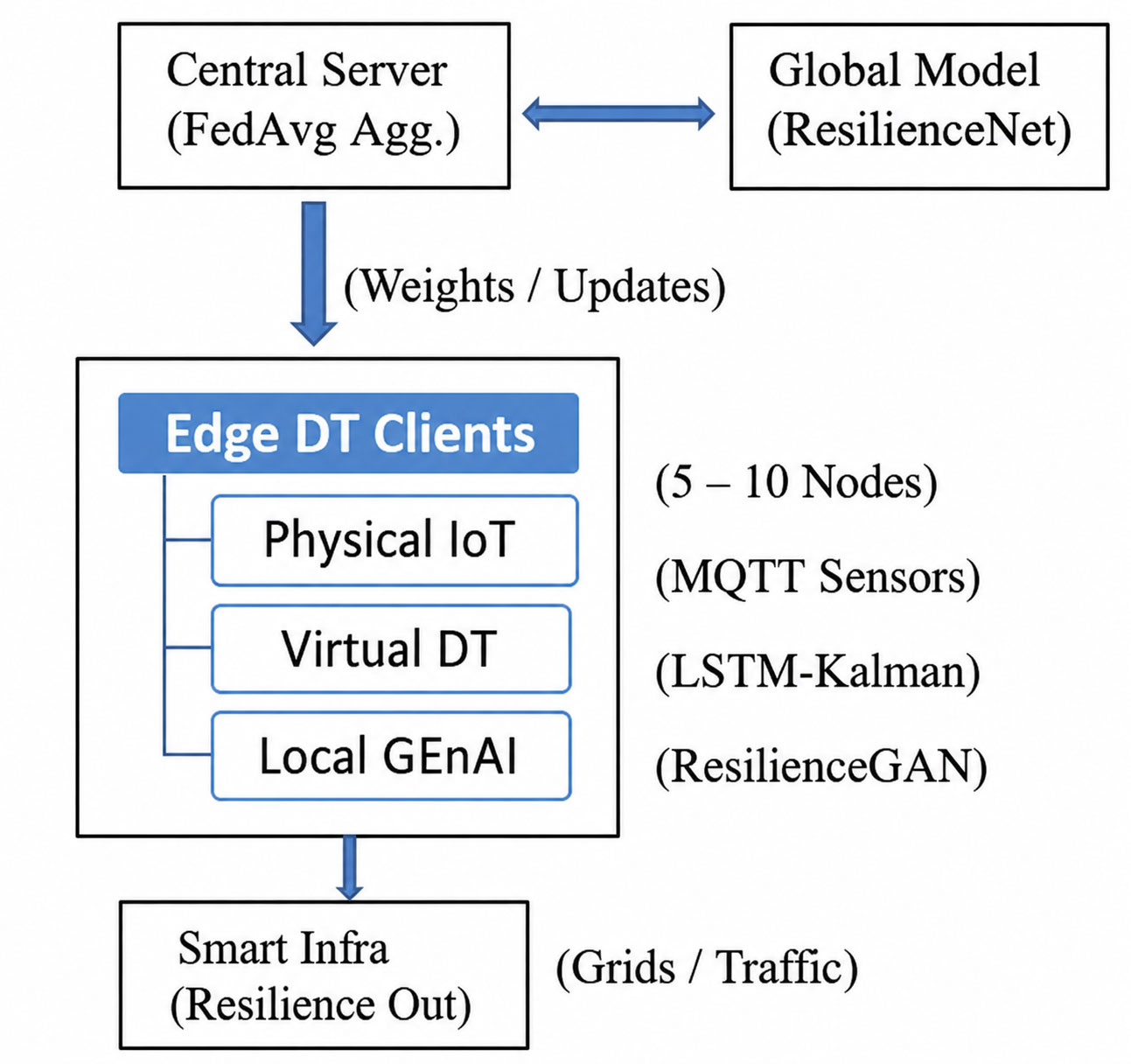
GenAI-Enhanced Federated Digital Twins for Predictive Resilience in IoT-Enabled Sustainable Smart Infrastructure
Open Access | Review Article | 22 December 2025
A Comprehensive Review of Diffusion Models, Gaussian Splatting and Their Integration in Augmented and Virtual Reality
Next-Generation Computing Systems and Technologies | Volume 1, Issue 2: 102-112, 2025 | DOI: 10.62762/NGCST.2025.477710
Abstract
The new progress in text-to-3D technology has greatly changed and improved the artificial intelligence (AI) applications in augmented and virtual reality (AR/VR) environments. Many different techniques in 2024-2025 like diffusion models, Gaussian splatting, and physics aware models have helped the text-to-3D much better by improving the visual fidelity, semantic coherence, and generation efficiency. Some models like Turbo3D, Dive3D and Instant3D are deigned to make the 3D generation faster by improving the working process of diffusion models. Other frameworks like LAYOUTDREAMER, PhiP-G and CompGS focus on creating scenes that are well organized and structured. Dream Reward and Coheren Dream... More >

Graphical Abstract
A Comprehensive Review of Diffusion Models, Gaussian Splatting and Their Integration in Augmented and Virtual Reality