

GenAI-Enhanced Federated Digital Twins for Predictive Resilience in IoT-Enabled Sustainable Smart Infrastructure



Article Information
Abstract
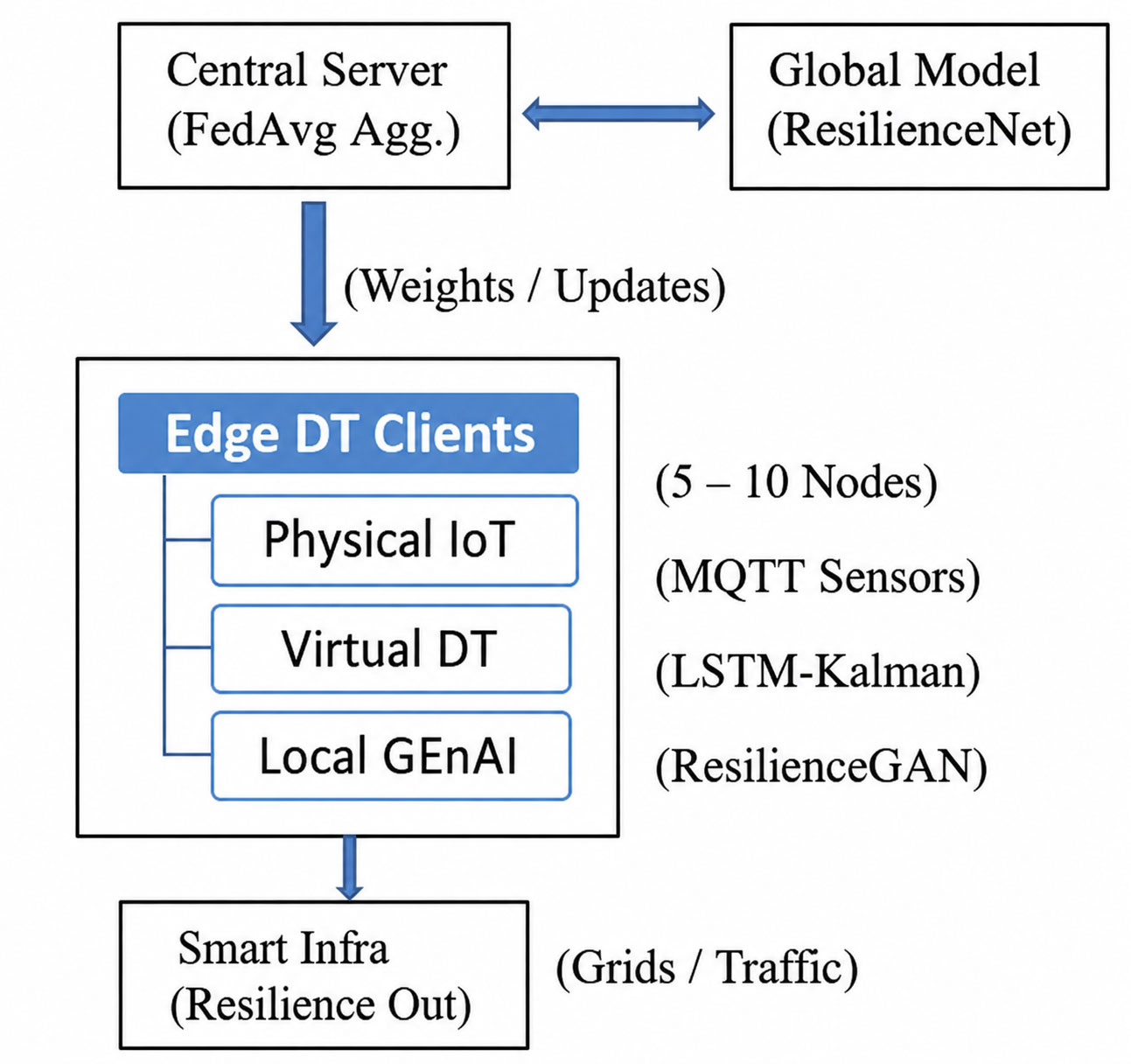
This study introduces GenAI-FDT (GenFedTwin Resilience), a decentralized architecture designed to address the growing vulnerability of IoT-enabled smart infrastructures to climate change, particularly in the context of data silos, strict privacy regulations, and the scarcity of ground-truth data for rare catastrophic events such as floods in Maharashtra. Unlike traditional centralized digital twins, which struggle with data heterogeneity and excessive communication costs, the proposed framework integrates quantized diffusion-based Generative AI, semi-supervised federated learning (FedProx), and lightweight LSTM-CNN digital twins deployed on resource-constrained edge devices like Raspberry Pi using TinyML. Local IoT nodes generate privacy-preserving failure traces from limited real-world data while consuming less than 1mW of inference power, and their model parameters are aggregated via Eclipse Ditto into a global resilience twin, enabling real-time ``what-if'' simulations without reliance on energy-intensive data centers. Empirical evaluations on augmented public datasets with 25% non-IID heterogeneity demonstrate clear advantages over centralized baselines, including a 10% improvement in anomaly detection (F1-score of 92.3) and a marked improvement in predicting infrastructure downtime during disasters. Moreover, the edge-native design yields substantial sustainability gains, reducing energy consumption by 21% compared to vanilla federated learning baselines, with projected CO$_2$ emissions of 12--18g per communication round at 100-node scale. By delivering a robust, low-carbon framework that upholds data sovereignty and supports scalable IoT-Federated Digital Twins for Society~5.0, GenAI-FDT directly advances UN SDG~11, promoting fair and lasting urban resilience while filling critical gaps in the current literature.
Graphical Abstract
Keywords
Data Availability Statement
Funding
Conflicts of Interest
AI Use Statement
Ethical Approval and Consent to Participate
References
- AbdulRahman, S., Otoum, S., Bouachir, O., & Mourad, A. (2023). Management of digital twin-driven IoT using federated learning. IEEE Journal on Selected Areas in Communications, 41(11), 3636-3649.
[CrossRef] [Google Scholar] - Lim, W. Y. B., Luong, N. C., Hoang, D. T., Jiao, Y., Liang, Y. C., Yang, Q., ... & Miao, C. (2020). Federated learning in mobile edge networks: A comprehensive survey. IEEE communications surveys & tutorials, 22(3), 2031-2063.
[CrossRef] [Google Scholar] - AbdulRahman, S., Tout, H., Ould-Slimane, H., Mourad, A., Talhi, C., & Guizani, M. (2020). A survey on federated learning: The journey from centralized to distributed on-site learning and beyond. IEEE Internet of Things Journal, 8(7), 5476-5497.
[CrossRef] [Google Scholar] - Belay, M. A., Rasheed, A., & Rossi, P. S. (2026). Digital Twin-Driven Communication-Efficient Federated Anomaly Detection for Industrial IoT. arXiv preprint arXiv:2601.01701.
[CrossRef] [Google Scholar] - Creswell, A., White, T., Dumoulin, V., Arulkumaran, K., Sengupta, B., & Bharath, A. A. (2018). Generative adversarial networks: An overview. IEEE Signal Processing Magazine, 35(1), 53-65.
[CrossRef] [Google Scholar] - Ramalingam, V., Kumar, B., Gupta, S. K., Alsekait, D. M., & AbdElminaam, D. S. (2026). A hybrid federated learning framework with generative AI for privacy-preserving and sustainable security in IOT-enabled smart environments. Scientific Reports, 16(1), 3071.
[CrossRef] [Google Scholar] - Alatawi, M. N. (2025). EdgeGuard-IoT: 6G-enabled edge intelligence for secure federated learning and adaptive anomaly detection in Industry 5.0. Computers, Materials & Continua, 85(1), 695-727.
[CrossRef] [Google Scholar] - Afolabi, A., Ogunrinde, O., & Zabihollah, A. (2025). Digital Twin and AI Models for Infrastructure Resilience: A Systematic Knowledge Mapping. Applied Sciences, 15(24), 13135.
[CrossRef] [Google Scholar] - Chiaro, D., Qi, P., Pescapè, A., & Piccialli, F. (2025). Generative AI-empowered digital twin: a comprehensive survey with taxonomy. IEEE Transactions on Industrial Informatics, 21(6), 4287-4295.
[CrossRef] [Google Scholar] - Ramu, S. P., Boopalan, P., Pham, Q. V., Maddikunta, P. K. R., Huynh-The, T., Alazab, M., ... & Gadekallu, T. R. (2022). Federated learning enabled digital twins for smart cities: Concepts, recent advances, and future directions. Sustainable Cities and Society, 79, 103663.
[CrossRef] [Google Scholar] - Megía, M., Melero, F. J., Chiachío, M., & Chiachío, J. (2024). Generative adversarial networks for improved model training in the context of the digital twin. Structural Control and Health Monitoring, 2024(1), 9997872.
[CrossRef] [Google Scholar] - McMahan, B., Moore, E., Ramage, D., Hampson, S., & y Arcas, B. A. (2017, April). Communication-efficient learning of deep networks from decentralized data. In Artificial intelligence and statistics (pp. 1273-1282). Pmlr.
[Google Scholar] - Rizwan, A., Ahmad, R., Khan, A. N., Xu, R., & Kim, D. H. (2023). Intelligent digital twin for federated learning in AIoT networks. Internet of Things, 22, 100698.
[CrossRef] [Google Scholar] - Qi, Y., & Hossain, M. S. (2024). Semi-supervised federated learning for digital twin 6G-enabled IIoT: A Bayesian estimated approach. Journal of Advanced Research, 66, 47-57.
[CrossRef] [Google Scholar]
Cite This Article
TY  - JOUR
AU  - Samal, Ajit Kumar
AU  - Mishra, Brojo Kishore
PY  - 2026
DA  - 2026/09/02
TI  - GenAI-Enhanced Federated Digital Twins for Predictive Resilience in IoT-Enabled Sustainable Smart Infrastructure
JO  - Next-Generation Computing Systems and Technologies
T2  - Next-Generation Computing Systems and Technologies
JF  - Next-Generation Computing Systems and Technologies
VL  - 2
IS  - 3
SP  - 76
EP  - 88
DO  - 10.62762/NGCST.2026.306047
UR  - https://www.icck.org/article/abs/NGCST.2026.306047
KW  - digital twins
KW  - federated learning
KW  - generative AI
KW  - IoT infrastructure
KW  - predictive resilience
KW  - sustainable smart cities
AB  - This study introduces GenAI-FDT (GenFedTwin Resilience), a decentralized architecture designed to address the growing vulnerability of IoT-enabled smart infrastructures to climate change, particularly in the context of data silos, strict privacy regulations, and the scarcity of ground-truth data for rare catastrophic events such as floods in Maharashtra. Unlike traditional centralized digital twins, which struggle with data heterogeneity and excessive communication costs, the proposed framework integrates quantized diffusion-based Generative AI, semi-supervised federated learning (FedProx), and lightweight LSTM-CNN digital twins deployed on resource-constrained edge devices like Raspberry Pi using TinyML. Local IoT nodes generate privacy-preserving failure traces from limited real-world data while consuming less than 1mW of inference power, and their model parameters are aggregated via Eclipse Ditto into a global resilience twin, enabling real-time ``what-if'' simulations without reliance on energy-intensive data centers. Empirical evaluations on augmented public datasets with 25% non-IID heterogeneity demonstrate clear advantages over centralized baselines, including a 10% improvement in anomaly detection (F1-score of 92.3) and a marked improvement in predicting infrastructure downtime during disasters. Moreover, the edge-native design yields substantial sustainability gains, reducing energy consumption by 21% compared to vanilla federated learning baselines, with projected CO$_2$ emissions of 12--18g per communication round at 100-node scale. By delivering a robust, low-carbon framework that upholds data sovereignty and supports scalable IoT-Federated Digital Twins for Society~5.0, GenAI-FDT directly advances UN SDG~11, promoting fair and lasting urban resilience while filling critical gaps in the current literature.
SN  - 3070-3328
PB  - Institute of Central Computation and Knowledge
LA  - English
ER  -
@article{Samal2026GenAIEnhan,
  author = {Ajit Kumar Samal and Brojo Kishore Mishra},
  title = {GenAI-Enhanced Federated Digital Twins for Predictive Resilience in IoT-Enabled Sustainable Smart Infrastructure},
  journal = {Next-Generation Computing Systems and Technologies},
  year = {2026},
  volume = {2},
  number = {3},
  pages = {76-88},
  doi = {10.62762/NGCST.2026.306047},
  url = {https://www.icck.org/article/abs/NGCST.2026.306047},
  abstract = {This study introduces GenAI-FDT (GenFedTwin Resilience), a decentralized architecture designed to address the growing vulnerability of IoT-enabled smart infrastructures to climate change, particularly in the context of data silos, strict privacy regulations, and the scarcity of ground-truth data for rare catastrophic events such as floods in Maharashtra. Unlike traditional centralized digital twins, which struggle with data heterogeneity and excessive communication costs, the proposed framework integrates quantized diffusion-based Generative AI, semi-supervised federated learning (FedProx), and lightweight LSTM-CNN digital twins deployed on resource-constrained edge devices like Raspberry Pi using TinyML. Local IoT nodes generate privacy-preserving failure traces from limited real-world data while consuming less than 1mW of inference power, and their model parameters are aggregated via Eclipse Ditto into a global resilience twin, enabling real-time ``what-if'' simulations without reliance on energy-intensive data centers. Empirical evaluations on augmented public datasets with 25\% non-IID heterogeneity demonstrate clear advantages over centralized baselines, including a 10\% improvement in anomaly detection (F1-score of 92.3) and a marked improvement in predicting infrastructure downtime during disasters. Moreover, the edge-native design yields substantial sustainability gains, reducing energy consumption by 21\% compared to vanilla federated learning baselines, with projected CO\$\_2\$ emissions of 12--18g per communication round at 100-node scale. By delivering a robust, low-carbon framework that upholds data sovereignty and supports scalable IoT-Federated Digital Twins for Society~5.0, GenAI-FDT directly advances UN SDG~11, promoting fair and lasting urban resilience while filling critical gaps in the current literature.},
  keywords = {digital twins, federated learning, generative AI, IoT infrastructure, predictive resilience, sustainable smart cities},
  issn = {3070-3328},
  publisher = {Institute of Central Computation and Knowledge}
}
Article Metrics
Publisher's Note
ICCK stays neutral with regard to jurisdictional claims in published maps and institutional affiliations.
Rights and Permissions
 Copyright © 2026 by the Author(s). Published by Institute of Central Computation and Knowledge. This article is an open access article distributed under the terms and conditions of the Creative Commons Attribution (CC BY) license (https://creativecommons.org/licenses/by/4.0/), which permits use, sharing, adaptation, distribution and reproduction in any medium or format, as long as you give appropriate credit to the original author(s) and the source, provide a link to the Creative Commons licence, and indicate if changes were made.


Portico
