

AI-Powered Detection and Quantification of Local Date Varieties Using YOLO: Toward Intelligent Supply Chain Integration in Agri-Food Technology



Article Information
Abstract
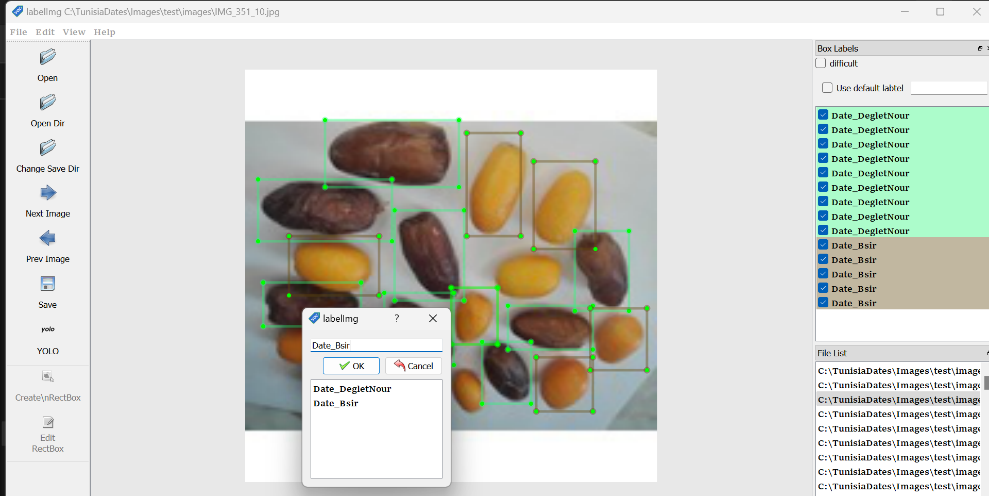
This study presents an AI-powered approach to enhance quality control and traceability in the agri-food sector, focusing on the automated detection and classification of two Tunisian date varieties: Deglet Nour and "Bsir". The main objective is to develop a smart system that can quantitatively and qualitatively determine the proportion of any contamination of one variety by the other within a batch. To achieve this, state-of-the-art object detection YOLO models, v8 and v12, have been employed, trained on a custom annotated dataset which includes a wide range of real-world images, capturing the variability in the studied date fruit size, shape, and presentation. Both YOLO models were fine-tuned over 50 epochs using transfer learning techniques, allowing them to adapt effectively to the specific classification task. Training step consisted of a thorough analysis of bounding box distributions and samples clustering, taking into account natural variations in date morphology based on their 2D images. Evaluation showed that both models achieved high detection accuracy, with YOLOv12 outperforming slightly in precision and speed, making it well-suited for real-time applications. By estimating the relative variety proportions within a mixed batch, the developed smart system supports the intelligent decision-making across the supply chain. This work lays the groundwork for embedding deep learning models into portable smart optical devices that can assess date mixtures on-site, from farms to packaging centers. Future developments will focus on expanding detection to additional date varieties and integrating the system into commercial post-harvest processes.
Graphical Abstract
Keywords
Data Availability Statement
Funding
Conflicts of Interest
Ethical Approval and Consent to Participate
References
- Ben Amara, S., Lakoud, A., Mahmoudi, I., Ben Tekaya, I., Amri, A., Snoussi, A., ... & Hassouna, M. (2024). Optimization of the industrial production process of tunisian date paste for sustainable food systems. Processes, 12(10), 2083.
[CrossRef] [Google Scholar] - Albarrak, K., Gulzar, Y., Hamid, Y., Mehmood, A., & Soomro, A. B. (2022). A deep learning-based model for date fruit classification. Sustainability, 14(10), 6339.
[CrossRef] [Google Scholar] - Dutta, S. K., Bhutia, B., Misra, T., Mishra, V. K., Singh, S. K., & Patel, V. B. (2025). Application and prospects of artificial intelligence (AI)-based technologies in fruit production systems. Applied Fruit Science, 67(1), 16.
[CrossRef] [Google Scholar] - Albahar, M. (2023). A survey on deep learning and its impact on agriculture: Challenges and opportunities. Agriculture, 13(3), 540.
[CrossRef] [Google Scholar] - Kang, H., & Chen, C. (2020). Fast implementation of real-time fruit detection in apple orchards using deep learning. Computers and Electronics in Agriculture, 168, 105108.
[CrossRef] [Google Scholar] - Steinbrener, J., Posch, K., & Leitner, R. (2019). Hyperspectral fruit and vegetable classification using convolutional neural networks. Computers and Electronics in Agriculture, 162, 364-372.
[CrossRef] [Google Scholar] - Gao, X., & Zhang, Y. (2023). Detection of Fruit using YOLOv8-based Single Stage Detectors. International Journal of Advanced Computer Science & Applications, 14(12).
[CrossRef] [Google Scholar] - Hussain, M. (2024). Yolov1 to v8: Unveiling each variant–a comprehensive review of yolo. IEEE Access, 12, 42816-42833.
[CrossRef] [Google Scholar] - Jegham, N., Koh, C. Y., Abdelatti, M., & Hendawi, A. (2024). Yolo evolution: A comprehensive benchmark and architectural review of yolov12, yolo11, and their previous versions. arXiv preprint arXiv:2411.00201.
[Google Scholar] - Jocher, G., Stoken, A., Borovec, J., Chaurasia, A., Changyu, L., Hogan, A., ... & Rai, P. (2020). ultralytics/yolov5: v3.0. Zenodo.
[CrossRef] [Google Scholar] - Fu, Y., Li, W., Li, G., Dong, Y., Wang, S., Zhang, Q., Li, Y., & Dai, Z. (2024). Multi-stage tomato fruit recognition method based on improved YOLOv8. Frontiers in Plant Science, 15, 1447263.
[CrossRef] [Google Scholar] - Tian, Y., Ye, Q., & Doermann, D. (2025). Yolov12: Attention-centric real-time object detectors. arXiv preprint arXiv:2502.12524.
[Google Scholar] - Hassan, E., Ghazalah, S. A., El-Rashidy, N., El-Hafeez, T. A., & Shams, M. Y. (2025). Sustainable deep vision systems for date fruit quality assessment using attention-enhanced deep learning models. Frontiers in Plant Science, 16, 1521508.
[CrossRef] [Google Scholar] - Zarouit, Y., Zekkouri, H., Ouhda, M., & Aksasse, B. (2024). Date fruit detection dataset for automatic harvesting. Data in Brief, 52, 109876.
[CrossRef] [Google Scholar] - Noutfia, Y., Ropelewska, E., Józwiak, Z., & Rutkowski, K. (2024). Non-Destructive Monitoring of External Quality of Date Palm Fruit (Phoenix dactylifera L.) During Frozen Storage Using Digital Camera and Flatbed Scanner. Sensors, 24(23), 7560.
[CrossRef] [Google Scholar] - Sapkota, R., Meng, Z., Churuvija, M., Du, X., Ma, Z., & Karkee, M. (2024). Comprehensive performance evaluation of yolov12, yolo11, yolov10, yolov9 and yolov8 on detecting and counting fruitlet in complex orchard environments. arXiv preprint arXiv:2407.12040.
[Google Scholar] - Ke, H., Li, H., Wang, B., Tang, Q., Lee, Y. H., & Yang, C. F. (2024). Integrations of LabelImg, You Only Look Once (YOLO), and Open Source Computer Vision Library (OpenCV) for Chicken Open Mouth Detection. Sensors & Materials, 36(6).
[CrossRef] [Google Scholar] - Lipiński, S., Sadkowski, S., & Chwietczuk, P. (2025). Application of AI in Date Fruit Detection—Performance Analysis of YOLO and Faster R-CNN Models. Computation, 13(6), 149.
[CrossRef] [Google Scholar] - Almutairi, A., Alharbi, J., Alharbi, S., Alhasson, H. F., Alharbi, S. S., & Habib, S. (2024). Date fruit detection and classification based on its variety using deep learning technology. IEEE Access, 12, 104042-104053.
[CrossRef] [Google Scholar] - Almomen, M., Al-Saeed, M., & Ahmad, H. F. (2023). Date fruit classification based on surface quality using convolutional neural network models. Applied Sciences, 13(13), 7821.
[CrossRef] [Google Scholar] - Dansana, D., Sahoo, S., & Mishra, B. K. (2021). Efficiency and reliability of IoT in smart agriculture. In Internet of Things and Analytics for Agriculture, Volume 3 (pp. 301-327). Singapore: Springer Singapore.
[CrossRef] [Google Scholar] - Ibrahim, D. M., & Elshennawy, N. (2022). Improving Date Fruit Classification Using CycleGAN-Generated Dataset. Computer Modeling in Engineering & Sciences, 131(1), 399-417.
[CrossRef] [Google Scholar]
Cite This Article
TY  - JOUR
AU  - Raboudi, Faten
AU  - Rebai, Olfa
AU  - Amara, Sana Ben
AU  - Fattouch, Tesnim
AU  - Fattouch, Sami
PY  - 2025
DA  - 2025/10/22
TI  - AI-Powered Detection and Quantification of Local Date Varieties Using YOLO: Toward Intelligent Supply Chain Integration in Agri-Food Technology
JO  - Next-Generation Computing Systems and Technologies
T2  - Next-Generation Computing Systems and Technologies
JF  - Next-Generation Computing Systems and Technologies
VL  - 1
IS  - 1
SP  - 33
EP  - 42
DO  - 10.62762/NGCST.2025.936740
UR  - https://www.icck.org/article/abs/NGCST.2025.936740
KW  - AI-ML
KW  - classification
KW  - date fruits
KW  - intelligent detection
KW  - YOLO
AB  - This study presents an AI-powered approach to enhance quality control and traceability in the agri-food sector, focusing on the automated detection and classification of two Tunisian date varieties: Deglet Nour and "Bsir". The main objective is to develop a smart system that can quantitatively and qualitatively determine the proportion of any contamination of one variety by the other within a batch. To achieve this, state-of-the-art object detection YOLO models, v8 and v12, have been employed, trained on a custom annotated dataset which includes a wide range of real-world images, capturing the variability in the studied date fruit size, shape, and presentation. Both YOLO models were fine-tuned over 50 epochs using transfer learning techniques, allowing them to adapt effectively to the specific classification task. Training step consisted of a thorough analysis of bounding box distributions and samples clustering, taking into account natural variations in date morphology based on their 2D images. Evaluation showed that both models achieved high detection accuracy, with YOLOv12 outperforming slightly in precision and speed, making it well-suited for real-time applications. By estimating the relative variety proportions within a mixed batch, the developed smart system supports the intelligent decision-making across the supply chain. This work lays the groundwork for embedding deep learning models into portable smart optical devices that can assess date mixtures on-site, from farms to packaging centers. Future developments will focus on expanding detection to additional date varieties and integrating the system into commercial post-harvest processes.
SN  - 3070-3328
PB  - Institute of Central Computation and Knowledge
LA  - English
ER  -
@article{Raboudi2025AIPowered,
  author = {Faten Raboudi and Olfa Rebai and Sana Ben Amara and Tesnim Fattouch and Sami Fattouch},
  title = {AI-Powered Detection and Quantification of Local Date Varieties Using YOLO: Toward Intelligent Supply Chain Integration in Agri-Food Technology},
  journal = {Next-Generation Computing Systems and Technologies},
  year = {2025},
  volume = {1},
  number = {1},
  pages = {33-42},
  doi = {10.62762/NGCST.2025.936740},
  url = {https://www.icck.org/article/abs/NGCST.2025.936740},
  abstract = {This study presents an AI-powered approach to enhance quality control and traceability in the agri-food sector, focusing on the automated detection and classification of two Tunisian date varieties: Deglet Nour and "Bsir". The main objective is to develop a smart system that can quantitatively and qualitatively determine the proportion of any contamination of one variety by the other within a batch. To achieve this, state-of-the-art object detection YOLO models, v8 and v12, have been employed, trained on a custom annotated dataset which includes a wide range of real-world images, capturing the variability in the studied date fruit size, shape, and presentation. Both YOLO models were fine-tuned over 50 epochs using transfer learning techniques, allowing them to adapt effectively to the specific classification task. Training step consisted of a thorough analysis of bounding box distributions and samples clustering, taking into account natural variations in date morphology based on their 2D images. Evaluation showed that both models achieved high detection accuracy, with YOLOv12 outperforming slightly in precision and speed, making it well-suited for real-time applications. By estimating the relative variety proportions within a mixed batch, the developed smart system supports the intelligent decision-making across the supply chain. This work lays the groundwork for embedding deep learning models into portable smart optical devices that can assess date mixtures on-site, from farms to packaging centers. Future developments will focus on expanding detection to additional date varieties and integrating the system into commercial post-harvest processes.},
  keywords = {AI-ML, classification, date fruits, intelligent detection, YOLO},
  issn = {3070-3328},
  publisher = {Institute of Central Computation and Knowledge}
}
Article Metrics
Publisher's Note
ICCK stays neutral with regard to jurisdictional claims in published maps and institutional affiliations.
Rights and Permissions
 Copyright © 2025 by the Author(s). Published by Institute of Central Computation and Knowledge. This article is an open access article distributed under the terms and conditions of the Creative Commons Attribution (CC BY) license (https://creativecommons.org/licenses/by/4.0/), which permits use, sharing, adaptation, distribution and reproduction in any medium or format, as long as you give appropriate credit to the original author(s) and the source, provide a link to the Creative Commons licence, and indicate if changes were made.


Portico
