

Dynamic Hybrid Recommendation Approach for Improving Accuracy in E-Commerce with Limited User Data




Article Information
Abstract
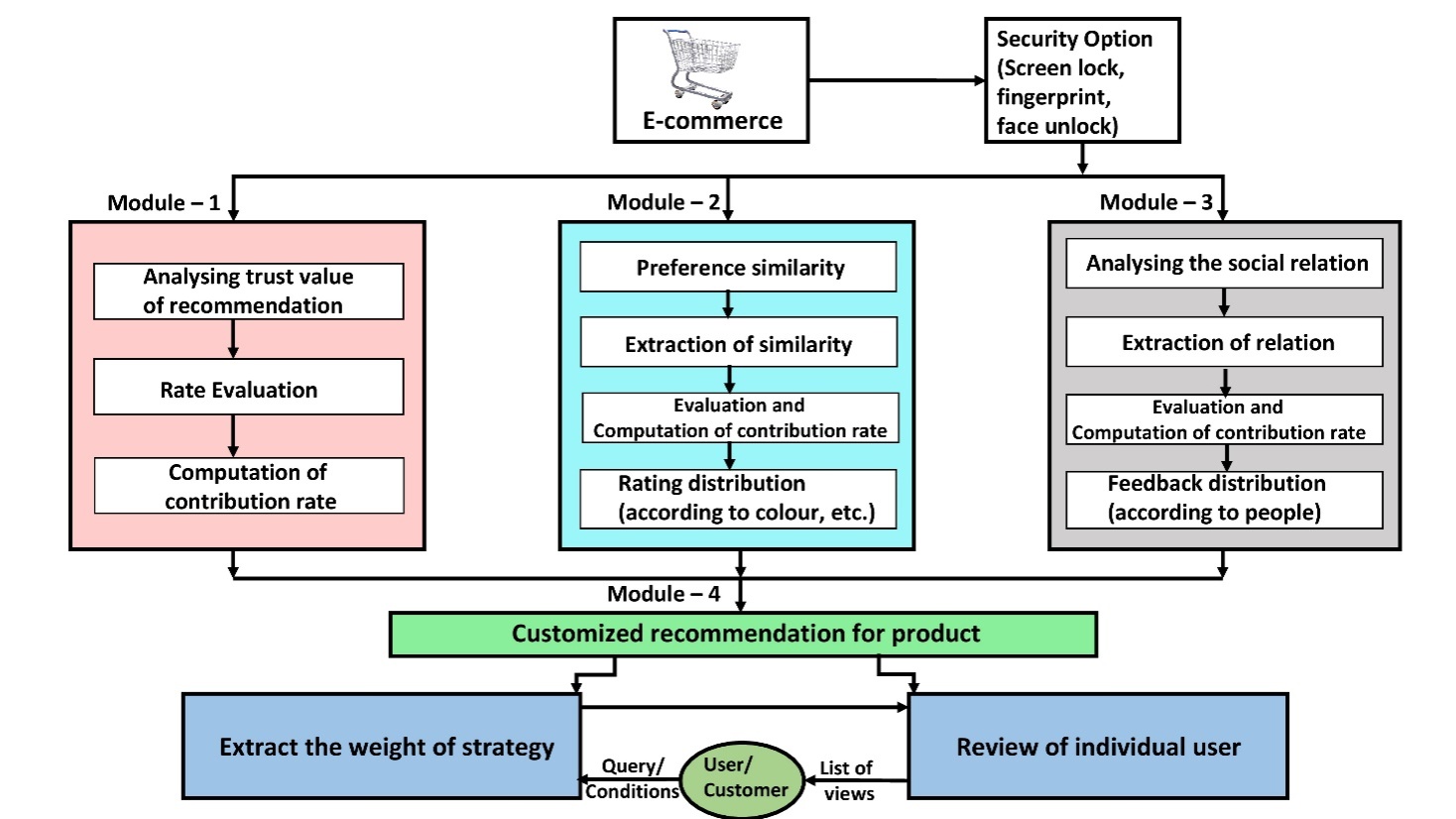
The 'Cold Start' problem, characterized by insufficient transaction history leading to inefficient personalization, represents one of the frequent challenges encountered in e-commerce systems. This issue, along with data sparsity resulting from limited product interactions, further complicates the reliability of conventional recommendation engines. The objective of this research is to design a novel hybridized recommendation system that enhances both security and suggestion accuracy by dynamically adapting to user interactions in digital environments. By leveraging contextual information and sequential user behavior patterns, the proposed method addresses gaps left by traditional recommender systems. A research methodology is employed that integrates context awareness and sequential pattern mining, combining conventional and advanced recommendation techniques within a unified framework. This hybrid strategy tackles challenges posed by Cold Start scenarios while optimizing the use of scarce user interaction data. Preliminary findings indicate that the hybrid approach significantly improves recommendation performance, particularly in settings with limited historical data. By utilizing contextual and sequential information, the proposed system outperforms existing methods in terms of accuracy and personalization. In conclusion, the study demonstrates the effectiveness of hybrid recommendation systems in addressing fundamental e-commerce challenges such as data sparsity and the Cold Start problem. The adaptability of the approach enables accurate predictions without requiring extensive user history. Future research will focus on the scalability of this strategy across diverse e-commerce platforms to deliver more individualized user experiences.
Graphical Abstract
Keywords
Data Availability Statement
Funding
Conflicts of Interest
Ethical Approval and Consent to Participate
References
- Najafabadi, M. K., & Mahrin, M. N. (2016). A systematic literature review on the state of research and practice of collaborative filtering technique and implicit feedback. Artificial Intelligence Review, 45(2), 167–201.
[CrossRef] [Google Scholar] - Ji, Z., Pi, H., Wei, W., Xiong, B., Wozniak, M., & Damasevicius, R. (2019). Recommendation Based on Review Texts and Social Communities: A Hybrid Model. IEEE Access, 7, 40416–40427.
[CrossRef] [Google Scholar] - Scholz, M., Dorner, V., Schryen, G., & Benlian, A. (2017). A configuration-based recommender system for supporting e-commerce decisions. European Journal of Operational Research, 259(1), 205–215.
[CrossRef] [Google Scholar] - Koren, Y., Bell, R., & Volinsky, C. (2009). Matrix factorization techniques for recommender systems. Computer, 42(8), 30-37.
[CrossRef] [Google Scholar] - Covington, P., Adams, J., & Sargin, E. (2016). Deep neural networks for YouTube recommendations. In Proceedings of the 10th ACM conference on recommender systems (pp. 191-198).
[CrossRef] [Google Scholar] - Bobadilla, J., Ortega, F., Hernando, A., & Gutiérrez, A. (2013). Recommender systems survey. Knowledge-Based Systems, 46, 109–132.
[CrossRef] [Google Scholar] - Hwangbo, H., Kim, Y. S., & Cha, K. J. (2018). Recommendation system development for fashion retail e-commerce. Electronic Commerce Research and Applications, 28, 94–101.
[CrossRef] [Google Scholar] - Paradarami, T. K., Bastian, N. D., & Wightman, J. L. (2017). A hybrid recommender system using artificial neural networks. Expert Systems with Applications, 83, 300–313.
[CrossRef] [Google Scholar] - Guo, Y., Liu, Y., Oerlemans, A., Lao, S., Wu, S., & Lew, M. S. (2016). Deep learning for visual understanding: A review. Neurocomputing, 187, 27–48.
[CrossRef] [Google Scholar] - Carmona, C. J., Ramírez-Gallego, S., Torres, F., Bernal, E., Del Jesus, M. J., & García, S. (2012). Web usage mining to improve the design of an e-commerce website: OrOliveSur.com. Expert Systems with Applications, 39(12), 11243–11249.
[CrossRef] [Google Scholar] - Kunaver, M., & Požrl, T. (2017). Diversity in recommender systems – A survey. Knowledge-Based Systems, 123, 154–162.
[CrossRef] [Google Scholar] - Paul, D., Sarkar, S., Chelliah, M., Kalyan, C., & Sinai Nadkarni, P. P. (2017, August). Recommendation of high quality representative reviews in e-commerce. In Proceedings of the eleventh ACM conference on recommender systems (pp. 311-315).
[CrossRef] [Google Scholar] - Burke, R. (2007). Hybrid web recommender systems. The adaptive web: methods and strategies of web personalization, 377-408.
[CrossRef] [Google Scholar] - Jamali, M., & Ester, M. (2010, September). A matrix factorization technique with trust propagation for recommendation in social networks. In Proceedings of the fourth ACM conference on Recommender systems (pp. 135-142).
[CrossRef] [Google Scholar] - Lu, Y., Dong, R., & Smyth, B. (2018). Coevolutionary recommendation model: Mutual learning between ratings and reviews. In Web Conference 2018 - Proceedings of the World Wide Web Conference WWW 2018 (pp. 773–782).
[CrossRef] [Google Scholar] - Kotkov, D., Wang, S., & Veijalainen, J. (2016). A survey of serendipity in recommender systems. Knowledge-Based Systems, 111, 180–192.
[CrossRef] [Google Scholar] - Yin, H., Sun, Y., Cui, B., Hu, Z., & Chen, L. (2013, August). Lcars: a location-content-aware recommender system. In Proceedings of the 19th ACM SIGKDD international conference on Knowledge discovery and data mining (pp. 221-229).
[CrossRef] [Google Scholar] - Chen, J., & Wang, H. (2018). Guest editorial: Big data infrastructure II. IEEE Transactions on Big Data, 4(3), 299-300.
[CrossRef] [Google Scholar] - Zhang, S., Yao, L., Sun, A., & Tay, Y. (2019). Deep learning based recommender system: A survey and new perspectives. ACM computing surveys (CSUR), 52(1), 1-38.
[CrossRef] [Google Scholar] - Lu, J., Wu, D., Mao, M., Wang, W., & Zhang, G. (2015). Recommender system application developments: A survey. Decision Support Systems, 74, 12–32.
[CrossRef] [Google Scholar] - Guan, C., Qin, S., Ling, W., & Ding, G. (2016). Apparel recommendation system evolution: an empirical review. International Journal of Clothing Science and Technology, 28(6), 854-879.
[CrossRef] [Google Scholar] - Kim, D., Park, C., Oh, J., Lee, S., & Yu, H. (2016, September). Convolutional matrix factorization for document context-aware recommendation. In Proceedings of the 10th ACM conference on recommender systems (pp. 233-240).
[CrossRef] [Google Scholar] - Rendle, S., Freudenthaler, C., & Schmidt-Thieme, L. (2010). Factorizing personalized Markov chains for next-basket recommendation. In Proceedings of the 19th international conference on World wide web (pp. 811-820).
[CrossRef] [Google Scholar] - Li, Y. M., Wu, C. T., & Lai, C. Y. (2013). A social recommender mechanism for e-commerce: Combining similarity, trust, and relationship. Decision Support Systems, 55(3), 740–752.
[CrossRef] [Google Scholar] - Shinde, S. K., & Kulkarni, U. (2012). Hybrid personalized recommender system using centering-bunching based clustering algorithm. Expert Systems with Applications, 39(1), 1381–1387.
[CrossRef] [Google Scholar] - Aher, S. B., & Lobo, L. M. R. J. (2013). Combination of machine learning algorithms for recommendation of courses in E-Learning System based on historical data. Knowledge-Based Systems, 51, 1–14.
[CrossRef] [Google Scholar] - Dou, D., Qin, H., & Lependu, P. (2010). OntoGrate: towards automatic integration for relational databases and the semantic web through an ontology-based framework. International Journal of Semantic Computing, 4(01), 123-151.
[CrossRef] [Google Scholar] - Yang, X., Guo, Y., Liu, Y., & Steck, H. (2014). A survey of collaborative filtering based social recommender systems. Computer Communications, 41, 1–10.
[CrossRef] [Google Scholar] - Choi, K., Yoo, D., Kim, G., & Suh, Y. (2012). A hybrid online-product recommendation system: Combining implicit rating-based collaborative filtering and sequential pattern analysis. Electronic Commerce Research and Applications, 11(4), 309–317.
[CrossRef] [Google Scholar] - Tarus, J. K., Niu, Z., & Kalui, D. (2018). A hybrid recommender system for e-learning based on context awareness and sequential pattern mining. Soft Computing, 22(8), 2449–2461.
[CrossRef] [Google Scholar] - Nilashi, M., Ibrahim, O., & Bagherifard, K. (2018). A recommender system based on collaborative filtering using ontology and dimensionality reduction techniques. Expert Systems with Applications, 92, 507–520.
[CrossRef] [Google Scholar] - Lv, J., Song, B., Guo, J., Du, X., & Guizani, M. (2019). Interest-Related Item Similarity Model Based on Multimodal Data for Top-N Recommendation. IEEE Access, 7, 12809–12821.
[CrossRef] [Google Scholar] - Yang, Z., & Cai, Z. (2017). Detecting abnormal profiles in collaborative filtering recommender systems. Journal of Intelligent Information Systems, 48(3), 499-518.
[CrossRef] [Google Scholar] - Liang, D., Krishnan, R. G., Hoffman, M. D., & Jebara, T. (2018). Variational autoencoders for collaborative filtering. In Proceedings of the 2018 world wide web conference (pp. 689-698).
[CrossRef] [Google Scholar] - Patro, S. G. K., Mishra, B. K., Panda, S. K., Hota, A., Kumar, R., Lyu, S., & Taniar, D. (2023). A conscious cross-breed recommendation approach confining cold-start in electronic commerce systems. IEEE Access, 11, 82857-82870.
[CrossRef] [Google Scholar] - Qian, M. A. O., Weicheng, X. I. E., Yitian, Q. I. A. O., Xiaolong, H. U. A. N. G., & Gang, D. O. N. G. (2024). Survey on Solving Cold Start Problem in Recommendation Systems. Journal of Frontiers of Computer Science & Technology, 18(5).
[CrossRef] [Google Scholar] - Nozari, R. B., Divsalar, M., Abkenar, S. A., Amiri, M. F., & Divsalar, A. (2024). A Novel Behavior-Based Recommendation System for E-commerce. arXiv preprint arXiv:2403.18536.
[Google Scholar] - Wu, L. H. (2024). BayesSentiRS: Bayesian sentiment analysis for addressing cold start and sparsity in ranking-based recommender systems. Expert Systems with Applications, 238, 121930.
[CrossRef] [Google Scholar] - Chaudhari, A., Seddig, A. H., Sarlan, A., & Raut, R. (2024). A hybrid recommendation system: A review. IEEE Access, 12, 157107-157126.
[CrossRef] [Google Scholar] - Ejjami, R. (2024). Enhancing user experience through recommendation systems: a case study in the ecommerce sector. International Journal for Multidisciplinary Research, 6(4), 6.
[Google Scholar] - Keikhosrokiani, P., & Fye, G. M. (2024). A hybrid recommender system for health supplement e-commerce based on customer data implicit ratings. Multimedia Tools and Applications, 83(15), 45315-45344.
[CrossRef] [Google Scholar] - Loukili, M., & Messaoudi, F. (2025). Enhancing Cold-Start Recommendations with Innovative Co-SVD: A Sparsity Reduction Approach. Statistics, Optimization & Information Computing, 13(1), 396-408.
[CrossRef] [Google Scholar] - Karabila, I., Darraz, N., El-Ansari, A., Alami, N., & El Mallahi, M. (2025). Addressing data sparsity and cold-start challenges in recommender systems using advanced deep learning and self-supervised learning techniques. Journal of Experimental & Theoretical Artificial Intelligence, 37(8), 1421-1451.
[CrossRef] [Google Scholar] - Bodduluri, K. C., Palma, F., Kurti, A., Jusufi, I., & Löwenadler, H. (2024). Exploring the landscape of hybrid recommendation systems in e-commerce: a systematic literature review. IEEE Access, 12, 28273-28296.
[CrossRef] [Google Scholar] - Jangid, M., & Kumar, R. (2025). Deep learning approaches to address cold start and long tail challenges in recommendation systems: a systematic review. Multimedia Tools and Applications, 84(5), 2293-2325.
[CrossRef] [Google Scholar] - Pires, F., Moreira, A. P., & Leitao, P. (2024, September). Cold-Start and Data Sparsity Problems in a Digital Twin Based Recommendation System. In 2024 IEEE 29th International Conference on Emerging Technologies and Factory Automation (ETFA) (pp. 01-08). IEEE.
[CrossRef] [Google Scholar] - Jafri, S. I. H., Ghazali, R., Javid, I., Mazwin Mohmad Hassim, Y., & Hayat Khan, M. (2024). A hybrid solution for the cold start problem in recommendation. The Computer Journal, 67(5), 1637-1644.
[CrossRef] [Google Scholar] - Hariyale, I., & Raghuwanshi, M. (2024). Advanced Hybrid Recommender Systems: Enhancing Precision and Addressing Cold-Start Challenges in E-Commerce and Content Streaming. International Journal of Computing and Digital Systems, 16(1), 1737-1753.
[Google Scholar] - Esmeli, R., Abdullahi, H., Bader-El-Den, M., & Can, A. S. (2024). Session context data integration to address the cold start problem in e-commerce recommender systems. Decision Support Systems, 187, 114339.
[CrossRef] [Google Scholar]
Cite This Article
TY  - JOUR
AU  - Patro, S. Gopal Krishna
PY  - 2025
DA  - 2025/12/08
TI  - Dynamic Hybrid Recommendation Approach for Improving Accuracy in E-Commerce with Limited User Data
JO  - Next-Generation Computing Systems and Technologies
T2  - Next-Generation Computing Systems and Technologies
JF  - Next-Generation Computing Systems and Technologies
VL  - 1
IS  - 2
SP  - 62
EP  - 78
DO  - 10.62762/NGCST.2025.832339
UR  - https://www.icck.org/article/abs/NGCST.2025.832339
KW  - e-commerce
KW  - hybrid
KW  - recommendation system (RS)
KW  - security
AB  - The 'Cold Start' problem, characterized by insufficient transaction history leading to inefficient personalization, represents one of the frequent challenges encountered in e-commerce systems. This issue, along with data sparsity resulting from limited product interactions, further complicates the reliability of conventional recommendation engines. The objective of this research is to design a novel hybridized recommendation system that enhances both security and suggestion accuracy by dynamically adapting to user interactions in digital environments. By leveraging contextual information and sequential user behavior patterns, the proposed method addresses gaps left by traditional recommender systems. A research methodology is employed that integrates context awareness and sequential pattern mining, combining conventional and advanced recommendation techniques within a unified framework. This hybrid strategy tackles challenges posed by Cold Start scenarios while optimizing the use of scarce user interaction data. Preliminary findings indicate that the hybrid approach significantly improves recommendation performance, particularly in settings with limited historical data. By utilizing contextual and sequential information, the proposed system outperforms existing methods in terms of accuracy and personalization. In conclusion, the study demonstrates the effectiveness of hybrid recommendation systems in addressing fundamental e-commerce challenges such as data sparsity and the Cold Start problem. The adaptability of the approach enables accurate predictions without requiring extensive user history. Future research will focus on the scalability of this strategy across diverse e-commerce platforms to deliver more individualized user experiences.
SN  - 3070-3328
PB  - Institute of Central Computation and Knowledge
LA  - English
ER  -
@article{Patro2025Dynamic,
  author = {S. Gopal Krishna Patro},
  title = {Dynamic Hybrid Recommendation Approach for Improving Accuracy in E-Commerce with Limited User Data},
  journal = {Next-Generation Computing Systems and Technologies},
  year = {2025},
  volume = {1},
  number = {2},
  pages = {62-78},
  doi = {10.62762/NGCST.2025.832339},
  url = {https://www.icck.org/article/abs/NGCST.2025.832339},
  abstract = {The 'Cold Start' problem, characterized by insufficient transaction history leading to inefficient personalization, represents one of the frequent challenges encountered in e-commerce systems. This issue, along with data sparsity resulting from limited product interactions, further complicates the reliability of conventional recommendation engines. The objective of this research is to design a novel hybridized recommendation system that enhances both security and suggestion accuracy by dynamically adapting to user interactions in digital environments. By leveraging contextual information and sequential user behavior patterns, the proposed method addresses gaps left by traditional recommender systems. A research methodology is employed that integrates context awareness and sequential pattern mining, combining conventional and advanced recommendation techniques within a unified framework. This hybrid strategy tackles challenges posed by Cold Start scenarios while optimizing the use of scarce user interaction data. Preliminary findings indicate that the hybrid approach significantly improves recommendation performance, particularly in settings with limited historical data. By utilizing contextual and sequential information, the proposed system outperforms existing methods in terms of accuracy and personalization. In conclusion, the study demonstrates the effectiveness of hybrid recommendation systems in addressing fundamental e-commerce challenges such as data sparsity and the Cold Start problem. The adaptability of the approach enables accurate predictions without requiring extensive user history. Future research will focus on the scalability of this strategy across diverse e-commerce platforms to deliver more individualized user experiences.},
  keywords = {e-commerce, hybrid, recommendation system (RS), security},
  issn = {3070-3328},
  publisher = {Institute of Central Computation and Knowledge}
}
Article Metrics
Publisher's Note
ICCK stays neutral with regard to jurisdictional claims in published maps and institutional affiliations.
Rights and Permissions
 Copyright © 2025 by the Author(s). Published by Institute of Central Computation and Knowledge. This article is an open access article distributed under the terms and conditions of the Creative Commons Attribution (CC BY) license (https://creativecommons.org/licenses/by/4.0/), which permits use, sharing, adaptation, distribution and reproduction in any medium or format, as long as you give appropriate credit to the original author(s) and the source, provide a link to the Creative Commons licence, and indicate if changes were made.


Portico
