

Development of an Intelligent Agricultural Decision Support System for Crop Recommendation Using Machine Learning Techniques



Article Information
Abstract
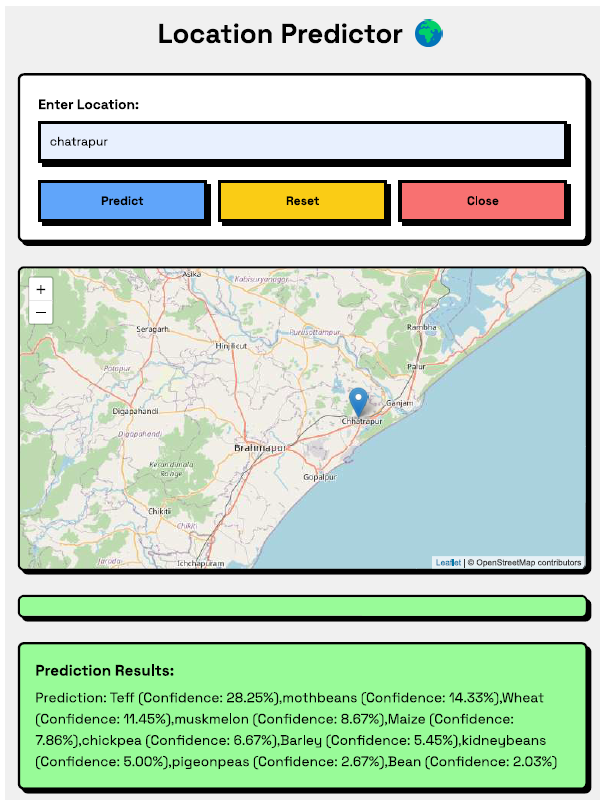
Agriculture plays a fundamental role in sustaining the global economy and ensuring food security, yet farmers often rely on intuition and traditional practices for crop selection, leading to inefficiencies in yield and resource utilization. This research proposes a machine learning-based system for smart crop prediction and recommendation, aimed at enhancing precision agriculture through data-driven decision-making. The study integrates historical datasets containing soil parameters (pH, nitrogen, phosphorus, potassium) and climatic factors (temperature, humidity, rainfall) with real-time environmental data fetched via APIs. Multiple machines learning models, including Decision Trees, Support Vector Machines, XGBoost, and Random Forest Classifiers, were evaluated, with the Random Forest model achieving the highest prediction accuracy of 87.93%. A user-friendly Flask web application was developed to allow farmers to input their location and receive real-time crop recommendations. Data preprocessing techniques such as normalization, feature selection, and outlier handling were implemented to improve model performance. Challenges like data imbalance, environmental variability, and the absence of socio-economic factors were acknowledged and addressed where possible. The system's adaptability and scalability make it suitable for diverse agricultural contexts, offering a significant step towards smart farming solutions. Future enhancements will involve the integration of IoT sensors, satellite imagery, and advanced deep learning techniques to further increase prediction reliability and applicability across different regions.
Graphical Abstract
Keywords
Data Availability Statement
Funding
Conflicts of Interest
Ethical Approval and Consent to Participate
References
- Burdett, H., & Wellen, C. (2022). Statistical and machine learning methods for crop yield prediction in the context of precision agriculture. Precision agriculture, 23(5), 1553-1574.
[CrossRef] [Google Scholar] - Shahhosseini, M., Hu, G., & Archontoulis, S. V. (2020). Forecasting corn yield with machine learning ensembles. Frontiers in Plant Science, 11, 1120.
[CrossRef] [Google Scholar] - Cai, Y., Guan, K., Lobell, D., Potgieter, A. B., Wang, S., Peng, J., ... & Peng, B. (2019). Integrating satellite and climate data to predict wheat yield in Australia using machine learning approaches. Agricultural and forest meteorology, 274, 144-159.
[CrossRef] [Google Scholar] - Jeong, J. H., Resop, J. P., Mueller, N. D., Fleisher, D. H., Yun, K., Butler, E. E., ... & Kim, S. H. (2016). Random forests for global and regional crop yield predictions. PloS one, 11(6), e0156571.
[CrossRef] [Google Scholar] - Drummond, S. T., Sudduth, K. A., Joshi, A., Birrell, S. J., & Kitchen, N. R. (2003). Statistical and neural methods for site–specific yield prediction. Transactions of the ASAE, 46(1), 5.
[CrossRef] [Google Scholar] - Shahhosseini, M., Hu, G., Huber, I., & Archontoulis, S. V. (2021). Coupling machine learning and crop modeling improves crop yield prediction in the US Corn Belt. Scientific reports, 11(1), 1606.
[CrossRef] [Google Scholar] - Chlingaryan, A., Sukkarieh, S., & Whelan, B. (2018). Machine learning approaches for crop yield prediction and nitrogen status estimation in precision agriculture: A review. Computers and electronics in agriculture, 151, 61-69.
[CrossRef] [Google Scholar] - Liakos, K. G., Busato, P., Moshou, D., Pearson, S., & Bochtis, D. (2018). Machine learning in agriculture: A review. Sensors, 18(8), 2674.
[CrossRef] [Google Scholar] - Van Klompenburg, T., Kassahun, A., & Catal, C. (2020). Crop yield prediction using machine learning: A systematic literature review. Computers and Electronics in Agriculture, 177, Article 105709.
[CrossRef] [Google Scholar] - Khan, S. N., Li, D., & Maimaitijiang, M. (2022). A geographically weighted random forest approach to predict corn yield in the US corn belt. Remote Sensing, 14(12), 2843.
[CrossRef] [Google Scholar] - Rani, S., Mishra, A. K., Kataria, A., Mallik, S., & Qin, H. (2023). Machine learning-based optimal crop selection system in smart agriculture. Scientific Reports, 13(1), 15997.
[CrossRef] [Google Scholar] - Karimi, N., Arabhosseini, A., Karimi, M., & Kianmehr, M. H. (2018). Web-based monitoring system using Wireless Sensor Networks for traditional vineyards and grape drying buildings. Computers and Electronics in Agriculture, 144, 269-283.
[CrossRef] [Google Scholar] - Ferrández-Pastor, F. J., García-Chamizo, J. M., Nieto-Hidalgo, M., Mora-Pascual, J., & Mora-Martínez, J. (2016). Developing ubiquitous sensor network platform using internet of things: Application in precision agriculture. Sensors, 16(7), 1141.
[CrossRef] [Google Scholar] - Pusatkar, A. C., & Gulhane, V. S. (2016). Implementation of wireless sensor network for real time monitoring of agriculture. International research journal of engineering and technology (IRJET), 3(05), 5.
[Google Scholar] - Reddy, C. K. K., Daduvy, A., Mohana, R. M., Assiri, B., Shuaib, M., Alam, S., & Sheneamer, M. A. (2024). Enhancing precision agriculture and land cover classification: A self-attention 3D convolutional neural network approach for hyperspectral image analysis. IEEE Access, 12, 125592-125608.
[CrossRef] [Google Scholar]
Cited By (1)
-
Rajasekaran P, Vijaya Kumar T, Poovizhi P, Sridharan A, Sharukesh A, Tushar Sharma. .
2025 International Conference on Emerging Research in Computational Science (ICERCS), 2025 .
[CrossRef]
Cite This Article
TY  - JOUR
AU  - Behera, Sobhana
AU  - Reddy, N. Toyaad Kumar
AU  - Pradhan, Shubhasri
PY  - 2025
DA  - 2025/10/23
TI  - Development of an Intelligent Agricultural Decision Support System for Crop Recommendation Using Machine Learning Techniques
JO  - Next-Generation Computing Systems and Technologies
T2  - Next-Generation Computing Systems and Technologies
JF  - Next-Generation Computing Systems and Technologies
VL  - 1
IS  - 1
SP  - 43
EP  - 53
DO  - 10.62762/NGCST.2025.340075
UR  - https://www.icck.org/article/abs/NGCST.2025.340075
KW  - smart crop prediction
KW  - machine learning in agriculture
KW  - precision farming
KW  - random forest classifier
KW  - agricultural decision support system
KW  - real-time data integration
AB  - Agriculture plays a fundamental role in sustaining the global economy and ensuring food security, yet farmers often rely on intuition and traditional practices for crop selection, leading to inefficiencies in yield and resource utilization. This research proposes a machine learning-based system for smart crop prediction and recommendation, aimed at enhancing precision agriculture through data-driven decision-making. The study integrates historical datasets containing soil parameters (pH, nitrogen, phosphorus, potassium) and climatic factors (temperature, humidity, rainfall) with real-time environmental data fetched via APIs. Multiple machines learning models, including Decision Trees, Support Vector Machines, XGBoost, and Random Forest Classifiers, were evaluated, with the Random Forest model achieving the highest prediction accuracy of 87.93%. A user-friendly Flask web application was developed to allow farmers to input their location and receive real-time crop recommendations. Data preprocessing techniques such as normalization, feature selection, and outlier handling were implemented to improve model performance. Challenges like data imbalance, environmental variability, and the absence of socio-economic factors were acknowledged and addressed where possible. The system's adaptability and scalability make it suitable for diverse agricultural contexts, offering a significant step towards smart farming solutions. Future enhancements will involve the integration of IoT sensors, satellite imagery, and advanced deep learning techniques to further increase prediction reliability and applicability across different regions.
SN  - 3070-3328
PB  - Institute of Central Computation and Knowledge
LA  - English
ER  -
@article{Behera2025Developmen,
  author = {Sobhana Behera and N. Toyaad Kumar Reddy and Shubhasri Pradhan},
  title = {Development of an Intelligent Agricultural Decision Support System for Crop Recommendation Using Machine Learning Techniques},
  journal = {Next-Generation Computing Systems and Technologies},
  year = {2025},
  volume = {1},
  number = {1},
  pages = {43-53},
  doi = {10.62762/NGCST.2025.340075},
  url = {https://www.icck.org/article/abs/NGCST.2025.340075},
  abstract = {Agriculture plays a fundamental role in sustaining the global economy and ensuring food security, yet farmers often rely on intuition and traditional practices for crop selection, leading to inefficiencies in yield and resource utilization. This research proposes a machine learning-based system for smart crop prediction and recommendation, aimed at enhancing precision agriculture through data-driven decision-making. The study integrates historical datasets containing soil parameters (pH, nitrogen, phosphorus, potassium) and climatic factors (temperature, humidity, rainfall) with real-time environmental data fetched via APIs. Multiple machines learning models, including Decision Trees, Support Vector Machines, XGBoost, and Random Forest Classifiers, were evaluated, with the Random Forest model achieving the highest prediction accuracy of 87.93\%. A user-friendly Flask web application was developed to allow farmers to input their location and receive real-time crop recommendations. Data preprocessing techniques such as normalization, feature selection, and outlier handling were implemented to improve model performance. Challenges like data imbalance, environmental variability, and the absence of socio-economic factors were acknowledged and addressed where possible. The system's adaptability and scalability make it suitable for diverse agricultural contexts, offering a significant step towards smart farming solutions. Future enhancements will involve the integration of IoT sensors, satellite imagery, and advanced deep learning techniques to further increase prediction reliability and applicability across different regions.},
  keywords = {smart crop prediction, machine learning in agriculture, precision farming, random forest classifier, agricultural decision support system, real-time data integration},
  issn = {3070-3328},
  publisher = {Institute of Central Computation and Knowledge}
}
Publisher's Note
ICCK stays neutral with regard to jurisdictional claims in published maps and institutional affiliations.
Rights and Permissions
 Copyright © 2025 by the Author(s). Published by Institute of Central Computation and Knowledge. This article is an open access article distributed under the terms and conditions of the Creative Commons Attribution (CC BY) license (https://creativecommons.org/licenses/by/4.0/), which permits use, sharing, adaptation, distribution and reproduction in any medium or format, as long as you give appropriate credit to the original author(s) and the source, provide a link to the Creative Commons licence, and indicate if changes were made.


Portico
